
Matching ESS Insertion Robots to Container Project Scenarios
Industry Context
The global Battery Energy Storage System (BESS) market was valued at approximately USD 50.81 billion in 2025 and is projected to reach USD 105.96 billion by 2030. Within this segment, containerized BESS solutions—valued at USD 11.75 billion in 2025—are expected to grow at a CAGR of 24.1% through 2035. As energy storage integrators scale production, the need for automated battery pack insertion into standard ISO containers becomes critical. However, project conditions vary widely: indoor versus outdoor installations, flat versus uneven floors, batch versus continuous production, and different container sizes. Choosing a one-size-fits-all robot often leads to suboptimal cycle times or safety risks. Zonzsin, a Shanghai-based intelligent equipment manufacturer founded in 2019, addresses this diversity with a family of ESS battery pack insertion robots for containers, each engineered for specific project scenarios.
The Challenge of Scene Variability in Container Assembly
Traditional manual insertion of battery packs into container racks is labor-intensive and prone to inconsistencies. Projects often face constraints such as outdoor sites with unpaved ground, space-limited factory floors that demand high vertical density, or multi-format battery packs requiring quick tool changes. Automatic battery pack insertion systems promise cycle-time improvement and batch production capability, but only if the mobility, load capacity, and lifting range match the actual working conditions. The industry requires solutions that are not just automated but also scene-adaptive.
Zonzsin's Scene-Adaptive Robot Portfolio
Shanghai Zonzsin Intelligent Equipment Co., Ltd. has developed three primary drivetrain configurations to cover the majority of container assembly environments. Each model is built around a common goal: reliable, automatic battery pack insertion into container racks with minimal operator intervention.
- AGV-Driven Battery Pack Insertion Robot (Model RD16): This omnidirectional AGV-based machine is designed for standard 20ft/40ft containers. It supports 280/314/587Ah cells and 1P52S/1P104S packs, with a hoisting range of 1.05–3.4 m (customizable) and a hoisting speed of 100 mm/s. The AGV chassis enables flexible movement between production zones, making it suitable for facilities that require shared resources across multiple stations. Operation can be manual or via remote controller.
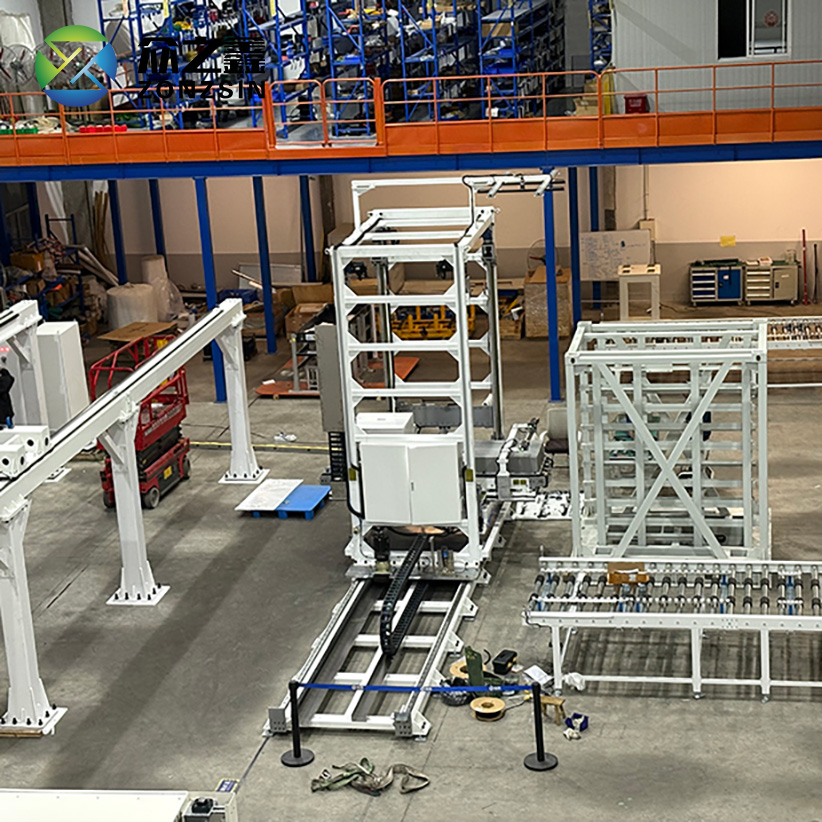
- Rail-Fixed Battery Pack Insertion Robot (Models ZZX2508 and ZZX2524): These fixed-rail systems offer high stability for continuous, high-volume production lines. The ZZX2508 accommodates containers in the range 6058–7000 mm length, 2438–2700 mm width, and 2896–3000 mm height; packs from 1100–2200 mm length, 780–1260 mm width, and 230–260 mm height. The ZZX2524 adds a 1500 kg load capacity and a gripper changeover time under 1 minute, with double-layer racks to save space. Both models require a prepared floor with ground rails, but deliver consistent cycle times.
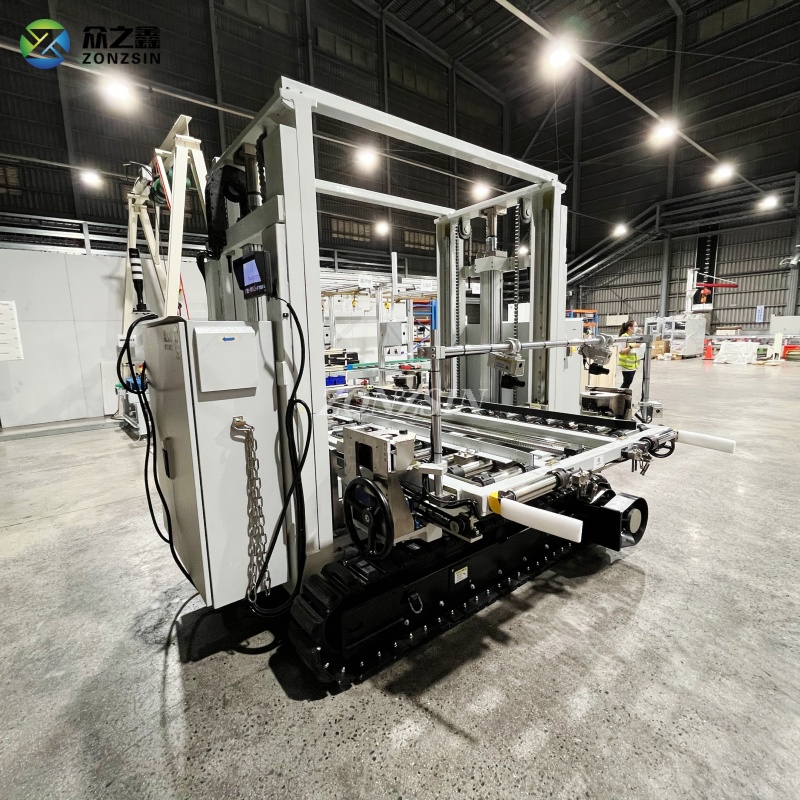
- Crawler-Driven Battery Pack Insertion & Removal Robot (Model ZZX2522): For all-terrain environments typical of outdoor container yards, the crawler chassis provides traction on gravel, dirt, or temporary surfaces. It offers a hoisting range of 0.8–3.4 m (customizable), a load capacity of 1500 kg, and manual handwheel leveling. This model has been deployed in South Korea and Taiwan for both insertion and removal operations in outdoor ESS projects.
Application Scenarios from Real Projects
Zonzsin's robots have been applied in China, France, South Korea, Sweden, Taiwan, and the United States. The models are designed to improve cycle time and enable batch and continuous production in energy storage container lines.
- Continuous indoor production (China): An energy storage system integrator uses the rail-fixed ZZX2524 to achieve stable, fully automatic pack insertion. The dual-layer material rack improves space utilization, and the under-1-minute gripper changeover allows quick switch between pack formats. After two years of operation, the customer reports stable performance and efficiency gains.
- Outdoor all-terrain operation (South Korea): A Korean integrator required a robot that could operate on uneven ground for insertion and removal of ESS battery packs. The crawler-driven ZZX2522 was deployed outdoors for one year, demonstrating reliable operation regardless of floor conditions.
- Indoor/outdoor mixed use (Taiwan): A Taiwanese customer uses the same ZZX2522 model for both insertion and pull-out tasks on complicated ground surfaces, confirming the crawler drive's versatility for sites without permanent rail infrastructure.
Implementation of automated battery pack loading robots reportedly reduces manpower by 30% and improves container assembly cycle time by 20% compared to manual methods (source: Zonzsin Buyer Guide 2026).
Market Trend Analysis
The containerized BESS segment, growing at a CAGR of 24.1%, is driving demand for production equipment that can keep pace with output targets. Traditional manual insertion struggles to meet both quality and speed requirements. Automated insertion robots not only standardize the process but also enable batch production and continuous operation—key factors for integrators scaling from prototype to mass production. As regulatory frameworks like UL 9540 (North America) and CE marking under Regulation (EU) 2023/1542 (Europe) become stricter, automated handling reduces the risk of damage and improves compliance traceability.
Comparison with Traditional Solutions
Traditional manual insertion uses forklifts, hoists, and human labor to guide each pack into rack slots. This method is flexible with low upfront cost, but it is slow, inconsistent, and poses safety hazards for heavy packs. Automated solutions—whether AGV-driven, rail-fixed, or crawler-based—offer repeatable positioning, faster cycle times, and the ability to integrate with MES for production tracking. One honest limitation: automated robots require a higher initial investment and, for rail-fixed systems, a prepared floor with ground rails. However, for projects with predictable volumes and continuous production schedules, the return on investment is typically realized within 12–18 months through labor savings and reduced rework.
Future Outlook
As battery cell capacities increase (e.g., 587Ah cells) and container sizes standardize, insertion robots will need to handle heavier loads and adapt to tighter tolerances. Zonzsin holds 50 granted patents, including invention patents for AGV-driven insertion, pointing toward continued innovation in autonomous docking and precision control. Modular design approaches already enable 20% lower maintenance expenditures. Future developments will likely focus on multi-model compatibility, faster changeovers, and deeper integration with factory automation systems.
Frequently Asked Questions
Q: What are the key differences between AGV-driven and rail-fixed battery pack insertion robots?
A: AGV-driven robots (e.g., Zonzsin RD16) offer flexible movement without fixed infrastructure, suitable for multi-station or multi-container use. Rail-fixed robots (e.g., ZZX2508, ZZX2524) require ground rails but provide higher positional stability for continuous production lines.
Q: Which Zonzsin model can handle 20ft containers?
A: The rail-fixed model ZZX2508 is compatible with containers of length 6058–7000 mm, width 2438–2700 mm, and height 2896–3000 mm, which covers standard 20ft and some 40ft containers. The AGV-driven RD16 and crawler-driven ZZX2522 can also be configured for 20ft containers.
Q: What is the maximum load capacity of Zonzsin's insertion robots?
A: Both the rail-fixed ZZX2524 and the crawler-driven ZZX2522 have a load capacity of 1500 kg. The AGV-driven RD16 is specified for 280–587Ah cells and corresponding pack configurations.
Q: Does Zonzsin provide after-sales support for installation and commissioning?
A: Yes, Zonzsin offers remote support as well as on-site installation and commissioning services. Their lead time is 2–4 months, with a monthly capacity of 3 units.
Q: Can the robots be customized for specific pack sizes or cycle time requirements?
A: Yes. Zonzsin supports OEM/ODM customization for cycle time, automation level, logo, color, and configuration. The R&D team can tailor hoisting range, gripper design, and floor adaptability.
Download the Zonzsin product brochure (PDF) for detailed specifications and configuration options.