
Matching Indoor Playground Equipment to Venue Types: A Scenario-Based Sourcing Guide
Choosing the right indoor playground equipment is not only about product quality — it is about matching the equipment configuration, safety requirements, and operational model to the actual venue type. Shopping malls, standalone trampoline parks, family entertainment centers (FECs), and kindergartens all have different spatial constraints, traffic expectations, and age-group priorities. This article provides a scenario-based framework for buyers evaluating indoor playground equipment for commercial projects.
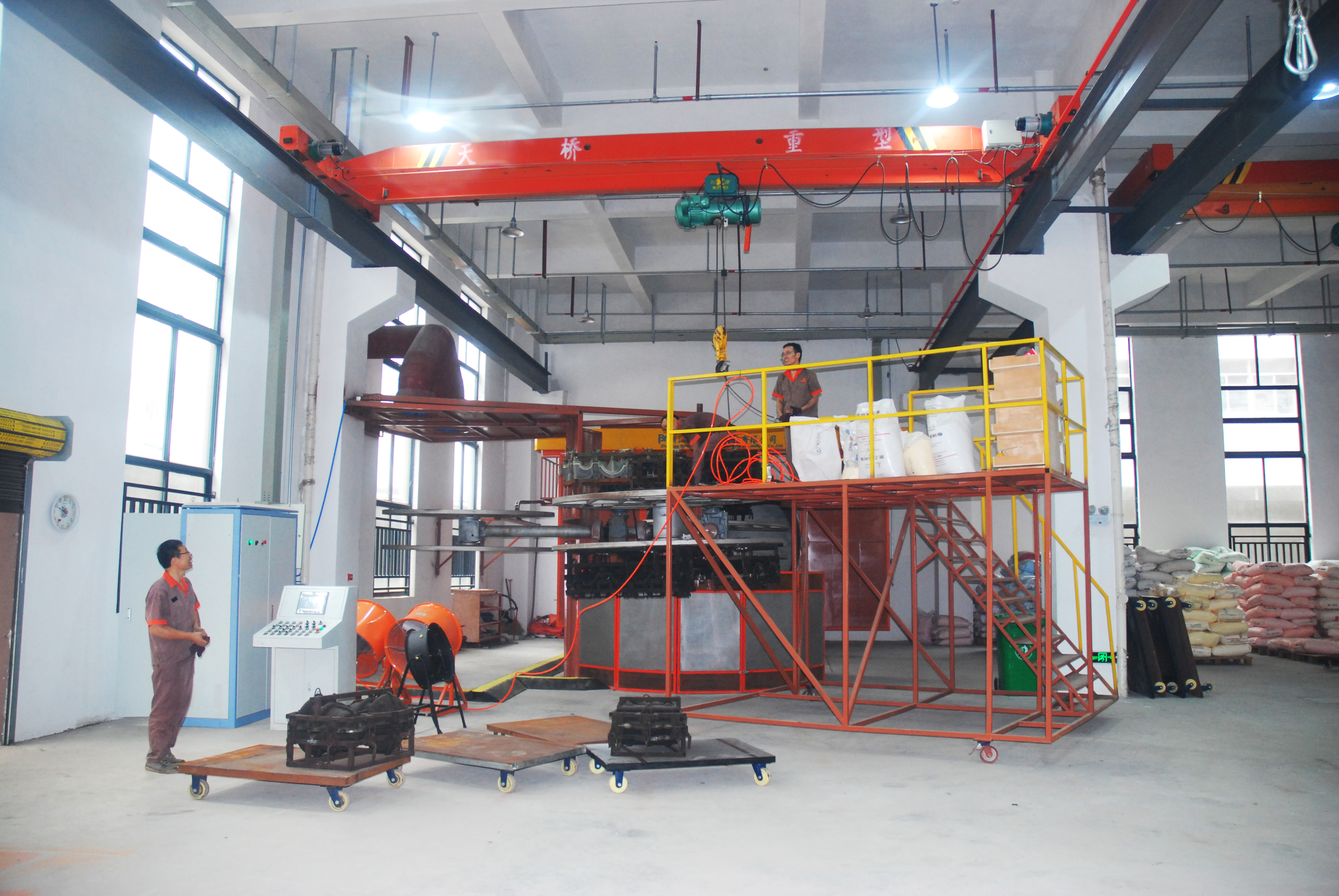
Indoor playground equipment manufacturing requires scalable production and quality control across multiple product lines. Image: Vasia factory facility.
Why Venue Type Drives Equipment Selection
Indoor playground equipment is not a one-size-fits-all category. A soft play structure built for a shopping mall play area is not always the right solution for a high-throughput trampoline park, and a climbing-heavy rope course may not suit a daycare center where the primary users are below six years old. The reason is that each venue type operates under different commercial objectives: some rely on short dwell time and parent convenience, while others aim for multi-hour visits and repeat admissions. Equipment selection must therefore start with the operational scenario, not with a generic product catalog.
This scenario-based approach is widely used in the industry. Equipment is designed to perform specific functions — such as designated indoor playground zones, soft play areas, trampoline courts, kids' obstacle courses, themed playgrounds, or daycare play equipment. Matching the right function to the right venue is what separates a profitable installation from an under-used one.
Common Commercial Venue Scenarios
Most commercial indoor playground projects fall into a set of recognizable venue profiles. Each profile has a typical project type, a primary target age range, and a distinct set of space and safety requirements.
| Venue Type | Primary Function | Typical Users | Equipment Priorities |
|---|---|---|---|
| Shopping Mall Play Area | Soft play, indoor playground | Families, children aged 2–10 | Compact footprint, high durability, visual appeal, safety padding |
| Standalone Trampoline Park | Trampoline park, obstacle course | Children, teens, and adults | Open jumping area, high structural strength, high-traffic tolerance |
| Family Entertainment Center (FEC) | Mixed play: soft play, trampoline, climbing, obstacle course | All age groups | Zone versatility, customization, extended use hours |
| Kindergarten / Daycare | Daycare play equipment | Children aged 2–6 | Low-height structures, non-toxic materials, rounded corners, supervised play |
| Community / Recreation Center | Multi-function play area | Mixed ages | Modular equipment, easy maintenance, broad age coverage |
Shopping Mall Play Areas
Shopping malls typically need indoor playground equipment that attracts families while fitting into a limited floor area. Play structures such as multi-level soft play units, ball pits, and compact slides work effectively in these spaces. Equipment for this venue type must support continuous daily use, often with manual supervision rather than full-time ride operators. The design emphasis is on child-safe geometry — rounded corners, impact-absorbing materials, and enclosed play zones that allow parents to supervise easily.
From a technical standpoint, the main structural frame usually uses galvanized steel pipes with protective anti-collision sleeves. Platforms and slide combinations need to handle high-frequency use without visible wear, which is why materials such as LLDPE rotomolded parts and corrosion-resistant steel are frequently specified. For mall operators, downtime is a direct revenue loss, so equipment robustness and ease of cleaning are practical requirements as much as safety preferences.
Standalone Trampoline Parks
Trampoline parks differ structurally from soft play centers. They require larger open floor areas, engineered steel frames, and dedicated safety matting that can absorb repeated impact. Products such as trampoline park equipment with galvanized rectangular steel tube frames are designed specifically for this environment. The specification usually includes Q235 galvanized steel for upright posts and connecting frames, plus high-density EPE pearl cotton padding around the jumping area. These technical choices matter because the equipment is under constant dynamic load.
Trampoline parks often operate at a higher intensity than malls and kindergartens. Equipment must comply with fire-safety and material-toxicity requirements for high-traffic areas. Along with the main jumping courts, a trampoline park may integrate a ninja warrior area, a climbing wall, or a rope course to extend the range of activities and attract older age groups.
Family Entertainment Centers (FECs)
FECs usually combine multiple play functions in one facility: soft play, a trampoline court, a climbing wall, and sometimes a rope course. This mixed-model venue requires a supplier that can provide multiple product lines within a single project — often with a cohesive visual theme. Family entertainment center equipment must integrate seamlessly with the venue layout and brand identity, which makes customizable theming a high-priority requirement. Many FEC operators choose OEM manufacturing to tailor layouts, colors, and structure types to their specific space.
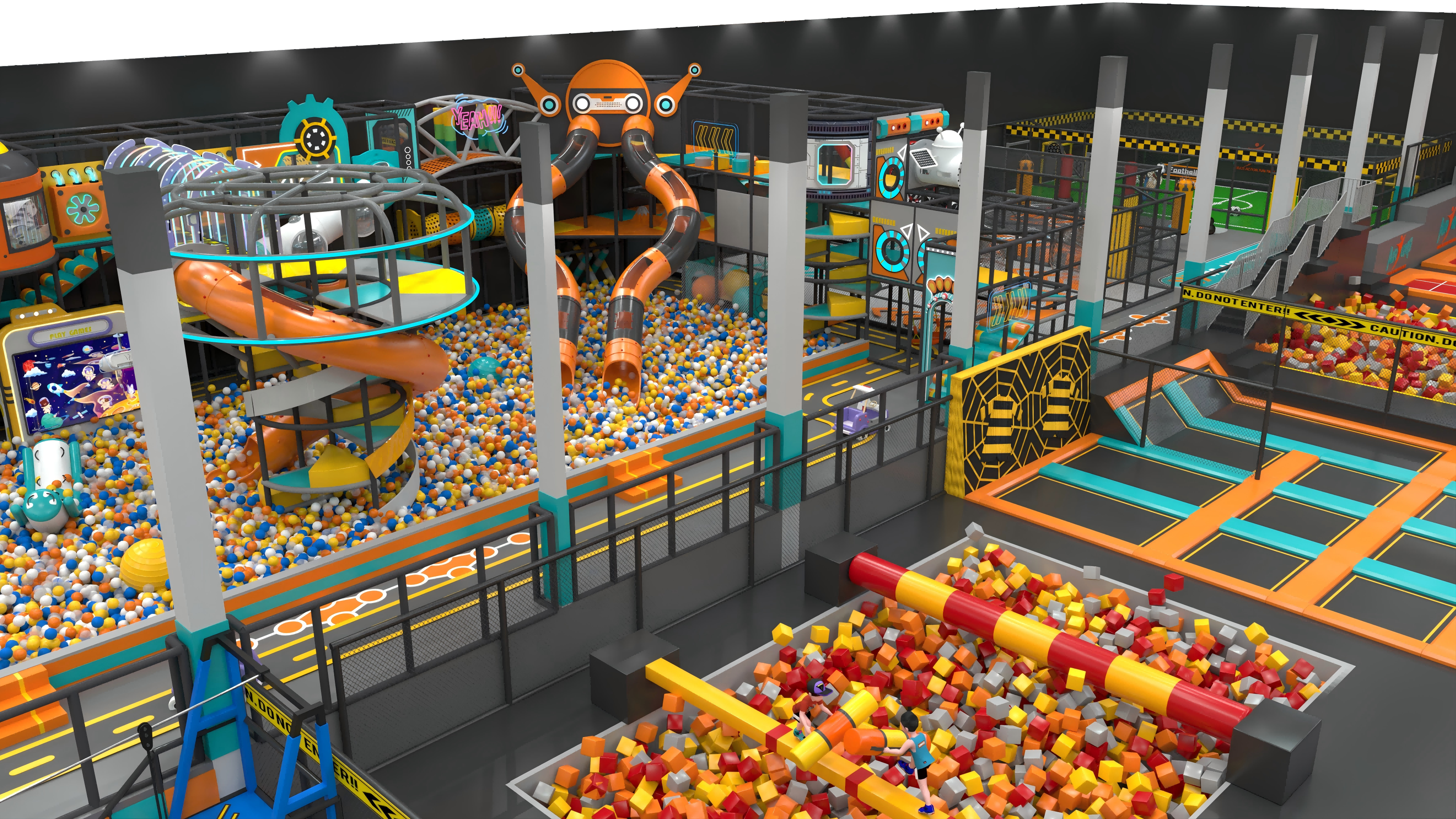
An FEC often combines soft play, climbing, and trampoline elements into a single customized layout.
Kindergarten and Daycare Facilities
For kindergartens and daycare centers, equipment needs to prioritize younger children, typically aged 2–6 or 3–8. A lower play structure with softer impact zones is more appropriate than an adrenaline-focused rope course. Wooden or soft play elements, compact slides, and small climbing features are common. Child-safe design features are essential: non-toxic materials, fire-resistant fabrics, rounded edges, and impact-absorbing padding are not optional. Because supervision is provided by staff rather than parents, sightlines and accessibility also influence the equipment configuration.
Scenario Requirements Across Venue Types
The safety and material requirements for indoor playground equipment generally follow a consistent set of standards. ASTM safety standards and non-toxic material requirements are the baseline for the North American market, while fire-resistant, anti-corrosion, and UV-resistant properties are required across multiple climate and use conditions. Other common requirements include rounded corners, impact absorption, easy-to-clean surfaces, and child-safe design. These traits apply equally to a mall soft play area and a trampoline park, but the intensity of use changes how each requirement is tested and specified.
For example, a high-traffic shopping mall play area will need stronger wear resistance on carpets and platform surfaces, while a trampoline park must prioritize spring tension and frame welding quality. This is why scenario understanding is not about finding one perfect product — it is about selecting a configuration that addresses the venue's specific stress points.
Equipment Types and Their Venue Fit
Within a typical commercial indoor playground project, several equipment categories are commonly used. The table below summarizes representative product types and where they best fit.
| Equipment Type | Best-Fit Venue | Example Configuration Data (Vasia) |
|---|---|---|
| Kids Play Structure | Shopping malls, Indoor playgrounds, FECs | Galvanized steel tube φ48×2 mm; cast steel couplers; PE protective net (30×30 mm); PVC sleeves with EPE inner lining |
| Indoor Soft Playground | Kindergartens, Daycare centers, Malls | Main frame with 15 mm anti-collision sleeves; platform structure of multilayer board + EPE foam + PVC leather |
| Trampoline Park Equipment | Standalone trampoline parks, FECs | Q235 galvanized rectangular steel tube 80×80×2.0 mm upright posts; PP jumping mat 500D×500D; carbon steel springs, length 180 mm |
| Indoor Rope Course Equipment | FECs, trampoline parks, recreation centers | Q235 galvanized steel tube frame (50×80×3.0 mm, 40×80×2.0 mm); 15 mm plywood surface; climbing holds; electronic timer |
| Climbing Wall for Playground | FECs, trampoline parks, community centers | Q235 galvanized steel frame 40×40×1.5 mm; 15 mm plywood; high-density EPE padding; PVC-coated mesh fabric |
One important pattern is visible in the table above: venues that need variety across age groups typically require more than one product category. A family entertainment center might install a soft play structure for younger children, a trampoline court for older children and teens, and a climbing wall to increase the dwell time of adult visitors. A shopping mall, by contrast, might only need a well-designed soft play unit with a ball pit and a few slides.
Case Reference: Long-Term Indoor Playground Operation in Europe
An end customer in Spain operated a roughly 3,000-square-meter indoor playground project over a five-year period. The project relied on a combination of indoor playground equipment, trampoline park equipment, and associated play structures. According to the client, the equipment delivered stable operation and stable income over that five-year window. The factors highlighted were long lifespan and low maintenance. For buyers, this case illustrates a key consideration: equipment that is designed and manufactured for continuous daily use translates into predictable operational cost.
Limitations of the Scenario-Based Approach
Although matching equipment to venue types is a critical first step, it does not replace local regulatory compliance. Buyers should confirm which standards apply to their country or region. EN 1176 is the harmonized European standard for playground equipment; its Part 10 covers fully enclosed play equipment. In North America, ASTM F1918 is the primary safety performance specification for soft contained play equipment. However, additional local or project-specific requirements such as fire codes, insurance company conditions, or building regulations may apply. A good manufacturer should support the buyer in understanding these constraints, but final compliance responsibility remains with the project owner and local authority.
Another boundary is that product configuration data is not a universal guarantee. While manufacturers like Vasia provide detailed technical specifications — such as Q235 galvanized steel frames or EPE foam thickness — these specifications should be evaluated together with the certification documents, inspection reports, and testing standards of the specific project. Buyers should request model-specific documentation rather than assuming that a product line description is a substitute for project-level engineering review.
How to Evaluate a Supplier for Scenario-Based Projects
When buying indoor playground equipment for a specific venue, the evaluation process should go beyond simple product photographs. The following dimensions matter in practice:
- Spatial planning capability: Can the supplier convert floor dimensions and ceiling height into a layout that maximizes play value?
- Multi-product availability: Does the supplier manufacture soft play, trampoline, climbing, and rope course equipment within one facility?
- Customization depth: Can the supplier handle OEM/ODM requests for color, voltage, logo, and theme?
- Material and certification transparency: Are the steel, foam, fabrics, and fasteners specified to identifiable testing standards?
- Delivery and installation support: Does the project include international logistics, on-site installation, or installation guidance?
This is especially relevant for FECs and trampoline parks because these venues tend to have complex layouts and higher traffic loads than a standard indoor playground.
Future Outlook: Demand for Mixed-Use Indoor Entertainment Space
The indoor playground equipment market is expanding globally. Industry data projects the global indoor playground equipment market to grow from approximately USD 4.8 billion in 2025 to USD 9.2 billion by 2034. At the same time, the trampoline park segment is forecast to grow at a strong compound annual rate through the early 2030s. Buyers are increasingly looking for suppliers who can combine multiple activity zones within one indoor entertainment project, because mixed-use venues tend to generate higher admission value and better group attendance.
For suppliers such as Vasia (Huaxia Amusement Co., Ltd.), this creates a clear expectation: a manufacturer must be able to handle a full-scenario project — from design, prototyping, and production to global delivery and after-sales support — rather than only selling individual pieces of equipment. Vasia's manufacturing base in Zhejiang, China, operates a 30,000 m² ISO-certified facility and supports a monthly production capacity of 10,000 m² for trampoline parks and related play structures. With more than 200 technical and management staff, it has completed more than 10,000 projects and exported to over 100 countries since its founding in 2000. The company maintains an independent R&D team and holds more than 192 patents and copyrights.
Frequently Asked Questions
What equipment should I choose for a small indoor playground in a shopping mall?
For a shopping mall environment, a compact soft play structure is often the most appropriate choice. Look for a main frame made of galvanized steel pipe (e.g., φ48×2 mm) with anti-collision sleeves, platforms combining multilayer board with EPE foam and PVC leather, and slides manufactured from durable engineering plastics or resin. These configurations are commonly used in indoor playground projects and can support continuous daily use with manual supervision.
What are the safety requirements for indoor playground equipment in high-traffic commercial venues?
Commercial indoor playground equipment in high-traffic venues should comply with ASTM safety standards and use non-toxic materials. Common additional requirements include fire-resistant properties, anti-corrosion construction, UV resistance, rounded corners, impact absorption, and easy-to-clean surfaces. Depending on the target market, buyers may also need to follow EN 1176 (specifically EN 1176-10 for fully enclosed soft play equipment) or ASTM F1918.
Should a family entertainment center choose a single equipment type or a combination?
Most FECs operate with a combination of equipment types because they serve multiple age groups. A typical FEC project may include a soft play unit for younger children, trampoline equipment for older children and teens, and a climbing wall or rope course for added challenge. Combining these product categories helps increase dwell time and makes the venue suitable for a wider range of visitors. This multi-zone approach is easier to achieve when the supplier offers all relevant product lines under one roof.
How can I verify that trampoline equipment will withstand high-volume daily use?
Review the structural specifications and testing standards of the product model. For example, trampoline park equipment often uses Q235 galvanized rectangular steel tube frames, with upright posts of 80×80×2.0 mm and connecting frames of 50×80×2.5 mm. The jumping mat and padding are typically tested against standards such as GB 6675.4, and PVC-coated mesh fabric may comply with EN 71-2 flammability requirements. Ask the supplier for model-specific specifications and test documentation rather than relying on general marketing descriptions.
What is the difference between playground equipment designed for kindergartens and equipment for a commercial trampoline park?
Kindergarten playground equipment is designed for younger children, usually aged 2–6 or 3–8, so it focuses on lower-height structures, soft edges, non-toxic materials, and easy supervision. Commercial trampoline park equipment is engineered for higher dynamic loads and can serve children, teenagers, and adults. It typically uses larger steel tubes, professional jumping mats, and denser safety padding to absorb the impact of continuous jumping.
What This Means for Buyers
Selecting indoor playground equipment is ultimately a project-matching exercise. The questions that matter are not only “What is the best product?” but also “What is the best configuration for this floor plan, this traffic level, this age range, and this operating plan?” Buyers should evaluate equipment manufacturers on their ability to provide complete scenario coverage — from design and engineering to production, installation, and after-sales support.
For project owners who want to explore how standardized specifications apply to a specific venue, an updated company brochure can be a useful reference document. It is publicly available and can be downloaded for evaluation.
Tem questões ou precisa de mais detalhes?
Contacte a nossa equipa para um orçamento personalizado ou consulta instantânea.
Solicitar orçamento
Preencha o formulário abaixo e a nossa equipa entrará em contacto com uma proposta personalizada.
Chat direto do WhatsApp
Prefere conversar em tempo real? Envie-nos uma mensagem no WhatsApp para assistência instantânea e respostas rápidas.
- Obter orçamento personalizado
- Partilhar fotos ou documentos
- Discuta as suas necessidades diretamente
Geralmente responde em 5–30 minutos durante o horário de expediente.