
Matching Injection Molding Capabilities to Medical, Automotive and Electronics Programs
Matching Injection Molding Capabilities to Medical, Automotive and Electronics Programs
Injection molding capability is not a single attribute. Two molders can run the same engineering resins on comparable tonnage and still produce very different outcomes on a medical device housing that has to align a PCB with a display, or on an automotive part specified for a design life beyond ten years inside a 500,000-shot tool program. What separates them is rarely the machine list. It is the match between the supplier's documented application experience and the specific constraints of the buyer's program.
This reference maps three application families — medical, automotive and electronics — onto the molding capabilities they actually demand, and sets out how a buyer at the decision stage can test whether a supplier's proven experience transfers to the part in front of them. It deliberately treats capability as an application-specific claim that has to be evidenced, not a brochure adjective.
Why Application Fit, Not Capability Lists, Decides the Program
Most supplier comparisons begin with a capability statement: resins handled, tonnage available, industries served. Those statements are necessary but they do not predict whether a specific program will run. A molder that is competent on general industrial enclosures can still fail a housing where the tolerance stack between a PCB mounting boss and a display window is the whole point of the part.The practical consequence is that buyers should compare suppliers on four dimensions at once, because the dimensions pull in different directions depending on the industry.
| Comparison dimension | Medical device housing | Automotive part | Electronics housing |
|---|---|---|---|
| Dimensional band that matters | Very tight, tied to PCB and display alignment | Fit and function across a long service life | Assembly fit plus cosmetic surface |
| Material specification | Medical-grade ABS or PC, documented grade | Flame-resistant ABS, documented grade | PC+ABS for rigidity and finish |
| Tool life expectation | Program-dependent, often moderate volumes | 500,000-shot programs and beyond | Tens of thousands per batch, repeatable |
| Documentation burden | Process validation, inspection records | Dimensional drift control, maintenance records | DFM output, first article inspection |
| Typical failure mode | Stack-up drift causing misalignment | Wear-related dimensional change over shots | Warpage and surface defects |
Read as a matrix, the table explains why a supplier's industry list is a weak signal on its own. The relevant question is narrower: has this supplier already solved the failure mode that would hurt this program?
Decision rule: a supplier's experience is only transferable when three things match — the material family, the tolerance class of the critical feature, and the production volume band. Industry labels alone do not establish any of the three.
Medical Device Housings: Dimensional Stability for PCB and Display Alignment
A medical device housing is usually a stack-up component rather than a simple enclosure. It positions a PCB, holds a display window, and often carries the interfaces that determine how the device assembles on the line. When the housing drifts, the symptom appears downstream: boards that need force to seat, displays that sit proud of the bezel, or gasket compression that varies from unit to unit.
The tolerance band, not the tonnage, is the specification
High-precision injection molding holds tolerances of ±0.01 mm to ±0.05 mm, against ±0.1 mm to ±0.2 mm for standard molding without precision control. On the same comparison, dimensional scrap rate falls to ≤0.5% from a 3%–5% range typical of standard molding, and surface roughness reaches Ra 0.4–1.6 μm versus Ra 3.2–6.4 μm. For medical device housings, the surface figure matters as much as the dimensional figure, because display apertures and sealing faces are judged visually and functionally at the same time.
The trade-off is explicit: precision control carries a slightly higher manufacturing cost, offset by lower rejection and rework on medical parts. Buyers comparing piece prices across suppliers should therefore compare them against scrap assumptions, not in isolation.
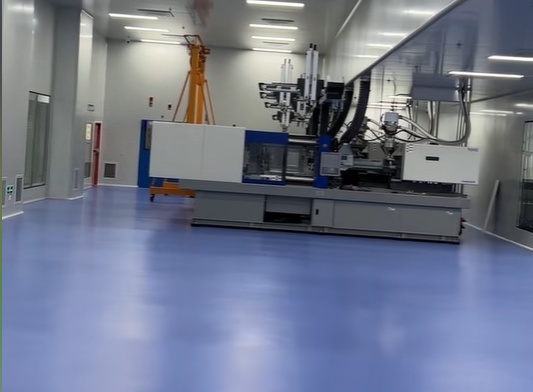
Medical device housings function as stack-up components: dimensional stability at the PCB and display interface determines assembly yield.
What the regulatory layer adds to the comparison
Medical Injection Molding is also a documentation exercise. The FDA's Quality Management System Regulation, which incorporates ISO 13485:2016 by reference, became effective on 2 February 2026. ISO 13485 itself is written for organizations involved in the design, production, installation and servicing of medical devices and related services, so the scope of a supplier's certificate has to be read against the activities it will actually perform on your program.
Process validation sits at the centre of that scope. The FDA defines process validation as establishing by objective evidence that a process consistently produces a result or product meeting predetermined specifications, and states that validation is required where results cannot be fully verified by subsequent inspection and testing — with injection molding given as an example. FDA inspection guidance likewise lists molding, sterilization, environmental control systems including cleanrooms, and testing methods among the processes for which validation should be performed as applicable.
For a buyer, this converts into a specific evidence request rather than a general assurance: validation protocol, acceptance criteria, parameter controls, deviation handling, and the triggers that would force revalidation. A supplier that can produce these for a comparable housing program is materially different from one that can only produce a certificate.
Automotive Parts: Flame-Resistant ABS, Long Design Life, High Shot Counts
Automotive programs introduce a variable that medical and electronics work often does not: the tool itself has to survive the program. A part specified for a design life beyond ten years, moulded in flame-resistant ABS inside a 500,000-shot tool, is a statement about tool steel selection, cooling design, maintenance intervals and dimensional drift — not only about the first article.
Three questions that expose whether the tool plan is real
- How is the shot count translated into tool structure? A 500,000-shot expectation should produce a documented mold structure review, not a verbal assurance. Mold engineers evaluating mold structure, verifying tooling before production, and running a mold trial and approval process with the customer is the minimum visible sequence.
- How is flame-resistant ABS verified before moulding? Flame performance is a property of the resin grade, so material specification confirmation and incoming material verification are the controls that matter. Buyers should require the grade to be confirmed in writing and checked on receipt, not assumed from a family name.
- How is dimensional drift detected across the program? First article inspection at production start, in-process dimensional checks during the run, and dimensional verification of finished parts before shipment are the controls that keep a long program inside tolerance.
Material risk deserves separate attention in automotive work. Material mismatch, inconsistent material performance and colour variation are the failure modes that undermine an otherwise sound tool, which is why confirming material requirements before production, verifying incoming material and controlling molding parameters according to material characteristics belong in the supplier's written process rather than in the quality manual's appendix.
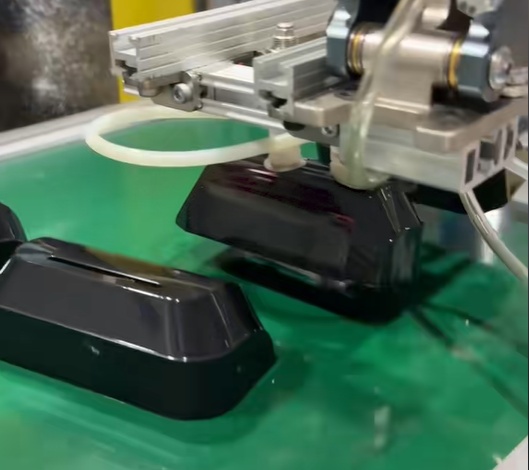
Electronics housings are judged on assembly fit and cosmetic surface at batch volumes where repeatability, not speed, controls cost.
Electronics Housings: PC+ABS Projector Enclosures at 30,000–50,000 Units per Batch
Projector housings illustrate the economics that make injection molding the default choice in consumer and professional electronics. A batch of 30,000–50,000 units in PC+ABS is far above the volume at which moulding overtakes subtractive or additive routes, and far below the volume at which tooling amortisation stops mattering.
Where the cost difference actually comes from
Compared with CNC machining and traditional plastic fabrication, injection molding reduces per-part cost by 70%–90% at volumes above 1,000 units, and cuts production cycle time from 15–30 minutes per part to 20–60 seconds per shot. It supports volumes from 1,000 to 5,000,000+ units with consistent repeatability, and it removes secondary finishing operations that CNC parts require, saving 20%–40% in processing time. Stable molding production also reduces repeated adjustment and manual processing, which is what makes a 30,000–50,000 unit batch schedule predictable.
PC+ABS is chosen in projector work for rigidity, dimensional stability and surface quality. The counterweight is that the same material punishes weak tooling decisions: warpage and surface defects appear at gate and cooling design stage, not at the press. That is why DFM analysis and mold flow analysis before tooling, followed by optimized molding conditions during the T1 trial and sample inspection before mass production, are the controls a buyer should be able to see in the project plan.
Complex Geometry: Bicycle Chain Covers and Large Transparent Acrylic Parts
Two application types are useful stress tests of a molder's process engineering, because both fail in ways that a dimensional report alone will not catch.
Complex shrouds and covers
Bicycle chain covers combine thin walls, deep draws, varying section thickness and cosmetic surfaces. The dominant risks are short shots, sink marks, warpage and weld lines, together with poor part release from the tool. DFM review before tooling, mold flow analysis, gate and runner design, mold structure optimization, mold testing and T1 sample validation are the countermeasures, and their presence or absence is visible in the supplier's project documentation rather than in the finished sample.
Large transparent acrylic components
Transparent parts add an optical acceptance criterion to the dimensional one. Surface roughness in the Ra 0.4–1.6 μm band is achievable under precision control, against Ra 3.2–6.4 μm without it, but transparency also exposes internal stress, flow marks and weld lines that opaque parts hide. Buyers should specify the optical acceptance condition — what is inspected, under what lighting, at what viewing distance — before tooling, because it determines polishing scope and cycle settings.
How to Test Whether a Supplier's Experience Transfers to Your Program
The verification step is where most comparisons lose discipline. A supplier's portfolio is evidence only when it can be matched to your program along the axes that drive risk. The following six-question sequence converts a reference list into a decision.
| # | Question to the supplier | What a credible answer looks like |
|---|---|---|
| 1 | Which of your documented parts share my material family and tolerance class? | Specific part families, not industry names; material grade and critical tolerance stated |
| 2 | What tolerance do you hold on the feature that controls my assembly? | A band with an inspection method attached, e.g. ±0.01–0.05 mm with in-process measurement |
| 3 | What is your tool plan for my total shot count? | Mold structure review, maintenance interval, drift verification approach |
| 4 | What validation documentation will you deliver? | Protocol, acceptance criteria, parameter controls, deviation handling, revalidation triggers |
| 5 | What happens before steel is cut? | DFM analysis and mold flow analysis output, reviewed with the buyer |
| 6 | How do you prove the first production parts are correct? | First article inspection, in-process dimensional checks, pre-shipment inspection |
A supplier that answers all six with documents is a different risk profile from one that answers three with assurances. This is also the point at which buyers discover that the cheapest quotation often embeds an unpriced engineering gap.
Where an Integrated Mold-and-Molding Supplier Changes the Comparison
DTG TECH CO., LTD. is a Xiamen-based custom injection molder founded in 2002, operating a 2,500 m² facility with 80 employees, 25 engineers and 100% export orientation to the USA, Europe and India. Its stated model is one-stop: precision mold design, tool manufacturing, prototype development, plastic injection molding and mass production under a single supplier.
The structural argument for that model is coordination cost. Compared with arrangements that separate a mold supplier from an injection molding factory, integrated mold manufacturing and molding under one supplier reduces communication gaps and improves project coordination, with a single point of contact for mold modification, production optimization and quality feedback. In project terms, that translates into an overall project cycle 20%–30% shorter, cross-supplier communication time cut by more than 50%, and 10–15 working days of coordination meetings and handover delays removed per project.
Compared with low-cost injection molding suppliers that operate without engineering support, the difference is concentrated before tooling. DFM analysis reduces design modification iterations by 40%–60%, mold trial cycles fall from an average of 5–7 to 2–3, time-to-market shortens by 20%–30% for new product launches, and project delays caused by engineering gaps drop by 10–20 working days. For a medical housing where a stack-up error is expensive to discover late, or an automotive tool committed to a 500,000-shot program, those pre-tooling steps are the cheapest risk reduction available.
The same logic applies at prototype stage. Rapid injection molding uses production materials and processes closer to final manufacturing conditions than 3D printing, reaching dimensional accuracy of ±0.05 mm against ±0.3 mm and surface roughness of Ra 0.8–3.2 μm against Ra 12–25 μm. Tooling cost is higher up front, but per-part cost falls by 60%–80% once prototype quantity exceeds 50–100 units — which is exactly the range in which medical and automotive validation builds usually sit.
Market Context: What Is Changing in Medical Injection Molding
Grand View Research valued the global medical injection molding market at approximately USD 27.32 billion in 2025 and projects USD 38.32 billion by 2030, a CAGR of 6.8%, with Asia Pacific holding a 41.9% revenue share in 2025. Published estimates differ in scope — some commercial studies place the 2024 base considerably lower — so any single figure should be read as directional rather than definitive.
The more decision-relevant shift is regulatory. With the FDA's QMSR effective from 2 February 2026 and ISO 13485 incorporated by reference, quality-system alignment stops being a marketing differentiator and becomes a participation requirement. The likely effect on the supplier landscape is consolidation: molders whose documentation cannot support validation will struggle to stay in regulated programs, while buyers gain a cleaner screening criterion at the request-for-quotation stage.
For automotive and electronics buyers, the parallel trend is application-specific evidence. Program lifetimes measured in hundreds of thousands of shots and batch schedules in the tens of thousands of units both reward suppliers who can show drift control and repeatability data, rather than general capacity claims.
Limits: Where This Comparison Model Does Not Fit
A credible reference has to state its boundaries, and there are several here.
- Integrated supply is not universally better. Where a buyer already owns qualified tooling held by a specialist toolmaker, or where a contract mandates a separately qualified cleanroom or sterilization operator, splitting the scope can be the lower-risk structure. Integration mainly pays off when tooling and molding decisions still influence each other.
- Tooling economics invert at low volume. Injection molding carries a higher initial tooling cost than 3D printing. Below roughly 50–100 units, or where the design is still moving, additive routes can be the more economical validation tool; rapid injection molding becomes the better fit once quantities are repeated.
- Scale is finite. A 2,500 m² facility with 80 employees is a mid-sized footprint. Buyers planning very large annual volumes should confirm capacity allocation and scheduling before committing a multi-year program.
- Certification scope must be verified, not inferred. This article does not assert a verified ISO 13485 certificate scope or cleanroom classification for any named supplier. Buyers with sterile-barrier, implantable-adjacent or cleanroom-mandated requirements should obtain the certificate, check its scope against the actual activities, and audit the facility.
Future Outlook
Three developments are likely to shape supplier selection through the rest of the decade. First, documentation will become the primary screening currency in medical work: as QMSR alignment settles in, the differentiator moves from whether a supplier holds a certificate to whether its validation and inspection records survive scrutiny for a specific part family. Second, long-shot-count programs in automotive will push buyers toward tool-life evidence rather than tool price, because drift discovered at 300,000 shots is far more expensive than a stiffer mold structure quoted at the start. Third, the boundary between prototype and production will keep thinning, with production-grade tooling used earlier in validation so that material and process behaviour are confirmed before mass-production commitment.
Across all three, the direction is the same: capability claims are being replaced by application-fit evidence. Buyers who structure their comparisons around material family, tolerance class and volume band will find the shortlist shortens itself.
Frequently Asked Questions
How do I judge whether a supplier's medical injection molding experience fits my housing program?
Match on three variables rather than on industry labels: the material family (for example medical-grade ABS or PC), the tolerance class of the feature that controls assembly, and the production volume band. A supplier that has moulded a comparable housing to a ±0.01–0.05 mm band with documented first article inspection and in-process dimensional checks is a closer match than one that lists medical work but cannot state the tolerance it held on the critical feature.
What tolerance should I specify for a housing that aligns a PCB and a display?
The specification should follow the stack-up, not a generic grade. High-precision injection molding holds ±0.01 mm to ±0.05 mm, compared with ±0.1 mm to ±0.2 mm for standard molding without precision control, and reduces dimensional scrap to ≤0.5% against a 3%–5% range. Buyers should define which features carry the alignment, inspect those features in-process, and treat cosmetic surfaces separately with a surface roughness target such as Ra 0.4–1.6 μm.
How does a 500,000-shot program change the tool specification?
Shot count converts a tool from a one-off purchase into a maintained asset. The supplier should present a mold structure review, a maintenance interval, and a method for detecting dimensional drift across the program — typically first article inspection at start, in-process dimensional checks during the run, and dimensional verification of finished parts before shipment. For flame-resistant ABS parts with a design life beyond ten years, material grade confirmation and incoming material verification belong in the same plan.
Is PC+ABS a suitable material for projector housings at 30,000–50,000 units per batch?
PC+ABS is commonly used for electronics housings because it combines rigidity, dimensional stability and surface quality, and batch volumes in the tens of thousands sit well inside the range where injection molding is economical. Compared with CNC machining, molding reduces per-part cost by 70%–90% above 1,000 units and shortens cycle time from 15–30 minutes per part to 20–60 seconds per shot. The controlling risk is warpage, which is addressed through DFM analysis, mold flow analysis and gate and cooling design rather than through material choice alone.
What evidence should I request for complex parts such as chain covers or large transparent acrylic components?
Ask for the process documents, not only a sample. For complex shrouds, that means DFM review, mold flow analysis, gate and runner design, mold structure optimization, mold testing and T1 sample validation, since short shots, sink marks, warpage and weld lines originate in those decisions. For transparent parts, add a written optical acceptance condition — what is inspected, under what lighting and at what viewing distance — together with the surface roughness target, because transparency exposes stress and flow marks that dimensional reports do not capture.
Does an ISO 13485 certificate alone qualify a supplier for medical molding?
No. ISO 13485 specifies quality-management-system requirements for organizations involved in the design, production, installation and servicing of medical devices, and the scope of a certificate has to be checked against the activities a supplier will perform on your program. The FDA's QMSR, which incorporates ISO 13485:2016 by reference, became effective on 2 February 2026, and FDA guidance treats molding as a process where validation is required when results cannot be fully verified by subsequent inspection and testing. Certificate plus matching validation documentation is the workable combination.
For buyers who want the full capability and process scope in one document, the DTG TECH CO., LTD. presentation is available as a public download: Xiamen DTG Tech Co., Ltd. company presentation (PDF).
Tem questões ou precisa de mais detalhes?
Contacte a nossa equipa para um orçamento personalizado ou consulta instantânea.
Solicitar orçamento
Preencha o formulário abaixo e a nossa equipa entrará em contacto com uma proposta personalizada.
Chat direto do WhatsApp
Prefere conversar em tempo real? Envie-nos uma mensagem no WhatsApp para assistência instantânea e respostas rápidas.
- Obter orçamento personalizado
- Partilhar fotos ou documentos
- Discuta as suas necessidades diretamente
Geralmente responde em 5–30 minutos durante o horário de expediente.