
Matching LED PCB Types to Real-World Lighting Projects
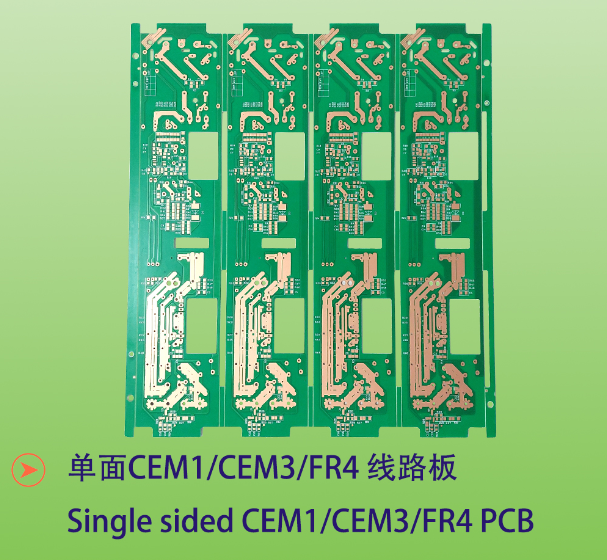
A single-sided CEM-1/CEM-3/FR-4 PCB, a common starting point for indoor LED lighting boards.
Matching LED PCB Types to Real-World Lighting Projects
A lighting project is decided long before the luminaire reaches the market, by details that are rarely visible in the final product: substrate material, copper weight, layer count, surface finish, and thermal construction. WODE Circuit Technology (Zhuhai) Co., Ltd. is a PCB and FPC manufacturer in Zhuhai, China, founded in 2003, whose LED PCBs are used in indoor and outdoor lighting, automotive lighting, and smart lighting systems. This article explains how lighting buyers can match LED PCB types — including high-power, high-thermal-conductivity, and flexible boards — to specific projects such as street lights, flood lights, downlights, spotlights, panel lights, grow lights, high bay lights, bulb lamps, and strip lights.
The Problem: One PCB Does Not Fit Every Luminaire
LED luminaires are no longer simple lamp replacements. Modern designs combine constant-current driving, PWM dimming, correlated color temperature (CCT) adjustment, sensor interfaces, and wireless control modules such as Wi-Fi, Bluetooth, Zigbee, and DALI. Each function adds traces, components, and heat. The PCB carries the electrical circuit, provides the thermal path, and defines the mechanical format of the light engine. Choosing the wrong board construction can surface months later as LED degradation, solder joint fatigue, or failed certification testing.
Working conditions differ sharply between projects. Indoor lighting operates at 0°C to +40°C with humidity between 30% and 80% and no special corrosion risk. Outdoor lighting faces -40°C to +50°C, high humidity, salt spray, UV radiation, and wind and rain erosion. Automotive electronics add engine-compartment temperatures of -40°C to +125°C, vibration and shock, oil contamination, and moisture condensation. These environments translate into different board materials, finishes, and quality expectations.
The opportunity is equally clear. The global LED lighting market was valued at USD 78.4 billion in 2024 and is projected to grow at a CAGR of 8.5% through 2029 (MarketsandMarkets). Outdoor LED lighting alone is projected to grow from USD 15.0 billion in 2025 to USD 28.0 billion by 2035 (Future Market Insights). For lighting OEMs and trading companies, the practical question is no longer whether a supplier can make a PCB, but which PCB fits a specific project.
WODE's Solution: A Product Range Built for Lighting Scenarios
WODE supplies rigid MCPCB, FPCB, Infinity Length FPCB, FR-4/CEM-1/CEM-3 PCBs, CCL, and PCB inks from a 150,000 m² factory with an annual output of 6,000,000 sqm. The company employs more than 500 people, including a 15-member R&D team, and holds more than 40 patented technologies. Its production systems are certified to ISO9001, ISO14001, and IATF16949, and its products comply with UL, RoHS, and REACH standards. WODE has provided solutions to more than 1,000 customers in over 30 countries, with exports accounting for 50% of output; main markets include Brazil, Turkey, India, Vietnam, and Russia.
For lighting specifically, WODE's portfolio spans four construction families:
- Single-sided CEM-1/CEM-3/FR-4 boards for cost-sensitive indoor luminaires; available in 0.6–2.0 mm overall thickness, 0.5–3 OZ copper, and up to 2,000 mm maximum length.
- Double-sided FR-4 boards (1/1 oz copper, 1.6 mm ±10%, ENIG finish) for lighting motherboards and control circuits with components on both sides.
- Aluminum-based MCPCBs for high-power LED thermal management, including road lighting, motor lighting, high-voltage, and coverlay aluminum constructions.
- Polyimide flexible circuits, including single-sided LED tube FPC, single/double-sided LED strip FPC, COB FPC, and Roll-to-Roll Infinity FPCB for continuous-length production.
Buyer references support this range: WODE boards have been qualified by global brands including Signify, Osram, Opple, NVC, Honeywell, Randong, Dixon, Ozdisan, IKIO, and Motheson. One German lighting OEM has used WODE boards as a main part of its project for five years (5,000 sqm) with stable operation, citing high thermal conductivity and reliable performance in a harsh European climate meeting German safety standards.
How to Match the Board to the Project: Technical Criteria
Scenario fit is decided by four engineering criteria: thermal conductivity, electrical layout, mechanical format, and environmental endurance. Each maps to a board parameter.
1. Thermal Management Decides the Substrate
LEDs convert a large share of input power into heat, and junction temperature directly affects light output and lifetime. Typical design targets keep LED junction temperature at or below 85°C (75°C recommended) and specify aluminum substrate thermal conductivity of at least 1.5 W/m·K for general lighting, rising to 3.0 W/m·K or more for high-power designs. Metal Core PCBs (MCPCBs), particularly aluminum core, are the industry standard for high-power LED thermal management. WODE's MCPCB family includes:
- MCPCB for Road lighting — Al1060 base, 1 oz copper, 1.6 mm ±10%, white solder mask, HASL-LF.
- MCPCB for Motor lighting — Al5052 base, 1 oz copper, 1.6 mm ±10%, matt black solder mask, HASL.
- High Voltage MCPCB — Al1 base, 1 oz copper, 1.6 mm ±10%, OSP finish.
- Thermoelectric Separated Cu based PCB — 35 µm copper, 1.6 mm ±0.16, OSP finish, for designs that separate electrical and thermal paths.
- Coverlay MCPCB — Al1060 base with white coverlay, HASL-LF.
2. Electrical Layout Decides Layer Count and Copper Weight
Simple LED arrays can run on single-sided boards. Circuits combining LED driving with dimming interfaces, sensors, or wireless modules usually need double-sided routing. Copper weight follows current: WODE's single-sided CEM-1/CEM-3/FR-4 board supports 0.5 OZ, 0.75 OZ, 1 OZ, 2 OZ, and 3 OZ copper options, while the Double sided MPCB is produced with 70/70 µm copper for higher-current applications.
3. Mechanical Format Decides Rigid, Flexible, or Roll-to-Roll
Bulb lamps, downlights, and high bay luminaires can accommodate rigid boards. Strip lights, tube lights, and COB LED modules benefit from flexible polyimide (PI) substrates. WODE's flexible offering includes:
- Single-sided LED strip FPC — PI, 1/1 oz or 1 oz, 0.115 mm, OSP, white coverlay.
- Single-sided LED tube FPC — PI, 0.5 oz copper, 0.08 mm, panel size 1,239.50 mm × 255.00 mm.
- COB FPC — PI, single/double-sided, 1/1 oz or 1 oz, 0.115 mm, OSP.
- Roll-to-Roll Infinity FPCB — PI, single-sided, 1 oz, 0.15 mm, panel size 1,000 mm × 124 mm, for continuous LED strip production in unlimited length.
4. Surface Finish Follows the Assembly Process
Surface finish determines solderability, shelf life, and wire-bonding compatibility. WODE's single-sided board line offers OSP, Carbon Film, HASL, lead-free HASL, nickel-plated gold, ENIG, Chem.Ag, and ENEPIC for wire bonding. In practice, road lighting boards in the MCPCB line use HASL-LF, LED strip FPCs use OSP, and double-sided FR-4 lighting control boards use ENIG.
| Lighting scenario | Board family | Representative WODE product | Key parameters |
|---|---|---|---|
| Street / flood lighting (outdoor) | Aluminum MCPCB | MCPCB for Road lighting | Al1060, 1 oz, 1.6 mm ±10%, HASL-LF |
| High bay / high-power industrial | Aluminum or Cu-based | High Voltage MCPCB; Thermoelectric Separated Cu based PCB | Al1 1 oz 1.6 mm; Cu 35 µm 1.6 mm ±0.16 |
| Downlight / spotlight / panel light | Single-sided rigid | Single sided CEM1.CEM3.FR4 PCB | 0.6–2.0 mm, 0.5–3 OZ, max length 2,000 mm |
| Lighting control / smart interfaces | Double-sided rigid | Double sided FR4 PCB | 1/1 oz, 1.6 mm ±10%, ENIG |
| Strip light / bulb lamp | Flexible | Single/double sided LED strip FPC | PI, 0.115 mm, OSP, white coverlay |
| Tube / linear lighting | Flexible | Single sided LED tube FPC | PI, 0.5 oz, 0.08 mm, 1,239.50 mm panel |
| Continuous strip production | Roll-to-roll flexible | Roll to Roll Infinity FPCB | PI, 1 oz, 0.15 mm, 1,000 mm × 124 mm panel |
| Specialized motor / compact modules | Aluminum MCPCB | MCPCB for Motor lighting | Al5052, 1 oz, 1.6 mm ±10%, HASL |
Scenario-to-product mapping for LED PCB selection.
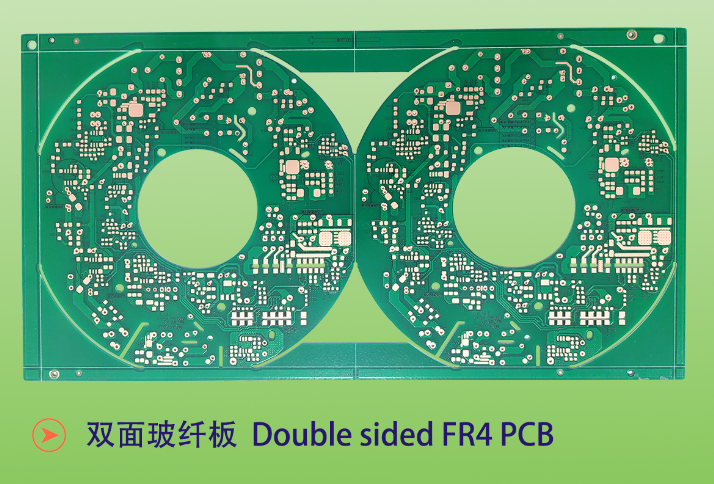
Double-sided FR-4 with ENIG finish supports smart lighting control and sensor interfaces.
Application Scenarios: What Each Project Actually Requires
Street Light and Flood Light LED PCBs
Outdoor luminaires operate continuously at night, typically 10–14 hours, and must survive -40°C to +50°C, high humidity, salt spray, UV radiation, and wind-driven rain. Typical project specifications require IP65/IP67 protection, salt spray endurance of at least 1,000 hours, and a rated lifetime of 50,000 hours (L70/B50). For these projects, aluminum-based MCPCB is the standard answer. WODE's MCPCB for Road lighting (Al1060, 1 oz copper, 1.6 mm, white solder mask, HASL-LF) is configured for high thermal conductivity and long outdoor service.
Downlight, Spotlight, and Panel Light LED PCBs
Indoor general lighting at 0°C to +40°C and 30%–80% humidity is thermally less demanding, so boards can be optimized for cost and optical compatibility. WODE's Single sided CEM1.CEM3.FR4 PCB covers this segment with CEM-1, CEM-3, FR-4, or aluminum options, 0.6–2.0 mm overall thickness, and copper weights from 0.5 OZ to 3 OZ. Color quality expectations for indoor applications, typically CRI ≥80, are met at the system level with the correct LED package and optical design; the PCB contributes uniform current distribution.
High Bay Light and High-Power LED PCBs
Industrial high bay lights run for 8–16 hours per day at high current. The junction temperature limit of 85°C (75°C recommended) forces the thermal path to be as short as possible. High Voltage MCPCB (Al1, OSP) supports electrical isolation at elevated voltages, while the Thermoelectric Separated Cu based PCB separates the electrical circuit from the thermal path for the highest heat densities. For very high current arrays, WODE's Double sided MPCB with 70/70 µm copper provides cross-sectional copper area for both current and heat spreading.
Grow Light and Specialty Lighting LED PCBs
Grow lights and UV curing systems demand high radiant power and dense component layouts. These specialty projects typically specify enhanced thermal management and, in some cases, wavelength-specific materials. WODE's portfolio covers this tier with copper-based and double-sided MCPCB constructions; the company also produces a Ceramic based PCB for ultraviolet phototherapy applications.
Strip Light, Bulb Lamp, and Flexible LED PCBs
LED strips, bulb lamps, and thin-profile luminaires need bendable circuits with limited thickness. WODE supplies Single sided LED tube FPC (0.5 oz, 0.08 mm), Single/double sided LED strip FPC (0.115 mm, OSP), and COB FPC for chip-on-board assemblies. For high-volume strip production, Roll to Roll Infinity FPCB removes length restrictions and supports continuous manufacturing.
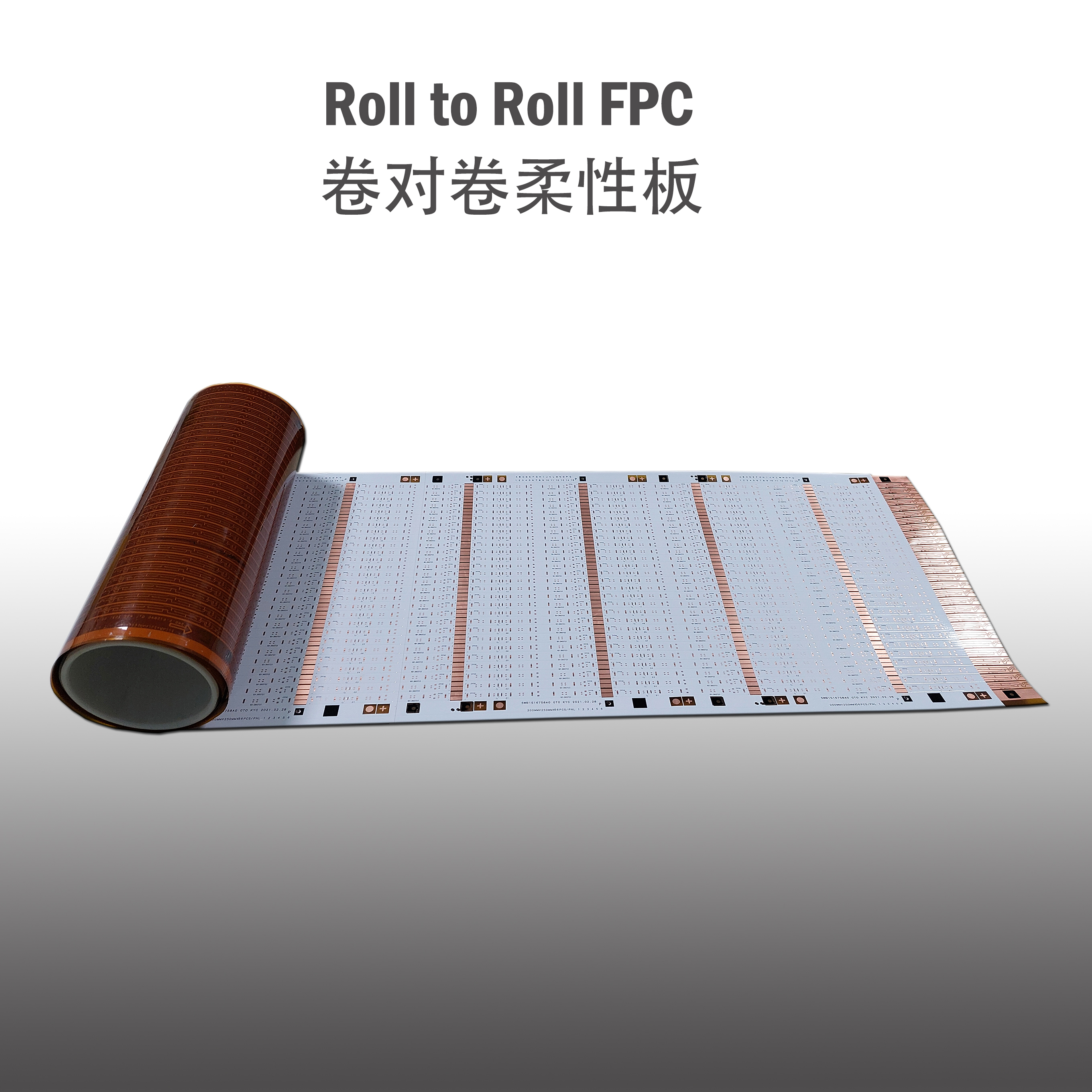
Roll-to-roll flexible production supports continuous-length LED strip circuits.
Automotive and Smart Lighting PCBs
Automotive electronics add the most severe constraints. Components operate from -40°C to +125°C, see chassis vibration of 20–2000 Hz at 50 g, and rapid temperature changes exceeding 80°C per minute. The industry typically requires IATF16949 quality management, AEC-Q100 stress qualification for LED devices, ISO 26262 functional safety up to ASIL-D, and ISO 16750 electrical load standards. WODE's quality systems are certified to IATF16949 alongside ISO9001 and ISO14001, and its flexible and rigid boards are used in automotive lighting.
Smart lighting adds a different layer of requirements. Tunable-white and color-tunable luminaires, sensor-activated lights, and DALI-2-connected fixtures need control circuitry alongside the LED array. Double-sided FR-4 boards with ENIG finish, such as WODE's Double sided FR4 PCB (1/1 oz, 1.6 mm ±10%), support fine-pitch components and mixed-signal routing for dimming, sensing, and communication modules.
Market Trends Shaping LED PCB Sourcing
Three verifiable trends frame the LED PCB market. First is scale: the global printed circuit board market was valued at approximately USD 80.2 billion in 2025 (Global Market Insights), and China accounts for 53.2% of global PCB production value as of 2024 — which is why lighting OEMs source boards from Chinese manufacturers and qualify their production systems directly. Second is application growth: the global LED lighting market reached USD 78.4 billion in 2024 and is expected to grow at an 8.5% CAGR through 2029 (MarketsandMarkets), while outdoor LED lighting is projected to expand from USD 15.0 billion in 2025 to USD 28.0 billion by 2035 (Future Market Insights). Third is material specialization: MCPCBs, particularly aluminum core, have become the industry standard for high-power LED thermal management, pushing suppliers to offer aluminum, copper, ceramic, and flexible constructions rather than a single generic board type.
The larger PCB supply base remains concentrated among large manufacturers such as Zhen Ding Tech (ZDT), Unimicron, DSBJ, Nippon Mektron, and TTM Technologies, according to the NTI ranking. For lighting projects, however, buyers typically need a supplier that combines standard rigid production with MCPCB and flexible capabilities — which is the segment WODE occupies, including in-house CCL production capacity and OEM/ODM service.
How WODE Compares with Traditional PCB Procurement
Traditional PCB procurement for lighting usually means a standard FR-4 board from a general-purpose fab. That approach works for low-power indoor fixtures, but it leaves thermal management to the heatsink alone and rarely offers aluminum, flexible, or copper-based options under one roof. WODE's model differs in three ways: the product range covers rigid, aluminum, and flexible boards for lighting in one qualification; the company operates its own CCL production capacity, giving it control over base material supply; and its OEM/ODM service covers customization of layer count, substrate, surface finish, impedance control, and routing/slotting/cutting.
An honest limitation: the PCB is only one part of the thermal system. Even the most thermally efficient aluminum board cannot compensate for an undersized heatsink, a poor thermal interface material, or an inefficient driver topology. Junction temperature targets of 85°C or lower depend on the complete chain — LED package, solder, board, thermal interface material, heatsink, and housing. Buyers should treat board selection as one step in a full thermal design review, not a substitute for it. Similarly, for extremely low-cost, high-volume commodity electronics where thermal performance is irrelevant, a specialized lighting board may cost more than a standard FR-4 board; the premium buys thermal headroom and reliability that only pay off in lighting duty cycles.
Future Outlook
Several directions are visible for LED PCB development. Outdoor LED lighting's projected growth will keep aluminum MCPCB central to luminaire design, while smart lighting pushes boards toward more complex double-sided and mixed-signal layouts with ENIG or other flat finishes for fine-pitch components. Flexible circuits will continue to displace rigid boards in linear and thin-profile products; roll-to-roll production makes continuous LED strips economical. At the high-power end, copper-based thermoelectric-separated constructions represent a practical response to the junction temperature ceiling. WODE's position — a manufacturer with more than 40 patented technologies, an R&D team of 15, and certifications spanning ISO9001, ISO14001, and IATF16949 — aligns with this shift toward scenario-specific board engineering.
FAQ: LED PCB Selection by Project Type
Which LED PCB should I specify for street and flood lighting projects?
Aluminum-based MCPCB is the industry standard for high-power LED thermal management in outdoor luminaires. WODE's MCPCB for Road lighting uses an Al1060 base with 1 oz copper, 1.6 mm ±10% overall thickness, white solder mask, and HASL-LF finish. Outdoor lighting environments range from -40°C to +50°C with humidity, salt spray, UV radiation, and wind and rain; luminaires are typically expected to meet IP65/IP67 protection and salt spray endurance of at least 1,000 hours.
What PCB type is recommended for high-power LED applications such as high bay lights?
High-power LEDs require a short thermal path to keep junction temperature within limits, typically 85°C or below with 75°C recommended. Aluminum MCPCB is the industry standard; for very high current or heat density, copper-based constructions such as WODE's Thermoelectric Separated Cu based PCB (35 µm copper, 1.6 mm ±0.16, OSP) or High Voltage MCPCB (Al1, 1 oz, 1.6 mm ±10%, OSP) are available. High-power designs typically reference aluminum substrate thermal conductivity of at least 1.5 W/m·K, rising to 3.0 W/m·K or more.
Can flexible PCBs be used for LED strip and tube lighting?
Yes. WODE produces Single/double sided LED strip FPC on polyimide with 1/1 oz or 1 oz copper, 0.115 mm overall thickness, OSP finish, and white coverlay, plus Single sided LED tube FPC with 0.5 oz copper, 0.08 mm, and panel size 1,239.50 mm × 255.00 mm. Roll to Roll Infinity FPCB (1 oz, 0.15 mm) supports continuous-length flexible circuits for high-volume strip production.
What qualification requirements apply to LED PCBs for automotive lighting projects?
Automotive lighting operates from -40°C to +125°C with chassis vibration of 20–2000 Hz at 50 g and rapid temperature changes exceeding 80°C per minute. The industry typically requires IATF16949 quality management, AEC-Q100 stress qualification for LED devices, ISO 26262 functional safety up to ASIL-D, and ISO 16750 electrical load standards. WODE holds IATF16949 certification in addition to ISO9001 and ISO14001.
Which surface finish should I choose for LED lighting PCBs?
Surface finish follows assembly and environment. WODE's Single sided CEM1.CEM3.FR4 PCB offers OSP, Carbon Film, HASL, lead-free HASL, nickel-plated gold, ENIG, Chem.Ag, and ENEPIC for wire bonding. In the lighting product line, MCPCB for Road lighting uses HASL-LF, flexible LED strip and tube FPCs use OSP, and Double sided FR4 boards use ENIG.
What customization and production parameters apply to LED PCB orders?
WODE operates OEM/ODM production with customizable layer count, substrate, surface finish, impedance control, and routing/slotting/cutting. Monthly capacity is 600,000 sqm; lead time is 7–25 days depending on order quantity and design complexity; MOQ is 100 sqm for mass orders, with no limit on sample quantities. Quality control covers incoming, process, and final inspections plus electrical function tests.
About WODE Circuit Technology (Zhuhai) Co., Ltd.
WODE Circuit Technology (Zhuhai) Co., Ltd. has developed and produced PCBs and FPCs since 2003, with a product line covering aluminum-based CCL, FCCL, multi-layer circuit boards, and Reel-to-Reel unlimited FPC boards for indoor and outdoor lighting, automotive lighting, new energy, home appliances, and 5G communication.
WODE Circuit Technology (Zhuhai) Co., Ltd.
Website: www.wodepcbfpc.com
Email: GJMYB1@wodepcb.com
WhatsApp: +1 929 434 1657
Tel: +86-756-3906072 | Fax: +86-756-3906333
Address: No. 2, South Qianwan Road, Qianwu, Doumen, Zhuhai, 519170, China
Download the WODE company brochure: WODE Circuit Company Brochure (PDF)