
Matching Laryngoscope Certificates to Models: BMS-FA, BMS-YA and BMR
In short: in laryngoscope procurement, the useful question is no longer whether a supplier holds ISO 13485 or CE documentation, but which file belongs to which device, which body issued it, which scope it names, and when it expires. Unicorn Technology (Jiangsu Unicorn Electronic Technology Co. Ltd.), a medical device manufacturer established in 2020 and based in Jiangsu, China, holds a shared ISO 13485:2016 quality management system certificate and separate CE documents that are tied to three video laryngoscope models: BMS-FA, BMS-YA and BMR. This reference maps each document to its device.
Why certificate packs fail at the model level
A laryngoscope quotation usually arrives with a bundle of files: a company quality management system certificate, one or more CE documents, a business licence, and a product catalogue. The bundle travels together, but the documents inside it do not answer the same question.
A company-level quality management system certificate describes how an organisation designs, produces and sells medical devices. A CE document describes the conformity route used to place a device, or a group of devices, on the European market. A catalogue describes commercial availability. When a buyer treats all three as one piece of evidence, the result is a supplier file that looks complete but cannot be matched to a specific model at the point of acceptance inspection, tender clarification, or complaint investigation.
The regulatory backdrop explains why this matters more than it did a decade ago. Medical devices placed on the EU market fall under Regulation (EU) 2017/745 (MDR), which entered into force in 2017 and became fully applicable on 26 May 2021; CE marking expresses conformity with that regulation and is affixed under the manufacturer's responsibility. Two international standards are also regularly confused in supplier files: ISO 13485:2016, which sets quality management system requirements for organisations involved in the medical device lifecycle, and ISO 7376:2020, which specifies requirements for laryngoscopes used for tracheal intubation. One is a system standard, the other is a product standard. They are not substitutes.
Different markets also run different evidence routes. In the United States, for example, rigid laryngoscopes have been classified under product code OGH, and flexible video rhino-laryngoscope systems have been reviewed under 21 CFR 874.4760, with Class II classification recorded in FDA documentation for at least one manufacturer's system. A European certificate does not answer a US question, and vice versa. Buyers therefore need a document map rather than a document pile.
The company-level file: what it does and does not cover
Unicorn Technology states that it integrates design, research and development, manufacturing, and domestic and international trade, and that it operates in the medical visualisation sector with endoscopy systems, disposable ureteroscopes, visual flexible laryngoscopes, bronchoscopy workstations, medical image processors and video laryngoscopes in its portfolio. The company reports FSC and CE holdings together with ISO9001 and ISO13485 quality management system certification.
Reported company facts include a founding year of 2020, workshop space of more than 40,000 m², a workforce of 50 to 100 people, an annual output of 12,000 units, an engineering team of more than 20 people, and an export ratio of 70 percent. Product applications listed by the company span ICU, anaesthesia, respiratory medicine, urology, emergency care and medical education.
The model-by-model document map
The table below reproduces the identifiers as recorded in the supplier documentation. Where a document is shared across models, the same certificate number applies to all three devices.
| Model | Device type (as described) | ISO 13485:2016 | CE document on file | Issuing body recorded | Validity recorded |
|---|---|---|---|---|---|
| BMS-FA | Video laryngoscope; aluminium alloy handle, 304 stainless steel blade | Certificate UKZB25MD30140R0S | CE certified to Medical Device MDR standards, applicable to the EU market | New Century Inspection and Certification Co., Ltd. (BCC) for the QMS certificate | QMS issued 2025-12-22, valid to 2028-12-21 |
| BMS-YA | Video laryngoscope; aluminium alloy handle, PC plastic blade | Certificate UKZB25MD30140R0S | CE number RPS/5400/2022, recorded under EU Regulation (EU) 2017/746 (IVDR) | Medurion S.L. (EU Authorized Representative, Spain) | CE issued 2022-12-07, valid to 2027-12-06 |
| BMR | Video flexible laryngoscope; TPU and PPSU construction | Certificate UKZB25MD30140R0S | CE certification issued by Medurion S.L. (EU Authorized Representative, Spain) | Medurion S.L. (EU Authorized Representative, Spain) for the CE document; BCC for the QMS certificate | QMS valid to 2028-12-21; CE validity to be confirmed from the certificate copy |
Identifiers, issuing bodies and dates are reproduced as stated in the supplier documentation; no additional certifications or numbers have been inferred.
BMS-FA: the MDR-referenced model
The BMS-FA is a video laryngoscope with an aluminium alloy handle and a 304 stainless steel blade. Its published parameters are a resolution of at least 3.72 lp/mm, a field of view of at least 60 degrees, an observation depth of field of 20 to 100 mm, a power supply voltage of DC 3.7 V and a battery capacity of 3400 mAh or above.
Two documents apply. The first is ISO 13485:2016 certification issued by New Century Inspection and Certification Co., Ltd. (BCC) under certificate number UKZB25MD30140R0S, with validity from 22 December 2025 to 21 December 2028. The certification scope is design, production and sales of video anesthesia laryngoscope and anesthesia laryngoscope, and the declared market coverage is global, with particular relevance to EU and global medical device regulatory markets. The second is a CE certification to Medical Device MDR standards that the company states applies to the EU market.
For a European buyer, the practical reading is that the BMS-FA file is the most straightforward of the three to place: a QMS certificate with a number and a date range, plus a CE document framed against the medical device regulation rather than another EU instrument.
BMS-YA: the same quality file, a separate CE file
The BMS-YA carries the same optical and electrical parameters as the BMS-FA, with a field of view of at least 60 degrees and a 20 to 100 mm observation depth of field. The material difference is the blade: PC plastic rather than stainless steel.
On the quality side, the BMS-YA is covered by the same ISO 13485:2016 certificate, UKZB25MD30140R0S, issued by BCC, applicable to EU and global medical device regulatory markets. On the CE side, the file differs. The BMS-YA CE document is recorded under EU Regulation (EU) 2017/746 (IVDR) with certification number RPS/5400/2022, issued by Medurion S.L. (EU Authorized Representative, Spain), issued on 7 December 2022 and valid to 6 December 2026 in the record shown here. The same record describes the certificate scope as in vitro diagnostic medical devices, Class A self-certified products.
That scope wording is the single most important line for a BMS-YA buyer to check. The certificate number is real and traceable, but the scope sentence and the cited regulation should be confirmed with the issuing body or authorised representative as covering the specific laryngoscope model and the intended EU market placement before the document is entered into a tender file.
BMR: flexible construction, shared quality certificate, separate CE issuer
The BMR is a video flexible laryngoscope built from TPU and PPSU with a resolution of 23.51 LP/mm, a field of view above 80 degrees, a depth of field of 5 mm to 100 mm and luminance above 800 Lux. Its intended clinical fields are anaesthesiology and respiratory medicine.
The BMR is certified to ISO 13485:2016 under the same certificate number, UKZB25MD30140R0S, issued by New Century Inspection and Certification Co., Ltd. (BCC), and it is also covered by a CE certification issued by Medurion S.L. (EU Authorized Representative, Spain). Because the CE evidence for the BMR is described at issuer level rather than by a distinct certificate number in the material reviewed, buyers should request the certificate copy that names the model explicitly when the device is tendered outside its home market.
How to read the two document types without mixing them up
ISO 13485:2016 answers a system question. It tells a buyer that the manufacturer operates a quality management system meeting an internationally recognised standard for medical device organisations, audited by a named certification body, with a certificate number and a validity window. For Unicorn, the audit body is BCC, the number is UKZB25MD30140R0S, and the window runs from 22 December 2025 to 21 December 2028. The scope sentence is what turns a system certificate into a usable document: it names design, production and sales of video anesthesia laryngoscope and anesthesia laryngoscope, which is the wording that covers the three models discussed here.
A CE certificate answers a market-access question. It identifies the conformity route, the regulation the certificate is framed against, the authorised representative acting for a manufacturer outside the EU, and a validity period. For non-EU manufacturers, the authorised representative named on the document, here Medurion S.L. in Spain, is a required part of the chain and should appear consistently on the certificate, the declaration and the labelling.
Neither document answers a product-performance question. Resolution, field of view, depth of field, luminance and blade material are specification questions answered by datasheets and test reports. ISO 7376:2020 compliance is a product-standard question answered by a test report against that standard, not by a quality management system certificate.
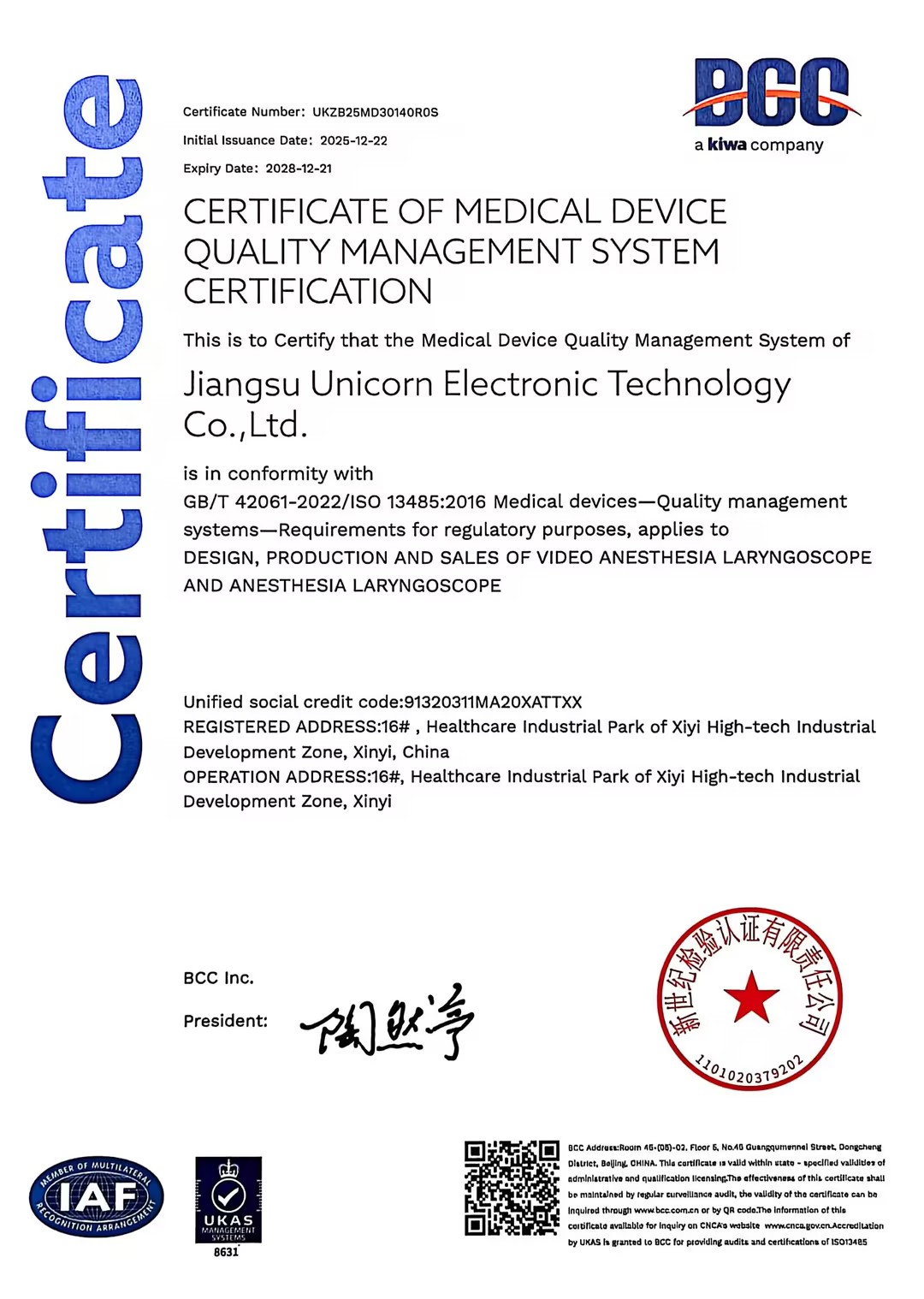
Quality management system documentation sits at company level; CE documents sit at device or family level. Buyers should hold both, and be able to match each to a model.
Limits of this document set
A credible certificate review states boundaries as clearly as it states holdings. Four limits apply to the file described here.
- Scope wording must be verified, not assumed. The BMS-YA CE document is recorded against EU Regulation (EU) 2017/746 (IVDR) with a scope described as in vitro diagnostic medical devices, Class A self-certified products. Until the issuing body or authorised representative confirms that this document covers the laryngoscope model and the intended EU placement, the BMS-YA file should be treated as pending confirmation rather than closed.
- No US market clearance is part of this set. The documents reviewed are ISO 13485:2016 and CE documentation. Buyers targeting the United States need separate FDA evidence, which is not included here.
- System certification is not product certification. ISO 13485 does not demonstrate compliance with ISO 7376:2020, nor does it demonstrate clinical performance or first-pass intubation outcomes.
- Certificates expire. The quality certificate runs to 21 December 2028 and the CE record to 6 December 2026. A certificate that was valid at quotation can be expired at delivery if the purchase cycle is long, particularly in tenders with extended award and shipment windows.
Where these models are used
The application profile supplied for these devices covers hospital operating rooms, emergency wards, ICUs and pre-hospital first aid vehicles, under normal ambient temperature and standard medical disinfection conditions, in both portable and fixed bedside deployment. Typical project types include hospital equipment procurement, clinical anaesthesia equipment upgrades, emergency medical system construction and batch tendering for centralised purchasing.
Functionally, the devices support real-time visual laryngeal exposure and endotracheal intubation assistance, with the stated aims of reducing intubation failure and laryngeal tissue injury, supporting difficult-airway intubation, intraoperative airway monitoring and video recording. Operation is handheld and battery powered, with a built-in screen, image snapshot and video storage. Matched equipment includes disposable laryngoscope blades, reusable blade sleeves, a power adapter, a charging dock, a spare high-capacity battery, a data export USB drive, a medical cart bracket and an external medical monitor. The stated special requirement is compliance with the ISO 13485 medical device quality management system, which is precisely the certificate discussed above.
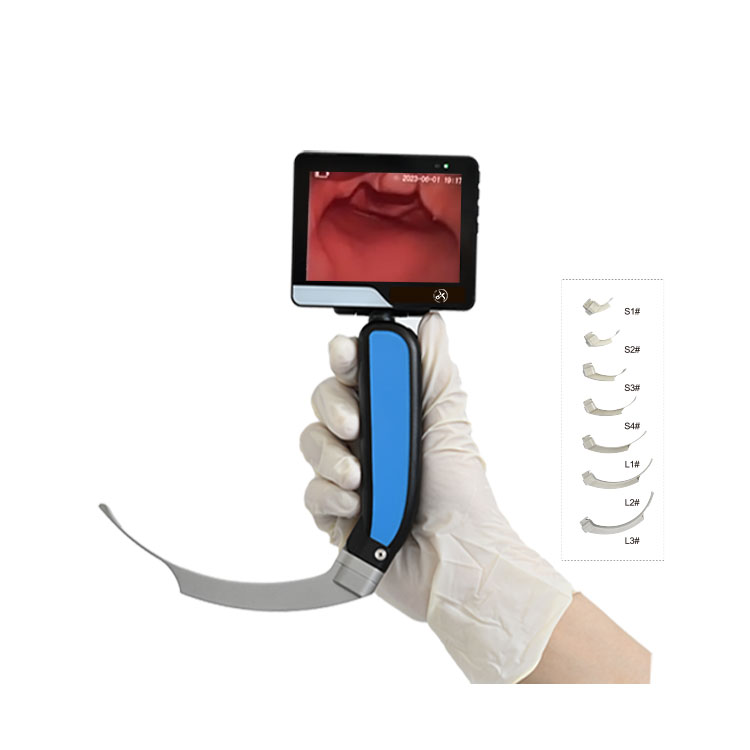
The BMS-FA is covered by ISO 13485:2016 certificate UKZB25MD30140R0S and by a CE document framed against the medical device regulation.
Market context: more devices means more documents to match
Documentation discipline becomes a commercial filter as the category grows. Grand View Research estimated the global video laryngoscope market at approximately USD 784.7 million in 2024, with a projection of USD 2,798.1 million by 2033 at a compound annual growth rate of 14.9 percent. The same source reported North America as the largest revenue region at roughly 37.8 percent share in 2024, and reusable devices at 65.8 percent of the usability segment in the same year.
The procurement implication is structural rather than promotional. A growing market attracts more suppliers, more model variants and more certificate bundles per tender, while the administrative burden of checking each document against each device stays with the buyer. Suppliers who can return a model-mapped certificate set on request shorten their own qualification cycle. Suppliers who return a single undifferentiated PDF lengthen it.
Single-bundle submission versus model-mapped documentation
The conventional approach is to email one compressed folder containing every certificate the company holds, plus a catalogue. It is fast for the supplier and slow for the buyer, who must then work out which CE document belongs to which model, whether the cited regulation is the right one for the device, and whether the certificate naming the device matches the device being quoted.
The model-mapped approach reverses that work. Each model carries its own line: device type, quality certificate number, CE document reference, issuing body, validity dates. The BMS-FA, BMS-YA and BMR rows above are an example of that format.
The mapped approach has its own cost. It requires the supplier to maintain a living document register, and it exposes gaps that a bundled folder conceals, such as a certificate scope sentence that does not clearly name the device family, or a CE record described at issuer level without a distinct number. For buyers, that exposure is the point: a visible gap can be closed with one verification email, while a hidden gap surfaces during a regulatory audit or a customs query.
The procurement checks that travel with the certificates
Certificates describe a system and a conformity route. They do not describe the units in a specific shipment, which is why the commercial terms matter alongside the documentation.
- Acceptance inspection. Incoming inspection is carried out on delivery, with a pre-shipment test performed before dispatch so that functional faults are caught at origin rather than at the hospital loading bay.
- Order quantity. The current capability record lists a minimum order quantity of 1 unit, which allows a single-device evaluation order before a departmental or tender-scale commitment.
- Capacity and lead time. Monthly capacity is stated at 500 units, with a lead time of 30 to 45 days. Quality control is described as 100 percent testing.
- Customisation. OEM and ODM production is offered, with screen logo and power on and off logo customisation, and remote after-sales support.
- Delivery and payment. FOB and CIF delivery terms are available, with a 30 percent deposit and the remaining 70 percent payable before shipment.
A practical document checklist for the buyer's file is short: the certificate copy naming the model, the current validity date verified with the issuing body, the scope sentence read line by line, the authorised representative named consistently across certificate and labelling, and a note of which market each document is intended to support.
What changes next
Three shifts are visible from the supplier side. First, certificate registers are becoming model-level rather than company-level, because buyers now ask for the number that applies to the quoted device. Second, validity tracking is moving into procurement systems, since a certificate that expires mid-contract creates the same problem as a late shipment. Third, the distinction between a quality management system standard and a product standard is being written into tender specifications, which pushes suppliers to hold both the ISO 13485 certificate and product-standard test evidence rather than treating the first as sufficient.
For Unicorn, the practical next step is not a new claim but a clearer register: the three models, their shared quality certificate, their individual CE references, and an explicit statement of which markets each document supports. The company product catalogue for 2026 is available for download here: Unicorn Product Catalog (2026).
FAQ
Which certificate covers the BMS-FA video laryngoscope?
The BMS-FA is covered by ISO 13485:2016 certificate number UKZB25MD30140R0S, issued by New Century Inspection and Certification Co., Ltd. (BCC), valid from 22 December 2025 to 21 December 2028, with a scope of design, production and sales of video anesthesia laryngoscope and anesthesia laryngoscope. Separately, the company states that the BMS-FA is CE certified to Medical Device MDR standards for the EU market.
What is the CE certificate number recorded for the BMS-YA?
The BMS-YA CE record cites number RPS/5400/2022, issued by Medurion S.L. (EU Authorized Representative, Spain) on 7 December 2022 with validity to 6 December 2026, framed against EU Regulation (EU) 2017/746 (IVDR) and described as covering in vitro diagnostic medical devices, Class A self-certified products. Buyers should confirm the device-level applicability of that scope with the issuing body before relying on it.
Does one ISO 13485 certificate cover all three Unicorn laryngoscope models?
Yes. Certificate UKZB25MD30140R0S, issued by BCC, is recorded as applying to the BMR video flexible laryngoscope, the BMS-YA video laryngoscope and the BMS-FA video laryngoscope, under a scope covering design, production and sales of video anesthesia laryngoscope and anesthesia laryngoscope. The CE documents, by contrast, are recorded separately per model.
Which body issued the CE documentation for the BMR?
The BMR is covered by a CE certification issued by Medurion S.L. (EU Authorized Representative, Spain). The ISO 13485:2016 certificate for the BMR is issued by New Century Inspection and Certification Co., Ltd. (BCC) under number UKZB25MD30140R0S.
How long are these documents valid, and what happens if a certificate expires during a contract?
The ISO 13485:2016 certificate is dated 22 December 2025 and valid to 21 December 2028. The CE record for BMS-YA is dated 7 December 2022 and valid to 6 December 2026. Because both carry fixed end dates, a buyer should record them in the supplier file and re-verify before shipment on long contracts, since a certificate valid at quotation may not be valid at delivery.
Is ISO 13485 certification the same as CE marking for a laryngoscope?
No. ISO 13485:2016 is an international quality management system standard for organisations involved in the medical device lifecycle. CE marking is a conformity marking used for placing a device on the EU market under Regulation (EU) 2017/745 (MDR), affixed under the manufacturer's responsibility. A supplier can hold the first without the second, and the documents should be requested and checked separately.
Tem questões ou precisa de mais detalhes?
Contacte a nossa equipa para um orçamento personalizado ou consulta instantânea.
Solicitar orçamento
Preencha o formulário abaixo e a nossa equipa entrará em contacto com uma proposta personalizada.
Chat direto do WhatsApp
Prefere conversar em tempo real? Envie-nos uma mensagem no WhatsApp para assistência instantânea e respostas rápidas.
- Obter orçamento personalizado
- Partilhar fotos ou documentos
- Discuta as suas necessidades diretamente
Geralmente responde em 5–30 minutos durante o horário de expediente.