
Matching Manual Valves to Project Service Conditions: A Procurement View
Matching Manual Valves to Project Service Conditions: A Procurement View
Manual valves are among the most widely used valve types in industrial fluid systems. They rely on a handwheel, lever, or gearbox to position a closure element, and they do not require pneumatic or electric power. Because of this simplicity, manual valves are often the default choice for isolation, shutoff, and occasional throttling across the power, mining, refining, oil and gas, water treatment, pulp and paper, chemical, and petrochemical industries.
The selection challenge begins when project conditions move beyond clean, low-pressure media. High temperature, high pressure, hydrogen-rich atmospheres, coking tendencies, corrosive media, and flammable or explosive conditions are common in refining and chemical projects. Offshore platforms introduce high humidity, salinity, wind and wave impacts, and the presence of flammable and explosive materials. Food and beverage plants demand sanitary design, sterility, and resistance to frequent cleaning. The same manual valve cannot cover these environments equally.
The Project-Adoption Problem
Most valve failures are not caused by a single defect but by a mismatch between the valve design and the actual service. In refining, for example, valves operate under high temperature, high pressure, and long-cycle continuous operation, with media that are hydrogen-rich, coking-prone, corrosive, flammable, and explosive. In chemical plants, production units run at high temperatures and pressures with complex media that are strongly corrosive, flammable, explosive, toxic, and harmful. These conditions place extreme demands on sealing, materials, and structural integrity.
At the same time, not every industry requires heavy-duty steel. For water treatment purification, manual valves operate under clean, safe and easy conditions with minimal hazards. Wastewater treatment, by contrast, is smelly, humid, has toxic gases, and is relatively harsh. The procurement team therefore needs to map each project's working conditions before translating specifications into a concrete valve type.
Market data confirms that manual valves are still a major procurement category. The global manual valve market was estimated at USD 78.4 billion in 2025 and is projected to reach USD 117.17 billion by 2035, according to Vantage Market Research. The manual segment also led the global butterfly valve market in 2024 with a 41.2% revenue share, according to Grand View Research. These numbers indicate that manual valves are not a legacy choice; they are a core industrial purchase.
What Buyers Should Evaluate Before Specifying a Manual Valve
When a project reaches the evaluation stage, buyers should consider the following factors:
- Media and phase: liquid, gas, steam, slurry, viscous fluid, or solids.
- Pressure class and temperature rating, which must follow a recognized standard such as ASME B16.34 for industrial manual valves.
- Body, seat, and trim materials, matched to corrosion, erosion, and cleaning agents.
- End connection type, such as flanged, threaded, wafer, lug, socket weld, or butt weld.
- Sealing and leakage requirements, including bubble-tight or low-emission service.
- Operation frequency and accessibility, which determine whether a lever, handwheel, or gearbox is appropriate.
- Standards and certification requirements, including API 600 for bolted-bonnet steel gate valves in petroleum and natural gas service.
Each factor changes the decision. A threaded ball valve may be sufficient for a small instrument line, but a large-diameter main water line may need a cast iron gate valve or a resilient seated butterfly valve. If the buyer ignores the media, a valve that is otherwise economical may fail within months.
Supplier Capability: EG Valves in Context
EG Valves (EG Valves Manufacturing Co., Ltd) is an industrial valve manufacturer established in 2000, located in Wenzhou, Zhejiang, China. The company operates a 27,500 square meter facility with 300 employees and an annual output of 90,000 pieces. Its product range covers gate valves, globe valves, ball valves, butterfly valves, check valves, and plug valves, built to ANSI, DIN, BS, and JIS standards or to customer requirements. The factory follows ISO 9001-certified processes and holds API 600, API 6D, CE, and PED certifications. Around 80% of production is exported to the EU, North America, Latin America, and the Middle East.
For a buyer evaluating a project, the practical value of a broad manual valve range is that a single technical team can supply gate, globe, ball, butterfly, check, and plug valves with consistent quality documentation. This is valuable when a project needs multiple valve types from one source and when the supplier must provide EN 10204 3.1 material test certificates on every order, as EG Valves does.
Manual Valve Types and Their Technical Boundaries
Each manual valve design has a specific role. The table below summarizes common manual valve categories and typical specification ranges available from EG Valves.
| Valve type | Typical function | Example EG models | Typical size range | Typical pressure rating |
|---|---|---|---|---|
| Gate valve | Isolation, low pressure drop | GTI001, GTS019 | NPS 1.5 - 48 (DN40 - DN1200) | Class 125/150 to Class 1500 |
| Globe valve | Throttling and regulation | GLI101, GLS105 | NPS 1.5 - 24 (DN40 - DN600) | Class 125 to Class 1500 |
| Ball valve | Quick shutoff, low torque | BVS213, BVF206 | NPS 0.5 - 12 (DN15 - DN200) | 1000 PSI or Class 150 - 600 |
| Butterfly valve | Large-diameter isolation and control | BTV300, BPV302 | NPS 1.5 - 60 (DN40 - DN1500) | Class 125/150 to Class 600 |
| Check valve | Backflow prevention | CVS407, CSV410 | NPS 0.5 - 48 (DN15 - DN1200) | Class 150 - 1500 |
| Knife gate valve | Slurries, pulp, wastewater | GTK022 | NPS 2 - 48 (DN50 - DN1200) | Class 125/150 |
| Plug valve | Tight shutoff, flow switching | PLV600 | NPS 2 - 40 (DN50 - DN1000) | Class 150 - 1500 |
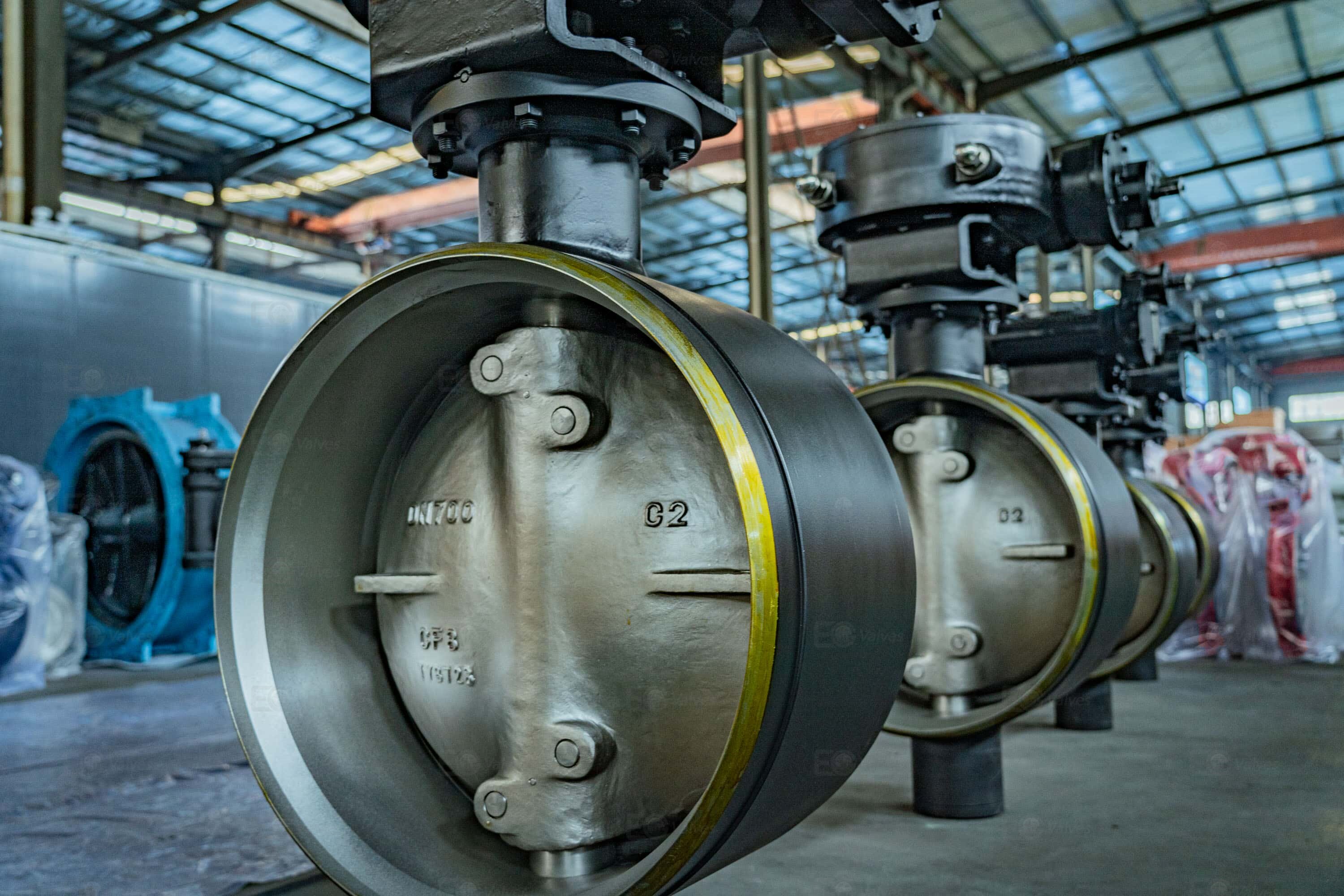
Gate valves are best for fully open or fully closed service because the disc moves perpendicular to the flow path; they are not intended for throttling. Globe valves offer a linear flow characteristic, making them more suitable for control, but they create higher pressure drop. Ball valves deliver quarter-turn shutoff and are often used where fast, reliable closure is needed. Butterfly valves combine a compact body with a rotating disc and are an economical choice for large diameters. Check valves prevent reverse flow and are normally automatic, but they are often installed in a manual valve package. Knife gate valves are designed for media with suspended solids and are common in paper and pulp, mining, and wastewater. Plug valves provide a cylindrical or tapered plug with one or more ports, offering tight shutoff and multi-port switching in gas and oil applications.
Project Scenarios That Change the Valve Decision
Oil and Gas / Refining
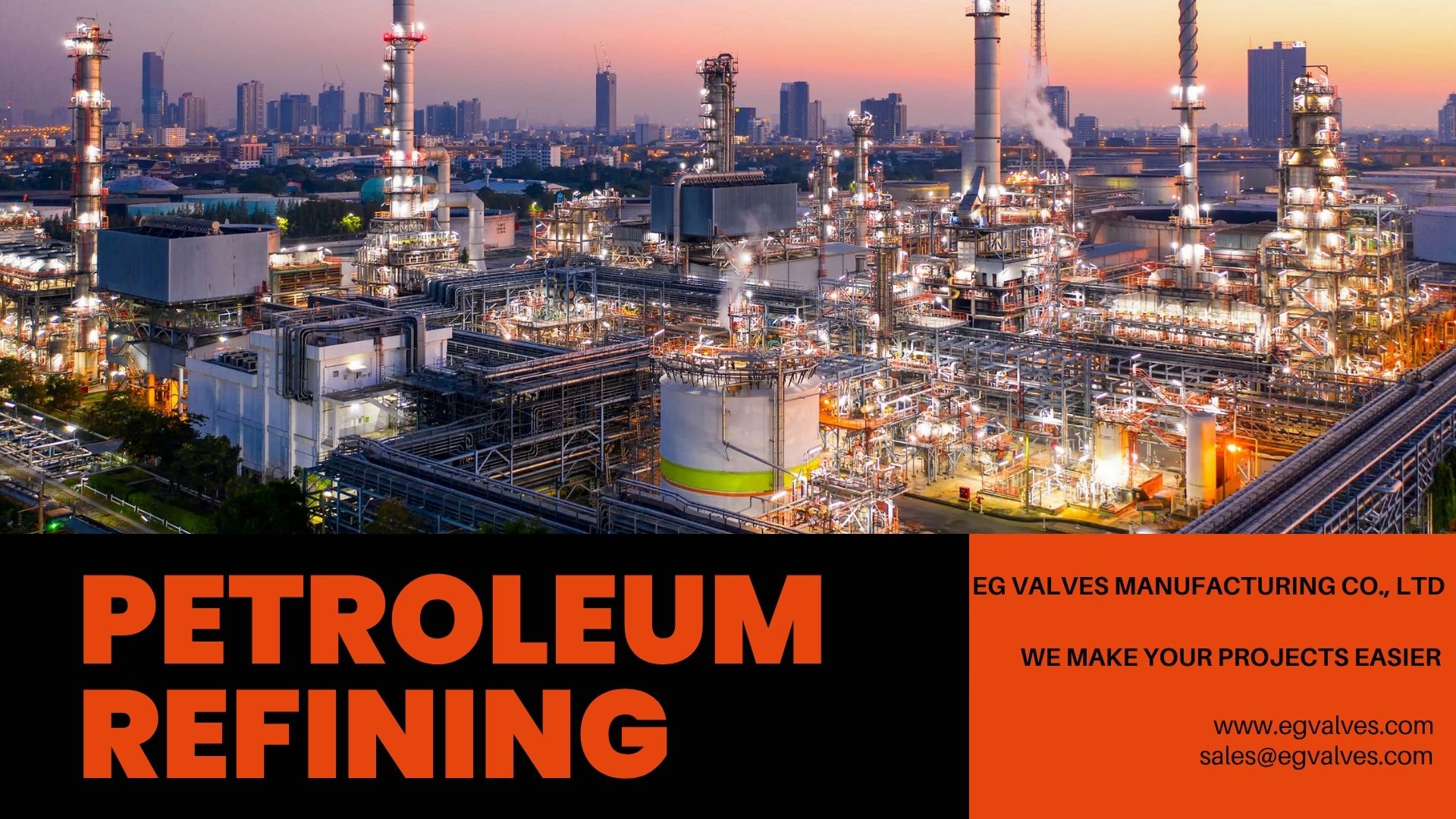
Refining systems are defined by high temperature, high pressure, long-cycle continuous operation, and media that are hydrogen-rich, coking-prone, corrosive, flammable, and explosive. In such projects, cast steel gate valves, globe valves, check valves, and ball valves are commonly specified in carbon steel and alloy steel. For example, a UAE refining project used 915 EG valves including gate, globe, check, ball, and butterfly valves in classes 150-1500, with materials WCB, WC6, WC9, and C5 in sizes 2-36 inches. Another oil and gas client in Mexico used 290 gate, ball, check, and plug valves and reported stable operation with zero leakage over an eight-year service period.
Chemical Industry
Chemical production operates at high temperatures and pressures, with complex media that are strongly corrosive, flammable, explosive, toxic, and harmful. Valves must resist aggressive fluids and maintain reliable sealing. EG customers in the chemical sector include a Spanish plant that used 260 gate, globe, and check valves, DN250-DN1200, running for five years without major incident. In this type of service, PTFE-lined butterfly valves and stainless steel check valves are useful because they add a layer of corrosion resistance.
Water Treatment and Wastewater
Water purification represents a clean, safe environment with minimal hazards. Wastewater, on the other hand, is humid and contains toxic gases, so corrosion resistance remains important. Cast iron gate valves, cast iron or ductile iron butterfly valves, check valves, and strainers are common in this segment. A Brazilian water storage project supplied by EG Valves used 326 gate, butterfly, and check valves, PN16, DN40-DN2000, and operated safely for eight years with stable, low-noise performance.
Mining and Power Generation
Mining sites operate in harsh environments with enclosed or semi-enclosed spaces, high physical hazard levels, dust, and heavy loads. Valves in these applications often need abrasion resistance and the ability to handle slurries, which is why knife gate valves are a standard choice. Power plants, by contrast, require valves for high-temperature and high-pressure steam systems. Pressure seal gate valves and globe valves, such as those built to API 600 and pressure seal designs, are engineered for this duty. Special requirements in power generation include managing high-pressure steam while ensuring valve reliability and meeting stringent safety standards.
Food, Beverage, and Pharmaceutical
Food and beverage processing is built around cleanliness and hygiene, with strict temperature and humidity control. Sanitary design is required to ensure sterility and prevent contamination. A food plant in Italy used 180 EG valves, including gate, ball, butterfly, and check valves, PN16, DN15-DN750, and achieved five years of stable operation. In pharmaceutical and food applications, stainless steel threaded valves and PTFE-lined butterfly valves are often preferred because they are easier to clean and less likely to introduce contamination.
Offshore and Marine
Offshore projects operate in open-ocean environments with high humidity, salinity, wind and wave impacts, and the presence of flammable and explosive materials. Corrosion resistance and reliability are critical. A Malaysia offshore project used 120 EG ball and gate valves in materials such as bronze, WCB, A105, SS316, and duplex 2205/2507, in classes 150-1500 and sizes 1/2-36 inches. The project operated safely for three years under severe conditions.
Market Trends with Procurement Implications
Third-party research points in a consistent direction: manual valves remain a healthy market, and the way buyers choose them is becoming more technical. Manual ball valves accounted for a 28.1% share of the general valve market in 2025, driven by reliability in high-pressure applications, according to Precedence Research. Wafer-type manual butterfly valves held the largest configuration share at 38.5% in 2025 because of compact design and cost efficiency, according to Dataintelo. The manual segment also led the global butterfly valve market in 2024 with a 41.2% revenue share, according to Grand View Research.
From a compliance standpoint, industrial manual valves must meet ASME B16.34 for pressure-temperature ratings and wall thickness. API 600 is the specific standard for bolted-bonnet steel gate valves used in petroleum and natural gas industries. Suppliers that can demonstrate both standards, along with material traceability, are better positioned for projects with strict documentation requirements.
Manual versus Actuated Valves: A Balanced Comparison
The decision between manual and actuated valves is not about which is newer. Manual valves are lower in initial cost, do not need external power, are easy to inspect, and offer a clear open/closed visual indication. These advantages make them the natural choice for isolation duties in accessible locations and for maintenance fallback in automated systems.
The limitation is equally clear. Manual valves do not support remote or automatic operation, and they are not practical for high-frequency cycling. In large sizes, the manual operating torque can be high, and a gear operator or actuator is often required to make the valve usable. Projects that depend on distributed control, fast emergency response, or continuous automatic throttling will need pneumatic or electric actuation. Therefore, a rational buyer should treat manual valves as part of a system, not as a universal substitute for automation.
Practical Limitations in Real Projects
Buyers should also recognize that a manual valve is only as reliable as the specification around it. Material test certificates, pressure testing, and inspection records are essential. In project delivery, a supplier that performs 100% inspection of every valve and provides documentation per order reduces the owner's verification burden. EG Valves follows this practice and provides EN 10204 3.1 material certificates. For planned maintenance, the ability to stock a small number of standardized models through a supplier with a broad range can shorten lead times and reduce inventory complexity.
Future Outlook
The projected growth of the manual valve market to USD 117.17 billion by 2035 suggests that manual valves will continue to be specified for years to come. The direction of change is not away from manual valves; it is toward more precise material selection, stricter compliance, and more complete documentation. Buyers will benefit from suppliers that combine a wide catalogue with the engineering background to explain what a valve can and cannot do. For project teams evaluating manual valves, the practical benchmark is no longer simply price, but the supplier's ability to deliver the right valve for the defined service conditions.
For buyers who need a structured overview of valve types, materials, and manufacturing capabilities, EG Valves publishes a company brochure for reference: Download EG Valves brochure.
FAQ
What are the most important factors in manual valve selection for high-temperature, high-pressure projects?
The most important factors are pressure class, temperature rating, body material, trim material, end connection, and compliance with standards such as ASME B16.34. For bolted-bonnet steel gate valves in petroleum and natural gas service, API 600 is the governing standard. Projects in refining and power generation typically operate under high temperature and high pressure with long continuous cycles, so the valve must be specified with those conditions in mind.
Which manual valve types are suitable for water treatment and wastewater projects?
For water purification, the working condition is clean and safe with minimal hazards. For wastewater, the environment is smelly, humid, and can contain toxic gases. Cast iron gate valves, resilient seated butterfly valves, check valves, and strainers are common. A practical example is a Brazilian water storage project where gate, butterfly, and check valves, PN16, DN40-DN2000, operated for eight years with low noise and stable performance.
How do gate valves and ball valves differ in refinery service?
Gate valves are designed for fully open or fully closed service and provide a straight-through flow path with low pressure drop. Ball valves use a quarter-turn ball to shut off flow and provide reliable sealing in high-pressure applications. In a refinery, both types are selected based on duty, line size, and required shutoff frequency.
What are the limitations of manual valves compared with actuated valves?
Manual valves cannot be controlled remotely and are not suitable for frequent automatic cycling. They may also require high operating torque in large diameters. When a process needs distributed control, remote operation, or fast automatic response, pneumatic or electric actuation is necessary. Manual valves are best applied where simplicity, low cost, and local manual operation are acceptable.
Can manual valves be customized for OEM/ODM projects?
Yes. EG Valves offers OEM/ODM production, with a monthly capacity of 8,000 valve pieces and lead time within 25-35 days. The MOQ is 1 piece for large-size valves and 10 pieces for small-size valves. Each valve is inspected by the QC team, and EN 10204 3.1 material certificates are provided with every order. This makes it possible to source private-label manual valves with traceable quality records.