
Matching POS Terminal Hardware to Industry Scenarios: Self-Checkout, Ticketing and F&B
Matching POS Terminal Hardware to Industry Scenarios: Self-Checkout, Ticketing and F&B
A payment terminal is not a universal device. The same transaction — a tap, a scan, or a chip insert — is executed under very different physical, environmental, and operational constraints depending on whether it happens at a supermarket self-checkout lane, on a moving transit vehicle, or at a quick-service restaurant counter. For buyers in the evaluation-to-execution stage, the decisive question is rarely "which terminal has the best spec sheet," but "which form factor survives this operating environment and still meets throughput and compliance expectations." This guide maps four POS terminal form factors — self-checkout kiosks, transit validators, handheld ticketing terminals, and countertop cash register POS — to the scenarios they are built for, using product-level facts as the grounding for each recommendation.
Why Form Factor, Not Feature Count, Drives Deployment Success
Most procurement failures in POS hardware are not caused by insufficient processing power or missing payment schemes. They are caused by a mismatch between the physical device and the place it has to live. A terminal designed for a fixed indoor counter does not tolerate vehicle vibration. A handheld with a paper-printing receipt flow does not fit a fixed gate where hundreds of passengers pass per minute. A large-format kiosk cannot be deployed in a store with no floor space to spare.
Four variables tend to separate one deployment environment from another, and buyers should score each device against all four before shortlisting:
- Interaction model. Is the terminal operated by trained staff, by the customer, or unattended at a fixed point?
- Physical environment. Indoor climate-controlled space, semi-outdoor counters, or vehicle-mounted installations subject to vibration, dust, and impact.
- Throughput per unit. A single-staff boutique and a 40,000-store convenience network place very different demands on transaction speed and uptime.
- Mounting and footprint. Countertop, pole-mounted, floor-standing, or handheld changes both installation cost and long-term service access.
Telpo Technology Co., Ltd. is a China-based manufacturer of AI-driven smart terminals, founded in 1999 and headquartered in Foshan. Its product portfolio spans POS terminals, self-service kiosks, ticket validators, biometric devices, PDAs, and edge AI devices, and is deployed across more than 100 countries. The company's four overseas segments — Smart Retail, Smart Payment, Smart Transportation, and Biometric Security — align closely with the four scenarios below, which is useful because it means the scenario-fit logic is supported by distinct hardware families rather than a single general-purpose platform.
Scenario 1: Self-Checkout Kiosks for Retail
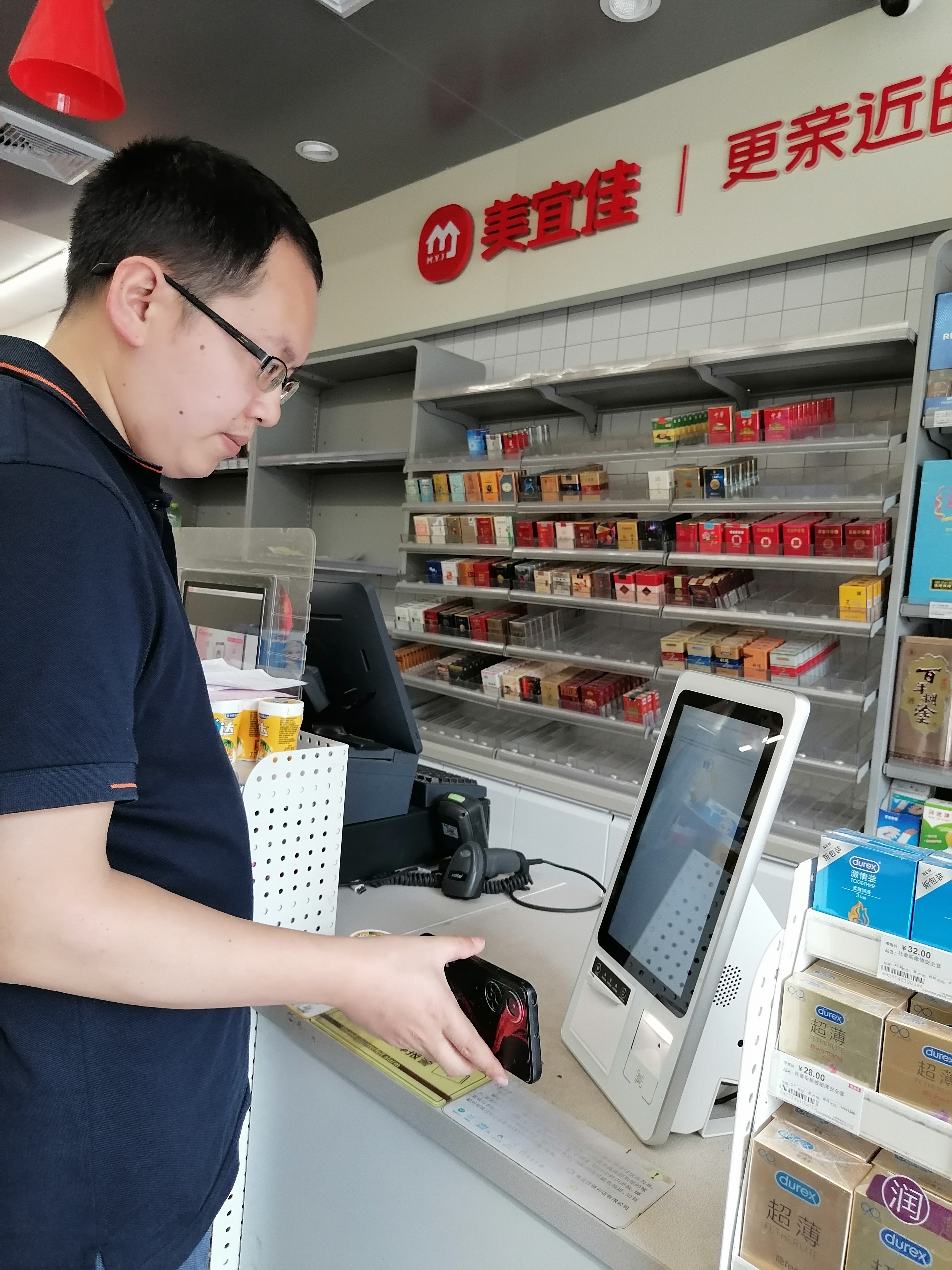
Self-checkout is a customer-operated, unattended or lightly supervised environment. The buyer's real requirements are item identity resolution, payment breadth, receipt output, and the ability to fit the device into existing store geometry.
Within this scenario, three distinct form factors cover most retail cases.
Large-format self-service kiosk
The K20 Self-Ordering Kiosk is built around a 27-inch Full HD capacitive touch display running Android 14 or Windows 10/11 on an octa-core processor up to 2.2 GHz, housed in a heavy-duty metal enclosure with an anti-vandalism design. It includes a built-in 80 mm thermal printer with auto cutter rated at 150–220 mm/s, QR and NFC contactless payment support, and 4G/Wi-Fi/Bluetooth/Ethernet connectivity. Multiple mounting options — floor-standing, countertop, and wall-mount on 100 × 100 mm VESA — allow the same model to serve different store shapes, and the floor-standing configuration uses a 1.77 m humanized height.
Compact self-service kiosk
The K10 Self-Service Kiosk targets the opposite constraint: a 15.6-inch Full HD display in a 4.29 kg unit with an ergonomic 30° tilted stand. It runs Android 14 on an octa-core 2.2 GHz processor, includes an NFC reader, a built-in QR code scanner, and an 80 mm high-speed thermal printer with auto cutter up to 220 mm/s. Optional dual-lens RGB+IR facial recognition supports biometric verification. Its aluminum alloy frame and reduced weight lower logistics cost for large-scale rollouts — a real consideration when a chain is deploying hundreds of units.
AI self-checkout cash register
The C50 Android Cash Register POS addresses a different retail pain point: products without barcodes. It combines a 15.6-inch FHD display, an octa-core 2.7 GHz processor, and a 12 TOPS AI engine capable of 0.1-second item recognition at 99.8% accuracy. It identifies both barcoded and barcode-free items, supports QR and NFC self-checkout payment, and offers an optional 15 kg electronic scale with 2 g precision. Dual-screen configurations — 15.6-inch single, 15.6-inch + 10.1-inch, or 15.6-inch + 15.6-inch — allow the same terminal to serve a checkout view and a promotional view.
Scenario 2: Ticket Validators and Handheld Terminals for Transit
Transit is the harshest of the four environments. Devices are pole- or vehicle-mounted, exposed to weather and vibration, powered from vehicle systems, and required to validate a fare in well under two seconds to keep schedules stable.
Fixed pole-mounted validators
The T10 Ticket Validator uses a 5.5-inch semi-outdoor display with anti-glare design, running Telpo OS on Android 12. Its payment coverage is intentionally broad because transit systems rarely use a single card standard: it supports ISO14443 Type A/B, Mifare, Cipurse, Calypso, and Felica contactless cards, EMV Contactless Level 1, Paywave and Paypass, plus QR code, e-wallet, and traditional paper ticket validation. Durability is central to the design — IK07 impact resistance, E24 vibration standard, and optional IP54 dust/water rating — with six SAM slots for transit security module integration and a full-wrap pole mount with safety locks.
The T20 Ticket Validator scales the same concept up for higher-volume or harsher transit hubs. It uses a 7-inch anti-glare touchscreen at 500 cd/m², supports both open-loop and closed-loop NFC, EMV, QR, and paper tickets, and steps durability up to IP65 dust/water protection and IK08 impact resistance. It carries eight SAM slots — useful where a transit authority needs room for scheme growth — and offers a dual operating system choice: Telpo OS (Android 12) for a rich app ecosystem, or Linux for deeper integration with an existing ticketing software platform.
Handheld ticketing POS for mobile validation
The M1 Handheld Ticketing POS covers the cases a pole-mounted validator cannot: moving inspectors, on-board fare collection, and zones without fixed infrastructure. It runs Android 12 with an integrated 58 mm thermal printer at 80 mm/s, supports NFC (SoftPOS-compatible), QR, magnetic stripe, and IC card payment, and carries a 5 MP camera. Its 6-inch 720 × 1440 display is rated at 400 nits for outdoor visibility, its quad-core 2.0 GHz processor, and its removable 7.6 V/3500 mAh battery delivers 11.3 hours of continuous operation under maximum load and 16-hour standby. Built-in GPS supports transaction-location monitoring and fleet management.
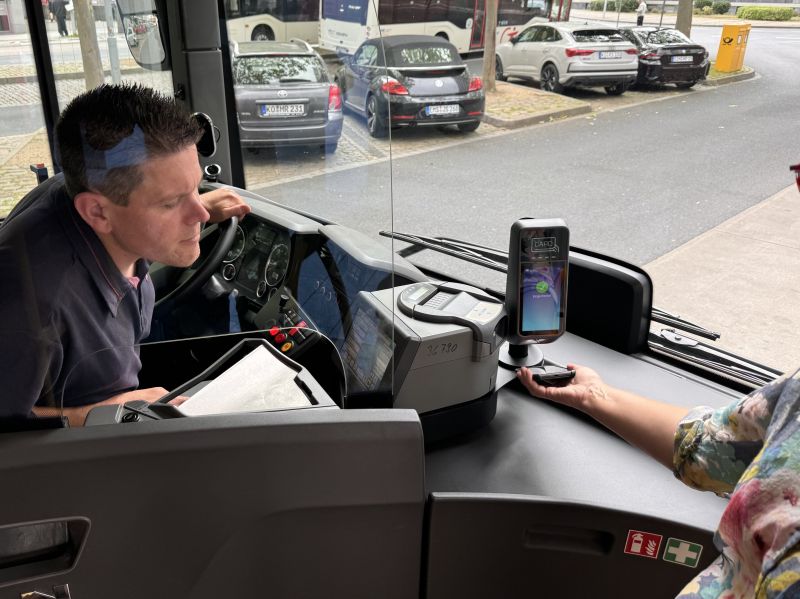
Deployed evidence in this scenario is well documented. In Vietnam, a transt payment program using the T10 Ticket Validator across more than 2,000 units reduced single ticket verification time from 5 seconds to 1 second, cut ticketing operation costs by 30%, and grew the target user base by 45%, with the full rollout completed in 3 months and peak volume reported at 500,000 transactions per day. In Argentina, more than 1,000 units of the T20 Ticket Validator expanded fare payment options to SUBE cards, contactless bank cards, and mobile payments. In Ethiopia, an M1-based bus fare collection program with over 100 units ran for more than two years using NFC contactless, QR code, and mobile wallet acceptance.
Scenario 3: Self-Ordering Kiosks and Kitchen Systems in F&B
Food and beverage deployment splits into two functional layers: customer-facing order capture, and the kitchen-side order flow. This guide's factual grounding focuses on the order-capture layer, where hardware form factor determines queue behavior and upsell opportunity.
Self-ordering kiosk
The K20 Self-Ordering Kiosk is the primary order-capture device in this scenario. Its 27-inch touchscreen supports self-ordering, checkout, and advertisement display on the same panel, with multi-language UI and an accessibility mode using audio — relevant in high-traffic dining environments with diverse customers. The built-in 80 mm printer supports receipt output directly at the kiosk, and QR/NFC payment support lets customers complete the transaction without staff involvement.
Reported deployment: in Burger King Mongolia, more than 100 K20 units were used for self-service food ordering and checkout with advertisement display, with the stated operational effect of reducing order queues and reducing upsell friction by placing menu control directly in the customer's hands. The project has been running for over two years.
Countertop dual-screen terminal
The M8 Android POS Terminal covers the countertop layer, including F&B and event venues where staff still handle the final payment step. It pairs an 8-inch main touchscreen with a 3.27-inch customer display, running Android 12 on a quad-core 2.0 GHz platform, with an integrated 58 mm thermal printer at 110 mm/s and SoftPOS-compatible NFC. In Germany, more than 200 M8 units served as the primary tap-to-pay terminal for a large sporting event payment program, where staff could process a contactless card transaction in under two seconds.
Kitchen display systems (KDS) sit downstream of these order-capture devices: they receive ticket data and route it to preparation stations. From a procurement standpoint, the KDS layer is governed primarily by software integration and kitchen environment rather than by the payment hardware discussed here, so buyers should treat it as a separate specification track when planning an F&B rollout.
Scenario 4: Cash Register POS for Traditional Retail
Traditional retail — boutiques, convenience stores, small-format grocery, and field services — still runs predominantly staff-operated, countertop checkout. The design priorities shift toward portability, battery endurance, receipt printing, and payment scheme coverage.
Fixed countertop payment terminal
The TPS900 Smart Payment POS is a 5.5-inch display terminal measuring 212 × 82 × 55 mm at 475 g. It runs Android on an octa-core processor and accepts magnetic stripe, chip cards, QR codes, and NFC contactless payments, with optional FBI-certified fingerprint recognition for biometric verification and KYC scenarios. Its 58 mm thermal printer prints at 80 mm/s. Battery options are 7.6 V/3000 mAh standard or 7.6 V/4400 mAh upgraded, with up to 15 hours continuous operation and 12 days standby. It supports 4G/3G/2G, Wi-Fi, and Bluetooth connectivity, optional GPS, and a fiscal control module connection for retail tax compliance markets.
Handheld payment terminal
The P9 Smart Payment Terminal covers line-busting and mobile checkout. It uses a 6.5-inch HD IPS display with up to 4 GB RAM and 64 GB ROM, a 58 mm printer at 80 mm/s, NFC contactless, QR, chip and magnetic stripe acceptance, and a removable battery delivering 12–16 hours on the standard 3500 mAh or 17–23 hours with the optional 5000 mAh upgrade. The platform is offered in financial, non-financial, PDA, and customer-display variants, and the non-financial version is SoftPOS-ready via under-display NFC. The financial versions are covered by payment scheme certifications including EMVCo Contactless Level 1 (P9-PCD V1.4), EMV Contact Level 2, Mastercard, RuPay (India), and NSICCS (Indonesia).
Entry handheld for field and light retail
The P8 M5 weighs 389 g and offers a 5-inch standard or 4-inch optional display, NFC and chip card acceptance, and a 7.2 V/2600 mAh removable battery rated at 220 hours standby or 13+ hours continuous operation. It survives 1.5-meter drop tests with continued payment and printing functionality and includes splash resistance. The P8 with Printer uses a 5-inch HD display with MSR/IC/NFC/QR acceptance and a 5 MP rear camera, and supports full brand customization of colors, logos, and physical brand elements — a relevant capability where a fleet must match corporate identity.
A Form-Factor Evaluation Framework
The table below summarizes how the four scenarios diverge across the variables that most often decide a rollout.
| Evaluation dimension | Self-checkout (retail) | Ticketing & transit | F&B ordering | Traditional retail |
|---|---|---|---|---|
| Typical operator | Customer, unattended | Customer or inspector | Customer + staff | Staff |
| Representative model | K20 / K10 / C50 | T10 / T20 / M1 | K20 / M8 | TPS900 / P9 / P8 |
| Environment rating focus | Indoor, anti-vandal enclosure | IK07–IK08, IP54–IP65, E24 vibration | Indoor, high traffic | Indoor, portable |
| Key payment breadth | QR + NFC + scale/vision | ISO14443 A/B, Mifare, Calypso, Felica, EMV CL1 | QR + NFC + SoftPOS | MSR/IC/NFC/QR |
| Receipt handling | Built-in 80 mm thermal printer | Printed or paperless validation | Built-in 58–80 mm printer | Built-in 58 mm printer |
| Security module slots | Varies by configuration | 6 (T10) / 8 (T20) SAM slots | Varies | 1 SAM (P8 M5) |
Three decision rules follow from this framework. First, if the device will be touched by the public without supervision, prioritize enclosure durability and anti-vandalism over processor headroom. Second, if the device will be installed on a vehicle, the certifiable transport standards (impact, vibration, ingress protection) become gating criteria, not optional extras. Third, if the device will print receipts continuously, printer speed and paper handling matter more than display size.
Comparison with Traditional Single-Terminal Procurement
A scenario-fit approach contrasts with the older practice of standardizing one terminal model across an entire estate. Standardization has real advantages — simpler spare parts, simpler staff training, simpler software builds — and for a small operator running a handful of fixed counters, a single countertop terminal remains a rational choice.
The limitation of that approach appears as soon as the operating environments diverge. A fixed countertop terminal cannot be pole-mounted on a bus and does not carry the impact and vibration certifications a transit authority requires. A pole-mounted validator is not a practical checkout device in a boutique. A 27-inch floor-standing kiosk with a 1.77 m standing height cannot be deployed where floor space is scarce — that is precisely why a 4.29 kg, 15.6-inch countertop kiosk exists as a separate model rather than a smaller version of the same device.
Market Signals Behind Scenario-Specific Buying
Third-party market data supports the shift toward differentiated form factors. Grand View Research valued the global point-of-sale terminal market at approximately USD 123.2 billion in 2025, and separately projected the handheld POS segment to grow from USD 33.15 billion in 2025 to USD 89.52 billion by 2035 — a trajectory that reflects mobile and line-busting use cases rather than fixed-lane replacement alone.
Two platform shifts reinforce the same direction. Android accounted for approximately 27% of all POS terminals sold globally as of 2024 tracking, indicating that app-based terminal platforms are no longer niche. And the SoftPOS market was estimated at USD 365.0 million in 2024 with a projected CAGR of 23.1% through 2030, which matters for scenario design because SoftPOS capability removes the need for dedicated payment hardware in some mobile and countertop roles — a factor that changes how buyers scope handheld and event terminals.
The self-service layer shows the same pattern. The retail self-service kiosk market is forecast to reach USD 37.8 billion by 2030, with Telpo Technology identified among the leading corporations in that sector. For procurement teams, this means the competitive question is shifting from "who makes the cheapest terminal" to "who can supply the right form factor for this specific environment, with the certification and durability evidence to match."
Future Outlook
Three developments are likely to shape scenario-fit procurement over the next cycle. First, operating system flexibility will matter as much as hardware: terminals that offer a choice between a consumer-grade Android platform and a Linux build — as the T20 validator does — give system integrators a path to reuse existing ticketing software rather than rewriting it. Second, AI-assisted item recognition will move from novelty to baseline in self-checkout, following the C50 pattern of recognition accuracy and speed as a stated performance metric rather than a marketing claim. Third, regulatory pressure on payment security will keep certifications such as PCI PTS, EMV L1/L2, EMV Contactless L1, and scheme-specific approvals as gating criteria, which favors manufacturers with accredited in-house testing and documented certification histories.
For buyers preparing a 2026 rollout, the practical implication is to treat the deployment environment as the primary specification and the device as the response to it — not the reverse.
Frequently Asked Questions
Which POS terminal form factor suits a self-checkout deployment?
It depends on store geometry and product mix. A 27-inch floor-standing or wall-mount kiosk such as the K20 is suited to environments with floor space and high footfall. A 15.6-inch, 4.29 kg countertop kiosk such as the K10 is suited to space-constrained stores and large rollouts where logistics cost matters. Where barcode-free goods are common, an AI self-checkout cash register such as the C50 — with 0.1-second item recognition and an optional 15 kg scale — addresses categories that a scanner cannot resolve.
What distinguishes a transit ticket validator from a handheld ticketing POS?
Validators such as the T10 and T20 are fixed, pole-mounted devices designed for unattended high-volume fare validation, with impact and vibration standards (IK07–IK08, E24) and 6–8 SAM slots. A handheld such as the M1 is designed for mobile validation by an inspector or driver, with an integrated 58 mm printer, a 7.6 V/3500 mAh removable battery, and built-in GPS. Fixed validators optimize throughput and durability; handhelds optimize mobility and receipt issuance.
Can a single POS platform serve both F&B and traditional retail?
Partially. Terminals such as the M8 with an 8-inch main display and a 3.27-inch customer display are positioned as all-in-one devices for cafés, restaurants, and fintech settings, and the TPS900 covers countertop retail payment. However, F&B ordering frequently adds a customer-operated self-ordering layer — the K20 — that is a distinct form factor from a staff-operated countertop terminal. Buyers should expect to combine two device types rather than force one model across both roles.
What customization options exist for scenario-specific terminals?
Available customization spans ID design (styling, color, brand elements), structural design (housing, dimensions, mounting), functional changes (hardware module selection such as biometric scanners or special interfaces, printer or battery changes), packaging and accessories, private mold housings, and system-level development. System customization includes device management platform development, application development, and deep operating system customization based on Android, Linux, or Windows. Branding and cosmetic customization can also be applied to existing hardware.
Which certifications should buyers verify for payment and transit devices?
For payment terminals, the relevant categories are PCI PTS (PIN Transaction Security), EMV Contact Level 1 and Level 2, and EMVCo Contactless Level 1, plus scheme-specific approvals such as Visa Paywave, Mastercard, RuPay, and NSICCS depending on the market. For transit devices, buyers should also look for transport-relevant standards, including ingress protection ratings and the E24 vibration standard. Fiscal markets additionally require tax control module support, which the TPS900 and M8 both address through dedicated fiscal module integration.
What are the typical lead times and minimum order quantities for customized orders?
Typical MOQ is 500–1,000 units but is adjusted per project complexity; samples or trial batches can start at 2–50 units, while OEM logo printing and custom packaging generally require 200+ units. For full-chain customization, motherboard lead time is around 20 working days, structural tooling around 10 working days, and full machine production a minimum of 45 working days, with a standard ODM cycle of 4–6 months. Standard model orders are shorter: stock orders typically 3–7 working days, and bulk standard orders 15–25 working days. Urgent projects can be negotiated on a case-by-case basis.
Reference Note
Product configuration, certification scope, and scenario suitability should always be confirmed against the current specification sheet for the exact model and variant under consideration, since payment scheme approvals and fiscal requirements vary by market. A product brochure covering payment and retail hardware is available for download: Telpo Products Brochure — Payment & Retail.
Third-party data referenced in this article is attributed to Grand View Research (global POS terminal market; SoftPOS market; handheld POS segment) and The Business Research Company (retail self-service kiosk market). Product specifications, deployment cases, and certification details are drawn from manufacturer-provided materials and should be verified against current documentation before procurement.