
Matching PVC Lamination Film to Wall Panels, WPC and Mouldings
Matching PVC Lamination Film to Wall Panels, WPC and Mouldings
Decorative PVC lamination film is bought as a roll, but it performs as part of a build-up. The same film that gives a clean matte finish on a PVC wall panel can behave differently on a wood-plastic composite board or a narrow wrapped moulding profile. For buyers and product engineers, the practical question is not which film is best in general, but which film suits a defined substrate, a defined lamination process and a defined finish.
Why Substrate, Not Film Alone, Drives Most Selection Decisions
A roll of decorative PVC film carries only part of the specification. Once it reaches a production line, the result is determined by four variables acting together: the film itself, the board or profile it is bonded to, the adhesive system, and the heat and pressure used during lamination. Change any one of those and the same roll can produce a saleable panel on one line and a rejected batch on another.
This is why supplier literature rarely lists PVC lamination film as a single universal product. One manufacturer's published application list names PVC laminate sheet, SPC board, bamboo charcoal fibre panel, carbon crystal panel, acrylic sheet, aluminium or galvanised sheet, plywood, MDF and WPC as substrate categories (LCL Films, 2026). The list is supplier-reported rather than an industry standard, but it illustrates the point clearly: PVC film is a product family defined by where it is applied, not only by its thickness.
The same logic applies to adhesive choice. Published supplier specifications identify PVA glue for cold laminating, PUR glue for hot laminating, and pressure-sensitive adhesives, noting that the correct choice depends on substrate, lamination process and application requirements (LCL Films, 2026). For a buyer planning a wall panel line, a WPC line and a profile wrapping line in the same factory, that single sentence has direct operational consequences.
Where XHDeco Sits in the Decorative Wall-Cladding Supply Chain
XHDeco is the brand of Haining Xihe Decoration Material Co., Ltd., a decorative building materials manufacturer based in Haining, Zhejiang, China — a region long associated with decorative wall-cladding production. Founded in 2016, the company integrates research and development, production and export, operating a 6,000 m² factory with 50 employees and an engineering team of 8. Around 70% of output is exported, mainly to Southeast Asia including Indonesia, the Philippines and Malaysia, with additional activity in Middle East and South American markets.
Its product range is relevant to this discussion because the film is not sold in isolation from the panels it decorates. The portfolio covers PVC interior wall and ceiling panels, ASA co-extruded exterior cladding, PVC decorative lamination film, and WPC wall panels and decorative lines. The factory runs extrusion, lamination and surface treatment lines, and supports both mass production and customised sizes, wood-grain patterns and colour options.
For a buyer, that combination matters in a specific way: the film supplier and the panel producer are the same organisation, so the matching question — which film goes on which board — is answered inside the same production system rather than across two separate supply relationships.
Technical Explanation: What a Lamination Line Actually Asks of a Film
Cold lamination and hot lamination are not interchangeable
Cold lamination typically relies on pressure-sensitive adhesive systems, where the film is bonded to the substrate under pressure without a heat-curing adhesive layer. Supplier material describes PVC cold lamination films built on pressure-sensitive adhesives, with finishes including gloss, satin and matte (DER Factory, 2026). Hot lamination, by contrast, uses a heat-activated adhesive such as PUR, and the bond develops under controlled temperature and nip pressure.
The distinction matters at the specification stage. A film developed for pressure-sensitive cold application and a film developed for PUR hot lamination may look identical on a shade card while behaving differently in adhesion, edge stability and process window. Buyers comparing quotes on price per roll without confirming the adhesive route are comparing two different products.
Thickness and roll length are supplier-specific, not industry constants
Published specifications across supplier pages vary widely. One decorative film range lists thicknesses from 0.12 mm upward with widths around 1220 mm and 1260 mm (LCL Films, 2026); the same page shows an internal inconsistency between its headline maximum thickness and its detailed list. Another supplier lists roll lengths between 100 m and 400 m with high gloss, matte, super matte and soft-touch finishes (LCL Films, 2026).
XHDeco's documented film specification follows a different commercial pattern: model LD-60139-9 is recorded at 0.1 mm thickness and 700 m roll length, in a wood-grain colour series, with wood-grain, marble and gold series available across the range. The divergence between suppliers is not a red flag in itself — it is a reminder that thickness and roll length should be read from the specific supplier's datasheet and confirmed on a sample, never inferred from a category average.
Surface finish is a process decision as much as an aesthetic one
Gloss, matte, super matte and soft-touch finishes are usually presented as a design choice. On a production line they also behave differently: a high-gloss surface shows substrate defects and dust more readily, while a matte or soft-touch surface tends to mask minor irregularities and fingerprint marking. For a wall panel sold through wholesale channels where handling is frequent, that difference affects the claim rate more than the shade card suggests.
Application One: PVC Wall Panels and Ceiling Panels
PVC wall and ceiling panels are the most established use case for decorative film in this product family. Documented application data describes the product as a decorative wall and ceiling covering that provides surface decoration and protection, used in residential, commercial, hotel, retail and renovation projects, and suited to normal indoor conditions with some exterior wall use.
Installation follows two routes. Panels can be bonded with adhesive sheets, or fixed mechanically using stainless steel buckles and screws, with adhesive sheets and other accessories forming part of the matched installation set. For a film specification, the panel route matters: a panel that will be cut and drilled on site needs an edge and surface that tolerate handling without visible chipping or delamination.
Two requirements sit outside the film specification entirely and should be handled separately. Fire resistance and formaldehyde safety are referenced against SGS test reports, and the exact grades and suitable environments require customer confirmation rather than assumption. A buyer planning a hotel or retail renovation should obtain the relevant report for the exact product and grade being supplied, not for a comparable product in the same catalogue.
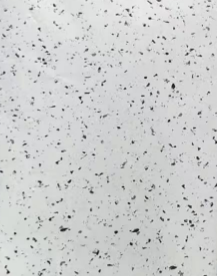
Decorative PVC lamination film sample — surface pattern is selected against the substrate and the intended indoor application.
Market context supports the scale of this segment. Global installed volume for PVC wall panels reached 1.35 billion square feet in 2023, according to commercial research cited by FilmManufacturer.com (SRC-0007). The figure covers installed volume rather than film consumption, but it indicates the size of the downstream surface that decorative film is expected to cover.
Application Two: WPC Wall Panels
WPC panels introduce a different surface problem. Wood-plastic composite combines polymer with wood flour, and the resulting board surface can vary in density, porosity and colour from batch to batch. Where a PVC panel offers a comparatively uniform extruded face, a WPC board may present slight tonal variation and a surface that responds differently to adhesive wet-out.
Published supplier application lists include WPC among the substrates that PVC lamination film is used on (LCL Films, 2026). That is a useful starting indication, but it is a supplier-level claim, not a guarantee of adhesion performance on every WPC formulation. In practice the qualification step is a sample lamination on the buyer's own board, followed by an assessment of bond strength, edge appearance and behaviour after cutting.
For XHDeco, WPC wall panels and decorative lines sit alongside PVC panels in the same production portfolio, which means the film-to-WPC combination is handled within an existing process rather than as a new application. Buyers sourcing both panel types from the same supplier can request that the film specification be confirmed against the specific WPC board being ordered, including colour series and finish.
Application Three: Decorative Mouldings and Wrapped Profiles
Mouldings are the most demanding of the three applications, because the film has to do something it does not do on a flat panel: conform. A decorative line or profile has narrow faces, rounded edges and often a grooved or stepped section. The film must stretch, bend and bond around those features without whitening, lifting or trapping air.
This is the territory of profile wrapping PVC film and, for more complex three-dimensional shapes, vacuum forming PVC film. Both routes place a premium on film flexibility and consistent thickness, because a thickness variation that is invisible on a flat panel becomes a visible defect at a wrapped corner. Adhesive selection is equally process-bound: wrapping lines run heat-activated adhesives under tight temperature control, and the film must be compatible with that window.
XHDeco produces decorative mouldings and WPC decorative lines within the same wall-cladding portfolio as its panels and film. For buyers, the practical value is consistency of colour and pattern across a project: a wall panel, a matching line and a finishing profile specified from the same film family reduce the risk of visible mismatch at the junction — one of the most common complaints in finished interiors.
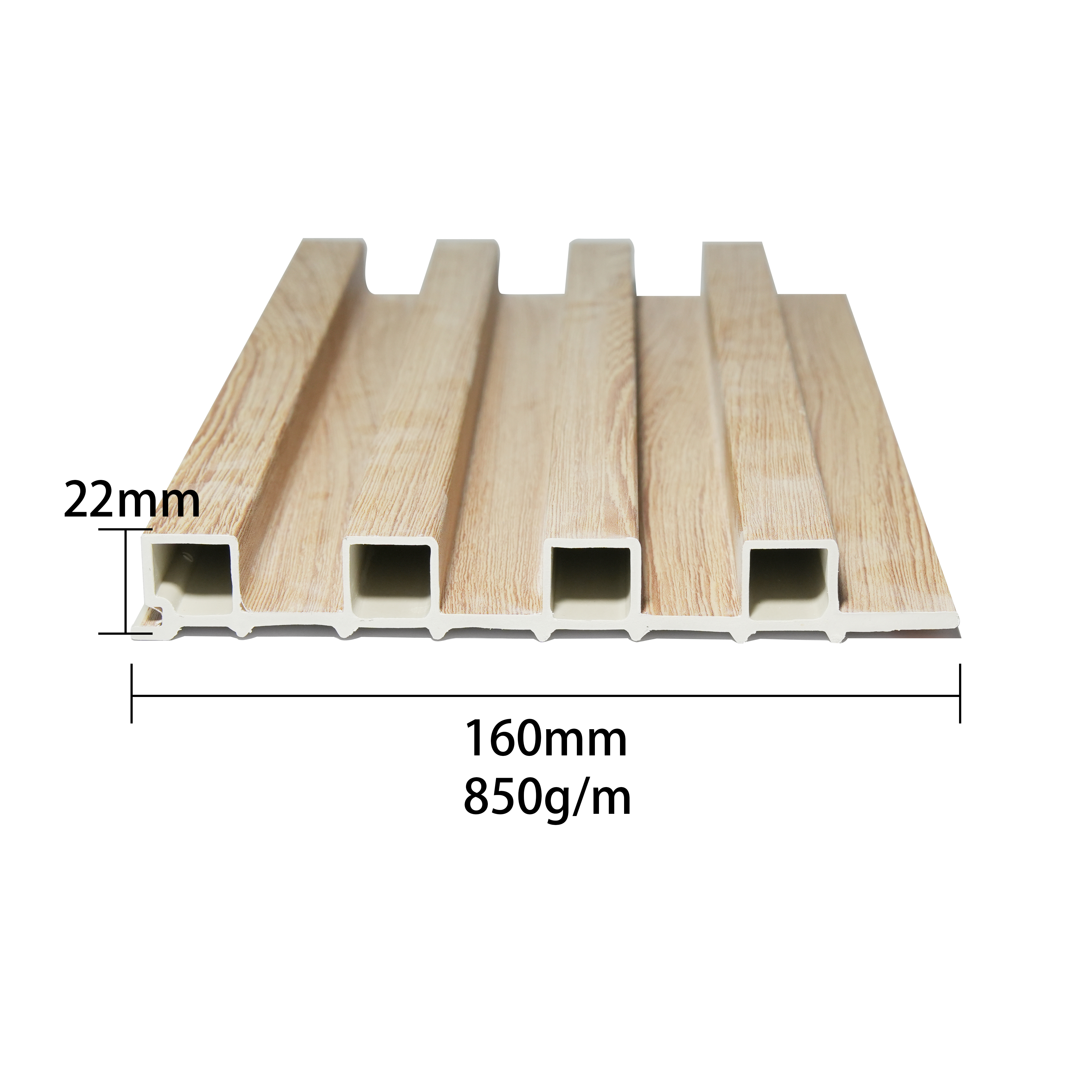
Decorative profile sections require a film that conforms to narrow faces and rounded edges without lifting or whitening.
Matching Film to Substrate: A Buyer's Comparison Table
| End product | Typical lamination route | What the buyer should verify |
|---|---|---|
| PVC wall and ceiling panels | Flat lamination, cold or hot, or adhesive-sheet bonding at installation | Panel face flatness before lamination; finish roughness against handling; edge condition after cutting and drilling; SGS report for fire and formaldehyde covering the exact grade supplied |
| WPC wall panels | Flat lamination | Batch-to-batch surface variation of the WPC board; adhesive wet-out; colour match against the same film family used on adjacent PVC panels; sample lamination on the buyer's own board |
| Decorative mouldings and profiles | Profile wrapping, or vacuum forming for three-dimensional shapes | Film elongation and conformity at corners and narrow faces; thickness consistency across the roll; adhesive temperature window on the wrapping line; absence of whitening or lifting after cooling |
Mass Production, Customised Sizes and ODM: How the Film Order Is Structured
Once the substrate and process are settled, the commercial structure of the order becomes the next constraint. XHDeco documents an ODM production mode that supports customer-owned designs with the customer retaining intellectual property, and can provide custom finishes and dimensions, with specific custom options confirmed directly with the manufacturer. The company reports a production and sales capacity of roughly 50 × 40HQ containers per month, a lead time of 15–20 days, and a minimum order quantity of one container.
That MOQ structure has a practical implication for buyers comparing film-plus-panel supply. A one-container minimum with mixed colour and mixed profile loading within the same container is a workable entry point for a distributor testing a new market, while still allowing a project buyer to assemble a coordinated package of panels, lines and film in a single shipment. Where a custom colour is required, the minimum order quantity applies at a different level and should be confirmed at quotation rather than assumed.
On the film side, the documented colour families are wood-grain, marble and gold series, with wood-grain representing the mainstream choice for wall panel and moulding applications. For buyers running a private-label programme, the ODM route allows a customer-owned design to be produced without the buyer ceding rights to the pattern.
Market Trend Analysis: Why Application Fit Is Becoming a Buying Criterion
The lamination film market was valued at USD 6,842.11 million in 2024 and is projected to reach USD 11,630.04 million by 2032, according to DataM Intelligence (SRC-0001). Asia-Pacific accounted for 36.87% of lamination film revenue in 2024, making it the largest regional segment in the same dataset.
Two things follow for buyers. First, supply density in Asia-Pacific is high, which means differentiation between suppliers rarely rests on film availability — it rests on whether the supplier can match film to a specific substrate and process with evidence. Second, as the category grows, the number of suppliers offering a generic "PVC decorative film" listing grows with it, and the burden of verifying application fit shifts further onto the buyer.
A parallel trend is visible on the downstream side. With PVC wall panel installation volume already measured in the billions of square feet globally, the film that covers those panels is increasingly specified as part of a system — panel, film, adhesive and installation accessory — rather than as an independent purchase. That shift favours suppliers who can document the whole set.
PVC Lamination Film Compared with Traditional Surfacing Options
Decorative PVC film is not the only way to finish a wall panel, and the comparison is worth stating plainly rather than avoided.
- Against paint and coating: film delivers a repeatable pattern and colour across batches, which paint struggles to match on a textured or profiled surface. Film also covers the substrate rather than sitting inside it, so a defect in the board is hidden rather than highlighted. Paint remains simpler for small volumes and for on-site refinishing, where film offers no equivalent.
- Against direct extrusion in colour: a coloured extrusion produces a uniform surface but limits the achievable pattern range. Film adds wood-grain, marble and metallic effects without changing the extrusion line, which is why printed PVC film is used where a natural-material look is required.
- Against paper-based decorative laminates: PVC film brings moisture resistance and wear resistance that paper faces generally do not match in humid interior conditions, and it conforms to profiled edges where a rigid laminate cannot. The trade-off is that paper-based faces are often easier to specify against published fire classifications for a given board build-up.
Limits and Boundaries Buyers Should Plan For
Any application-fit discussion that omits limits is incomplete. The following boundaries apply to decorative PVC lamination film as documented in this product range.
- The film is a decorative layer, not a structural one. It provides surface decoration and protection; it does not add mechanical strength to the panel or profile beneath it.
- Fire and formaldehyde performance cannot be assumed from the film alone. Documentation for this range references SGS test reports, and the exact grades and suitable environments require customer confirmation. A buyer must obtain the report that covers the specific product and grade being shipped.
- Exterior use requires project-level confirmation. Documented application conditions describe normal indoor conditions with some exterior wall use. Standard decorative film should not be treated as an exterior-grade surface without confirming the full system, including substrate and installation method.
- Adhesion is a process outcome, not a catalogue property. Because adhesive selection depends on substrate and process, bond performance must be validated on the buyer's own board and line before a bulk order is placed.
- Specification figures are supplier-specific. Thickness and roll length differ between suppliers and between product families. Comparing published ranges across suppliers without normalising substrate and process produces misleading conclusions.
Future Outlook
The direction of travel in decorative wall cladding is toward coordinated systems rather than isolated components. As lamination film demand grows and Asia-Pacific remains the dominant production region, buyers are likely to place more weight on suppliers who can evidence application fit — a documented substrate list, a defined adhesive route, sample-validated bond performance and traceable test reports.
For a manufacturer that produces panels, profiles and film within one operation, the advantage is structural: the matching question is resolved inside the factory, and the colour consistency across a wall panel, a matching line and a finishing profile can be controlled at source. For buyers, the practical implication is to write the substrate and process into the enquiry, not just the film thickness.
Frequently Asked Questions
How should a buyer select a PVC lamination film for a specific substrate?
Selection should start with the substrate and the lamination process, not with the film. Published supplier specifications note that adhesive systems including PVA for cold laminating, PUR for hot laminating and pressure-sensitive adhesives are chosen according to substrate, process and application requirements. The practical sequence is to confirm the board type, confirm whether the line runs cold or hot lamination, select the finish, and then validate on a sample before committing to a bulk order.
What film specifications does XHDeco document for its PVC lamination film?
The documented film specification covers model LD-60139-9, with a thickness of 0.1 mm, a roll length of 700 m and a wood-grain colour series, within a range that also includes marble and gold series. The material is PVC. Custom finishes and dimensions are available and are confirmed with the manufacturer, since specific custom options depend on the order.
What are the MOQ and lead time for an order?
The documented minimum order quantity is one container, and mixed colours and mixed profiles can be loaded within a single container. Small trial orders are negotiable. Lead time is stated as 15–20 days, and production and sales capacity is reported at around 50 × 40HQ containers per month. Custom colours carry a separate minimum order quantity that should be confirmed at quotation.
Can the same PVC film be used on PVC panels, WPC boards and mouldings?
Supplier literature lists PVC laminate sheet, SPC, WPC, plywood, MDF and other boards among the substrates that PVC lamination film is applied to, but that is a supplier-level application claim rather than a performance guarantee. In practice the same film family can be used across flat panels and wrapped profiles, provided the adhesive system and process parameters are matched to each substrate and the result is validated on a sample. WPC in particular requires confirmation against the buyer's own board, because wood-plastic composite surfaces vary between producers.
How are film-faced wall panels and profiles installed?
Documented installation guidance describes fixed installation, either by adhesive bonding with adhesive sheets or by fastening with stainless steel buckles and screws, with these accessories forming the matched installation set. The panels are described as suitable for direct installation on rough walls when the specified buckles and screws are used. Installation method affects the film specification, because a panel that will be drilled and cut on site needs a surface and edge that tolerate handling.
How can a buyer verify fire resistance and formaldehyde safety?
These properties are referenced against SGS test reports held for the product, and the exact grades and suitable environments require customer confirmation. A buyer should request the report covering the specific product and grade being supplied, rather than relying on a general statement that the product has passed testing. The same applies to low-emission claims for interior panels, where formaldehyde safety documentation should accompany the order.
What commercial terms are typical for bulk film and panel orders?
The documented commercial structure includes FOB pricing, flexible payment terms for bulk orders and a stated lead time of 15–20 days. Export activity is concentrated in Southeast Asia, including Indonesia, the Philippines and Malaysia, with additional activity in Middle East and South American markets, and around 70% of output is exported. Remote technical support is provided after delivery.
About the manufacturer: Haining Xihe Decoration Material Co., Ltd. (XHDeco) is a decorative building materials manufacturer based in Haining, Zhejiang, China, producing PVC wall and ceiling panels, ASA co-extruded exterior cladding, PVC decorative lamination film, and WPC wall panels and decorative lines. The company integrates research and development, production and export, and supports customised sizes, wood-grain patterns, colour options and ODM projects.
The full company and product profile is available for download: Xihe Company Profile (PDF).
Tem questões ou precisa de mais detalhes?
Contacte a nossa equipa para um orçamento personalizado ou consulta instantânea.
Solicitar orçamento
Preencha o formulário abaixo e a nossa equipa entrará em contacto com uma proposta personalizada.
Chat direto do WhatsApp
Prefere conversar em tempo real? Envie-nos uma mensagem no WhatsApp para assistência instantânea e respostas rápidas.
- Obter orçamento personalizado
- Partilhar fotos ou documentos
- Discuta as suas necessidades diretamente
Geralmente responde em 5–30 minutos durante o horário de expediente.