
Matching Pan Assembly Busbars to Building Applications
Electrical & Electronics · Low-Voltage Distribution Systems
: A Scenario-Fit Guide to DB01, DB02 and the BP Series
Busbar selection in industrial plants and commercial buildings is decided by four constraints — incoming device interface, pole distance, way count and enclosure environment — long before it is decided by a headline current rating.
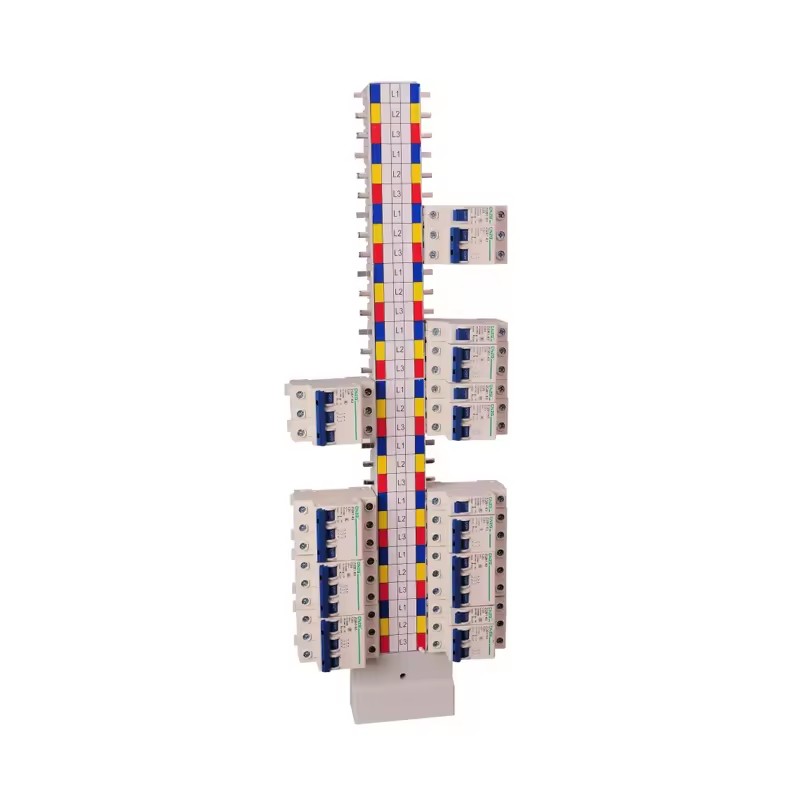
A distribution board rarely fails a design review because the incoming breaker is the wrong size. It fails later, on site, because the pan assembly busbar underneath it does not fit — wrong incoming interface, wrong pole pitch, wrong number of ways, or an enclosure that was never appropriate for where the board is installed. In industrial application and commercial building electric management, the specification that matters is not the highest rating in a catalogue; it is the configuration that matches the application.
This reference maps the Barfuse BP3, BP5 and BP6 pan assembly busbars and the DB01, DB02 and DB13 distribution box platforms to concrete application scenarios. It is written for procurement teams, panel builders and electrical contractors who are past the discovery stage and are now checking whether a configuration will actually fit a project.
Why application fit decides more than specification
A pan assembly busbar is a pre-formed conductive system — typically copper conductors with polycarbonate insulating parts — that replaces individual cable links between the incoming device and the outgoing protective devices inside a distribution board. Because the pitch between outlets is fixed during manufacture, compatibility is determined by geometry first and by current rating second.
That has a practical consequence for buyers. Three of the most common causes of board rework are structural rather than electrical:
- Incoming device mismatch. A busbar built for an MCCB incomer interface does not accept an MCB incomer, and vice versa. DB01, for example, accepts an incomer of MCCB 250A, MCCB 125A or MCB 63A, while DB02 is built around MCCB incomers.
- Pole distance mismatch. The BP3 MCCB 3P pan assembly is designed for MCCBs with pole distances of 25mm, 30mm, 35mm and 45mm. A device outside those spacings is not a candidate for a standard configuration.
- Way count mismatch. Way count drives enclosure width, busbar length and terminal geometry. DB01 supports 2W to 32W; DB02 supports 2 to 16 ways. Choosing the wrong platform changes the enclosure, not only the busbar.
A fourth constraint — environment — is often treated as a separate purchase decision. It should not be. DB13 is a steel-sheet enclosure with a protection degree of IP65 and an impact resistance of IK10, which places it in a different application class from a standard indoor panel. The board's location should be settled at the same time as its busbar format.
The four constraints, in the order buyers should check them
| Constraint | What it decides | Typical values in this range |
|---|---|---|
| Incoming device family | Incoming interface, panel depth, protection coordination | MCB incomer from 63A up to MCCB incomer at 800A |
| Pole distance and terminal geometry | Whether the busbar physically accepts the devices | 25 / 30 / 35 / 45mm pole distances on BP3; outgoing terminals from 6.5×12mm to 15mm width |
| Way count | Enclosure width, busbar length, spare capacity | 2W–32W (DB01), 2–16 ways (DB02), 2W–40W (BP5) |
| Environment | Enclosure class, material thickness, ingress and impact rating | IP65 / IK10 on DB13; steel sheet 1.2–1.5mm enclosure and door, 2.0mm mounting plate |
How the Barfuse range is positioned by scenario
Barfuse (Yueqing Barfuse Electric Co., Ltd.) is a Wenzhou, Zhejiang-based manufacturer of low-voltage fuse switch disconnectors, busbar systems and high and low voltage distribution wiring management products, including MCB pan assemblies and MCCB pan assemblies. Its products are exported to the Middle East, Russia, Central Asia, Latin America, Africa, Oceania and the EU, and are used in low-voltage distribution systems across petroleum, chemical, metallurgical, power and construction applications. The relevant question for this article is narrower: which configuration is positioned for which building or plant scenario?
BP3 — MCCB 3P pan assembly for high-current, mixed-brand MCCB distribution
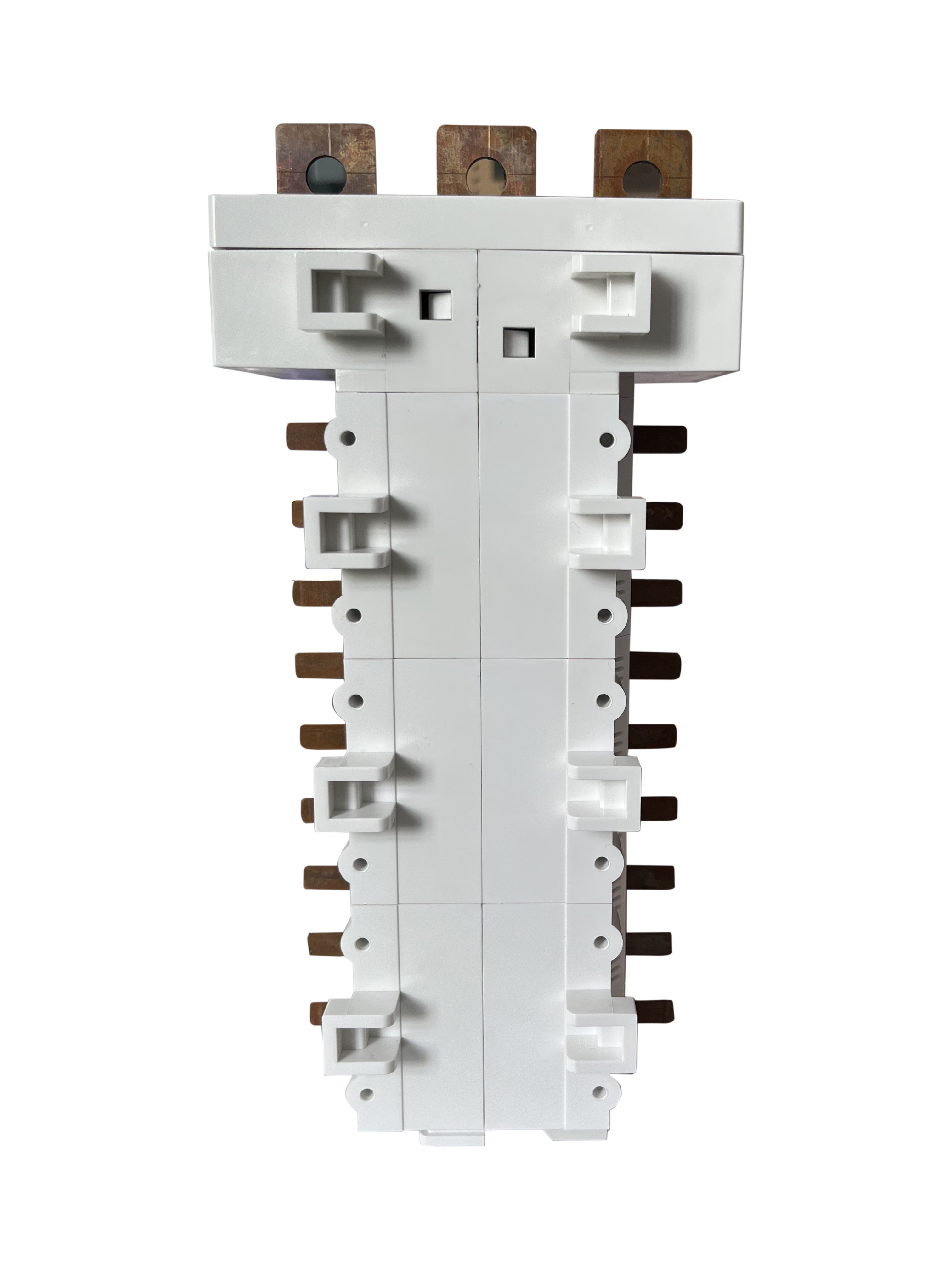
The BP3 MCCB pan assembly is available with incoming ratings of 250A, 400A, 630A or 800A and outgoing ratings of 125A, 250A or 400A in 2W to 14W configurations. Its defining feature is brand tolerance: the series can be used for different brand MCCBs with pole distances of 25mm, 30mm, 35mm and 45mm, the size can be customized according to the customer's MCCB, and OEM production is accepted. In practice, BP3 is the family to examine when an industrial board has a high incoming rating and the MCCB brand is either not yet fixed or varies between projects.
BP5 — MCCB 2P pan assembly busbar for dense two-pole branch distribution
BP5 is a two-pole MCCB pan assembly busbar with incoming ratings of 125A (T 4mm), 250A (T 6mm) and 400A (T 10mm), and outgoing ratings of 63A (T 2mm) and 125A (T 3mm). It supports 2W to 40W, a high way count for a 2P platform, and is intended for branch DP MCCBs with a pole distance of 25mm and a width of 50mm. The outgoing terminal width is 15mm and the incoming terminal width is 25mm. The scenario fit is a board where outgoing load is dominated by two-pole branch devices and the binding constraint is horizontal space rather than current.
BP6 — MCB 3P chassis busbar for standard-driven panels
BP6 is a chassis busbar rated at 250A, with an outgoing terminal width of 6.5×12mm and an incoming terminal width of 21×22mm. The mounting plate can be customized according to the outgoing MCB configuration, which allows adaptation across panel layouts. The product states compliance with IEC 61439 and AS/NZS standards, so it is the configuration to check first when a project specification names those standards and the outgoing devices are MCBs. Its 250A rating is also its boundary: above that incoming level, a different family is required.
DB01 — distribution box with MCB pan assembly busbar, 2W to 32W
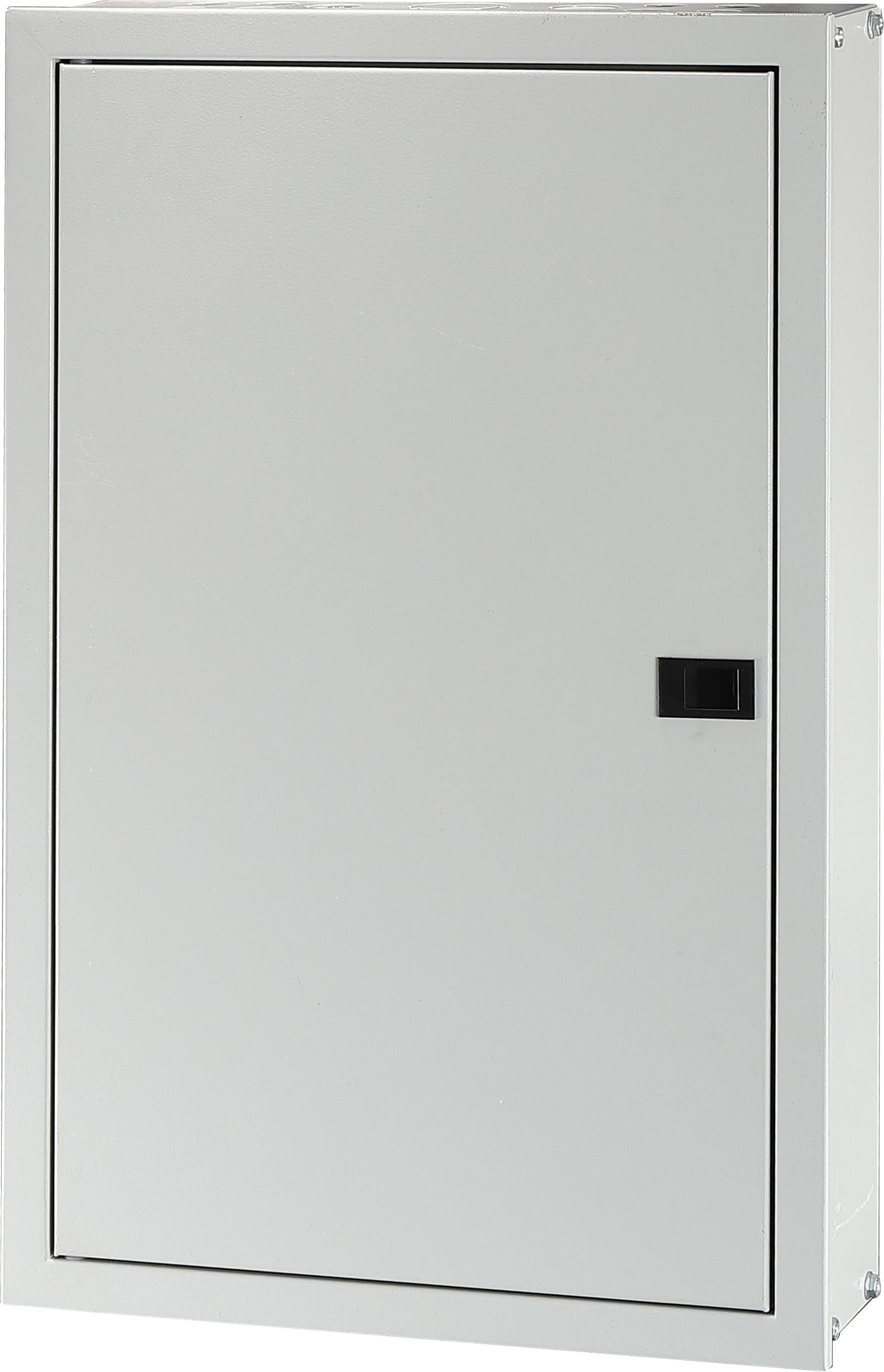
DB01 combines a steel-sheet box body with a copper pan assembly busbar and MCB branch circuits. The incoming supply can be an MCCB 250A, an MCCB 125A or an MCB 63A, and the board supports 2W to 32W. Painting is a textured finish in RAL7032 or RAL7035, with customized specifications available. The wide way range and the three incoming options make DB01 the natural platform for commercial tenant distribution, sub-metering and floor-level boards where branch count is high and individual branch current is moderate.
DB02 — distribution box with MCCB pan assembly busbar, 2 to 16 ways
DB02 uses the same steel-sheet body and copper pan assembly busbar principle but is built around MCCB protection: incomer MCCB ratings of 800A, 630A, 400A, 250A and 125A, and branch MCCB ratings of 400A, 250A and 125A across 2 to 16 ways. Fewer ways and larger devices is the pattern here. DB02 fits sub-main and riser-level distribution in commercial buildings and feeder distribution in industrial plants, where outgoing circuits are large enough to require moulded case breakers rather than MCBs.
DB13 — IP65 and IK10 enclosure for demanding locations
DB13 is a waterproof low-voltage distribution box made of steel sheet, with an enclosure and door thickness of 1.2mm to 1.5mm and a mounting plate of 2.0mm. Its protection degree is IP65 and its impact resistance is IK10. Those two figures — not the current rating — decide where it belongs: dusty, wet, washdown or impact-exposed locations where a standard indoor enclosure would be the wrong specification regardless of how well the busbar inside it matches the load.
Configuration summary: ratings, ways and terminals
| Model | Incoming | Outgoing | Ways | Terminal / geometry note |
|---|---|---|---|---|
| BP3 (MCCB 3P pan assembly) | 250A / 400A / 630A / 800A | 125A / 250A / 400A | 2W–14W | Fits MCCB pole distances 25 / 30 / 35 / 45mm; size customizable, OEM accepted |
| BP5 (MCCB 2P pan assembly busbar) | 125A (T 4mm) / 250A (T 6mm) / 400A (T 10mm) | 63A (T 2mm) / 125A (T 3mm) | 2W–40W | Outgoing terminal width 15mm; incoming terminal width 25mm; DP MCCB pole distance 25mm, width 50mm |
| BP6 (MCB 3P chassis busbar) | 250A rated | MCB, per configured mounting plate | Mounting plate customizable | Outgoing terminal 6.5×12mm; incoming terminal 21×22mm; states IEC 61439 and AS/NZS compliance |
| DB01 (MCB pan assembly box) | MCCB 250A / MCCB 125A / MCB 63A | MCB branches | 2W–32W | Steel sheet body, copper pan assembly busbar; RAL7032 or RAL7035 textured finish |
| DB02 (MCCB pan assembly box) | MCCB 800A / 630A / 400A / 250A / 125A | MCCB 400A / 250A / 125A | 2–16 ways | Steel sheet body, copper pan assembly busbar; customized specifications available |
| DB13 (waterproof box) | Enclosure platform | — | — | IP65, IK10; enclosure and door 1.2–1.5mm, mounting plate 2.0mm |
Materials are consistent across the busbar families: copper conductors with polycarbonate insulating parts. Copper remains the dominant busbar material globally, accounting for 62.8% of market share by material in 2025 according to Precedence Research. Buyers evaluating aluminum pan assembly busbar options should note that the same source forecasts aluminum busbar growth at a 6.9% CAGR, driven largely by weight and cost considerations in large infrastructure rather than by conductivity improvements.
Application scenarios: which configuration belongs where
| Application scenario | Binding constraint | Configuration that fits |
|---|---|---|
| Commercial tenant boards and sub-metering | High branch count, moderate branch current, MCB branches | DB01 with MCB branches, 2W–32W, incomer MCCB 250A, MCCB 125A or MCB 63A |
| Commercial sub-main and riser distribution | Large outgoing circuits requiring MCCBs, limited ways | DB02 with incomer MCCB up to 800A, branch MCCB 125A–400A, 2–16 ways |
| Industrial plant feeder distribution | High incoming current, MCCB brand not fixed at design stage | BP3 MCCB 3P pan assembly, 250A–800A incoming, 2W–14W, pole distance 25–45mm |
| Two-pole branch MCCB distribution | Dense two-pole branches, horizontal space limits | BP5 MCCB 2P pan assembly busbar, 2W–40W, incoming 125A–400A |
| Panels specified to IEC 61439 / AS/NZS with MCB outgoing | Standard compliance on the outgoing chassis | BP6 chassis busbar, 250A rated, customizable mounting plate |
| Outdoor, washdown, dusty or impact-exposed locations | Ingress and impact protection | DB13, IP65 and IK10, steel sheet enclosure |
Two patterns are worth noting. First, way count and incoming rating tend to move in opposite directions across the range: DB01 reaches 32W at up to 250A incoming, while DB02 reaches 800A incoming at up to 16 ways. Second, the environment decision is independent of both — a high-current industrial board and a low-current commercial board can sit in the same harsh location and both require an IP65-rated enclosure.
A five-point pre-order checklist
- Confirm the incoming device family and rating, not only the current level: MCB 63A, MCCB 125A and MCCB 250A are different interfaces on DB01.
- Confirm the pole distance of the actual MCCB or MCB model, particularly where multiple brands appear in one project.
- Confirm the way count against future spare capacity, and check the platform ceiling — 16 ways on DB02, 32W on DB01.
- Confirm terminal geometry against the outgoing device terminals; a 6.5×12mm outgoing terminal and a 15mm-wide outgoing terminal suit different device families.
- Confirm the enclosure class from the installation location, and treat IP65 / IK10 as a siting decision rather than an upgrade.
Market context: what is changing around pan assembly busbars
The global busbar market was valued at USD 19.83 billion in 2025, according to Precedence Research. Copper busbars accounted for 62.8% of that market by material in the same year, while aluminum busbars are forecast to grow at a 6.9% CAGR, a faster growth rate than the overall market, reflecting cost and weight pressure in large infrastructure projects rather than a shift in electrical fundamentals. Laminated busbars used in high-density applications carry a forecast 8.9% CAGR from Congruence Market Insights.
Two structural points matter for buyers of modular pan assemblies. First, market size estimates differ materially between research houses — Stratview Research reports the 2025 market at USD 15.72 billion, while IMARC reports USD 20.3 billion. The difference is methodological, and is most plausibly explained by whether locally custom-fabricated busbars are counted alongside factory-assembled trunking systems. Procurement teams should treat any single market figure as directional rather than definitive. Second, standards continue to tighten at the trunking level: IEC 61439-6:2025, the part of the IEC 61439 series covering busbar trunking systems, was published in December 2025, continuing harmonisation of assembly verification requirements.
China's role on the supply side remains significant: the country accounts for more than 30% of global copper processing capacity, which underpins both the availability and the price behaviour of copper conductor systems. For a manufacturer such as Barfuse, whose factory is in Yueqing and whose export share is 90%, that supply concentration is part of the cost structure buyers ultimately price into a project.
Pan assembly busbars compared with traditional cable-and-ferrule wiring
Conventional distribution boards connect the incoming device to each outgoing breaker with individual insulated cable links, crimped ferrules and per-outlet terminations. This approach is highly flexible: any device combination that fits the enclosure can be wired, and non-standard pole spacings are not a barrier. It also depends heavily on panel-builder labour, and every termination is a potential loose connection. A modular pan assembly busbar system moves that work into the factory.
The trade-off is structural rather than commercial:
- Format-bound by design. A pre-assembled busbar is only correct for the device family and pole distance it was manufactured for. In boards that mix brands or use non-standard spacing, individual wiring can still be the more practical choice. BP3's 25 / 30 / 35 / 45mm pole distance coverage and OEM customization address part of this, but not every device on the market.
- Current ceilings per family. BP6 is rated 250A. Projects with higher incoming MCCB ratings need a different platform, such as BP3 or DB02, rather than a BP6 variant.
- Way count ceilings per platform. DB02 supports 2 to 16 ways. Where a project needs more branch circuits, DB01 at up to 32W or a wider platform from the same range is the appropriate direction, not an extension of DB02.
- Customization is a schedule item. Customization covers color, logo, material, new design, surface treatment, mold development and packing, with a stated lead time of 15–45 days and a minimum order quantity of one piece. Projects with tight delivery windows should confirm whether the required configuration is standard or customized before committing to a programme date.
- Certification scope is per model. The DEKRA test certificates numbered 3309992.100 and 3309992.101, issued by DEKRA Certification B.V. to IEC 61439-2:2011 and EN 61439-2:2011, cover the BP1-125 and BP1-250 open-type assemblies without enclosure under the BARFUSES brand (series BFSe). They do not automatically extend to every model in the range, so specifiers who need per-model third-party evidence must confirm coverage for the exact model and configuration being purchased rather than assuming it.
Manufacturing-side evidence is more uniform: busbar system (MCCB / MPCB busbars) and distribution box production is covered by ISO 9001:2015 certification number 62724Q1160R0S, issued by Jingxin Certification (Beijing) Co., Ltd. against GB/T19001-2016 idt ISO 9001:2015, valid from 8 November 2024 to 7 November 2027 and applicable to the EU market. Quality control is stated as 100% test.
Future outlook
Three directions are likely to shape pan assembly busbar selection in industrial and commercial building projects over the next few years. Material substitution will continue at the margin: aluminum busbar growth at a 6.9% CAGR reflects weight and cost pressure in large infrastructure, but copper's 62.8% share suggests the conductor of record for most low-voltage assemblies will remain copper in the near term. Assembly verification will keep moving toward harmonised standards, with IEC 61439-6:2025 the most recent signal at trunking level. And prefabrication will keep shifting cost from site labour into factory configuration, which raises the value of specifying the right platform early, because a mis-specified pan assembly discovered on site costs more than it did as a line item on a bill of materials.
For buyers, the practical implication is unchanged by any of these trends: the configuration that matches the incoming device, the pole distance, the way count and the environment is the configuration that gets installed once.
Frequently asked questions
What incoming options does the DB01 distribution box support, and how many ways does it provide?
DB01 accepts an incoming MCCB 250A, an incoming MCCB 125A or an incoming MCB 63A, with MCB branch circuits, and supports 2W to 32W. The box body is steel sheet and the pan assembly busbar is copper. Painting is a textured finish in RAL7032 or RAL7035, with customized specifications available.
Which busbar should be used when the incoming MCCB rating exceeds 250A?
The BP6 chassis busbar is rated 250A, so it is not the appropriate choice above that level. The BP3 MCCB 3P pan assembly is available with incoming ratings of 250A, 400A, 630A and 800A, with outgoing ratings of 125A, 250A and 400A and configurations from 2W to 14W. For enclosure-based systems, DB02 accepts incomer MCCBs of 800A, 630A, 400A, 250A and 125A.
How many ways does DB02 support and which protective devices fit it?
DB02 supports 2 to 16 ways with an MCCB pan assembly busbar. Incoming MCCB ratings are 800A, 630A, 400A, 250A and 125A; branch MCCB ratings are 400A, 250A and 125A. The box body is steel sheet and the pan assembly busbar is copper, available in RAL7032 or RAL7035 textured finish with customized specifications.
Which pole distances and terminal dimensions should be confirmed before ordering a pan assembly busbar?
For BP3, the series is designed for different brand MCCBs with pole distances of 25mm, 30mm, 35mm and 45mm, and the size can be customized according to the customer's MCCB. For BP5, the platform suits branch DP MCCBs with a pole distance of 25mm and width of 50mm, with an outgoing terminal width of 15mm and an incoming terminal width of 25mm. For BP6, the outgoing terminal width is 6.5×12mm and the incoming terminal width is 21×22mm, with a mounting plate that can be customized according to the outgoing MCB configuration.
What protection rating does DB13 provide and where does it apply?
DB13 has a protection degree of IP65 and an impact resistance of IK10. It is made of steel sheet, with enclosure and door thickness of 1.2mm to 1.5mm and a mounting plate of 2.0mm. Those ratings suit locations where water ingress, dust or mechanical impact would affect a standard indoor enclosure.
Which certifications apply to these busbar and distribution box products, and what is their scope?
Busbar system and distribution box production is covered by ISO 9001:2015 certification number 62724Q1160R0S, issued by Jingxin Certification (Beijing) Co., Ltd. against GB/T19001-2016 idt ISO 9001:2015, valid from 8 November 2024 to 7 November 2027. The DEKRA test certificates numbered 3309992.100 and 3309992.101, issued by DEKRA Certification B.V. to IEC 61439-2:2011 and EN 61439-2:2011, cover the BP1-125 and BP1-250 open-type assemblies without enclosure under the BARFUSES brand, series BFSe. BP1 also complies with CE and RoHS directives, and BP6 states compliance with IEC 61439 and AS/NZS standards. Certification scope is model-specific and should be confirmed against the exact configuration being purchased.