
Matching Scent Diffusers to Venues: Hotels, Retail, Restrooms & Lobbies
Matching Scent Diffusers to Venues: Hotels, Retail, Restrooms & Lobbies
Commercial scenting outcomes are decided at the specification stage, not the fragrance stage. A hotel lobby, a retail sales floor, a public restroom and a building reception area differ in ceiling height, air exchange rate, power availability and how visible equipment may be — and those differences map onto three equipment variables: coverage rating, housing material and power source. Matching a diffuser to the wrong venue profile produces the two most common complaints in the category: weak scent in large open volumes, and over-scented, over-serviced small rooms.
Shenzhen Scentsea Technology Co., Ltd. is a Shenzhen-based developer and manufacturer of scent diffusers and fragrance oils, established in 2021. The company operates a 3,000 m² manufacturing facility with an annual production capacity of 100,000 units, employs approximately 30 staff, and supplies CE, RoHS and FCC certified scent machines to customers in more than 70 countries and regions, with main markets in the EU and the USA. Its commercial range is organized around venue variables, which makes the lineup a useful reference case for buyers evaluating how coverage, material and power supply should drive model selection.

Why Venue Type Comes Before Coverage Rating
A coverage figure on a specification sheet is a filter, not a decision. A model rated for 500–800 m² assumes a reasonably open space with typical ceiling height and normal air movement. A 600 m² hotel lobby with a double-height atrium, a 600 m² retail floor with open entrances and heavy foot traffic, and a 600 m² office floor served by mechanical ventilation will not behave identically.
Three venue characteristics change the calculation most often:
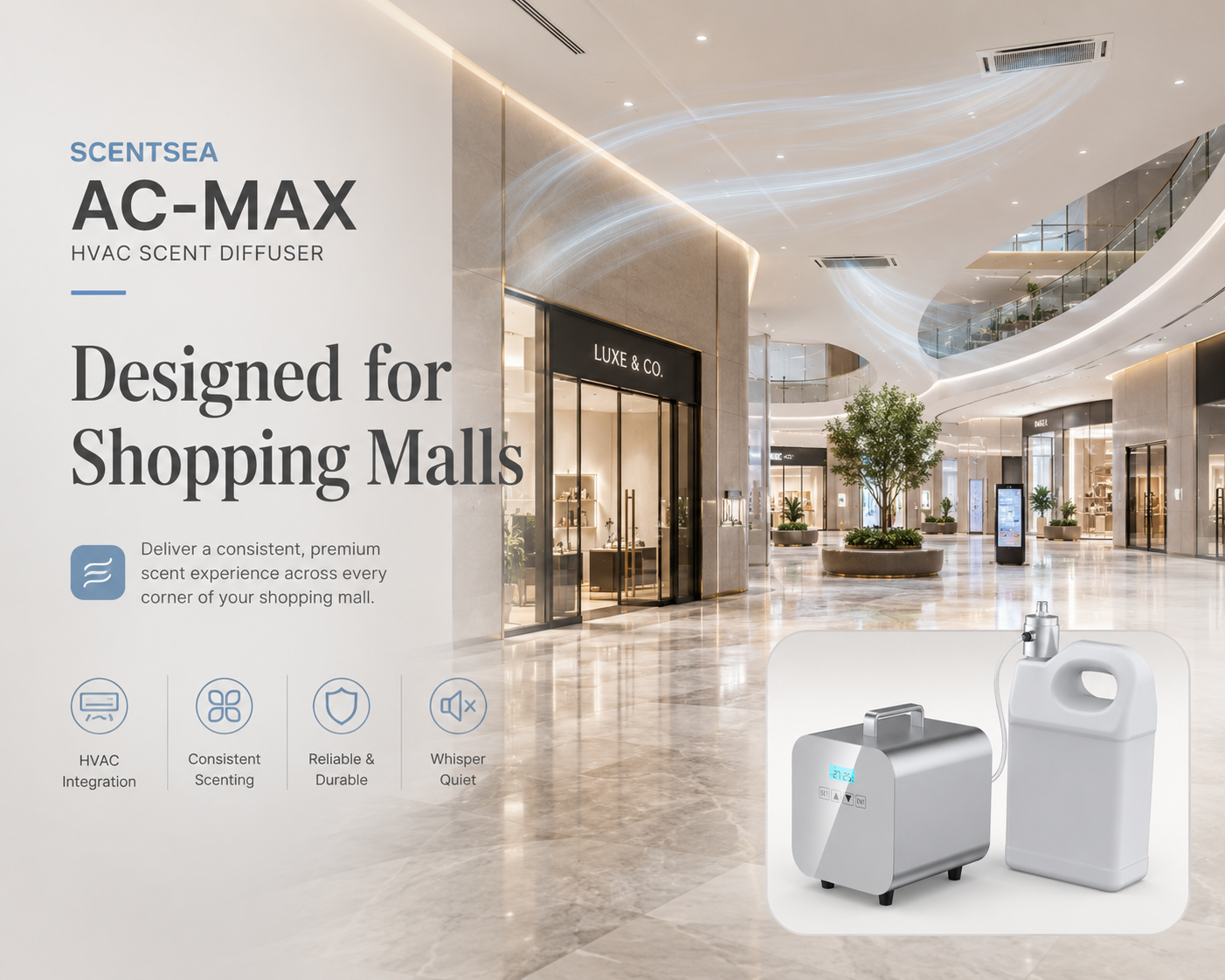
- Air volume and air exchange. Spaces with high ceilings or strong mechanical ventilation dilute fragrance faster, which is why the AC-MAX HVAC scent diffuser is rated in both floor area (2,500–3,500 m²) and air volume (8,000–10,000 m³ / 25,000–35,000 ft²).
- Power availability. Public restrooms, elevator cars and older corridors often have no convenient outlet, which rules out plug-in units regardless of their coverage rating.
- Visibility, access and noise. Front-of-house venues tolerate decorative equipment but not noise; back-of-house spaces usually require lockable, low-attention units that can be serviced on a fixed schedule.
How the SCENTSEA Range Maps to Venue Profiles
The table below matches venue profiles to models using only published coverage, material and power data. It is a starting point for project planning, not a substitute for site assessment.
| Venue profile | Model | Rated coverage | Housing material | Power source | Installation note |
|---|---|---|---|---|---|
| Hotel lobby, reception, showroom, retail store (up to ~800 m²) | A300 | 500–800 m² / 1,500–2,500 m³ / 5,000–8,500 ft² | Steel | DC12V, 12 W | Standalone, wall-mounted or HVAC-connected; TFT touch screen and app control; <40 dB |
| Large glazed lobby or open atrium (800–1,300 m²) | H5000 | 800–1,300 m² / 2,500–4,000 m³ / 8,600–14,000 ft² | Aluminum (gunmetal) | DC12V, 20 W, plug-in | Floor-standing; no wall installation required; <45 dB |
| Large hall, mall concourse, event venue (1,000–1,600 m²) | T3 | 1,000–1,600 m² / 3,000–5,000 m³ / 10,000–17,000 ft² | Acrylic panel + steel casing | DC12V 2A, 15 W | 1,000 ml capacity; <55 dB, not intended for quiet rooms |
| Mall, bank or hotel where scent and digital advertising run together (150–250 m²) | SC19 | 150–250 m² / 500–800 m³ / 1,500–2,500 ft² | Aluminum + steel | 110–240V AC, 30 W | 18.5-inch 1920×1080 display, 8 GB storage, 500 ml capacity, ≤30 dB |
| Restroom, elevator, corridor, small shop (100–150 m²) | P01 / P03 | 100–150 m² / 300–500 m³ / 1,000–1,600 ft² | Plastic | D batteries or Type-C, 5 V, 2.5 W | Cordless wall-mount; lockable front cover; <35 dB |
| Whole-building scenting through existing ductwork (2,500–3,500 m²) | AC-MAX | 2,500–3,500 m² / 8,000–10,000 m³ / 25,000–35,000 ft² | Aluminum body + plastic bottle | DC12V, 48 W | Split structure; connects to central HVAC ducts; 5 L capacity; <45 dB |
Hotels: A300 for Lobbies and Guest-Facing Floors
The A300 is a commercial scent diffuser with a steel housing, rated for 500–800 m² (1,500–2,500 m³ / 5,000–8,500 ft²) with a 500 ml fragrance oil capacity. It operates on a DC12V power supply at 12 W, produces noise below 40 dB, and consumes oil at 4 ml ±10% per hour. Its TFT color touch screen, app-based scheduling and intensity control, and support for standalone, wall-mounted or HVAC-connected installation position it for hotel lobbies, retail stores, showrooms, offices, banks and hospitals. It is available in white and black.
Two details matter in hotel use. A steel housing handles frequent cleaning and public contact better than plastic, and the below-40 dB noise figure keeps the unit appropriate for quiet reception areas. Where a lobby exceeds the A300 envelope, the H5000 floor standing scent diffuser covers 800–1,300 m² with a 1,000 ml capacity in a gunmetal aluminum housing, while the T3 covers 1,000–1,600 m² with a 1,000 ml capacity for larger halls and event venues.
Retail: A300 for Stores, SC19 Where Promotion Runs Alongside Scent
Retail stores typically sit in the same 500–800 m² band as hotel lobbies, so the A300 match holds; the wall-mount option keeps equipment out of customer circulation. Where a venue wants scent and digital messaging delivered by one device, the SC19 advertising scent machine combines an 18.5-inch display (1920×1080 resolution, 8 GB internal storage) with a 500 ml oil capacity and 110–240V AC power at 30 W, rated for 150–250 m² (500–800 m³) with noise at or below 30 dB. It is intended for shopping malls, hotels and banks, including elevators, lobbies, retail stores and exhibitions.
Restrooms, Elevators and Corridors: P01 and P03 Battery Operated Units
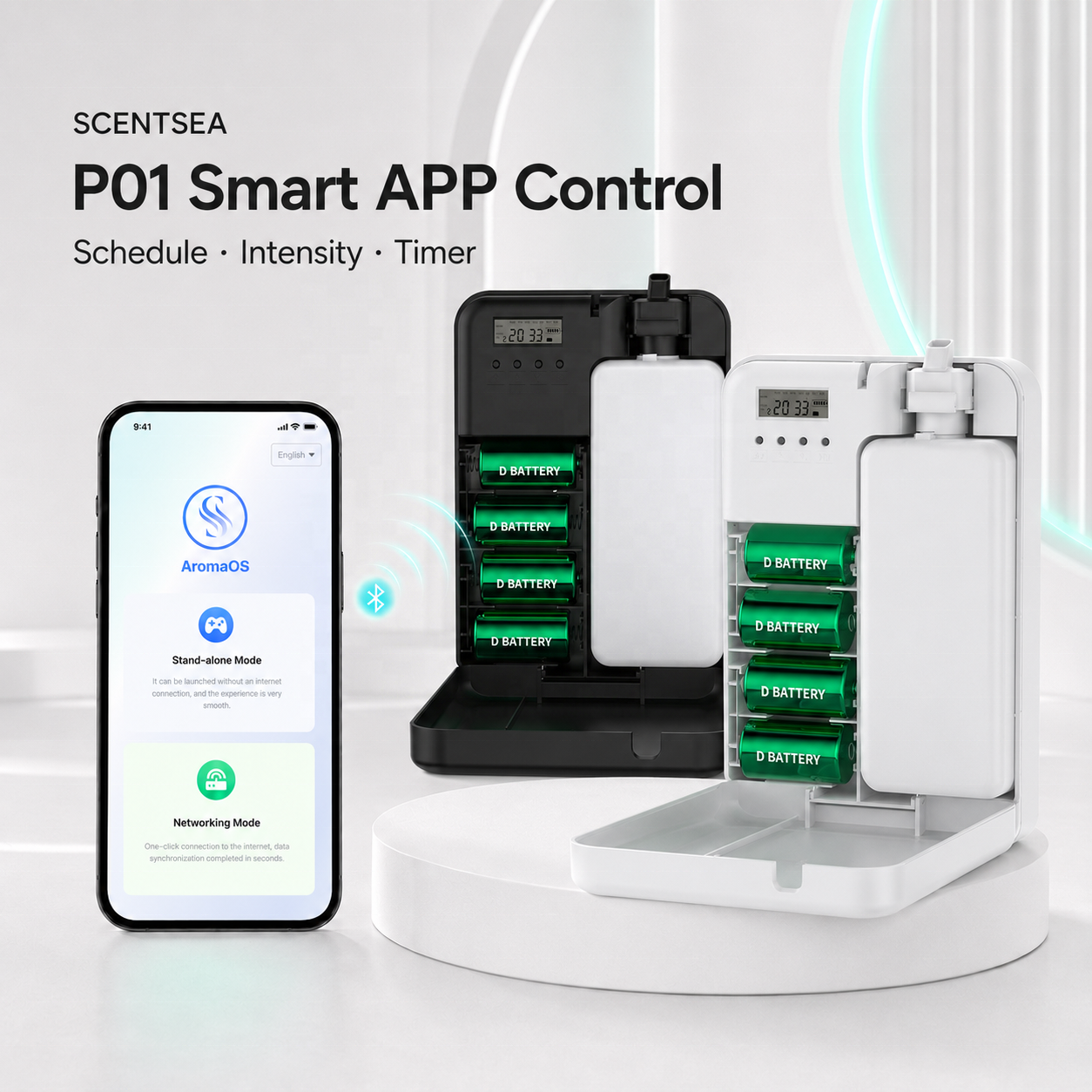
Restroom and elevator scenting is limited by power access rather than by diffusion capacity. Both the P01 and the P03 are battery operated scent diffusers made of plastic, running on 5 V and rated for 100–150 m² (300–500 m³ / 1,000–1,600 ft²) with noise below 35 dB.
- P01: 500 ml capacity, powered by 4 × D batteries or Type-C, 2.5 W, dimensions H168 × L240 × W50 mm, net weight 0.55 kg. Intended for toilet and elevator scenarios. Cordless installation with waterless cold-air diffusion, AromaOS app control, adjustable schedules and intensity, and a lockable front cover.
- P03: 150 ml capacity, powered by 3 × D batteries or Type-C, 2.5 W, dimensions 132 × 58 × 176 mm, net weight 0.35 kg, packing 135 × 70 × 180 mm. Intended for toilet, elevator, corridor and small shop scenarios, with the same waterless atomization, app control and lockable design.
The practical difference between the two is service interval against footprint. The P01 carries a larger 500 ml bottle for high-traffic washrooms, while the P03 is the smaller wall-mounted unit for elevator cars and narrow corridors where mounting space is constrained. Both are available in white and black.
Lobbies and Large Open Areas: H5000 and AC-MAX
Lobby scenting splits into two technical cases: a single large open volume, or a building where the HVAC system can carry fragrance to multiple zones.
The H5000 floor standing scent diffuser is built in aluminum with a gunmetal finish, holds 1,000 ml, and is rated for 800–1,300 m² (2,500–4,000 m³ / 8,600–14,000 ft²). It runs on DC12V plug-in power at 20 W, consumes 5.4 ±10% ml/h, and operates below 45 dB, with dimensions of L180 × W180 × H610 mm. Because it stands on the floor, no wall installation is required — useful for glazed lobbies and interiors where drilling is restricted.
The AC-MAX HVAC scent diffuser is the centralized option: an aluminum body with a plastic bottle, 5 L capacity, rated for 2,500–3,500 m² (8,000–10,000 m³ / 25,000–35,000 ft²), DC12V at 48 W, oil consumption 6 ml ±5% per hour, noise below 45 dB, dimensions L160 × W200 × H160 mm, net weight 4.2 kg. It uses a split structure with a separate machine and oil tank and connects directly to central HVAC ducts, delivering fragrance through the building's existing airflow. Wi-Fi and Bluetooth control, adjustable working schedules and fragrance intensity, password protection for project management, and an optional airflow sensor that synchronizes scenting with HVAC operation are part of the configuration. It is intended for hotels, malls, airports, office buildings and large commercial complexes.
Technical Explanation: What Each Specification Actually Controls
Cold-air atomization, the diffusion method used across this range, breaks fragrance oil into fine particles using controlled airflow and pressure, without adding water or applying heat. Because nothing is diluted or evaporated, output is expressed directly in milliliters per hour and can be scheduled by hour of day and adjusted by intensity.
Four specification values drive venue fit:
- Coverage rating. Figures are listed in m², m³ and ft²; for high-ceiling spaces the cubic figure is the more meaningful comparison.
- Oil capacity combined with consumption rate. Together these set refill frequency: A300 at 500 ml and 4 ml ±10% per hour, T3 at 1,000 ml and 4.6 ml ±10% per hour, AC-MAX at 5 L and 6 ml ±5% per hour.
- Power source. Plug-in units (S01, P02, A300, T2, T3, H5000), AC mains (SC19 at 110–240V AC), and battery or Type-C models (P01, P03) serve different installation realities.
- Noise level. The published range runs from below 30 dB (S02, P02; SC19 at ≤30 dB) through below 35 dB (P01, P03), below 38 dB (S01), below 40 dB (A300), below 45 dB (T2, H5000, AC-MAX) to below 55 dB (T3). Quiet venues should read this line before the coverage line.
Housing material tracks the same logic. Plastic bodies (S01, P01, P02, P03) suit concealed or back-of-house positions; steel (A300, T2, T3, SC19) suits public areas with frequent contact and cleaning; aluminum (S02, H5000, AC-MAX) is used where a lighter, more finished appearance is required in visible locations.
Venue-by-Venue Selection Notes
- Hotel lobby and reception. A300 at 500–800 m² wall-mounted or standalone, mounted where air circulation is unobstructed and away from direct door drafts. For double-height lobbies, evaluate H5000 (800–1,300 m²) by air volume rather than floor area.
- Guest floors and back-of-house. P01 in larger washroom clusters and P03 in corridors and small rooms; both are cordless, so no new cabling is needed, and both use lockable covers to limit tampering.
- Retail stores and showrooms. A300 with scheduled intensity set to match trading hours; the steel housing tolerates frequent cleaning and the below-40 dB rating keeps it unobtrusive on a sales floor.
- Malls, banks and airports. SC19 where advertising display and scent are combined, T3 for concourses of 1,000–1,600 m², and AC-MAX where a central plant can carry fragrance through ductwork.
- Elevators and corridors. P03 wall-mounted inside or adjacent to the car, with intensity kept low because the enclosed volume is small.
Where the Venue Match Breaks Down: Limits Buyers Should Plan For
Coverage ratings are conditional. They assume reasonably open geometry and normal air movement; high ceilings, partition walls and strong supply-air dilution can reduce effective performance, so a site assessment or sample test is the reliable way to confirm a selection before a multi-unit rollout.
Several boundaries follow from the specifications themselves:
- Model envelopes are hard limits. The A300 is rated to 800 m²; a 1,500 m² mall atrium sits outside that envelope and belongs to T3 (1,000–1,600 m²) or AC-MAX (2,500–3,500 m²) territory.
- HVAC scenting is not a retrofit-free option. AC-MAX requires existing ductwork plus suitable positions for the split machine and its separate oil tank, and it depends on the building's air handling operating as intended.
- Battery models carry service logistics. P01 and P03 remove the need for wiring but add battery replacement and a fixed refill schedule, particularly in high-traffic restrooms where access windows are narrow.
- Scenting complements, and does not replace, cleaning and ventilation. In restrooms especially, atomization controls perceived odor but does not substitute for waste management and air exchange.
- Fragrance oil compatibility must be tested. Compatible third-party oil can be used, but viscosity and formulation should be verified to ensure stable atomization and to avoid blocked nozzles or thickened oil.
- Certification is model-specific. CE, RoHS and FCC documentation applies to defined product configurations; Bluetooth or Wi-Fi models may also fall under RED requirements in the EU, and certificates should match the exact production model.
- Noise ceiling by venue. T3 at below 55 dB is suited to concourses and halls rather than quiet reception or guest-room-adjacent spaces.
Market Trend Analysis
Several published data points frame where venue-based selection is heading. The global fragrance diffuser market was valued at USD 29.61 billion in 2024 and is projected to reach USD 38.10 billion by 2032, according to Data Bridge Market Research. Within that total, the HVAC scent diffuser segment was valued at USD 1.01 billion in 2024 and is expected to grow at a CAGR of 4.5% through 2034, per Intel Market Research — a segment that corresponds directly to centralized, duct-connected equipment such as the AC-MAX.
Regional concentration remains significant: North America held the largest regional share of the fragrance diffuser market in 2024, accounting for approximately 43.87% of global revenue (Data Bridge Market Research). Technology mix is also shifting toward waterless systems; nebulizing diffusers, which include waterless and cold-air designs, represent approximately 22.6% of the market, favored for professional-grade scent potency in commercial environments, according to the Ambient Scent Diffuser Market Research Report 2034.
Two regulatory and competitive signals matter for venue planning. IFRA 51 (2023) introduced stricter global safety standards for fragrance ingredients used in diffusers, affecting allowable usage levels for inhalation safety, which places more weight on fragrance oil compliance when a venue specifies a signature scent. On the product side, Xiaomi launched the Mijia Smart Aroma Diffuser in October 2024 with a 50-day battery life and app control, indicating a broader trend toward high-endurance smart features — a direction already reflected in the commercial range by AromaOS and Wi-Fi/Bluetooth app control and by battery-operated P01 and P03 units. Competitive context in commercial scenting includes ScentAir, Aroma360 and AromaTech, identified by Intel Market Research as leading players focused on nebulizing technology for hotels and shopping malls.
For trade and logistics planning, fragrance diffusers and prepared room deodorizers are commonly categorized under HS code 33074900.
Comparison with Traditional Solutions
The most common alternative in venue projects is an ultrasonic water-based aroma diffuser. Waterless cold-air units atomize fragrance oil without water, providing stronger and more consistent diffusion and larger coverage, with no water refilling or tank cleaning. Ultrasonic units mix a small quantity of oil with water in a tank; they cost less to buy but require regular water refilling and tank cleaning and are mainly suited to small areas and light personal use.
The trade-off is explicit: waterless cold-air equipment usually carries a higher initial equipment cost, and it should be paired with compatible fragrance oil and a defined maintenance routine. In return, it removes water handling from the daily workload, delivers programmable output measured in milliliters per hour, and scales from a single washroom unit to duct-connected building coverage. For hotels, malls, retail stores, offices and showrooms that require continuous, large-area scenting, that balance favors waterless cold-air technology; for bedrooms and small rooms with light fragrance needs, an ultrasonic unit remains adequate but is less suitable for continuous professional scenting.
Procurement Notes for Project Buyers
For bulk purchasing, the venue match should be documented model by model rather than as a single property-wide standard. Buyers should confirm coverage against measured space conditions, verify that the selected power source is available at the intended mounting position, and align oil capacity with the service interval the facility can realistically support.
On the supplier side, the SCENTSEA range is supported by functional testing, aging test and leakage inspection before shipment, with samples of diffusers and fragrance oils available for quality verification and an MOQ starting from 1 piece for diffusers. OEM/ODM options include logo customization, color customization, exclusive mold development, app customization, user manual customization and private label packaging, with fragrance oil scent selection, bottle labelling and private label packaging also supported for buyers building their own aroma brand. The company holds over 20 product patents and a 4-engineer R&D team within its 3,000 m² facility.
Future Outlook
Three directions are visible in the current data. First, duct-connected scenting is likely to take a larger share of large-property projects as HVAC integration matures, consistent with the USD 1.01 billion HVAC scent diffuser segment and its projected 4.5% CAGR through 2034. Second, the waterless nebulizing share — approximately 22.6% of the diffuser market — should keep expanding as venues prioritize consistent potency and lower daily maintenance over the lowest purchase price. Third, smart control and battery endurance are becoming default expectations rather than differentiators, following the pattern set by consumer launches such as the Xiaomi Mijia Smart Aroma Diffuser.
For venue operators, the practical implication is that model portfolios will remain multi-format: a steel unit for public lobbies and retail floors, a duct-connected unit for centralized zones, and compact battery units for restrooms and elevators. Planning a property around one diffuser type is likely to remain the main source of under- and over-scented areas.
FAQ
How do buyers determine the right coverage rating for a commercial scent diffuser?
Coverage should be assessed against actual space size, ceiling height, ventilation, airflow and partitions rather than the maximum rated figure alone. A model rated for 500–800 m² suits spaces matching that profile at typical ceiling height; high-ceiling or mechanically ventilated spaces are better evaluated by air volume, which is why specifications list figures in both m² and m³. Where a space exceeds a model's envelope, the next class up — for example T3 at 1,000–1,600 m² or AC-MAX at 2,500–3,500 m² — is the appropriate starting point.
Do commercial scent diffusers require water?
Waterless cold-air scent diffusers atomize fragrance oil directly and do not require water; this differs from ultrasonic water-based aroma diffusers, which mix a small amount of oil with water in a tank. Waterless operation removes water refilling and tank cleaning from the maintenance routine, but the unit must be kept upright, filled only with compatible fragrance oil, and installed so that oil does not enter electronic components.
Which models suit restrooms and elevators where wiring is unavailable?
The P01 and P03 battery operated scent diffusers are the relevant models. Both are plastic-bodied, rated for 100–150 m² (300–500 m³ / 1,000–1,600 ft²) at below 35 dB, and operate at 5 V and 2.5 W. The P01 uses 4 × D batteries or Type-C with a 500 ml oil capacity; the P03 uses 3 × D batteries or Type-C with a 150 ml capacity. Both are wall-mountable with a lockable front cover and AromaOS app control.
Can a scent diffuser be connected to an existing HVAC system?
Yes, for selected models. The AC-MAX is a dedicated HVAC scent diffuser with a split structure that connects to central HVAC ducts, a 5 L oil capacity and 2,500–3,500 m² coverage. The T2 supports HVAC duct connection, the A300 supports HVAC-connected installation, and the P02 has an optional connector and tube for HVAC integration. HVAC connection depends on existing ductwork and suitable access for the machine and its separate oil tank.
What certifications should buyers verify for commercial scent diffusers?
Certification requirements depend on the destination market, product model and wireless functions. For the European market, applicable CE and RoHS compliance documents should normally be checked, and Bluetooth or Wi-Fi models may also need to meet RED requirements; for the US market, applicable FCC compliance should be verified. SCENTSEA diffuser models carry CE, RoHS and FCC certification. Certificates and test reports should match the exact production model and configuration being purchased.
How often does a commercial scent diffuser need maintenance?
Maintenance frequency depends on usage hours and fragrance oil. Regular oil-level checks and atomizer cleaning help maintain stable performance, and larger oil capacities reduce refill frequency — 5 L on the AC-MAX compared with 500 ml on the A300, for example. Common issues such as failure to start, no atomization, weak atomization or abnormal noise are usually traced to the power supply, working schedule, pump connection, nozzle, tubing or oil condition before components are replaced.
Can scent diffusers be customized for OEM or private-label projects?
Yes, depending on the model and quantity. Customization options include logo, color, exclusive mold development, app, user manual and private label packaging. For fragrance oils, scent selection, bottle labelling and private label packaging are also supported, which allows buyers to build their own aroma brand alongside the hardware.
A consolidated model and specification reference covering these venue categories is available in the SCENTSEA product catalog: SCENTSEA CATALOG (PDF).