
Matching Screw Press Sludge Dewatering Machines to Project Conditions
Sludge dewatering is a site-specific engineering decision, not a catalog selection. Municipal wastewater plants, food processors, and industrial facilities run different sludge types, different operating schedules, and different disposal constraints. For buyers in the research and evaluation phase, the practical question is which screw press sludge dewatering machine matches the actual project profile — not which brand has the highest name recognition. This article explains how machine parameters translate into project fit, using model-level data and documented field references across multiple industries.
Why Project Fit Is the Real Selection Criterion
The most common specification error is sizing on hydraulic flow alone. A screw press selected only for cubic meters per hour, without checking its dry-solids load in kg/h, can fail in two directions. If the incoming solids load exceeds the machine's DS envelope, the press cannot reach the target cake dryness. If the solids load sits far below the DS range, the operator pays for surplus capacity: higher power draw, more wash water, and a larger footprint than the site needs.
Sludge quality also varies within a single site. Municipal plants receiving industrial influent, food factories with seasonal production, and DAF units treating high-solids slurry all create fluctuating feed conditions. A multi-disk screw press tolerates a reasonable band of variation because its moving rings keep the filtration gaps open, but tolerance has limits. The model must be matched to a site's average and peak conditions rather than to a brochure headline figure.
Three mismatch patterns are common in practice. Oversizing: a machine chosen for a future expansion that never arrives, running at low load and wasting energy. Undersizing: a machine chosen by daily average flow that cannot handle peak solids events. Material mismatch: standard stainless steel specified where the sludge or wash environment demands higher corrosion resistance. All three are avoidable when the specification starts from the project's operating data.
The Machine Family: Multi-Disk Screw Press Models
Benenv (JIANGSU BENENV ENVIRONMENTAL TECHNOLOGIES CO., LTD) is a water and solid waste treatment equipment manufacturer based in Yixing, China. The company operates a wholly owned R&D center in Japan and a 20,000 m² manufacturing base, employs nearly 200 staff, and reports an annual output of approximately 500 units. About 70% of its production is exported to Europe, the United States, Southeast Asia, the Middle East, and Australia. The group has 18 overseas agents and more than 4,500 project references in over 60 countries.
For project planners, the relevant fact about Benenv's screw press line is the width of the MDS series: 16 models from MDS101 to MDS404. Hydraulic capacity ranges from 0.12 m³/h to 200 m³/h; dry-solids throughput ranges from 3 kg/h to 680 kg/h. All models are manufactured in SS304 or SS316L. A platform this wide allows the same dewatering technology to serve a small on-site DAF sludge line and a municipal-scale installation, with comparable spare-part logic and operator training across the range.
Technical Explanation: Mapping Machine Parameters to Site Conditions
A multi-disk screw press dewaters sludge through a screw shaft surrounded by fixed and moving rings. Conditioned sludge enters the dewatering body and is conveyed toward the outlet; as the chamber volume decreases, internal pressure rises and water is forced out between the rings. The moving rings continuously wipe the gaps, which reduces manual cleaning frequency. This self-cleaning mechanism is a central reason the design suits continuous operation.
The documented operating context for these systems is fully automatic continuous operation running 24/7, normally as part of a dewatering line that includes a sludge feed pump (screw pump), a polymer dosing system (PAM), an electrical control system (PLC control cabinet), and a cake conveying system (belt conveyor or screw conveyor). Working conditions documented by the manufacturer include landfill leachate treatment, low to high concentration sludge, continuous operation systems, and applications requiring low energy consumption and low noise.
Five parameters define the fit between a screw press and a project. Hydraulic capacity (m³/h) is the volume of incoming sludge the machine can accept per hour. DS capacity (kg/h) is the weight of dry solids the machine can process per hour. Power range (kW) is the installed energy demand. Wash water consumption (L/h) is the auxiliary water requirement. Weight and material define installation logistics and corrosion resistance — SS316L is chosen where the environment demands higher resistance.
The selection sequence is straightforward. Determine the site's average and peak sludge flow, estimate the solids load from sludge concentration, and compare both values against the model envelope. For example, a site with up to 30 m³/h hydraulic flow and up to 120 kg/h DS fits within the MDS302 envelope. A plant running up to 150 m³/h with up to 510 kg/h DS fits the MDS403 envelope. A 200 m³/h, 680 kg/h case points to the MDS404.
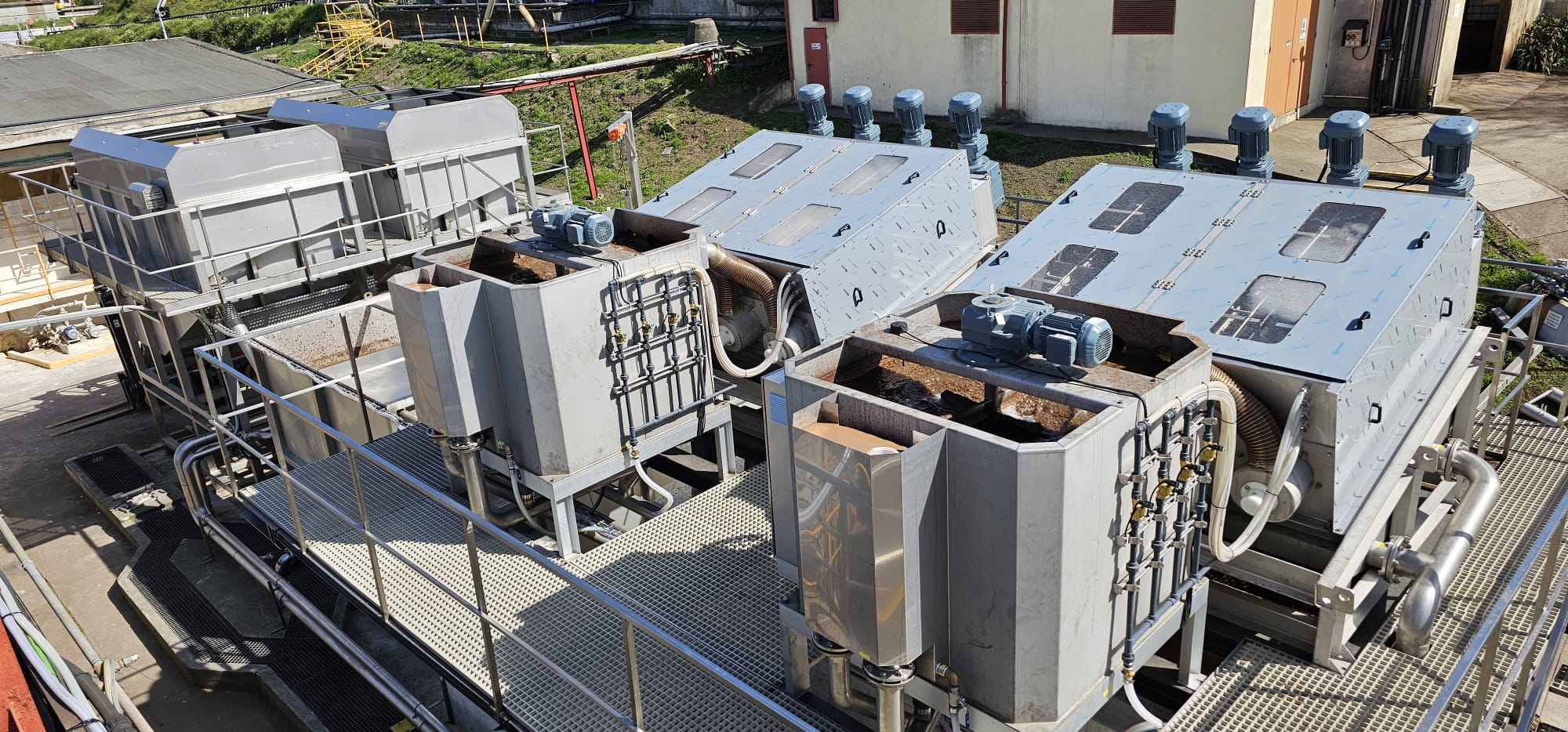
The MDS354 represents the mid-to-large segment of Benenv's multi-disk screw press range.
One operating detail is easy to miss. Several MDS models share similar hydraulic capacity but differ in solids handling. The MDS302 and MDS352 both accept up to 30 m³/h, yet the MDS302 is rated at 60–120 kg DS/h while the MDS352 is rated at 120–240 kg DS/h. When two models fit the same flow, the deciding variable is the solids load, not the pump size.
| Model | Power | Hydraulic capacity | DS capacity | Weight | Wash water |
|---|---|---|---|---|---|
| MDS101 | 0.2 kW | 0.12–1.5 m³/h | 3–6 kg/h | 205 kg | 24 L/h |
| MDS132 | 0.3 kW | 0.48–3 m³/h | 12–24 kg/h | 275 kg | 48 L/h |
| MDS202 | 0.6 kW | 0.8–12 m³/h | 24–40 kg/h | 470 kg | 64 L/h |
| MDS302 | 1.2 kW | 2.4–30 m³/h | 60–120 kg/h | 1,350 kg | 80 L/h |
| MDS352 | 3.75 kW | 4.8–30 m³/h | 120–240 kg/h | 2,300 kg | 144 L/h |
| MDS353 | 6 kW | 7.2–90 m³/h | 180–360 kg/h | 3,350 kg | 216 L/h |
| MDS403 | 6.7 kW | 10.2–150 m³/h | 300–510 kg/h | 4,550 kg | 240 L/h |
| MDS404 | 8.2 kW | 13.6–200 m³/h | 400–680 kg/h | 6,550 kg | 320 L/h |
Power, wash water, and weight scale with capacity. A buyer's cost model should therefore include not only the machine price but the site-specific cost of electricity, wash water, and installation logistics.
Supply and quality control: Benenv supports OEM/ODM production with a monthly capacity of 100 units, a lead time of 30–45 days, and a 1-unit MOQ. Quality control includes 100% pre-shipment testing and third-party inspection (SGS). For project schedules, these figures provide a planning baseline.
Field References: Documented Deployments Across Scenarios
Project references offer the most direct evidence of scenario adaptation. The following installations, documented by Benenv, show the model range applied to different sludge types and operating environments.
| Project scenario | Location | Model | Units | Operation period | Documented highlight |
|---|---|---|---|---|---|
| Municipal sludge dewatering | France | MDS353 | 1 | 1 year | Low energy consumption |
| DAF sludge dewatering | United States | MDS353 | 3 | 2 years | Self-cleaning mechanism |
| DAF sludge minimization | Canada | MDS302 | 1 | 3 years | Low energy consumption |
| Industrial park sludge dewatering | UAE | MDS302 | 3 | 2 years | Low noise and vibration |
| Industrial park sludge dewatering | Belgium | MDS353 | 1 | 3 years | Simple maintenance |
| Sewage treatment plant sludge | Thailand | MDS352 | 2 | 3 years | Self-cleaning mechanism |
| Palm oil mill sludge | Indonesia | MDS403 | 2 | 2 years | Simple maintenance |
| Printing and dyeing sludge | Vietnam | MDS202 | 1 | 2 years | Self-cleaning mechanism |
| Textile mill chemical sludge | Iran | MDS132 | 1 | 2 years | Low energy consumption |
| Chemical sludge | India | MDS302 | 1 | 3 years | Continuous operation |
| Meat processing DAF sludge | Portugal | MDS303 | 1 | 2 years | Water-saving operation |
| Food industry sludge reduction | New Zealand | MDS301 | 1 | 1 year | Compact design |
| Shipyard municipal sludge | Oman | MDS202 | 1 | 1 year | Low energy consumption |
Several patterns emerge. DAF sludge is documented in North America on MDS302 and MDS353 machines. Chemical and textile sludge appears in Vietnam, Iran, and India on MDS132, MDS202, and MDS302 machines. Municipal, sewage treatment, and industrial park sludge in Europe, the Middle East, and Southeast Asia falls mainly in the MDS302-to-MDS353 band. A palm oil mill application in Indonesia uses the MDS403, one of the largest models in the series.
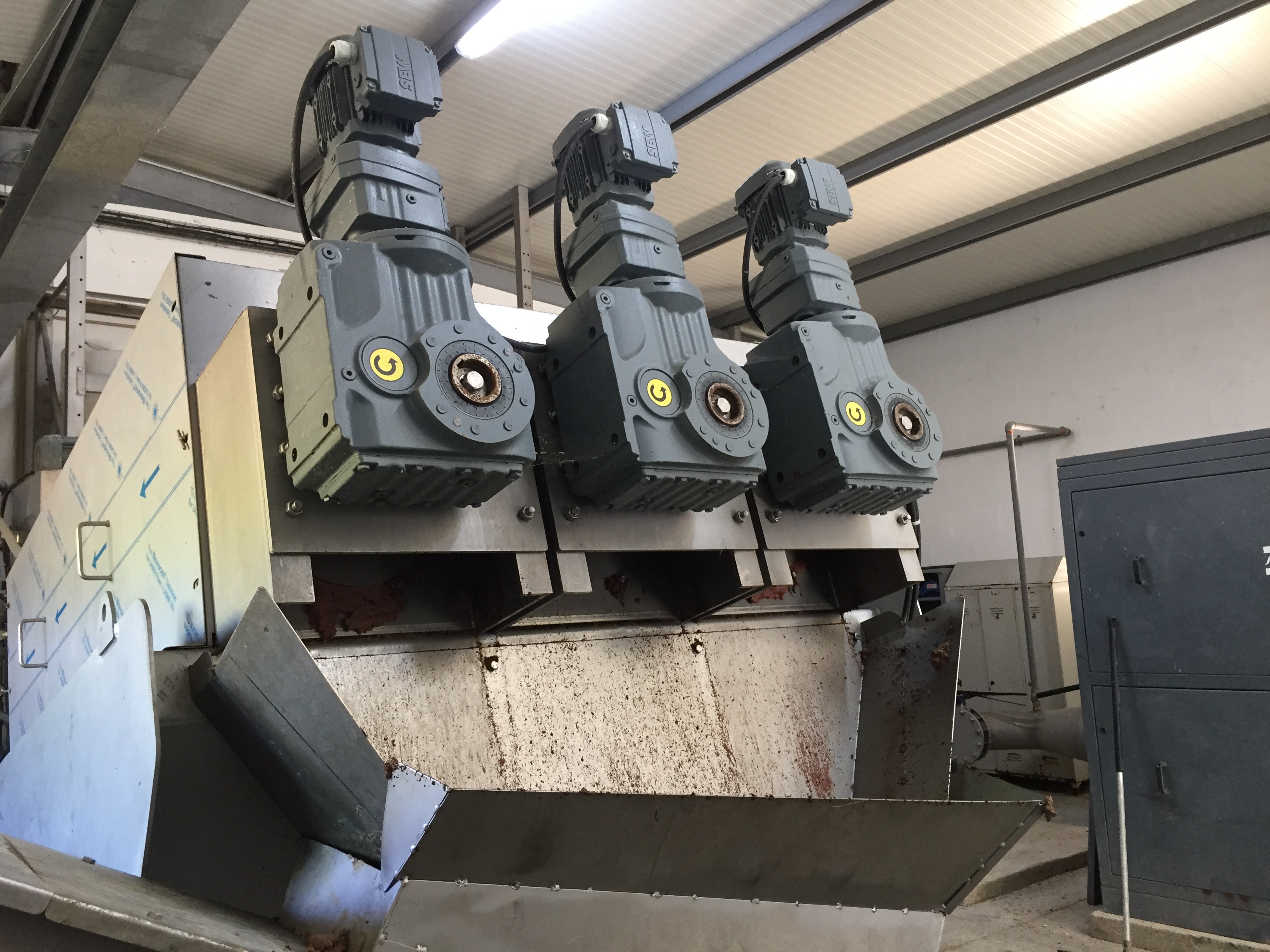
DAF sludge dewatering at a European food processing site — an application type where screw presses are frequently evaluated against alternative equipment.
Each reference reports stable operation over one to three years, with the project highlight varying by site: low energy consumption, self-cleaning, low noise and vibration, simple maintenance, or continuous operation. For a buyer, this indicates which model has been deployed in comparable scenarios and which operating characteristic the site emphasized.
Market Trend Analysis: Why Screw Press Is Accelerating
Third-party data supports the shift toward screw press technology. The global sludge dewatering equipment market was valued at USD 5.19 billion in 2024 and is projected to grow to USD 10.16 billion by 2032, according to Fortune Business Insights. Within this market, the screw press segment is expected to show the highest CAGR of 9.4% from 2025 to 2032. Asia Pacific held the largest revenue share in 2024 at 37.57%, supported by rapid urbanization and stricter wastewater regulations.
The same market report recognizes Benenv as a key global player in the sludge dewatering equipment market. For buyers, this is a relevant reference point because it places the brand inside the competitive set that market analysts track.
On the operating-cost side, a comparative industry analysis indicates that screw press technology typically consumes 90% to 95% less power than centrifuges in sludge dewatering applications. For sites running 24/7, this difference changes the total cost of ownership calculation before the machine is even purchased.
Multi-Disk Screw Press vs. Traditional Dewatering Equipment
Most buyers evaluating screw presses compare them against centrifuges and belt filter presses. The trade-offs are well established in qualitative terms.
| Factor | Multi-disk screw press | Centrifuge | Belt filter press |
|---|---|---|---|
| Energy demand | Low | High | Moderate |
| Wash water consumption | Low to moderate | Low | Continuous wash required |
| Noise level | Low | High | Moderate |
| Self-cleaning | Yes — moving rings | Mechanical cleaning | Manual cleaning |
| Enclosed operation | Yes | Yes | Open |
| 24/7 continuous operation | Suited | Suited | Operator-dependent |
Multi-disk screw press technology also has boundaries that buyers should weigh. First, on certain biological sludges, a high-G centrifuge can produce a drier cake; projects where maximum cake dryness is critical — for example, feeding an incinerator — may still favor a centrifuge. Second, for very large municipal flows, multiple screw press units may be required to match the throughput of a single large centrifuge, which affects layout and capital cost. Third, screw press performance depends on stable polymer flocculation; a site with inconsistent polymer dosing will see lower capture rates and wetter cake regardless of the press design.
Future Outlook: From Dewatering to Resource Recovery
As discharge standards tighten and sludge disposal costs rise, buyers are prioritizing equipment that runs unattended, consumes less energy, and produces consistent cake quality. Screw press dewatering aligns with these pressures: automatic continuous operation, low installed power, and enclosed construction suit both new builds and retrofits. The modular MDS platform, from small packaged units to large municipal models, also simplifies spare-parts logistics and operator training for buyers managing multiple sites. The wider industry direction, including sludge drying and carbonization, will keep pressuring upstream dewatering for stable and predictable performance.
For project planners who need the full technical documentation and product overview, Benenv's corporate brochure is publicly available for download: Download Benenv corporate brochure (PDF).
FAQ: Project-Specific Screw Press Questions
Which screw press sludge dewatering machine size does my project need?
Model selection starts by comparing two values against the machine envelope: the site's hydraulic flow (m³/h) and the dry-solids load (kg/h). Benenv's MDS series covers 16 models, from the MDS101 (0.12–1.5 m³/h; 3–6 kg/h DS) to the MDS404 (13.6–200 m³/h; 400–680 kg/h DS).
What is the difference between hydraulic capacity (m³/h) and DS capacity (kg/h)?
Hydraulic capacity is the volume of incoming sludge the machine can accept per hour. DS capacity is the weight of dry solids it can process per hour. Both must be checked because the same flow can carry very different solids loads depending on sludge concentration.
Which sludge types can a multi-disk screw press handle?
The MDS series is applied in municipal, industrial, and food processing wastewater treatment, including chemical, textile, paper, pharmaceutical, and agricultural industries. Documented references include DAF sludge, palm oil mill sludge, printing and dyeing sludge, chemical sludge, and municipal sludge.
Can a screw press dewatering machine handle DAF sludge?
Yes. Documented DAF sludge installations include a three-unit MDS353 project in the United States and a single MDS302 unit in Canada, both reported as stable operations over two and three years respectively.
How much wash water does a screw press sludge dewatering machine consume?
Wash water consumption scales with machine size. In the MDS series, it ranges from 24 L/h on the MDS101 to 320 L/h on the MDS404.
What materials are available for corrosive sludge environments?
MDS machines are manufactured in SS304 or SS316L. SS316L is specified where the sludge or wash environment requires higher corrosion resistance.
What is the typical power demand of a multi-disk screw press?
Installed power in the MDS series ranges from 0.2 kW on the MDS101 to 8.2 kW on the MDS404. A comparative industry analysis indicates screw press technology typically uses 90% to 95% less power than centrifuges.
Tem questões ou precisa de mais detalhes?
Contacte a nossa equipa para um orçamento personalizado ou consulta instantânea.
Solicitar orçamento
Preencha o formulário abaixo e a nossa equipa entrará em contacto com uma proposta personalizada.
Chat direto do WhatsApp
Prefere conversar em tempo real? Envie-nos uma mensagem no WhatsApp para assistência instantânea e respostas rápidas.
- Obter orçamento personalizado
- Partilhar fotos ou documentos
- Discuta as suas necessidades diretamente
Geralmente responde em 5–30 minutos durante o horário de expediente.