
Matching Solar Water Heaters to Small Hotel Operations
For a property with around 80 guest rooms and a public bathing area, hot water is not one load. It is two different load shapes running through the same system, and the difference between a solar installation that works and one that disappoints usually appears at peak simultaneity rather than in annual energy totals. Scenario fit is the discipline of matching collector area, storage volume, working pressure, tank material and backup strategy to the way a hotel actually consumes hot water, instead of to a headline capacity number.
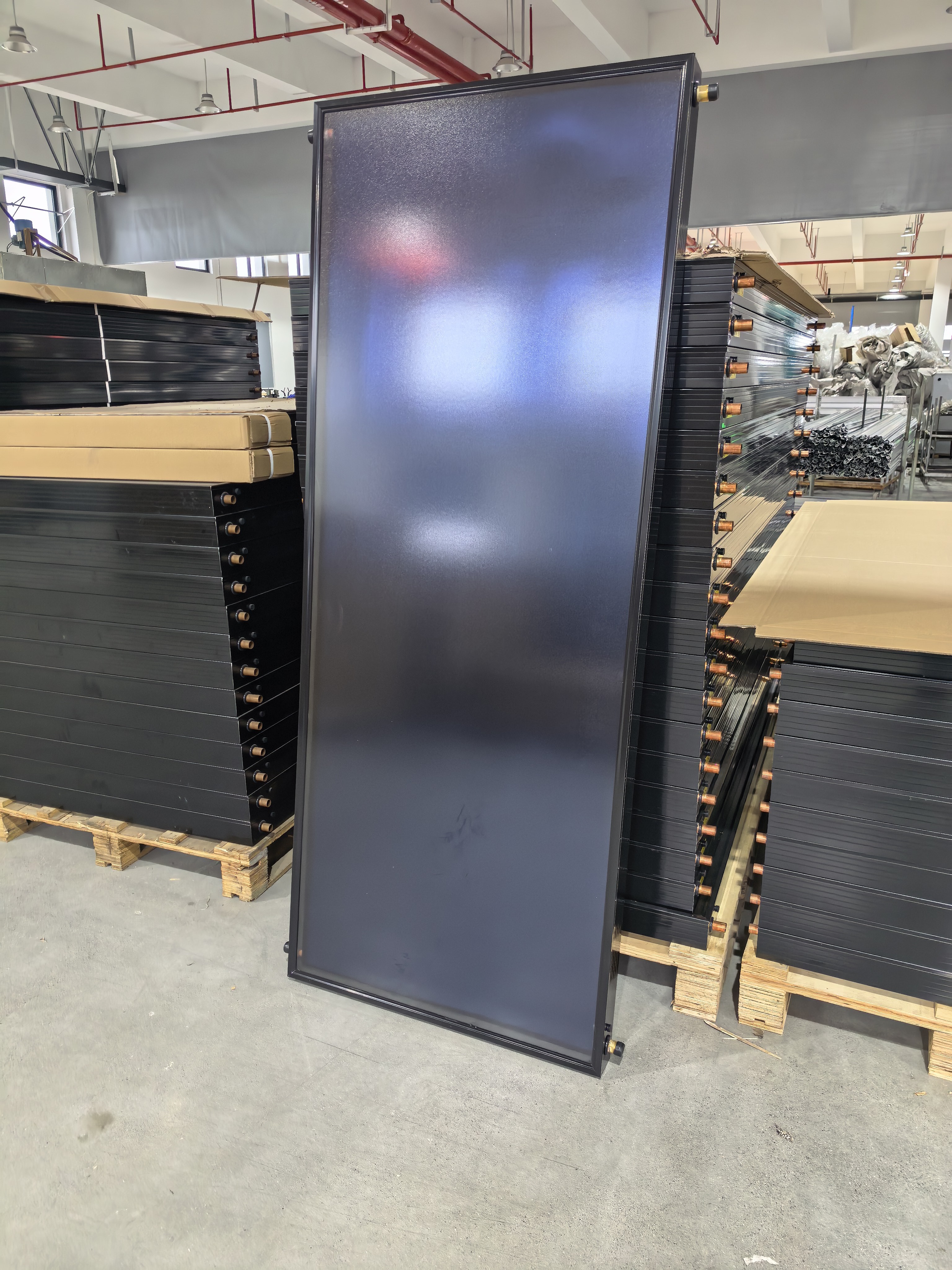
Collector selection is the first scenario decision in a hotel hot water project, not the final one.
Why hotel hot water fails as an operating issue before it fails as an equipment issue
Hot water complaints in small hotels rarely trace back to total daily consumption. They trace back to peak simultaneity. Guest bathrooms in a limited-service hotel empty into a narrow window in the morning and a second window in the evening, while a public bathing or spa area adds a separate block of demand that often arrives outside those windows and recovers more slowly. A system sized only against an average daily volume has two predictable failure modes: storage that is too small delivers falling temperatures on the second and third simultaneous draw, and storage that is oversized relative to the real draw profile leaves capital sitting idle in the plant room.
The second operating pressure is cost. Hotels that heat domestic hot water with electric resistance or gas absorb the full cost of every litre they deliver, and both fuel categories expose the property to tariff movement that management does not control. The reference project in the company's case material is a small and medium-sized hotel installation in Southeast Asia, where a complete solar hot water system serves daily water supply for 80 guest rooms and public bathing areas and replaces traditional electric and gas heating equipment. The recorded outcome is a reduction in electricity and gas costs of more than 40%, with a stable service life of more than 15 years.
The third pressure is climate. In Southeast Asia's hot and rainy conditions, corrosion and weather exposure dominate component degradation rather than frost. That shifts the selection logic toward collector construction, tank material and corrosion resistance, and away from insulation performance as the single deciding variable. Where a site does face freezing conditions or salt-affected water, the constraint changes again, and the configuration has to change with it.
The opportunity side of the same picture is regulatory and reputational. Hotels pursuing green certification need a documented reduction in carbon emissions, and solar thermal is one of the few building systems that produces both an operating cost effect and a compliance narrative. The counterweight is that a solar system is not a drop-in replacement for a boiler. It is a system with boundary conditions that have to be settled at design stage, before the purchase order is raised.
A scenario fit framework for hotel hot water demand
Scenario fit means fixing the configuration from four variables before any supplier comparison begins: the shape of daily demand, the simultaneity of peak draw, the water and pressure conditions on site, and the climate and roof conditions of the building. Each variable eliminates some configurations from consideration and narrows the field to a small set of defensible options.
| Operating scenario | Dominant demand pattern | Constraint that drives selection | Documented configuration options |
|---|---|---|---|
| Limited-service hotel, up to roughly 80 rooms, no bathing facility | Two sharp peaks, morning and evening | Storage volume and working pressure for mains-fed showers | CPS series high-pressure solar geysers, 100L to 300L per unit, with a maximum operating pressure of 6 bar and a 9 bar test pressure |
| Hotel with a public bathing area or spa | Block demand layered over a continuous background load | Collector area, recovery capacity and temperature stability | HSC series heat pipe vacuum tube collectors, 10 to 30 tubes per unit, combined with CPS or CPS-FJ pressurized storage |
| Hot-rainy or coastal site with aggressive water conditions | Constant corrosion exposure with steady daily draw | Tank and collector material selection | Food-grade stainless steel inner tanks in SS304, SS316, Duplex 2205 or Duplex 32001 with a galvanized steel outer tank (CPS); SS304 or SS316 for the CNP series |
| Site needing loop separation or protection against cold snaps | Indirect draw with a heat transfer fluid | Freeze protection and separation of potable water from the collector loop | CPS-FJ series indirect solar water heater, 150L to 300L, with a flat plate collector, for use with anti-freezing heat transfer media |
| Constrained roof area with parallel electricity ambitions | Daytime-biased heating with electrical routing | Controller capability and energy routing between solar and mains | PV Series PV solar water heater, 100L to 500L, 600W per solar panel input, 800W to 3500W heating output, MPPT controller with DC/AC automatic switch |
The framework is deliberately constraint-first, because in hotel projects the constraints decide far more than the preference does. Once the scenario row is fixed, the remaining questions are about materials, pressure ratings and third-party verification rather than about collector brand styling. Corrosion-resistant materials, water quality treatment, freeze protection where relevant, and roof load-bearing capacity are recurring project concerns that should be defined per project location and per design, not assumed from a catalogue.
How Kesun configures solar hot water for hotel-scale demand
Zhejiang Kesun New Energy Co., Ltd. (kesun solar) is a Chinese solar thermal manufacturer founded in 2009, formed through the merger of Haining Ensun Solar Technology Co., Ltd. and Zhejiang Yile New Energy Co., Ltd. The company manufactures solar water heaters, buffer tanks, domestic hot water tanks and hybrid solar panels at a 42,000 m² facility with an annual output of 300,000 sets and a 15-engineer R&D team, and exports about 60% of its output, with main markets in Mexico, the EU and Africa.
For hotel and commercial hot water projects, the configuration the company documents pairs HSC series solar collectors with CPS-FJ or CPS series pressurized solar water heaters, a combination it positions for stable large-volume domestic hot water supply in hotels and commercial buildings. In concrete terms, that pairing puts a heat pipe vacuum tube collector array in front of pressurized storage in the 100L to 300L range per vessel, with the option of the indirect CPS-FJ unit at 150L to 300L where the loop has to be separated from potable water or protected with anti-freezing heat transfer media.
Production capability matters at the point where a hotel refit is scheduled rather than debated. The company reports monthly capacity of 25,000 units, a lead time of 20 to 35 days, a minimum order quantity of one 40-foot container, 100% testing before shipment, OEM and ODM support, and customization by capacity, type and system configuration. After-sales support is provided remotely. A third-party company profile on Alibaba reports 2025 export revenue of approximately USD 19.6 million for Zhejiang Kesun New Energy Co., Ltd.
The technical constraints that decide fit
Collector choice: heat pipe vacuum tube or flat plate
HSC series collectors use 58-1800 vacuum tubes with heat pipes, 10 to 30 tubes per unit, in an aluminium alloy frame, and are listed for villa, hotel, house heating, spa centre and school applications. The FPC2.0 flat plate collector is available in 1, 1.5, 2 and 2.5 m² formats at 80 mm thickness, built from copper and aluminium alloy, and is listed for swimming pool, housing heating and solar water heater duty. For a hotel with a bathing block, the collector decision is usually decided by available roof area and mounting geometry rather than by a categorical technology preference, because both families carry Solar Keymark certification in this portfolio.
Working pressure and the guest bathroom
Working pressure is the constraint that separates a system able to feed upper-floor showers directly from one that needs an intermediate tank or booster set. The CPS series high-pressure solar geysers operate at a maximum of 6 bar with a 9 bar test pressure, and are available in 100L, 150L, 200L and 300L capacities using 58-1800 vacuum tubes with heat pipes and 50 mm PU foam insulation, mounted at an angle between 25 and 45 degrees. The CNP series, by contrast, is a non-pressure design in 60L to 500L capacities that the company lists for houses, villas, gardens, gas stations, car wash centres, small hotels and schools. Both are legitimate products, but they are not interchangeable in a guest bathroom, and the distinction should be settled before quantities are quoted.
Tank material, corrosion and the indirect option
The CPS series uses a food-grade stainless steel inner tank available in SS304, SS316, Duplex 2205 or Duplex 32001, with a galvanized steel outer tank, a material set the company describes as providing corrosion resistance. The CNP series uses SS304 or SS316. The PV Series uses Duplex 2205 or Inox 316L. The CPS-FJ series takes a different route: an indirect design with an enamel coated SPCC tank that can be fixed with anti-freezing heat transfer media, which is the configuration to consider when water chemistry or ambient conditions make a direct loop impractical.
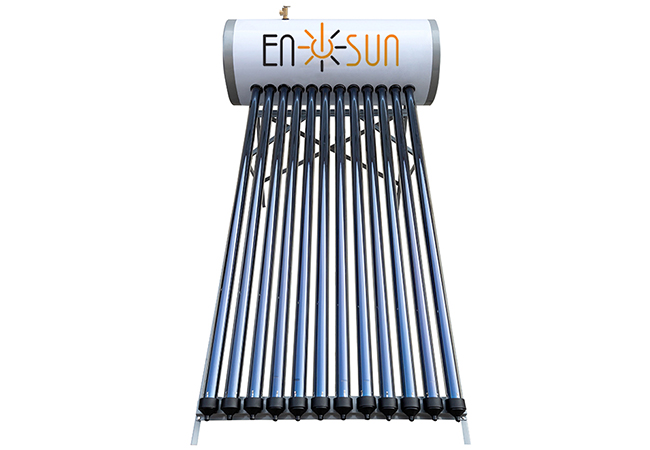
Pressurized storage and a heat pipe absorber are what allow a solar system to feed guest showers directly.
Certification as a hard filter
In the evaluation stage, certification scope is often the fastest way to shorten a supplier list, because it is verifiable and it is specific. The CPS series holds Solar Keymark certification issued by DIN CERTCO under certificate number 011-7S3077 A, valid to 2029-06-30 and covering the ENSUN-CPS100 to ENSUN-CPS300 models against DIN EN 12976-1:2017-04 and DIN EN 12976-2:2019-11. The CPS-FJ series holds Solar Keymark certification 011-7S3343 A, valid to 2031-06-30, covering CPS/F150 to CPS/F300. The CNP series holds 011-7S3239 A, valid to 2030-03-31. The HSC series collectors hold 011-7S3325 R under the KESUN brand for models HSC10 to HSC30, valid to 2030-11-30, against DIN EN 12975:2022-06 and DIN EN ISO 9806:2018-04, and the FPC2.0 and FPC2.5 flat plate collectors hold 011-7S3241 F.
Beyond the collector and system certificates, the tank and pressure envelope is covered separately. Storage tanks PWT200 and PWT300 were type examined by Intertek against EN 12897:2016+A1:2020 under report numbers 251023056GZU-001 and 251023056GZU-002. A performance test report for the stainless steel inner tank, Intertek report 251230069GZU-001, covers both the CPS and CPS-FJ series and is not restricted to a specific market. The CPS series is also certified to PED (2014/68/EU) under ICR verification of conformity ICR/VC/HM2605327, valid to 2031-05-27, and the wider product range carries LVD and EMC verification of conformity under ICR/VC/HM2605326 with the same validity period.
Application: an 80-room hotel with public bathing areas
The representative case behind this guide is a commercial hotel purchaser running a complete solar hot water system for a small to medium-sized property of 80 guest rooms. The system supplies all-day domestic hot water to guest rooms and public bathing areas, supports auxiliary regional heating, and replaces traditional electric and gas heating equipment in order to meet the stable heat demand of daily hotel operation.
Three design decisions in that project are worth carrying into any comparable specification. First, the system was built around high-adaptability vacuum heat collection modules chosen for corrosion and weather resistance in Southeast Asia's hot-rainy climate, which is the same constraint logic described earlier. Second, the layout used an integrated design intended for easy installation and low-cost maintenance, with smart temperature adjustment to hold efficiency in a small to medium commercial project. Third, the outcome was measured on operating cost as well as on comfort: the hotel cut electricity and gas costs by more than 40%, while the stable system delivered constant-temperature hot water with minimal failures, improving guest satisfaction and reducing carbon emissions for green-hotel compliance. The system has maintained a stable service life of more than 15 years.
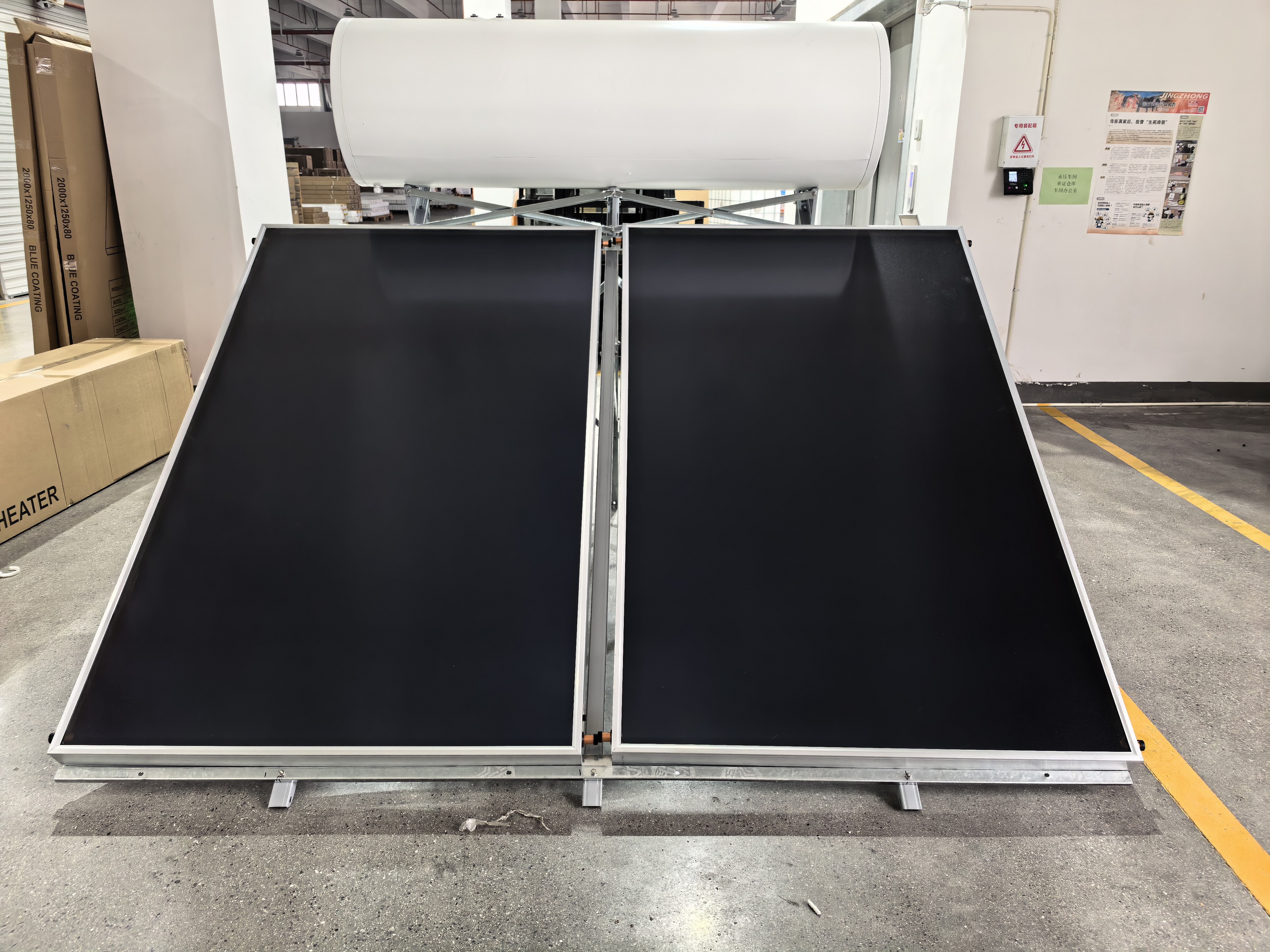
An indirect configuration separates the potable water circuit from the collector loop in hotels with aggressive water conditions.
The published case does not disclose collector count, storage volume or site irradiation, so the figures should be read as project outcomes rather than as a replicable specification. The over 40% cost reduction is a result achieved in one Southeast Asian hotel installation, not a performance guarantee that transfers automatically to another building. What does transfer is the method: define the scenario, size against peak simultaneity, select materials for the local climate and water, then verify certification coverage against the target market.
Market context for hotel solar thermal
The demand context for these decisions is not static. The global solar water heater market was valued at USD 4.2 billion in 2025, according to Fortune Business Insights. By the end of 2023, cumulative global solar heat capacity had reached 560 GWth, covering 800 million m² of collector area, according to the IEA Solar Heating and Cooling Programme's Solar Heat Worldwide 2024 report. Grand View Research places evacuated tube collector technology at a 44.2% revenue share in 2023, which is consistent with the prevalence of vacuum tube absorbers in commercial hot water systems.
Two regulatory and trade developments matter for hotel procurement. New US federal energy conservation standards for consumer water heaters took effect on 5 July 2024, with compliance required by 2029, signalling a tightening efficiency baseline in a major market. Separately, HS Code 841912 was introduced in 2023 to differentiate solar water heaters from the generic 841919 classification, which improves the transparency of solar thermal trade data over time. For hotel buyers, both changes point in the same direction: efficiency claims and product classification are becoming easier to check, which raises the value of documented certification and tested components in supplier evaluation.
Solar versus electric and gas heating: what changes, and what does not
The honest comparison is not solar versus conventional heating in general terms. It is solar with backup versus conventional heating alone, evaluated against the same daily demand profile.
| Consideration | Electric resistance heating | Gas heating | Solar thermal with backup |
|---|---|---|---|
| Operating cost exposure | Full cost of every litre delivered, exposed to tariff movement | Full cost of every litre delivered, exposed to fuel price movement | Solar energy covers part of the daily load; the reference hotel case records an electricity and gas cost reduction of more than 40% |
| Peak performance | Reliable at any hour within capacity limits | Reliable at any hour within capacity limits | Dependent on irradiation and storage sizing; the reference system supports auxiliary regional heating to hold stability |
| Maintenance profile | Heating elements and controls | Burner, flue and controls | The CPS series has no moving parts, which the company links to low maintenance requirements |
| Carbon position | Grid-dependent | Combustion-based | Documented emissions reduction used for green-hotel compliance in the reference case |
| Installation constraints | Low, but requires plant space and electrical capacity | Low, but requires flue and gas supply | Requires roof area, load-bearing assessment, correct tilt between 25 and 45 degrees, and a project-level design calculation |
The boundary conditions deserve the same weight as the benefits, because a hotel buyer who ignores them will meet them later at commissioning. A solar system does not eliminate backup: the case material notes that installations in this category support auxiliary regional heating, and system documentation across the portfolio describes pairing with electric heaters or heat pumps for backup and compensation. The over 40% cost reduction reflects one project's load profile and climate and should not be quoted as a universal figure.
Product scope matters too. The CNP series is a non-pressure design; it suits applications where gravity or low-pressure delivery is acceptable and should not be specified for mains-pressure guest showers. The PV Series is listed for villa, house, apartment and camp applications, so hotel-scale daily draw would require separate evaluation rather than assumption. Certification coverage in this portfolio is centred on the EU market through Solar Keymark, PED and LVD/EMC schemes; projects in other regions should verify local conformity requirements separately. Corrosion resistance, water quality treatment, freeze protection and roof load-bearing capacity remain project-level concerns that depend on location and design. Finally, the commercial terms themselves are a constraint: a minimum order quantity of one 40-foot container and a lead time of 20 to 35 days have to fit the renovation schedule.
Future outlook
The direction of travel in hotel hot water is hybrid rather than purely thermal. Storage and buffer vessels, heat pump linkage and photovoltaic-thermal collectors are moving from niche to standard options in commercial specifications, and manufacturers that already build domestic hot water tanks, buffer tanks and hybrid solar panels alongside conventional collectors are positioned for that shift. Kesun's own product history follows the pattern: the merger that created the company retained non-pressure and pressurized lines, then added PVT systems, 2205 duplex stainless steel tanks and heat pipe solar collectors, supported by in-house salt spray and pulse testing in a laboratory the company established to bring formerly outsourced reliability testing on site.
For hotel operators, the practical implication is that the specification written today should leave room for integration tomorrow, whether that means storage capacity that a heat pump can later charge or a control strategy prepared for electrical routing. A summary of the company's current product documentation is available in its 2025 product brochure.
FAQ
What does scenario fit mean when specifying a solar water heater for a small hotel?
Scenario fit means selecting a configuration from the property's actual demand shape rather than from a nominal capacity figure. The four variables are the shape of daily demand, the simultaneity of peak draw, the site's water and pressure conditions, and the local climate and roof conditions. Each variable narrows the candidate configurations before supplier comparison starts.
How should a hotel with 80 guest rooms and a public bathing area approach capacity?
Capacity should be sized at project level against the measured or designed daily draw, because solar hot water designs are calculated per site rather than by a universal per-room rule. The documented reference configuration for this class of property is a complete solar hot water system serving daily water supply for 80 guest rooms and public bathing areas, with pressurized storage units available in 100L to 300L capacities in the CPS series and 150L to 300L in the CPS-FJ series, which allows multi-unit banks to be arranged around the calculated demand.
Vacuum tube or flat plate collector for a hotel hot water project?
Both are used in commercial hot water work and both carry Solar Keymark certification in this portfolio. The HSC series heat pipe vacuum tube collector is available with 10 to 30 tubes and is listed for hotel, spa centre and school applications. The FPC2.0 flat plate collector is available in 1, 1.5, 2 and 2.5 m² formats at 80 mm thickness and is listed for swimming pool, housing heating and solar water heater duty. The deciding factors are usually available roof area, mounting geometry and the required recovery profile.
Which certifications should a hotel buyer verify before ordering?
Verification should cover the system, the collector and the pressure envelope. For the systems, that means Solar Keymark certificates 011-7S3077 A (CPS, valid to 2029-06-30), 011-7S3343 A (CPS-FJ, valid to 2031-06-30) and 011-7S3239 A (CNP, valid to 2030-03-31), all issued by DIN CERTCO. For collectors, 011-7S3325 R covers HSC10 to HSC30 and 011-7S3241 F covers the FPC2.0 and FPC2.5. For the pressure and tank envelope, PWT200 and PWT300 were type examined by Intertek against EN 12897:2016+A1:2020 under report numbers 251023056GZU-001 and 251023056GZU-002, the CPS series holds PED (2014/68/EU) verification ICR/VC/HM2605327, and the range carries LVD and EMC verification ICR/VC/HM2605326.
What pressure and tank material should be specified for guest bathrooms?
For direct mains-fed showers, a pressurized product is required. The CPS series operates at a maximum of 6 bar with a 9 bar test pressure and is available in 100L, 150L, 200L and 300L capacities. Its inner tank is food-grade stainless steel in SS304, SS316, Duplex 2205 or Duplex 32001, with a galvanized steel outer tank and 50 mm PU foam insulation. The CNP series is a non-pressure design and should not be specified for mains-pressure guest showers.
Can a solar system replace electric or gas heating entirely?
In the documented hotel case, the solar system replaced traditional electric and gas heating equipment and reduced electricity and gas costs by more than 40%, but the design still supports auxiliary regional heating. System documentation across this portfolio describes pairing with electric heaters or heat pumps for backup and compensation. A solar installation therefore reduces conventional fuel consumption rather than removing the backup circuit from the design.
What order quantities and lead times should be planned?
The manufacturer reports a minimum order quantity of one 40-foot container and a lead time of 20 to 35 days, against a monthly capacity of 25,000 units with 100% testing. OEM and ODM are supported, and customization is available by capacity, type and system configuration. After-sales support is provided remotely.