
Matching Sublimation Printer Widths to Your Textile Line
Printing width is a procurement constraint before it is a performance specification. On a roll-to-roll sublimation line, an 1800 mm machine, a 1900 mm machine and a 1950 mm machine do not solve the same problem. Each one defines which fabric formats can be printed whole, how transfer paper is loaded, how much floor space and electrical capacity the line requires, and — in regulated markets — which certification file a buyer can attach to an import shipment.
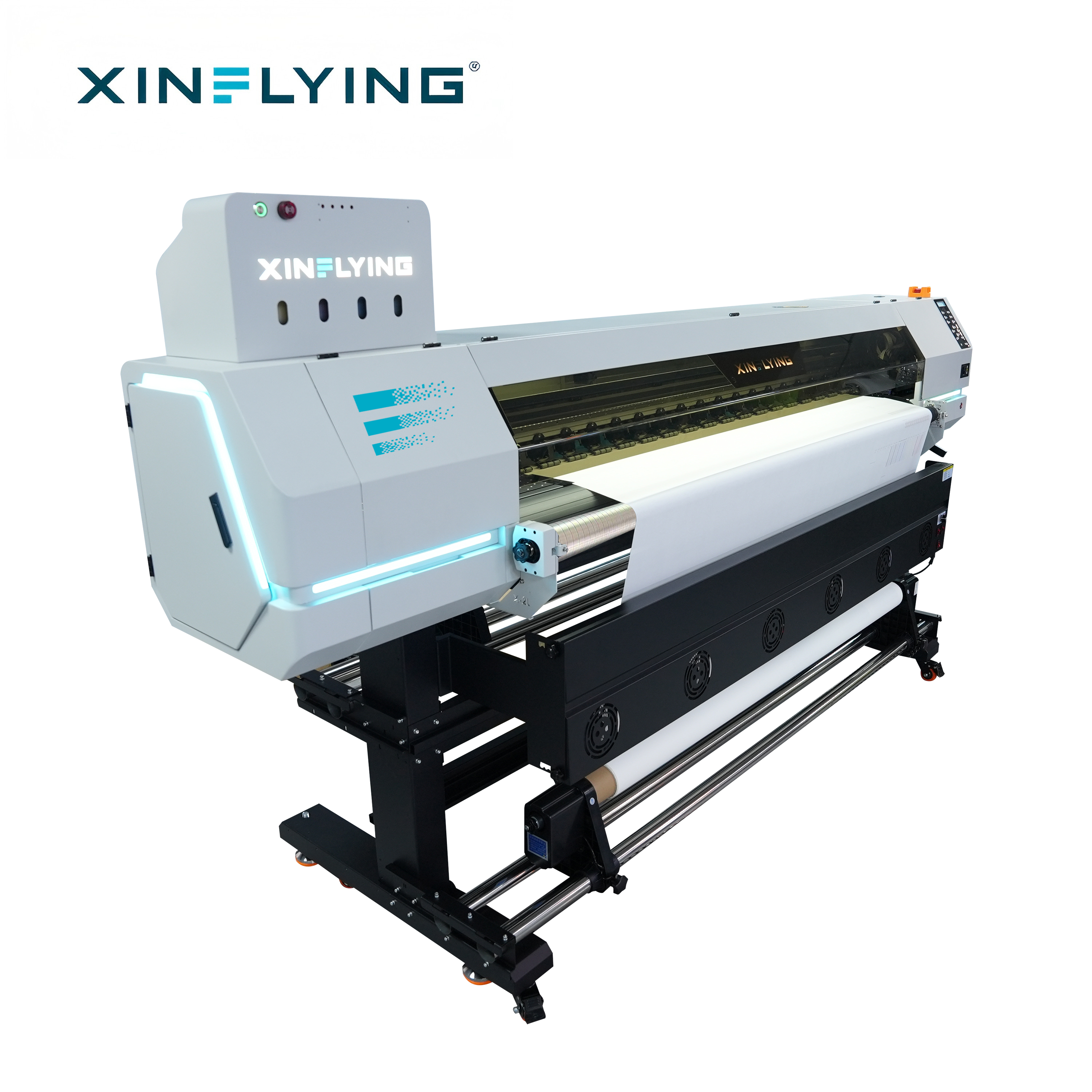
XinFlying XF-H1802X-2I32A1, an 1800 mm roll-to-roll sublimation printer specified for polyester fabric production.
This reference compares four sublimation printer widths from XINFLYING — Guangzhou Xin Flying Digital Technology Co., Ltd., a digital printing equipment manufacturer founded in 2010 with a 37,440 m² facility in Panyu, Guangzhou — and the compliance documentation published for each model. The four are the 1800 mm XF-H1802X-2I32A1, the 1900 mm XF-19E8-PRO and XF-19E15-PRO, and the 1950 mm XF-O2000-4I32A1.
Why width should open the selection, not printhead count
Specification sheets for textile sublimation printers are usually organised around printheads, pass modes and speed. Those figures describe throughput. They do not describe fit. Fit is decided earlier, by printable width, because width determines whether a plant can run a given fabric format without splitting panels, whether the printed roll matches the downstream calender and cutting table, and how many transfer paper formats the line has to stock.
Industry practice reflects the same logic. Roll-to-roll sublimation printers with widths of 1.9 m (1900 mm) are treated as standard for high-volume textile and soft signage applications, according to FESPA market insight material. That width maps onto common fabric roll formats, onto the panel sizes used in sportswear, flags and home textiles, and onto the finishing equipment that follows the printer on the line.
Two machines with identical printhead counts can therefore serve quite different lines if their printable widths differ. Equally, a machine with fewer printheads and a wider printable area can be the better fit for decorative textile work, where panel width matters more than hourly output.
The four widths in this comparison
All four models are roll-to-roll dye sublimation printers using Epson i3200-A1 printheads and sublimation ink, but they are built around different widths and different published application profiles.
| Model | Print width | Printheads | Media | Published application profile |
|---|---|---|---|---|
| XF-H1802X-2I32A1 | 180 cm (1.8 m) | 2 × Epson i3200-A1, CMYK+CMYK | Heat transfer paper | Textile sublimation printing on polyester fabrics |
| XF-19E8-PRO | 190 cm (75 inch) | 8 × Epson i3200-A1, CMYK | Sublimation paper | Industrial textile sublimation printing |
| XF-19E15-PRO | 190 cm (75 inch) | 15 × Epson i3200-A1, CMYK | Sublimation paper, loads 1000 m rolls | Industrial textile sublimation printing (high-volume) |
| XF-O2000-4I32A1 | 195 cm (1.95 m) | 4 × Epson i3200-A1, CMYK ×4 | Heat transfer paper, rolls of 1000–1500 m; media up to 1 mm thick and 200 kg | Clothing, home decor, canvas bags, cushions, flags |
The 1800 mm format is the entry point of the family. With two printheads and a 180 cm printable width, the XF-H1802X-2I32A1 is aimed at businesses starting sublimation printing, custom textile production, apparel sampling and small-batch orders. Its value in a procurement comparison is format fit at low installation weight, not maximum output.
The 1900 mm format appears in two configurations that share the same 190 cm printable width but differ in printhead count. That separation is useful: the XF-19E8-PRO and the XF-19E15-PRO answer the same format question and a different volume question. The XF-19E15-PRO is specified to load 1000 m rolls of sublimation paper, which suits continuous production rather than order-by-order media handling.
The 1950 mm format adds 50 mm of printable area over the 1.9 m family. The XF-O2000-4I32A1 is specified for print media up to 1 mm thickness and 200 kg weight, and supports heat transfer paper rolls of 1000–1500 m. Its published application list is the broadest of the four, covering clothing, home decor, canvas bags, cushions and flags — a décor-weighted profile rather than a pure sportswear profile.
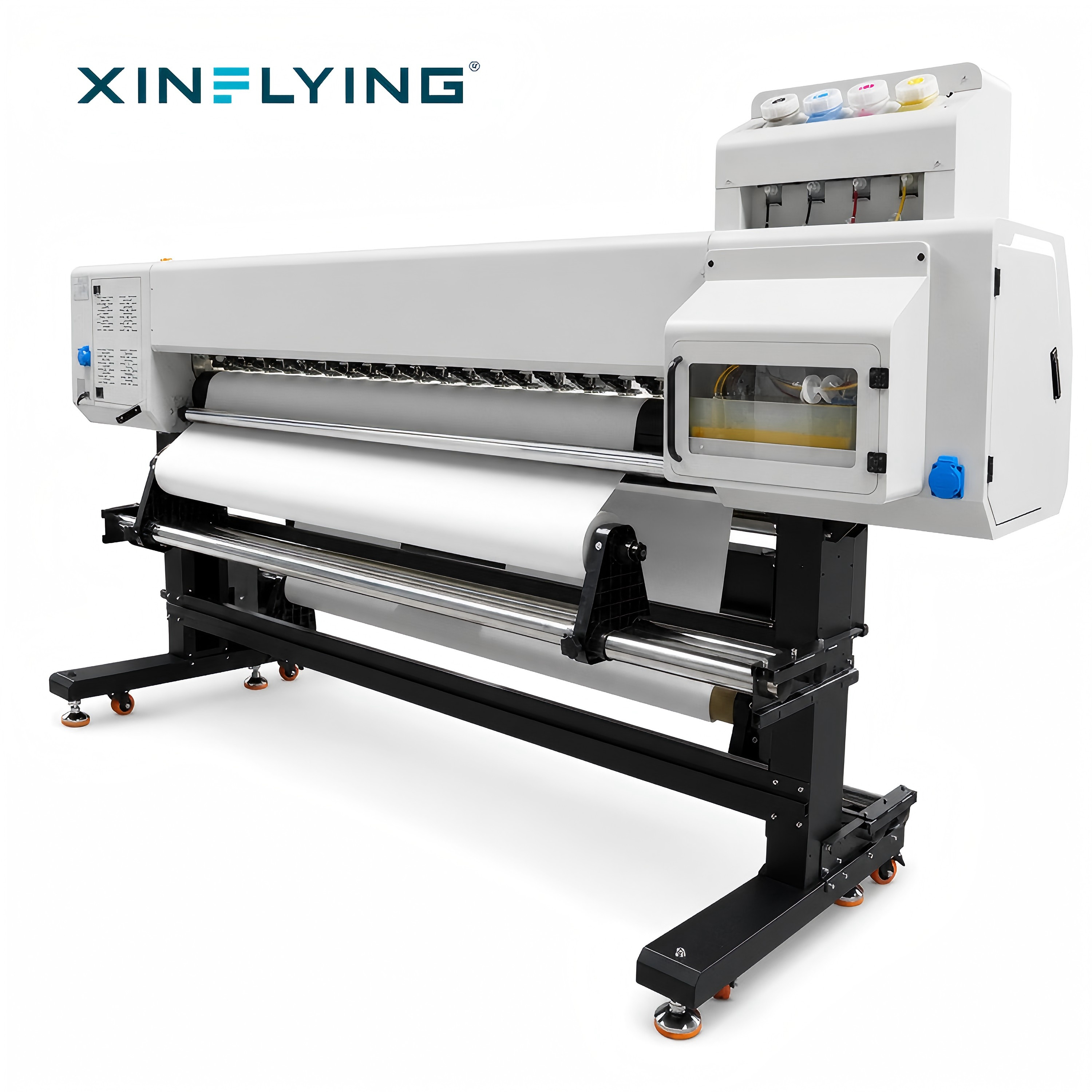
The 1800 mm XF-H1802X-2I32A1 uses front, middle and rear break-controlled heating and Maintop as standard RIP software.
What the certificates actually cover, model by model
In the European Union and other regulated markets, the width shortlist and the compliance shortlist are the same exercise. The useful question is not whether a supplier holds CE documentation, but whether the certificate names the model that is being ordered and shipped. A technical file assembled around a certificate that does not list the delivered model is a customs and sales risk, not an assurance.
| Model | Machinery safety | Electrical safety and EMC | Substance compliance |
|---|---|---|---|
| XF-H1802X-2I32A1 (1800 mm) | CE Machinery Directive; applicable standards EN ISO 12100:2010, EN 60204-1:2018/A1:2025, EN ISO 12643-1:2023 | CE LVD & EMC certificate M.2026.206.C142475 (UDEM); CE LVD certificate TQT1550D271EC; CE certificate BSTXD211021006201EC | RoHS certificate M.2026.206.C142366 |
| XF-19E8-PRO (1900 mm) | CE MD Certificate of Conformity M.2026.206.C142385 (UDEM) | CE LVD certificate TQT1550D271EC; CE EMC certificate TQT1550D270EC; CE certification under CTICAIQ415250900815313DC and M.2026.206.C142475 | RoHS certificate M.2026.206.C142366 |
| XF-19E15-PRO (1900 mm) | CE MD Certificate of Conformity M.2026.206.C142365 (UDEM) | CE LVD certificate TQT1550D271EC; CE EMC certificate TQT1550D270EC; CE certification under CTICAIQ415250900815313DC and BSTXD211021006201EC | RoHS certificate M.2026.206.C142366 |
| XF-O2000-4I32A1 (1950 mm) | CE Machinery Directive with EN ISO 12100:2010 cited; issued by UDEM | CE LVD & EMC certificate M.2026.206.C142475 (UDEM); CE LVD certification issued through TQT; CE EMC certificate TQT1550D270EC; CE Certificate of Compliance BSTXD211021006201EC | RoHS certificate M.2026.206.C142366 |
Machinery safety documentation is issued under the Machinery Directive 2006/42/EC. The XF-19E8-PRO holds CE MD Certificate of Conformity number M.2026.206.C142385 and the XF-19E15-PRO holds CE MD Certificate of Conformity number M.2026.206.C142365, both issued by UDEM. The XF-O2000-4I32A1 is certified to CE Machinery Directive requirements with EN ISO 12100:2010 cited as an applicable standard, issued by UDEM. The XF-H1802X-2I32A1 is certified to the CE Machinery Directive, with EN ISO 12100:2010, EN 60204-1:2018/A1:2025 and EN ISO 12643-1:2023 among the applicable standards.
Electrical and electromagnetic documentation covers two separate directives. CE Low Voltage Directive certificates reference EN IEC 62368-1:2020/A11:2020, and certificate TQT1550D271EC is issued through TQT (Shenzhen Tianqi Testing Technology Service Co., Ltd.). CE EMC certificates reference EN 55032:2015/A11:2020, EN 55035:2017/A11:2020, EN IEC 61000-3-2:2019+A1:2021 and EN 61000-3-3:2013/A2:2021 under certificate TQT1550D270EC, issued within the scope of EMC Directive 2014/30/EU. The XF-O2000-4I32A1 and the XF-H1802X-2I32A1 are additionally covered by CE LVD & EMC certificate M.2026.206.C142475 issued by UDEM.
Substance compliance is documented separately. The RoHS attestation M.2026.206.C142366, issued by UDEM, cites EN IEC 63000:2018 and the EN IEC 62321 series and states an expiry date of 9 June 2031. It covers the sublimation printer models discussed in this reference.
Scope discipline matters as much as certificate count. The OEKO-TEX ECO PASSPORT certificate SH150194016, issued by TESTEX AG and valid for the global market, covers the textile printing inks and printing pastes used in the Digital Textile Printer XF-450PRO under EN ISO 17050-1. That is a material-level document about consumables, not a machinery safety document about a printer — a distinction that becomes important when an importer is assembling a technical file across equipment and chemistry.
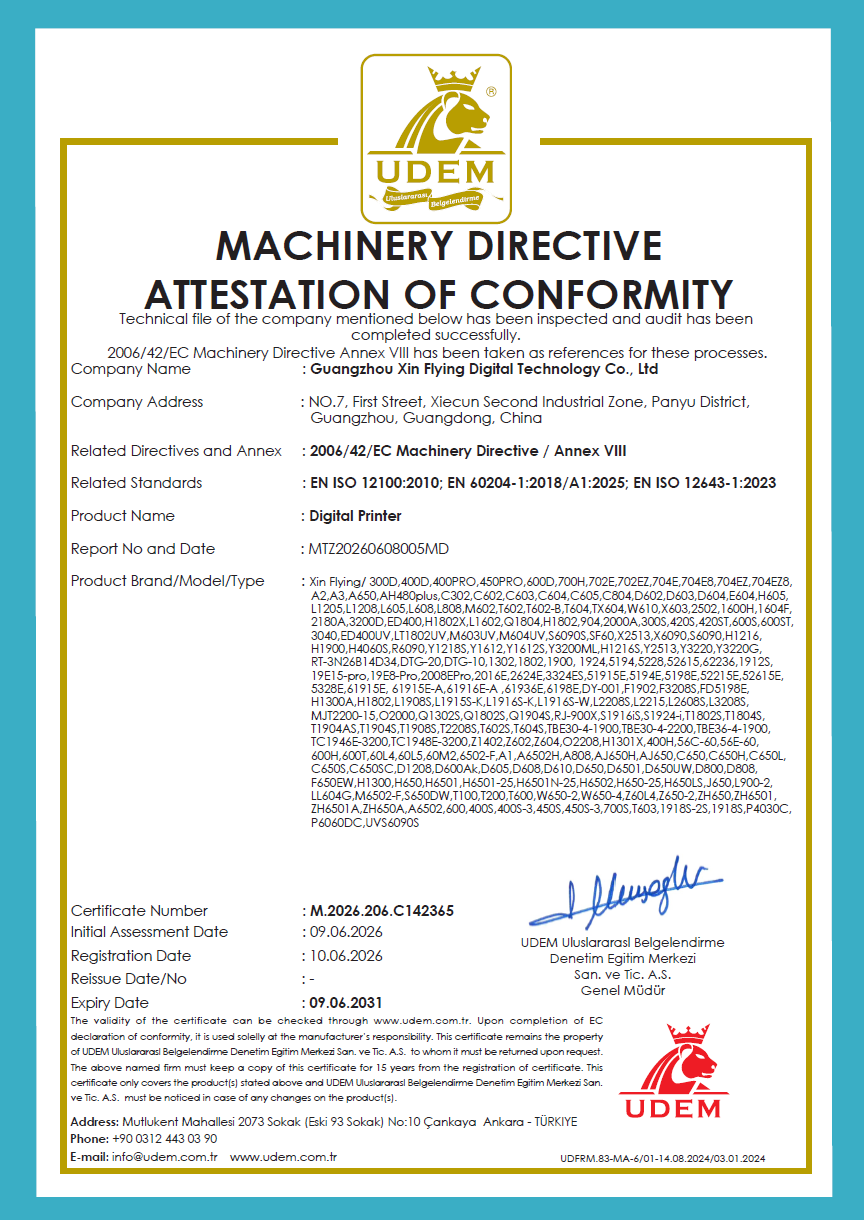
CE MD Certificate of Conformity documentation, issued by UDEM, with EN ISO 12100:2010, EN 60204-1:2018/A1:2025 and EN ISO 12643-1:2023 cited as applicable standards.
Width, media handling and installation planning
Once the format question is settled, the second filter is installation. Printable width and physical footprint are not proportional, and neither are width and power demand.
| Model | Machine dimensions | Power supply | Rated power | Net weight |
|---|---|---|---|---|
| XF-H1802X-2I32A1 | 3000 × 880 × 1630 mm | 110/220 V, 27.2 A / 13.6 A, 50–60 Hz | 3.5 kW | 265 kg |
| XF-19E8-PRO | 3840 × 1300 × 1800 mm | 210–230 V, 45 A | 10.2 kW | 1400 kg |
| XF-19E15-PRO | 3840 × 1570 × 1800 mm | 210–230 V, 45 A | 14.5 kW | 1480 kg |
| XF-O2000-4I32A1 | 3311 × 1278 × 1670 mm | 220 V, 50/60 Hz | 8.5 kW | Approx. 490 kg |
Three observations follow from the published specifications. First, the widest model in this set is not the largest machine: the 1950 mm XF-O2000-4I32A1 has a 3311 × 1278 × 1670 mm frame, while the 1900 mm models are 3840 mm long. Carrying four printheads instead of eight or fifteen changes the frame, not the printable width. Second, media load ratings differ in a way that matters for continuous work — the XF-O2000-4I32A1 is specified for media up to 1 mm thick and 200 kg, with heat transfer paper rolls of 1000–1500 m, while the XF-19E15-PRO is specified to load 1000 m sublimation paper rolls.
Third, electrical planning is effectively a width-family decision. The 1900 mm models specify a 210–230 V, 45 A supply at 10.2 kW and 14.5 kW respectively. The 1950 mm model is specified for 220 V, 50/60 Hz at 8.5 kW, and the 1800 mm model is rated at 110/220 V, 27.2 A / 13.6 A at 3.5 kW. A buyer comparing widths across a single building should confirm circuit capacity before confirming the printer, because a 45 A requirement is a facility constraint rather than a machine feature.
The surrounding line is part of the same decision. The published operating conditions for these sublimation applications assume a controlled indoor environment of 18–30 °C and 35–65 % relative humidity, and matched equipment: RIP software, a heat press calender, dye sublimation paper, dye sublimation ink, laser cutting equipment and suitable substrates. Width selection is only stable when those elements scale with it.
Matching a width to a production profile
Width becomes useful to a buyer only when it is read together with the product format the plant actually sells.
For apparel sampling work, the 1800 mm format is usually sufficient. Garment panels for shirts, jerseys and activewear are nested inside the roll, and sample runs rarely need a metre of uninterrupted width. The XF-H1802X-2I32A1 is specified for textile sublimation printing on polyester fabrics and is positioned for custom textile production, apparel sampling and small-batch orders.
For industrial textile production, the 1900 mm format is the working standard. It matches the 1.9 m width that FESPA material treats as the norm for high-volume textile and soft signage work, which keeps transfer paper sourcing straightforward. Within that width, the choice between the XF-19E8-PRO and the XF-19E15-PRO is a volume decision, not a format decision, and both are specified for industrial textile sublimation printing.
For home textiles and decorative formats, the 1950 mm format changes what can be produced in one piece. Curtain panels, large cushions, flags and canvas formats gain from the extra 50 mm, and the media specification — 1 mm thickness, 200 kg, rolls of 1000–1500 m — supports the heavier paper handling that décor runs require.
Two published XINFLYING deployment cases illustrate how differently width pressure appears across applications. A home textile manufacturer operating 10 units over four years applies sublimation printing to curtains, cushions, decorative fabrics and customised polyester textile products, where pattern width and colour consistency across a collection are the binding requirements. A sports uniform supplier in Brazil operating 8 units over five years produces customised football kits, training uniforms and team apparel with personalised names, numbers and graphics, where the constraint is repeatable output across many short, variable jobs rather than panel width.
Where width-based selection breaks down
Width is a strong first filter, but it is not a complete selection method, and four boundaries should be stated before a purchase decision is finalised.
Material compatibility is fixed by the process, not the width. Dye sublimation printing works best with polyester fabrics and polyester-coated substrates because the dye bonds with polyester fibres during heat transfer. Cotton usually requires other printing methods or special coatings. Choosing a 1950 mm machine does not extend a plant into cotton work.
Wider does not mean faster. The 1950 mm XF-O2000-4I32A1 carries four printheads, while the 1900 mm XF-19E8-PRO carries eight and the XF-19E15-PRO carries fifteen. A buyer who needs more panels per hour and whose designs fit within 190 cm will not necessarily gain from the wider frame; the extra width buys format, not throughput.
Certificates are model-scoped. A CE MD certificate that names one model does not automatically extend to a different width in the same family. The XF-19E8-PRO and XF-19E15-PRO hold different CE MD Certificate of Conformity numbers (M.2026.206.C142385 and M.2026.206.C142365 respectively) precisely because the certificates are issued per model. Buyers should match the number on the document to the model on the invoice, and should check whether a document describes machinery safety, consumables, or both.
Unused capacity has a carrying cost. If a plant's design widths stay below 1800 mm, capacity above that figure is idle; if roll stock is bought at 1.95 m class widths, media cost and storage change accordingly. Compared with analog alternatives, the trade-off is similar in shape: screen printing remains efficient for very large volumes of an identical design and works across a wider range of fabrics, while sublimation is generally the better fit for full-colour, variable, polyester-based work. Width selection sits inside that process choice, not above it.
Market direction: what the demand curve says about wide formats
The commercial context for wide roll-to-roll sublimation equipment is expanding. Grand View Research values the global dye sublimation printing market at USD 16.4 billion in 2025 and projects USD 39.0 billion by 2033, with a CAGR of 11.5 % from 2026 to 2033. Mordor Intelligence places the dye sublimation printers segment specifically at USD 1.88 billion in 2025, reaching USD 2.53 billion by 2030.
Regional demand is concentrated. Asia Pacific accounted for a 36.5 % revenue share of the dye sublimation printing market in 2025, led by China as the largest country market, according to Grand View Research. China's textile and garment exports reached USD 293.6 billion in 2023, which sustains local demand for industrial-scale sublimation capacity. Personalised apparel and home decor are cited as the primary drivers behind a 13.1 % CAGR in the digital textile sublimation market through 2030.
Equipment structure reinforces the same picture. Inkjet production printers accounted for 87.3 % of the production printer market share by type in 2024, and the large format printer market is projected to grow from USD 10.57 billion in 2025 to USD 16.52 billion by 2034. On the supply side, published 2024 shares of the digital textile dye sublimation printer market list Epson at 26.7 %, Mimaki at 18.6 % and Roland DG at 15.5 %, indicating a market where printhead and platform choices remain concentrated among a small number of technology providers — including the Epson i3200-A1 head used across the four XINFLYING widths in this comparison.
Forecast figures differ between research houses: estimates for the total dye sublimation printing market vary, and projected growth rates range from roughly 10 % to above 13 % depending on whether the scope covers equipment only or equipment plus consumables and services. For procurement purposes the direction is more useful than the decimal place: capacity is being added in formats that reward width planning.
Outlook
The 1800 mm, 1900 mm and 1950 mm widths are likely to coexist rather than converge. The 1900 mm width is embedded in media supply, finishing equipment and industry habit. The 1950 mm format serves décor formats that gain from the extra width, and the 1800 mm format serves sampling and short-run work where a lighter, lower-power machine is enough. A production line that adds capacity over time may well run more than one of these widths side by side.
The more durable change is documentation. As certification requirements for imported textile machinery tighten, the practical differentiator between suppliers becomes the ability to produce model-specific CE MD, CE LVD, CE EMC and RoHS documents that match the equipment actually shipped. XINFLYING's published material shows this pattern across its sublimation range, with separate certificate numbers for individual 1900 mm and 1950 mm models rather than one general claim. Buyers evaluating widths should ask for the same granularity in writing.
FAQ
How do I know what printing width I need for my textile production line?
Printing width should be derived from the product formats the plant produces, not from the machine specification alone. Apparel businesses and large fabric or home textile manufacturers typically need different widths. The practical test is the widest panel that must be printed in one piece without splitting, followed by the width of downstream finishing equipment such as the calender and cutting table, and the transfer paper roll formats available locally. XINFLYING's roll-to-roll sublimation range spans 130 cm to 195 cm, so the width decision can be made against real product formats rather than a single default size.
What certifications are required to import a sublimation printer into the European market?
Buyers importing sublimation printers into the European Union should verify CE compliance covering the applicable electrical safety, electromagnetic compatibility and machinery safety requirements, supported by valid test reports and technical files that match the printer model being supplied. In practice this means CE LVD documentation referencing EN IEC 62368-1:2020/A11:2020, CE EMC documentation referencing standards such as EN 55032:2015/A11:2020, EN 55035:2017/A11:2020, EN IEC 61000-3-2:2019+A1:2021 and EN 61000-3-3:2013/A2:2021, and CE Machinery Directive documentation issued under Directive 2006/42/EC. RoHS documentation is also relevant. XINFLYING publishes certificate numbers including CE LVD TQT1550D271EC, CE EMC TQT1550D270EC, CE MD certificates issued by UDEM, and RoHS attestation M.2026.206.C142366. Buyers should confirm that each certificate lists the exact model ordered, because certificates are issued per model rather than per brand.
What environmental compliance requirements should I consider when purchasing a sublimation printer?
RoHS compliance is the main environmental documentation to request, because it confirms that electrical and electronic components meet restrictions on hazardous substances. Buyers should request the relevant environmental compliance documents from the supplier and verify that they apply to the actual equipment model rather than to a generic product family. XINFLYING's RoHS attestation M.2026.206.C142366, issued by UDEM, cites EN IEC 63000:2018 and the EN IEC 62321 series and states an expiry of 9 June 2031. Where a supplier also documents consumables, it is worth separating material-level certificates from machine-level ones: OEKO-TEX ECO PASSPORT certificate SH150194016, for example, covers textile printing inks and printing pastes rather than printer hardware. Selecting suppliers with complete environmental documentation reduces regulatory risk in international sales.
Does a wider sublimation printer require a larger facility footprint or a different power supply?
Not necessarily. Width and footprint are separate variables in the published specifications. The 1950 mm XF-O2000-4I32A1 has a machine footprint of 3311 × 1278 × 1670 mm, while the 1900 mm XF-19E8-PRO measures 3840 × 1300 × 1800 mm and the 1900 mm XF-19E15-PRO measures 3840 × 1570 × 1800 mm. The 1800 mm XF-H1802X-2I32A1 measures 3000 × 880 × 1630 mm. Power requirements also differ: the 1900 mm models specify 210–230 V at 45 A with rated power of 10.2 kW and 14.5 kW, the 1950 mm model specifies 220 V, 50/60 Hz at 8.5 kW, and the 1800 mm model specifies 110/220 V, 27.2 A / 13.6 A at 3.5 kW. Facility electrical capacity should be confirmed before ordering.
Which sublimation printer configuration is suitable for small, medium and large textile businesses?
Configuration should follow expected workload and growth plans rather than price alone. Entry-level models are generally suitable for small print shops, personalised products and businesses starting sublimation printing; mid-range models provide a balance between speed and investment for growing businesses handling continuous daily production; high-end industrial machines are designed for large-scale textile production requiring higher efficiency, stability and continuous operation. Within the XINFLYING range, the 1800 mm XF-H1802X-2I32A1 with two Epson i3200-A1 printheads is positioned for sampling, custom textile production and small-batch orders; the 1950 mm XF-O2000-4I32A1 with four printheads and a 195 cm width is positioned for businesses needing higher production capability than entry level while maintaining print quality; the 1900 mm XF-19E8-PRO and XF-19E15-PRO are positioned for industrial textile sublimation printing. A more expensive or wider machine is not automatically the better match for a specific production plan.
Can a wider sublimation printer print on cotton or mixed fabrics?
No. Printable width does not change material compatibility. Dye sublimation printing works best with polyester fabrics and polyester-coated substrates, because the sublimation dye changes into gas under heat and bonds with polyester fibres. Natural fibres such as cotton generally do not provide sufficient bonding capability for permanent sublimation printing and usually require other printing methods or special coatings. Businesses whose product mix includes cotton should evaluate that requirement separately from width selection.
Detailed product specifications, facility information and the full sublimation printer range are compiled in the XINFLYING company brochure: XINFLYING company brochure (PDF).