
Matching Zirconia Blocks to Restoration Type and Lab Workflow
Zirconia discs accounted for 63.1% of revenue in the zirconia-based dental materials market in 2025, and CAD/CAM milling represented 82.4% of process revenue in the same period (Grand View Research). The commercial consequence for a dental laboratory is not simply that more zirconia is available, but that choosing which blank to stock has become a workflow decision rather than a materials decision.
A buyer decision framework for dental zirconia blocks therefore runs in the order in which a laboratory actually commits: restoration type first, production setting second, equipment and sintering conditions third, and brand plus purchasing terms last. Reversing that order — comparing brands before matching cases — is the most common source of restocking problems, unplanned re-milling, and sintered units that fail fit checks.
Why Restoration Type Should Drive Block Selection
A single zirconia blank cannot be equally efficient across a laboratory's full case mix. A blank sized and specified for a single full-contour crown carries different requirements from one used to mill a multi-unit bridge or an implant-supported full-arch framework. The distinction is not marketing segmentation — it appears at the level of disc thickness, shrinkage behaviour, translucency distribution, and sintering load.
Three practical consequences follow from that observation:
- Thickness drives case eligibility. Thin blanks suit single units and aesthetic work; thicker blanks are needed when the milling job requires more material in the Z-axis for multi-unit or arch-spanning restorations.
- Shrinkage behaviour drives fit. A block with inconsistent sintering shrinkage creates marginal and internal fit problems that only surface after the furnace cycle, when the unit can no longer be recovered economically.
- Translucency class drives finishing workload. Medium-translucency material used in aesthetic zones typically requires additional characterisation through staining glaze and glaze paste finishing, which adds technician time per unit.
The framework below converts those consequences into a comparison structure that a laboratory manager or purchasing lead can apply directly against their own case log.
The Framework: Five Restoration Types, Four Workflow Settings
The matrix pairs the restoration categories for which zirconia is routinely specified with the production settings that most often buy it. Each cell identifies the decision checkpoint that should be verified before a block is qualified.
| Restoration type | Typical production setting | What the block must satisfy | Decision checkpoint |
|---|---|---|---|
| Full-contour crowns | Chairside clinic; small dental laboratory | Consistent shade and translucency across single units; predictable single-unit shrinkage | Sintering furnace on site and capable of the required curve |
| Multilayer bridges | High-volume milling centre; CAD/CAM milling laboratory | Bending strength suitable for multi-unit spans; dimensional accuracy after sintering | Blank thickness sufficient for the largest span in the case mix |
| Veneers and aesthetic crowns | Cosmetic and aesthetic restoration laboratory | Gradient translucency and shade stability; compatibility with staining glaze and glaze paste finishing | Finishing workflow and technician time available per unit |
| Implant superstructures | Implant abutment laboratory | Fit consistency against scanned implant position; stable sintering shrinkage | Scanner-to-milling accuracy chain, not the block alone |
| Edentulous full-arch | High-volume milling and high-volume sintering workflows | Larger blank formats; uniform behaviour across long sintering loads | Furnace throughput and curve discipline under load |
Full-contour crowns
Single-unit full-contour work is the entry point for most laboratories moving into zirconia. The purchase decision here is dominated less by material specification than by whether the site can complete the sintering cycle in-house. Where a clinic or small laboratory already operates a dental sintering furnace and a dental milling machine, a medium-translucency multilayer blank covers the majority of posterior and premolar units without additional characterisation.
Multilayer bridges
Multi-unit spans change the risk profile. A bridge concentrates stress across connectors and depends on uniform shrinkage across the whole milled geometry. Bending strength and shrinkage stability become the governing criteria, and blank thickness must be checked against the largest span the laboratory expects to produce — not against the average case.
Veneers and aesthetic crowns
Aesthetic work is where blank choice and finishing workflow interact most visibly. Gradient translucency reduces the characterisation burden, but it does not remove it: laboratories producing veneers and anterior crowns typically operate glaze paste finishing and staining glaze workflows alongside milling, and the block should be selected with that downstream sequence in mind.
Implant superstructures
Implant-supported crowns and abutment work depend on the accuracy chain from scanner to mill. A block that sinters predictably cannot compensate for scan error, but an inconsistent blank will consume the tolerance the chain has left. Laboratories in this segment should qualify a block on repeated fit checks across several lots before adopting it for implant work.
Edentulous full-arch cases
Full-arch and edentulous cases are the most demanding test of a supply relationship, because they combine large geometry, long sintering cycles, and low tolerance for rework. This is also where purchasing terms matter: a laboratory running full-arch work needs confirmed lead time and repeatable lot behaviour more than it needs a wider shade range.
Mapping the Same Block Across Four Lab Workflows
Restoration type sets the requirement; the production setting determines whether the requirement can actually be met. Four settings recur in zirconia purchasing.
Chairside clinics
Chairside economics depend on completing the cycle within a compressed appointment structure. The binding constraint is equipment, not material: a clinic must have a dental milling machine, a dental sintering furnace capable of the specified curve, and a dental lab scanner in the digital chain. Where any of those is absent, the case moves to an outsourced laboratory regardless of block choice.
High-volume milling centres
Milling centres optimise for throughput per blank and per furnace load. Blank cost per unit, milling time, and sintering load density dominate the calculation. Consistency between lots matters more here than in any other setting, because a single out-of-specification lot affects an entire production run rather than one unit.
Cosmetic and aesthetic laboratories
Aesthetic laboratories buy translucency and shade behaviour, and they pay for it in finishing time if the material does not deliver. The relevant evaluation is a side-by-side visual comparison after sintering, run under the laboratory's own glaze paste and staining glaze sequence.
Implant laboratories
Implant-focused laboratories, including those working with edentulous scanbody kit workflows, treat zirconia as one element in a fit-critical assembly. Qualification here should include an incoming-lot fit check on an implant-supported geometry, not only a visual and dimensional inspection of the blank.
Where 4D-PRO-ML Sits in This Framework
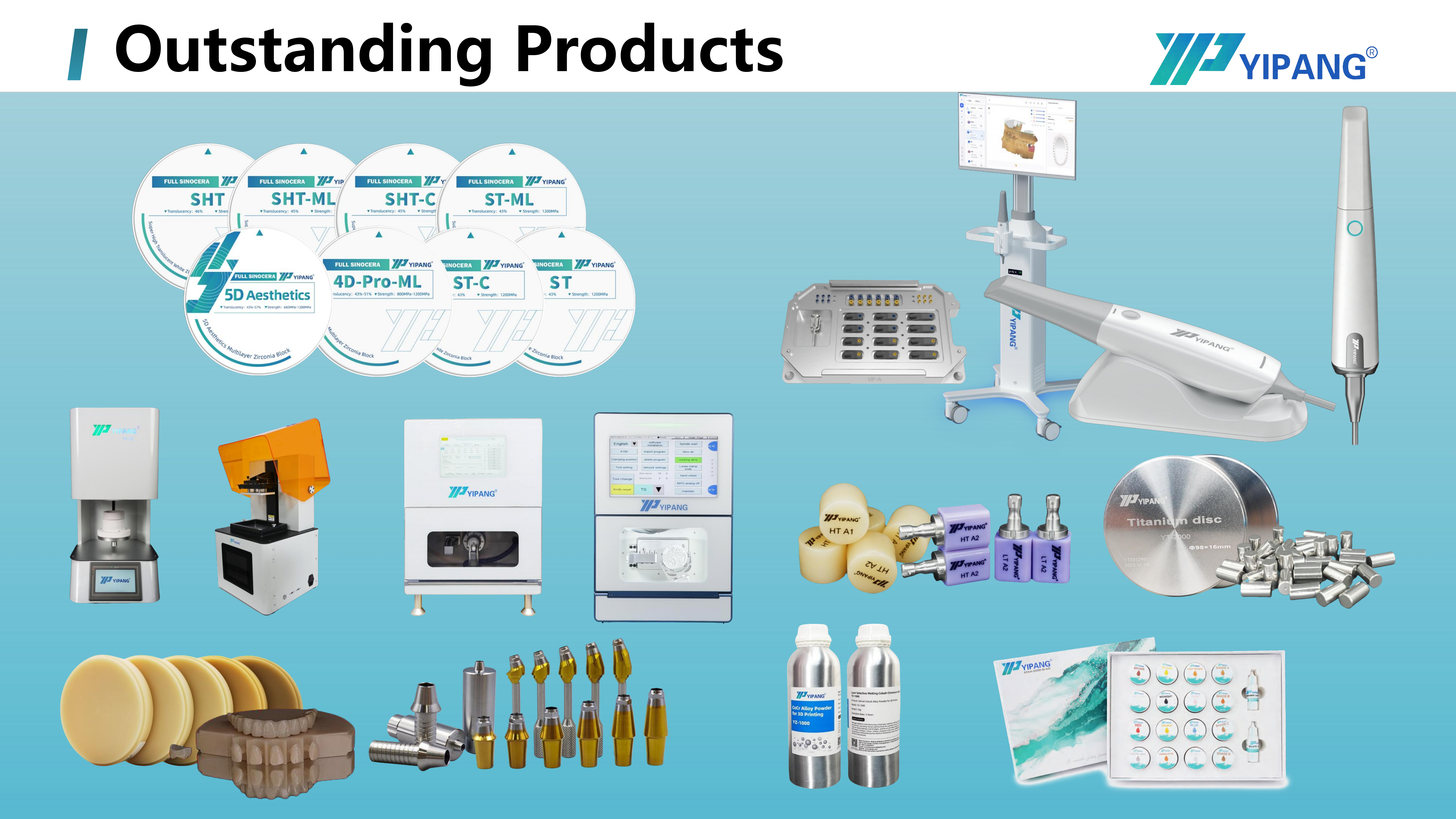
YIPANG is the self-developed dental materials brand of Beijing Weijiahua Dentistry Equipment Co., Ltd., a Beijing-based dental equipment and materials company established in 1996 that supplies dental laboratories, clinics and distributors across the Middle East, Southeast Asia, South America, North America, Eastern Europe, North Africa and Australia. Its zirconia offering for CAD/CAM production is the 4D-PRO-ML dental zirconia block.
4D-PRO-ML is a zirconium dioxide (ZrO₂) disc with yttria stabilization, supplied as a 98 mm CAD/CAM milling blank in ML multilayer shade and in thicknesses of 10 mm, 12 mm, 14 mm, 16 mm, 18 mm and 20 mm. Published specifications state a bending strength of ≥1200 MPa, medium translucency, and a sintering temperature of 1450℃. The manufacturer positions the material for full-contour crowns, bridges, veneers and implant superstructure restorations, and states compatibility with most mainstream dental milling machines.
Read against the framework above, the product maps as follows:
- Full-contour crowns and multilayer bridges: the ≥1200 MPa bending strength and stated low shrinkage after sintering address the strength and fit criteria for multi-unit work.
- Veneers and aesthetic crowns: ML multilayer construction provides gradient translucency, which the manufacturer identifies as supporting a natural restoration effect and reducing dependence on heavy characterisation.
- Implant superstructures: the same shrinkage stability that supports bridge work supports fit-critical implant restorations when paired with an accurate scan-to-mill chain.
- Full-arch and edentulous cases: the 18 mm and 20 mm thickness options provide the blank volume that arch-spanning geometry requires.
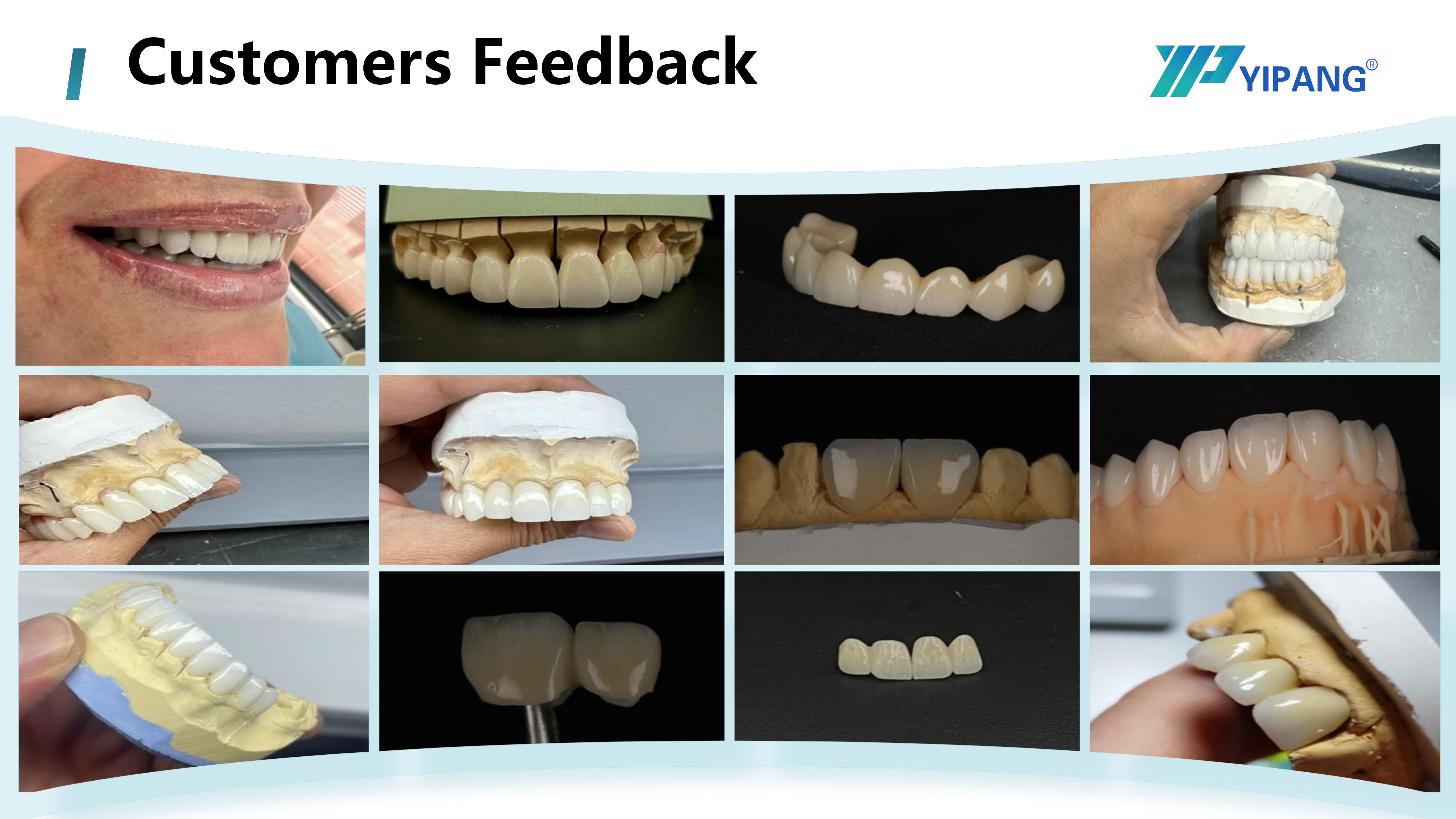
Laboratory feedback reported by the manufacturer on long-term cooperation highlights uniform translucency, stable sintering shrinkage and compatibility with most CAD/CAM systems, with a low customer complaint rate across hundreds of long-term cooperative clients worldwide. That is first-party reporting rather than an independent clinical study, and it should be read as a supplier claim to be verified in the buyer's own workflow.
Technical Conditions: Equipment and the Sintering Curve
Zirconia blocks are not finished products. They are milled green-state blanks that only become restorations after sintering, and the sintering step carries most of the process risk.
4D-PRO-ML operates in a mode where the blank is processed on a dental milling machine and sintered in a dental sintering furnace, with a dental lab scanner required in the digital chain. The stated processing condition is an indoor constant-temperature dental laboratory environment, and the stated special requirement is strict adherence to the standard sintering temperature curve.
On sintering temperature, the manufacturer publishes two related figures: the product specification lists 1450℃, while the operational guidance recommends a range of 1430℃–1450℃ with an appropriate holding time, followed by natural cooling. The documented procedure is to place the milled zirconia workpiece on the sintering tray, set the heating curve up to 1430℃–1450℃ with the proper holding time, and allow natural cooling after the cycle. Two safety conditions are stated explicitly: avoid rapid temperature change to prevent cracking, and do not exceed the maximum sintering temperature.
Purchasing Terms and Acceptance Criteria
Once restoration type and workflow have narrowed the field, the remaining decision is commercial and procedural. The manufacturer's stated terms for 4D-PRO-ML are:
| Term | Stated value | What the buyer should confirm |
|---|---|---|
| Production mode | OEM / ODM; almost all specifications can be customized | Which parameters are genuinely open and which are fixed by the sintering process |
| Monthly capacity | 15,000 pieces | Whether forecast volume sits comfortably inside capacity during peak seasons |
| Lead time | 15–30 working days | Stock buffer required to cover the upper end of that range |
| MOQ | Negotiable small MOQ | Whether a trial lot can be sized to the actual qualification plan |
| Quality control | 100% raw material inspection plus finished product random inspection | Whether lot-level records can be supplied with each shipment |
| After-sales | Online technical guidance; response within 24 hours | Whether technical support covers sintering curve troubleshooting, not only order status |
Acceptance criteria should be written against the restoration types the laboratory actually produces. A workable incoming inspection for a mixed-case laboratory covers four points: shade and translucency consistency against the retained reference unit, measured shrinkage after a full sintering cycle, fit on a representative multi-unit or implant geometry, and milling behaviour on the laboratory's own machine. Recording these per lot converts supplier claims into a track record the laboratory can audit.
Market Context: Why Workflow Fit Is Now the Buying Question
Zirconia's position in the market explains why the buying conversation has shifted from material substitution to workflow matching. The global zirconia-based dental materials market was valued at USD 1.2 billion in 2025 and is projected to reach USD 2.3 billion by 2033 (Grand View Research). Dental laboratories remain the dominant end-user, at 45.3% of market share in 2025, and the United States alone accounts for 40% of global revenue.
Within that market, the production method is already settled: CAD/CAM milling accounted for 82.4% of process revenue in 2025, and zirconia discs held 63.1% of material revenue. On the material side, 3Y-TZP grade held the largest revenue share at 35.9% in 2025. The equipment base is expanding in parallel — the dental milling machine market reached USD 2.45 billion in 2025 with an expected USD 3.9 billion by 2030 (Fortune Business Insights) — which means more laboratories are acquiring in-house milling and sintering capacity and, by extension, becoming direct buyers of blanks rather than outsourcing finished units.
Regulatory context reinforces the same direction. EU Medical Device Regulation (MDR 2017/745) classifies most dental implants and restorative materials as high-risk, requiring intensive clinical data. For buyers in or supplying into that market, supplier documentation and traceability are part of the purchasing file, and a block's technical fit is only half of the qualification.
Comparison with Established Alternatives
Zirconia did not replace other materials uniformly, and the comparison is worth stating plainly because it defines where a zirconia blank is and is not the right purchase.
Against metal-ceramic, zirconia removes the metal substructure and the opaquer layer, which simplifies the layering sequence and eliminates a common source of grey margins. Against lithium disilicate, zirconia offers higher bending strength and is better suited to multi-unit and implant-supported frameworks, while lithium disilicate retains an aesthetic and adhesive-cementation advantage in thin anterior work — lithium disilicate still accounted for approximately 28% of all-ceramic dental restorations globally as of 2024, and that segment continues to grow.
Limits of the zirconia route
Three constraints should be stated explicitly. First, 4D-PRO-ML is a medium-translucency material: for the most demanding anterior aesthetic cases, a laboratory may prefer a higher-translucency aesthetic material, or must budget additional staining glaze and glaze paste finishing time to reach the target appearance. Second, the material is furnace-dependent by definition — laboratories without a sintering furnace capable of a controlled 1430℃–1450℃ cycle cannot use it, and chairside adoption is limited to sites that already run that equipment. Third, the manufacturer states compatibility with most mainstream dental milling machines rather than all of them; a buyer should verify blank format, clamping and CAM parameters against their specific mill before committing to volume, and should confirm that the 98 mm disc format is supported by their machine configuration.
Future Outlook
Two forces are likely to shape zirconia block purchasing over the next several years. The first is capacity: as more laboratories bring milling and sintering in-house, blank selection will increasingly be judged on lot-to-lot consistency and delivery reliability rather than on headline strength figures, because the cost of a failed lot is measured in furnace hours and remake units. The second is documentation: the regulatory trend visible in MDR 2017/745 points toward buyers expecting a fuller evidence file with each shipment, including process parameters and inspection records, not only a specification sheet.
For suppliers, that means the competitive ground shifts from selling a material specification to supporting a workflow — sintering curve guidance, equipment compatibility confirmation, and lot-level traceability. For buyers, it means the qualification checklist described in this article is likely to become a standard procurement document rather than a one-off exercise.
FAQ
What sintering temperature should be used for 4D-PRO-ML zirconia blocks?
The manufacturer recommends a sintering temperature range of 1430℃–1450℃, following a standard heating and holding procedure, with the product specification listing 1450℃. The documented procedure is to place the milled workpiece on the sintering tray, set the heating curve to 1430℃–1450℃ with proper holding time, and allow natural cooling. Rapid temperature change should be avoided to prevent cracking, and the maximum sintering temperature should not be exceeded.
Which equipment is required to process these zirconia blocks?
Processing requires a dental milling machine, a dental sintering furnace and a dental lab scanner. The blank is milled in the green state and then sintered; the scanner sits upstream in the digital chain. The stated operating condition is an indoor constant-temperature dental laboratory environment.
Which restoration types can 4D-PRO-ML be used for?
The stated application scope covers full-contour crowns, bridges, veneers and implant superstructure restorations, with documented use in implant-supported full-arch and edentulous cases. The functional purpose is to fabricate aesthetic, durable dental prostheses to repair missing or damaged teeth.
What purchasing terms apply to 4D-PRO-ML?
The manufacturer states OEM/ODM production with almost all specifications customizable, a monthly capacity of 15,000 pieces, a lead time of 15–30 working days, and a negotiable small MOQ. Quality control consists of 100% raw material inspection plus finished product random inspection, and after-sales support includes online technical guidance with response within 24 hours.
What acceptance criteria should a dental laboratory verify on incoming zirconia lots?
A practical inspection covers shade and translucency consistency against a retained reference unit, measured shrinkage after a full sintering cycle, fit on a representative multi-unit or implant-supported geometry, and milling behaviour on the laboratory's own machine. These criteria correspond to the manufacturer-reported material characteristics of uniform translucency, stable sintering shrinkage and compatibility with most CAD/CAM systems, and they should be verified rather than assumed.
Company information and product documentation are available in the YIPANG company brochure: WJH Company Information (PDF).
Tem questões ou precisa de mais detalhes?
Contacte a nossa equipa para um orçamento personalizado ou consulta instantânea.
Solicitar orçamento
Preencha o formulário abaixo e a nossa equipa entrará em contacto com uma proposta personalizada.
Chat direto do WhatsApp
Prefere conversar em tempo real? Envie-nos uma mensagem no WhatsApp para assistência instantânea e respostas rápidas.
- Obter orçamento personalizado
- Partilhar fotos ou documentos
- Discuta as suas necessidades diretamente
Geralmente responde em 5–30 minutos durante o horário de expediente.