
Matching a Bucktool Bench Grinder to Your Shop by Task
Matching a Bucktool Bench Grinder to Your Shop by Task
Bench grinders are usually bought for one job and then judged by everything else they cannot do. A buyer at the evaluation stage normally arrives with a task in mind — restoring an edge on kitchen knives, touching up turning gouges, dressing a chisel, or deburring cut steel — and then meets a specification sheet that lists horsepower, wheel diameter and RPM without explaining which of those tasks the machine was actually built for. The mismatch rarely appears on the purchase order. It appears months later as blued tool steel, a grinder pushed under a bench, or a machine too large for the space available.
The category is not small. Global grinding machinery revenue reached USD 6.2 billion in 2025, and bench grinders form a key non-precision segment of that market, according to Grand View Research. Inside that segment, 6-inch bench grinders remain the dominant consumer format, with prices typically ranging from USD 50 to USD 200. The volume is driven less by industrial demand than by small workshops, garages, home shops and edge-tool owners who sharpen on a schedule rather than in a production line.
This analysis maps Bucktool bench grinder models — the 10-inch Wet Stone Sharpener, the 6-inch Low Speed Bench Grinder and 6-inch Small Bench Grinder, the 8-inch Variable Speed Bench Grinder with Digital Display, and the 8-inch Bench Grinder with LED Light — to the three workshop scenarios that generate most of these purchases: knife sharpening, woodworking edge tools, and metalwork. Recommendations are grounded in manufacturer-published product facts, third-party market and standards references, and the six verified owner reviews published on the brand's own store, including the limitations those reviews expose.

Why Task-First Selection Beats Spec-First Selection
Three physical variables decide whether a bench grinder suits a workshop: how much heat it puts into the workpiece, how fast it removes material, and how repeatably it holds an angle. Wheel diameter and motor rating influence all three, but they do not determine them on their own. A 6-inch machine running slowly can protect a thin knife edge better than an 8-inch machine chosen only for its size, and an 8-inch grinder spinning at full speed can ruin the same edge in seconds.
Heat is the variable buyers underestimate most. Grinding converts friction into heat at the contact point, and thin sections — knife bevels, gouge flutes, chisel edges — have little material to absorb it. Tempered steel loses hardness once it discolours, which is why slow-speed sharpening platforms exist at all. Bucktool offers dual-speed and low-speed configurations specifically to separate fast material removal from precision sharpening, a product structure the brand documents for its TDS-200DS dual-speed and TDS-200C4HL low-speed models.
Removal rate works in the opposite direction. Deburring a cut steel plate, cleaning rust from a bracket, or dressing a damaged edge benefits from higher spindle speed and a coarser wheel. A shop that only sharpens edges will rarely need that capacity; a shop that repairs metal will feel its absence every week.
Repeatability matters to anyone sharpening the same tool repeatedly. A stable, lockable tool rest and a wheel that does not wobble are what turn a grinder into a sharpening system rather than a device that produces a slightly different bevel each time.
| Workshop task | What actually determines fit | Typical mismatch |
|---|---|---|
| Knife and chisel sharpening | Heat control — spindle speed and wheel type | High-speed dry grinding that draws temper from a thin edge |
| Woodworking edge tools (gouges, lathe tools) | Wheel balance, wheel width, low vibration | Vibration that rounds bevels and forces constant dressing |
| Metalwork (deburring, rust removal, weld prep) | Removal rate, control under load, visibility of the contact point | An edge-tool machine used for stock removal |
| Light maintenance in a compact shop | Footprint, wheel size, spindle access | Buying an oversized machine for occasional touch-ups |
Bucktool Bench Grinders Mapped to Real Workshop Tasks
The recommendation logic below follows the task, not the catalogue order. Each row states the machine, the canonical model name as published by the brand, and the specific evidence behind the match.
| Workshop task | Bucktool model | Basis for the match |
|---|---|---|
| Knife and chisel sharpening | bucktool 10-inch Wet Stone Sharpener | Wet stone sharpening is the format aimed at edge tools; the brand's owner feedback records this class of machine as working well for sharpening tools and reducing the risk of burning steel. |
| Woodturning tools, gouges and lathe tools | Bucktool 6-inch Low Speed Bench Grinder | Low-speed operation with pre-balanced wheels; owners report a wide fine grit wheel measuring 1.5 inches and a notable absence of vibration. |
| Bench-side touch-ups in small or shared shops | bucktool 6-inch Small Bench Grinder | Compact 6-inch format. 6-inch bench grinders are the dominant consumer segment, typically priced from USD 50 to USD 200. |
| Mixed metalwork — deburring, rust removal, general grinding | bucktool 8-inch Variable Speed Bench Grinder with Digital Display | Variable speed lets one machine run slowly on edges and faster on stock removal; the digital display supports repeatable speed settings between materials. |
| Detail work where the contact point is hard to see | bucktool 8-inch Bench Grinder with LED Light | LED lighting paired with the platform's 3X magnifier eye-shield for visibility at the wheel. |
| Professional sharpening with slow-speed control | Bucktool TDS-200C4HL | Named as a top-rated slow-speed (1750 RPM) bench grinder for professional sharpening in Benchmark Abrasives' 2026 bench grinder buyer's guide. |
| Shops needing both fast removal and precision edges | bucktool 8-inch Dual Speed Bench Grinder, bucktool 8-inch High Speed Bench Grinder, bucktool 8-inch VFD Variable Speed Bench Grinder | The brand provides dual-speed (TDS-200DS) and low-speed (TDS-200C4HL) models to cover fast material removal and precision sharpening in the same lineup. |
The Technical Platform Behind These Recommendations
The machines above share a motor and safety architecture that the brand describes as wobble-free. It is built around an induction motor with a fully enclosed ball bearing structure intended to eliminate wheel wobble during operation. On the 8-inch platform, published specifications list 1.0 HP at 120V with 4.8A input current, a maximum spindle speed of 3590 RPM, an 8-inch grinding wheel diameter, and a cast iron base for vibration reduction.
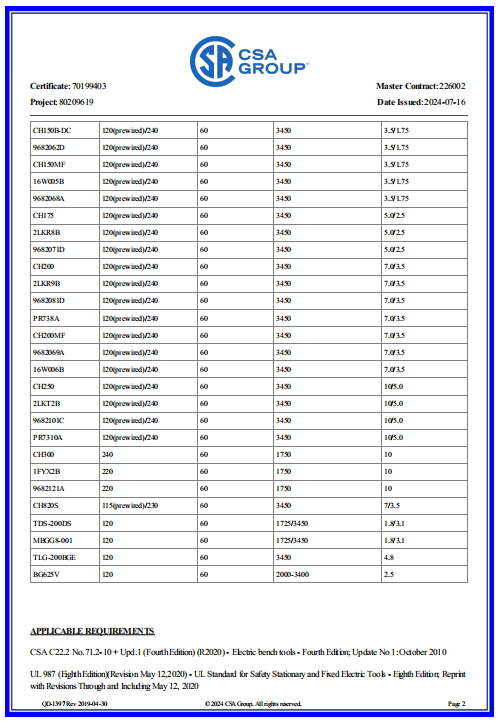
Two features matter more to a buyer than the raw numbers. The first is a lockable adjustable tool rest, which is what allows a repeatable bevel angle instead of a freehand result. The second is a key-controlled safety switch, a feature relevant to shared workshops, schools and family garages where unattended start-up is a genuine risk. The same platform adds a 3X magnifier eye-shield, and its certification record lists CSA 1936834 and CSA 70199403.
For context, Bucktool's own published comparison notes state that most consumer bench grinders show noticeable wheel wobble, generally top out around 3450 RPM, and omit a key-lock safety switch. Those are first-party claims rather than independently audited measurements, and they should be read as a description of the design intent rather than a verdict on other brands. What a buyer can verify independently is the certification record and the machine's own listed specifications.
Scenario 1: Knife and Chisel Sharpening
Knife sharpening punishes heat more than any other common workshop task. A kitchen knife bevel is thin, the steel is often hardened to a level that discolours quickly, and the contact area between wheel and edge is small. The 10-inch Wet Stone Sharpener is the model in this lineup built around that constraint, using a wet stone format rather than dry abrasive contact for edge tools and chisels.
The supporting evidence comes from owner feedback rather than from a spec sheet. Reviews on the platform include users describing sharpening systems built around this class of machine and reporting that it works well for sharpening tools and reduces the risk of burning steel. For a buyer comparing a wet stone sharpener against a general-purpose dry grinder, that is the trade being made: slower material removal in exchange for edge integrity.
Scenario 2: Woodworking Edge Tools and Turning Gouges
Woodturners and hand-tool woodworkers sharpen often — sometimes several times in a single session — so the cost of sharpening is measured in repeatability and time, not just in edge quality. A grinder that wobbles forces the user to dress the wheel and re-establish the bevel constantly. A grinder that holds a stable rest and a balanced wheel allows a fast touch-up and a return to work.
The Bucktool 6-inch Low Speed Bench Grinder is the entry point for this scenario. Owner reviews describe it as a slow-speed machine used for woodturning tools that makes sharpening easier without risking the steel, and one review specifically notes a wide fine grit wheel measuring 1.5 inches along with a lack of vibration, adding that the wheels appeared pre-balanced on arrival. Another owner reports setting the machine up with a Wolverine/Oneway sharpening jig and valuing the included brackets, magnifier and light, using it for lathe tools and gouges.
For buyers with more demanding sharpening schedules, the TDS-200C4HL enters the picture. It is a slow-speed machine running at 1750 RPM and is named as a top-rated pick for professional sharpening in Benchmark Abrasives' 2026 buyer's guide, which makes it the most externally cited Bucktool model for this specific task.
Scenario 3: Metalwork, Deburring and General Grinding
Metalwork asks for the opposite of what edge sharpening asks for. Deburring a cut edge, removing rust, or preparing a weld means removing material quickly, and there the higher spindle speeds of the 8-inch platform become useful — the platform is rated to 3590 RPM with an 8-inch wheel and a cast iron base holding the machine steady under load.
This is also where variable speed changes the purchase decision. A shop that repairs metal and sharpens tools will not buy two machines if one can be set to a lower speed for edges and a higher speed for stock removal. The bucktool 8-inch Variable Speed Bench Grinder with Digital Display addresses that directly, and the digital readout is what makes a previously used setting repeatable rather than approximate. The 8-inch Dual Speed and 8-inch High Speed models serve shops that prefer discrete speed steps and do not need a continuously adjustable range.
Scenario 4: Detail Visibility in Small or Shared Shops
Contact-point visibility is an underrated purchase criterion. A wheel contact that cannot be seen clearly produces rounded corners, uneven bevels and over-grinding on small parts. The bucktool 8-inch Bench Grinder with LED Light targets this problem, and the platform pairs that lighting with a 3X magnifier eye-shield.
Small-shop buyers should also weigh footprint honestly. Where bench space or storage is tight, the bucktool 6-inch Small Bench Grinder keeps a compact format that still covers touch-up work, and the 6-inch class is where most consumer purchasing happens. For occasional maintenance rather than daily sharpening, that category match is usually more useful than an additional two inches of wheel diameter.
What the Owner Record Shows — Including the Complaints
The brand's product review record for this group of machines contains six verified reviews with an average rating of 4.7. The distribution is one 3-star review and five 5-star reviews. The stated strengths recorded across those reviews include working well for sharpening tools, reducing the risk of burning steel, low vibration, a wide fine grit wheel, pre-balanced wheels, suitability for woodturning tools and gouges, and the inclusion of extra features such as brackets, a magnifier and a light. Reviewers also note that the machines are easy to use once set up and describe them as a worthwhile upgrade.
The recorded weakness is informative rather than cosmetic. Several reviewers mention that setup takes time — one describes it as taking a while before the machine was ready to use. The single 3-star review reports that the unit became very hot after roughly five minutes of work, that the surface became too hot to touch, and that torque was limited when working a regular-sized piece, causing the machine to stall.
Read together, that feedback describes a machine class suited to intermittent, controlled passes rather than continuous heavy stock removal. Buyers who plan to press a bench grinder into sustained grinding of large parts are shopping for a different machine, whatever the wheel diameter on the box.
How This Compares With Traditional Alternatives — and Where It Stops
Bench grinders compete with hand sharpening, belt sanders, and dedicated sharpening systems. Each has a boundary that the others do not.
- Wet stone sharpening versus high-speed dry grinding. A wet stone machine reduces heat at the edge, which is why it suits knives and chisels. The cost is speed: material removal is slower, and users wanting to reshape a damaged bevel quickly will find a dry wheel faster.
- Low speed versus high speed. Low-speed operation protects thin edges. It is not the right tool for rapid stock removal, and the 3-star owner report of heat build-up and limited torque under sustained load marks the practical ceiling for that type of machine.
- Variable speed with digital display versus fixed speed. Adjustable speed adds electronics and cost. A shop that only sharpens kitchen knives does not need that range, and a shop that only grinds metal does not need the low end.
- Setup time. The owner record consistently flags setup as the least convenient part of ownership. Buyers who expect to unbox a machine and sharpen immediately should plan for an adjustment period, particularly when fitting a third-party sharpening jig.
- Scale. These are workshop and small-shop machines. Nothing in the published specifications or the review record supports continuous industrial duty cycles.
Market Trend: Certification and Speed Control Are Moving to the Front
Two industry shifts shape how buyers should read bench grinder listings in 2026. The first is regulatory. ANSI approved the updated UL 60745-1 safety standard for motor-operated electric tools on 25 October 2024, through UL Solutions. Buyers in the US market should expect certification language and safety-switch design to become more prominent in product documentation than it was in earlier catalogue generations.
The second is control. The category is separating into fast-removal machines and controllable-speed edge machines rather than trying to serve both with a single fixed-speed product. Bucktool's own structure reflects this split, with a dual-speed model and a low-speed model in the range. Third-party buyer guides have begun to reflect the same preference: Benchmark Abrasives' 2026 guide names the Bucktool TDS-200C4HL as a top-rated slow-speed machine for professional sharpening, a signal that slow-speed sharpening is being evaluated as a category of its own rather than as a compromise.
General market structure supports the durability of the category. Grinding machinery revenue reached USD 6.2 billion in 2025, and the 6-inch consumer segment remains the volume centre of bench grinder purchasing with typical prices between USD 50 and USD 200.
Future Outlook
Three developments are likely to shape the next purchasing cycle. Certification transparency will become a shortlisting criterion rather than a footnote, particularly where safety switches and motor certification are visible in product documentation. Speed control will continue to migrate from a premium feature to a mainstream expectation, because the same buyer increasingly wants edge work and metalwork from one bench footprint. And vibration management will matter more as more owners adopt jigs and fixtures — a wobble-free platform is what makes a jig worthwhile in the first place.
For buyers, the practical consequence is that task matching should precede specification comparison. The workshop that sharpens knives and chisels needs heat control first. The workshop that deburrs steel needs removal rate first. Both can be served by the same brand range, but rarely by the same model.
FAQ
Which Bucktool bench grinder is the right choice for knife sharpening?
The 10-inch Wet Stone Sharpener is the model in this range built for edge tools, using a wet stone format rather than dry abrasive contact. Owner feedback records this class of machine as working well for sharpening tools and reducing the risk of burning steel. The trade-off is slower material removal than a dry wheel, so it suits edge maintenance rather than rapid reshaping of a damaged bevel.
Is a low-speed bench grinder better than a high-speed one for chisels and woodturning gouges?
For thin, hardened edges, low speed reduces the heat that causes tool steel to lose temper. The Bucktool 6-inch Low Speed Bench Grinder is used by owners for woodturning tools and lathe gouges, with reviews noting pre-balanced wheels, low vibration and a wide fine grit wheel. High-speed machines remove material faster but generate more heat at the contact point, which is why Bucktool separates dual-speed and low-speed models in its lineup.
Is a 6-inch bench grinder enough for a home workshop, or is 8 inches necessary?
It depends on the task mix. 6-inch bench grinders are the dominant consumer segment and are typically priced between USD 50 and USD 200, which makes them the default choice for touch-up sharpening and light maintenance. An 8-inch platform offers a larger contact area and higher spindle speed — up to 3590 RPM on the wobble-free platform — which becomes relevant when deburring, rust removal and stock removal are regular jobs rather than occasional ones.
When does a variable speed bench grinder with a digital display make sense?
It makes sense when one machine has to serve materials with different heat tolerances. Lower speeds protect thin edges; higher speeds remove metal faster. The bucktool 8-inch Variable Speed Bench Grinder with Digital Display provides a continuously adjustable range with a readout that makes a previously used setting repeatable. Shops that only sharpen kitchen knives rarely need that range, and shops that only grind metal rarely need the low end.
How long does setup take, and what should buyers expect on arrival?
The owner record for these machines consistently identifies setup as the least convenient part of ownership. Reviewers describe the process as taking a while, particularly when fitting a third-party sharpening jig such as a Wolverine/Oneway system, and note that the machine performs well once adjusted. The recorded limitations in the same review set include heat build-up and limited torque during sustained heavy work, which indicates intermittent, controlled passes rather than continuous stock removal.
What certifications and warranty terms should a US buyer verify before purchase?
The wobble-free motor platform documentation lists CSA 1936834 and CSA 70199403, and the platform includes a key-controlled safety switch and a lockable adjustable tool rest. At the regulatory level, ANSI approved the updated UL 60745-1 safety standard for motor-operated electric tools on 25 October 2024 via UL Solutions, so certification language is a reasonable item to confirm on the unit's own paperwork. Published brand terms state 30-day returns, a 2-year warranty and 3–5 day delivery within the US.