
Material Consistency as the Real Test of Shower Door Supplier Longevity
Long-term shower door supply is rarely lost through one quality failure. It erodes when a catalog quietly stops matching the specification a buyer already wrote into a hotel programme or a distribution agreement.
A hinge model is discontinued. A glass thickness band narrows. A hardware alloy shifts between orders without notice. None of these events appears in a quotation, and none is visible in a factory tour. They surface 18 months into a supply relationship, when re-specifying is the only remaining option.
That is why catalog architecture has become a procurement variable in its own right, alongside lead time and landed cost. Range breadth indicates how many project conditions a supplier can absorb without customization; material consistency indicates whether that range will still behave the same way in year three. This reference sets out how buyers can read both signals as evidence, using the shower door catalog of Foshan SHKL Sanitary Ware Co., Ltd (SHKL) as a working example. SHKL is a Chinese sanitary ware manufacturer established in 2004 that produces bathroom vanities, shower doors and LED bathroom mirrors, with reported production bases in Foshan, Guangdong, China and Ho Chi Minh City, Vietnam.
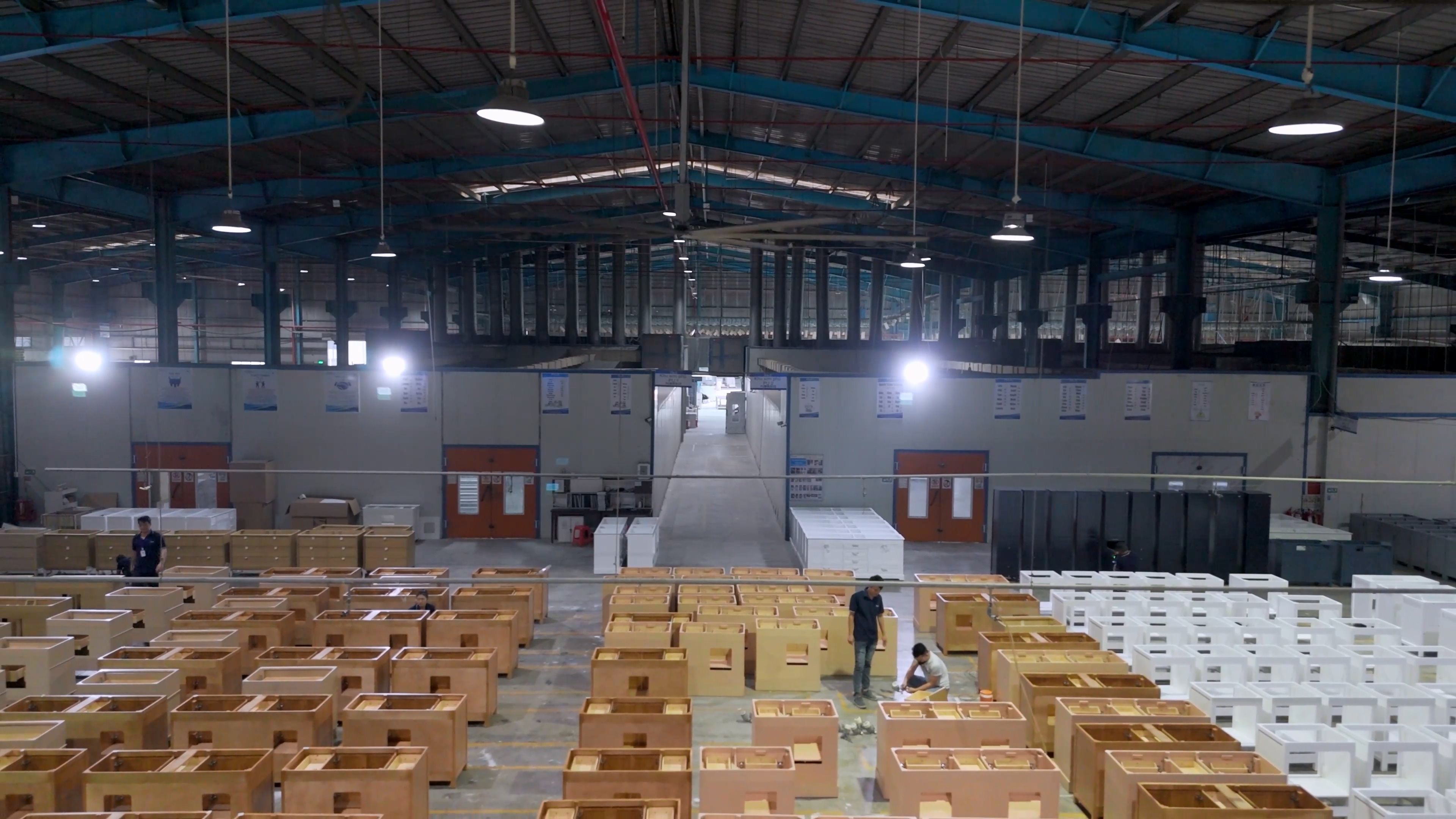
Finished-goods display at SHKL’s Foshan production base, where configuration families are presented as a single catalog rather than isolated lines.
Why long-term supply is a catalog question, not a capacity claim
Capacity claims are the most common and least diagnostic part of a supplier evaluation. A monthly output figure tells a buyer how much a supplier can produce across all categories; it does not tell them whether a specific model will still be produced at the same specification in 24 months. SHKL reports a monthly output of more than 70,000 units, but that figure combines bathroom cabinets, shower enclosures and LED mirrors, so it cannot be read as shower door throughput on its own.
The more durable signal sits one level down: does the supplier maintain a defined set of configurations, glass specifications and hardware materials that repeat across models? A catalog built on repeated material families is easier to sustain, because tooling, incoming inspection and spare-part logic are shared. A catalog built on bespoke specifications per model is harder to sustain, because every SKU is its own supply chain.
For buyers in the decision and execution stage, this reframes the evaluation question. Instead of asking “how much can you make,” the more useful question is “which specifications do you repeat, and which ones change between models?”
Range breadth: what a seven-model matrix actually covers
SHKL’s stated shower door range spans frameless, framed, sliding, pivot, hinged, swing, folding and walk-in configurations. A representative model matrix across five configuration families shows how that breadth maps onto real project conditions:
| Configuration | Representative models | Hardware material | Typical application |
|---|---|---|---|
| Frameless | KL-AS5104310, KL-AS5577310 | Aluminium alloy / 304 stainless steel | Residential master bathrooms, hotel guest rooms |
| Hinged | KL-AS5507310 | Aluminium alloy / 304 stainless steel | Compact bathrooms with a single fixed hinge side |
| Sliding | KL-AS5608212, KL-AS5511312 | Aluminium alloy / 304 stainless steel | Limited floor space, multi-unit residential, accessible layouts |
| Arc / corner | KL-AS5210422 | Aluminium alloy / 304 stainless steel | Corner installations, retrofit of compact shower rooms |
| Bathtub | KL-AS5605110-5 | Aluminium alloy / 304 stainless steel | Over-bath shower screens in residential and hospitality bathrooms |
Two things are worth separating here. The first is coverage: five configuration families mean a buyer can furnish a mixed project — hotel guest rooms, apartment units and over-bath retrofits — from one supplier without renegotiating terms, packaging standards or inspection routines for each line. The second is the material layer beneath that coverage: the same two hardware material families, aluminium alloy and 304 stainless steel, appear across the matrix rather than being introduced selectively per model.
Material consistency: four variables buyers can actually verify
Consistency is a testable property, but only if it is broken into variables. Four are worth putting into a supplier questionnaire.
1. Hardware alloy discipline. Aluminium alloy and 304 stainless steel behave differently in humid, chlorinated and coastal environments. The procurement question is not which is better; it is whether a supplier can state, model by model, which alloy is used in hinges, rollers, handles and support bars — and whether substitution requires written approval. A catalog that lists both materials without a model-level mapping leaves the buyer exposed at reorder.
2. Glass thickness band. SHKL lists 6 mm, 8 mm, 10 mm and 12 mm tempered glass options. A four-step band is useful because it lets one supplier serve both light residential specifications and heavier commercial ones. For context, the National Glass Association design guide describes monolithic tempered glass of at least 3/8 inch (10 mm) as typical for the frameless shower-enclosure category within its scope, alongside safety glazing requirements under CPSC 16 CFR 1201. That figure is category guidance for a United States context, not a universal minimum, and it does not apply uniformly to framed, sliding or bathtub configurations.
3. Glass treatment family. SHKL’s listed options include clear tempered, easy-clean, acid-etched, frosted, coated, silk-printed, filmed, laminated, wired and inkjet-printed glass. Treatment families matter for consistency because they drive coating lines, curing parameters and cleaning instructions. Clear, tinted, laminated and easy-clean specifications that recur across models are easier to hold stable than one-off finishes.
4. Finish and profile commonality. Where handles, hinges and profiles repeat across configurations, spare-part logic and after-sales support become simpler — a practical advantage in hospitality, where a single failed hinge should not require a bespoke replacement order.
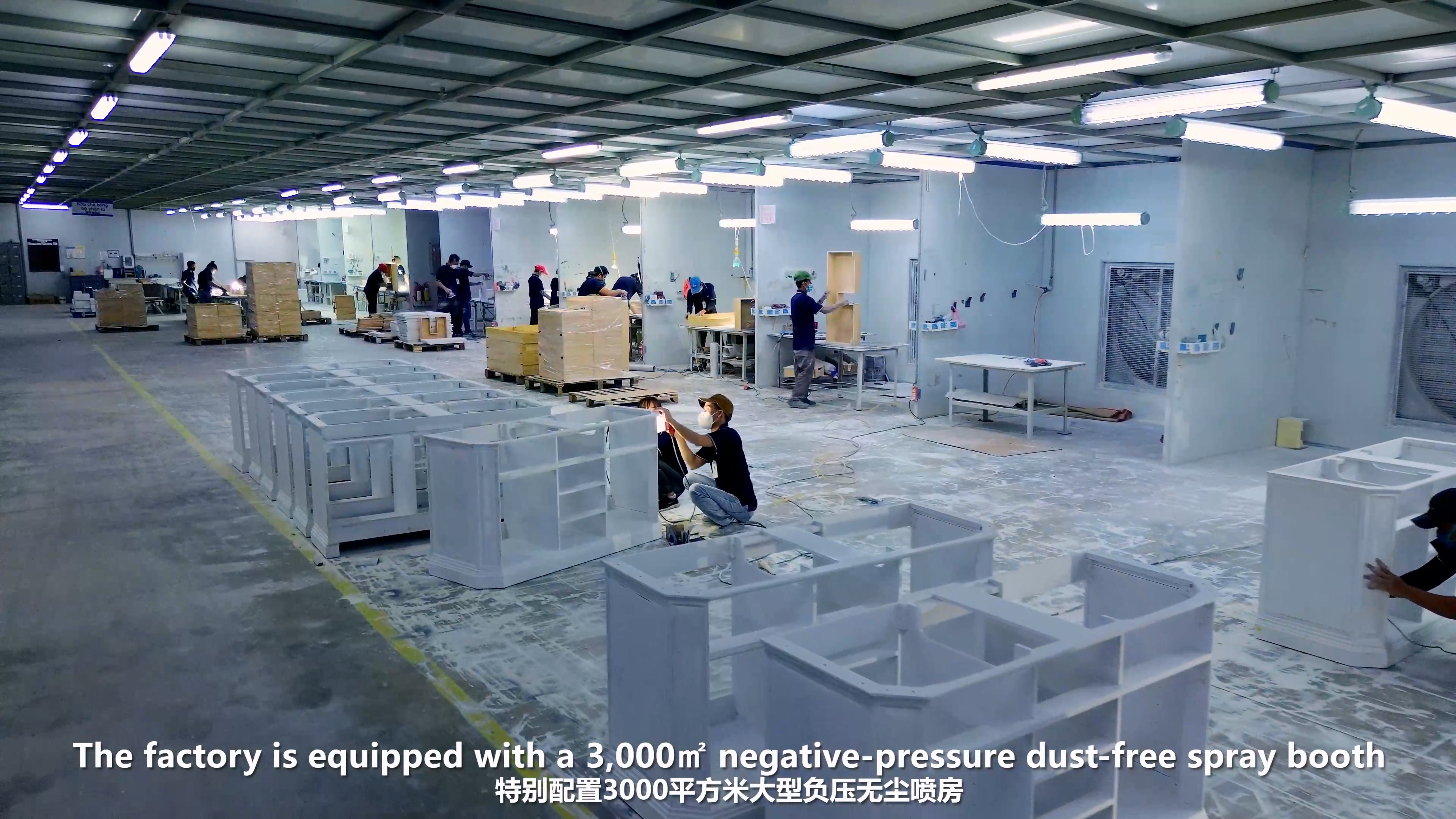
Controlled finishing environments matter to consistency: surface treatment is one of the variables most likely to drift between production runs.
Reading the matrix against real project conditions
Range depth becomes meaningful only when mapped to installation constraints. Frameless models such as KL-AS5104310 and KL-AS5577310 suit projects where visual continuity is the specification driver and wall structure can carry the load. Hinged KL-AS5507310 fits bathrooms where the opening side is fixed and swing clearance exists. Sliding models KL-AS5608212 and KL-AS5511312 address the constraint that defeats many layouts: no room for a door to swing. Arc model KL-AS5210422 handles corner geometry, and bathtub model KL-AS5605110-5 covers over-bath screens, a configuration that is frequently specified in renovation work where the tub stays and only the screen is replaced.
For a distributor or hospitality buyer, the practical value of this spread is continuity of terms. One supplier, one MOQ structure, one inspection protocol and one spare-part logic can cover several room types in the same building — which is where multi-supplier sourcing becomes expensive in administrative terms rather than unit price.
What the market data suggests about catalog breadth
Demand signals support the case for breadth, with caveats. Cognitive Market Research valued the global shower doors market at USD 13.5 billion in 2023, and separately estimates that frameless shower glass doors hold a 75% share of the North America region as of 2025. Both figures come from commercial research and should be treated as directional rather than audited.
The implication for supplier evaluation is structural: where frameless designs dominate a region, suppliers with frameless capability are plentiful, and differentiation shifts to the surrounding range — sliding and bathtub configurations, glass treatment options and hardware material choice. Buyers sourcing for mixed portfolios therefore gain more from a supplier whose catalog holds several configuration families at a consistent material standard than from a supplier that is deeper in one family but silent on the rest.
Single consistent catalog versus multi-supplier specialization
The conventional approach — sourcing each configuration from a specialist — has real strengths. A frameless-only fabricator may offer deeper glass edge-work options and faster iteration on that single family, and buyers with a narrow, stable specification can benefit from that depth.
A single consistent catalog trades some of that per-family depth for coordination. The trade-off is genuine, and so are the limits. Three deserve explicit statement.
First, breadth is not per-SKU capacity. A seven-model matrix shows configuration coverage; it does not show how much of any one model can be produced in a given month, what the tooling changeover cost is, or how lead time varies by model. SHKL’s reported output of more than 70,000 units per month is aggregated across three product categories, so shower door volume per model remains a supplier-declaration item requiring confirmation.
Second, range breadth does not establish product conformity. SHKL reports ISO 9001, ISO 14001 and ISO 45001 certificates issued on 11 May 2024 and valid until 10 May 2027. These are management-system certifications covering quality, environmental and occupational safety processes; they are not product conformity certificates for a specific shower door model. Destination-market requirements remain separate. EN 14428:2015+A1:2018 sets functional requirements and test methods for domestic shower enclosures in Europe, and United States installations involve safety glazing requirements under CPSC 16 CFR 1201 as described in the National Glass Association guide. Buyers should request model-specific test documentation rather than inferring conformity from an ISO certificate.
Third, treatment definitions are not standardized across the industry. Terms such as easy-clean, filmed, coated and laminated describe different constructions and performance criteria depending on the supplier. Comparing treatment counts between suppliers without harmonized definitions and test reports produces false comparisons.
A procurement checklist for long-term supplier evaluation
| Evaluation area | Evidence to request | Why it matters over a 3-year horizon |
|---|---|---|
| Configuration coverage | Model list per family with drawings | Confirms which project conditions avoid custom engineering |
| Hardware material mapping | Model-level bill of materials: alloy grade, finish, component source | Prevents silent alloy substitution at reorder |
| Glass specification | Thickness band, treatment definition, tempering record | Keeps a repeated specification reproducible across batches |
| Compliance documents | Certificate PDFs with issuer, scope and site; model test reports | Separates management-system certification from product conformity |
| Commercial terms | MOQ, delivery basis, payment terms, acceptance protocol | Defines what “same terms next year” means in practice |
| Supply risk controls | Material planning, safety stock policy, bottleneck management | Indicates whether schedule reliability survives demand peaks |
On commercial terms, SHKL lists a minimum order quantity of 20 units, FOB delivery terms, T/T payment terms and a pre-shipment test as the acceptance criterion. Buyers should treat these as the baseline to be confirmed in a signed agreement, not as a complete commercial framework — lead time by model and packaging specification are separate items.
Supply risk controls are worth probing directly. SHKL’s stated measures include decomposed delivery scheduling, early warning on critical materials, SKU control that limits combinations, rolling production scheduling, safety stock and supplier rating — alongside quality controls based on certified raw-material sources and higher-grade hardware components. These are process statements; their value to a buyer lies in whether they can be audited against actual production records.
Future outlook
Two pressures are likely to shape how shower door catalogs are evaluated through 2026 and beyond. The first is documentation: as buyers in Europe and North America separate management-system certification from product conformity, suppliers will be assessed on model-level test evidence rather than certificate counts. The second is geographic resilience. SHKL reports production bases of 100,000 m² in China and 40,000 m² in Ho Chi Minh City, Vietnam, and reports exports to more than 50 countries and regions — figures that are company-reported and should be verified through site records and shipment documentation, but which point to a dual-region structure that buyers increasingly factor into continuity planning.
Neither pressure changes the core evaluation logic. A supplier’s long-term suitability is still read from the same two signals: whether the catalog covers the configurations a buyer actually specifies, and whether the materials behind those configurations repeat predictably enough to be reordered without re-engineering.
FAQ
What does product range breadth actually prove about a shower door supplier?
It demonstrates configuration coverage and catalog planning capability, not per-model production capacity. Breadth becomes meaningful evidence of long-term supply only when it is paired with material specifications that repeat across models, because repetition is what allows a buyer to reorder without re-specifying.
How can buyers verify that aluminium alloy and 304 stainless steel hardware are applied consistently?
Request a model-level bill of materials that names the alloy grade, finish and component source for hinges, rollers, handles and support bars across every SKU in the order, and require written approval for any substitution. Confirm the mapping against pre-shipment inspection rather than against catalog descriptions alone.
Which glass thicknesses and treatments does SHKL list for shower doors?
SHKL lists 6 mm, 8 mm, 10 mm and 12 mm tempered glass, with options including clear tempered, easy-clean, acid-etched, frosted, coated, silk-printed, filmed, laminated, wired and inkjet-printed glass. The National Glass Association design guide describes at least 3/8 inch (10 mm) as typical for the frameless enclosure category within its scope, which is category guidance rather than a universal requirement.
What are SHKL’s stated purchasing terms and acceptance criteria?
SHKL lists a minimum order quantity of 20 units, FOB delivery terms, T/T payment terms, and a pre-shipment test as the acceptance criterion.
How do management-system certificates differ from product conformity for shower doors?
SHKL reports ISO 9001, ISO 14001 and ISO 45001 certificates issued on 11 May 2024 and valid until 10 May 2027, which cover quality, environmental and occupational safety management processes. They do not certify that a specific shower door model meets destination-market requirements such as EN 14428:2015+A1:2018 in Europe or safety glazing requirements under CPSC 16 CFR 1201 in the United States. Model-specific test documentation should be requested separately.
What limits range breadth as evidence of long-term supply capability?
Three limits apply. Per-model capacity and lead-time variance are not disclosed by a catalog. Aggregated output figures spanning several product categories cannot be converted into shower door volume. And treatment definitions such as easy-clean, filmed or laminated are not standardized across suppliers, so cross-supplier comparison requires harmonized definitions and test reports.
For buyers who want to review SHKL’s product and manufacturing documentation in more detail, the company brochure is available here: SHKL company brochure (PDF).
Tem questões ou precisa de mais detalhes?
Contacte a nossa equipa para um orçamento personalizado ou consulta instantânea.
Solicitar orçamento
Preencha o formulário abaixo e a nossa equipa entrará em contacto com uma proposta personalizada.
Chat direto do WhatsApp
Prefere conversar em tempo real? Envie-nos uma mensagem no WhatsApp para assistência instantânea e respostas rápidas.
- Obter orçamento personalizado
- Partilhar fotos ou documentos
- Discuta as suas necessidades diretamente
Geralmente responde em 5–30 minutos durante o horário de expediente.