
Material Handling Forklift Procurement FAQ: Terms, Fuel and Battery Care
A material handling forklift tender runs through two separate evaluations: the commercial stage that fixes price, delivery and acceptance, and the operational stage that decides whether the unit will survive the shift pattern it was bought for. Most of the questions that stall a tender sit in the gap between them — what a purchasing schedule must specify, what acceptance testing has to prove, whether a Chinese diesel counterbalance truck is a defensible substitute for a legacy Western brand, how a dual fuel LPG & gasoline unit is switched in the yard, and what a lithium battery actually needs from the charging bay.
This reference answers those questions in the order they surface during evaluation and execution. Product and purchase facts are drawn from TAVOL Forklift — the forklift line of Shandong Tavol Machinery Co., Ltd, a manufacturer established in 2003 in Tai'an, Shandong, operating a 40,000 m² production site with approximately 300 employees and a monthly capacity of 300 units.
Why the mid-tender questions decide the purchase
Material handling forklift purchases are rarely decided by a single specification number. In most tenders the buyer is comparing three powertrain families — diesel, dual fuel LPG & gasoline, and lithium electric — at two or three tonnage points, with attachments and mast heights layered on top. A 3-ton unit with a 4.5 m mast, a 5-ton truck for container work and a 3.5-ton dual fuel machine for a chemical plant are not interchangeable, yet they arrive in the same bid package.
The practical consequence is that comparison only holds when both suppliers answer the same three questions: what the machine is built from, what it can be configured to do at the factory, and what support exists after delivery. TAVOL's production model answers the second question directly. OEM and ODM builds allow customization of fuel type (diesel, LPG, dual fuel or lithium), tonnage, mast height, fork length, attachment type, cabin type (open or enclosed), logo printing and paint colour, at a minimum order quantity of 1 unit and a lead time of 10 to 45 days.
Commercial terms to fix before technical scoring
Purchasing terms belong in the schedule before the technical annex, because they define what is being compared. In a TAVOL quotation the following terms carry the commercial risk:
| Term | What the tender should state |
|---|---|
| Minimum order quantity | 1 unit |
| Delivery terms | EXW, FOB, CFR, CIF, FCA, DDU or DAP |
| Payment terms | T/T or L/C |
| Lead time | 10–45 days, depending on configuration and order volume |
| Production reference | 300 units per month |
| Warranty | 2 years on the forklift; 5 years on the lithium battery |
| Quality control | 100% pre-shipment test; third-party inspection on request |
| Acceptance criteria | Pre-shipment test of the unit being shipped |
A tender that omits lead time and warranty from the commercial annex ends up comparing sticker prices between machines with different support obligations. A 10-day lead time on a stock configuration and a 45-day lead time on a custom attachment build are both normal; what matters is that the number is stated, so the delivery plan and the site schedule are built on the same assumption.
Acceptance criteria: what the pre-shipment test must prove
Acceptance should specify three things: a pre-shipment test carried out on the exact unit being shipped, third-party inspection where the buyer's compliance process requires independent confirmation, and the certification and standard set the machine must carry into the destination market.
The certificate that matters for EU-bound tenders is the CE certificate held for the forklift range under number TTC-26-0104/03/01, issued by INTERTÜRK (İNTERTÜRK Uluslararası Belgelendirme Ltd. Şti.), with an issue date of 1 April 2026 and an expiry date of 1 April 2031. Its scope covers the CPC10, CPCD10, CPC15, CPCD15, CPC18, CPCD18, CPC20–CPCD100, CPQD120–CPQD60 and FB10–FB50 series together with the T3007–T6018 series, assessed against EN 1175:2025, EN ISO 3691-1:2015/AC:2016, EN ISO 12100:2010 and EN 60204-1:2018/A1:2025. For US-bound tenders the reference standard is ANSI/ITSDF B56.1-2020, the safety standard for low-lift and high-lift trucks effective through 2025.
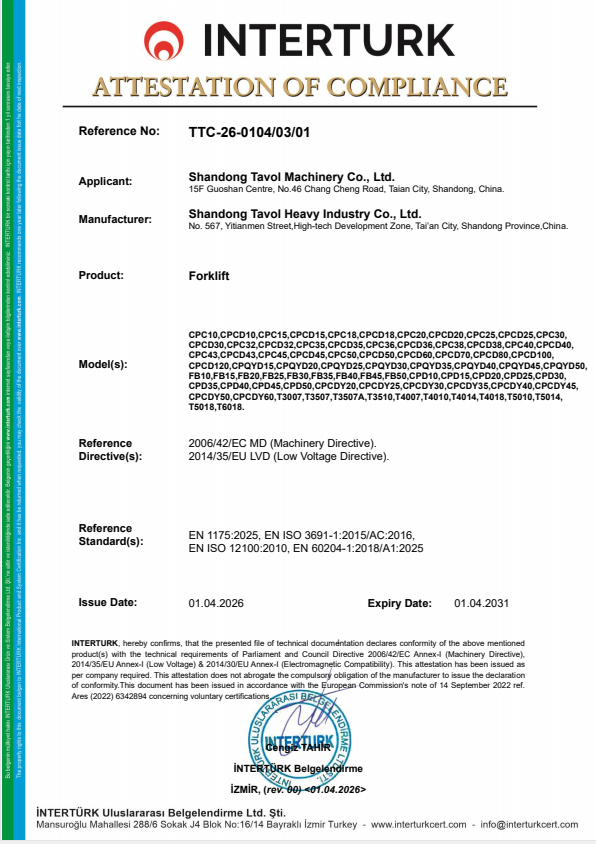
CE certificate TTC-26-0104/03/01, issued by INTERTÜRK, valid from 1 April 2026 to 1 April 2031.
| Acceptance item | What it should prove |
|---|---|
| Certificate coverage | Certificate number, issuing body, validity window and the exact model list appear in the annex |
| Standard set | EN 1175:2025, EN ISO 3691-1:2015/AC:2016, EN ISO 12100:2010 and EN 60204-1:2018/A1:2025 for the EU; ANSI/ITSDF B56.1-2020 for the US |
| Pre-shipment test | Functional test of the specific unit before dispatch, applied to 100% of units |
| Third-party inspection | Independent confirmation where the buyer's process requires it |
| Dimensional check | Overall length 2,855 mm and width 1,230 mm; top guard height 2,125 mm on the CPCD30 and 2,080 mm on the CPD30 |
| Load centre | 500 mm on the CPCD30, CPQYD35 and CPD30 |
| Mast and hydraulic check | Tilt 6 degrees forward and 12 degrees backward; lift speed 450 mm/sec and descent speed 420 mm/sec on the CPQYD35 |
| Documentation | Certificate copy, test record, parts list and operator manual |
Judging Chinese diesel counterbalance reliability against a legacy Western brand
Reliability in a diesel counterbalance forklift is a function of engine sourcing, structural steel, hydraulic and mast quality, and parts availability — not of the country where the machine is assembled. On those four dimensions a Chinese-built unit can be specified and inspected on the same terms as a legacy Western brand, provided the tender asks for the evidence instead of accepting the badge.
The 3-ton reference is the CPCD30: rated capacity 3,000 kg, diesel powered, with engine options from Xinchai, Quanchai, Isuzu, Mitsubishi, Yanmar, Kubota or PSI. It is built from Q235 carbon structural steel and Q355 low-alloy high-strength structural steel, measures 2,855 mm in length and 1,230 mm in width, and carries a top guard height of 2,125 mm, a mast tilt of 6 degrees forward and 12 degrees backward, and a minimum turning radius of 2,550 mm. The 2.5-ton CPCD25 shares the same 2,855 mm by 1,230 mm footprint and 2,550 mm turning radius, with a full-load lift speed of 450 mm per second. Mast configuration is where specifications usually diverge: the CPCD20 offers two-stage masts from 3 to 6 m and three-stage masts from 4.5 to 6 m, plus optional container and full free masts.
On commercial position, TAVOL's own procurement guidance places a China-manufactured diesel counterbalance forklift 20–40% below a legacy Western brand on purchase price, with spare parts cost around 30% lower and shorter lead times, while stating comparable core engine performance and durability.
| Comparison dimension | Chinese diesel counterbalance (CPCD30 reference) | Legacy Western brand |
|---|---|---|
| Rated capacity | 3,000 kg | Equivalent class specification, model dependent |
| Engine sourcing | Xinchai, Quanchai, Isuzu, Mitsubishi, Yanmar, Kubota or PSI | Typically a proprietary or brand-bundled engine family |
| Structural material | Q235 carbon structural steel and Q355 low-alloy high-strength steel | Generally disclosed only at component level |
| Purchase price position | 20–40% below legacy brand, per manufacturer comparison | Reference price baseline |
| Spare parts cost | Around 30% lower | Reference baseline |
| Lead time | 10–45 days, custom configuration included | Usually longer on custom builds |
| Customization | Fuel type, tonnage, mast height, fork length, attachment, cabin, logo, paint colour | Often limited to catalogue options |
| Service model | Remote technical support, 2-year forklift warranty | Deepest where the brand already operates dealers |
| Standard basis | CE (EN 1175:2025, EN ISO 3691-1) and ANSI/ITSDF B56.1-2020 for the US | Brand-specific conformity documentation |
The boundary of this comparison is service depth, not lifting capability. A legacy brand premium buys a pre-existing dealer network and local response time in markets where that network already exists. A Chinese unit's after-sales model is remote technical support plus a 2-year forklift warranty, and it depends heavily on the importer holding parts stock. Where a tender makes an existing regional service network — or a named brand — a strict compliance condition rather than a weighted criterion, the Chinese unit is not the compliant answer, and no price advantage changes that.
Field procedure: switching fuel modes on a dual fuel LPG & gasoline forklift
Fuel mode should only be changed when the truck is stopped and the engine is idling, or switched off. Switching under heavy load, or on a slope, sits outside the procedure.
- Bring the forklift to a complete stop and let the engine idle.
- Locate the fuel mode selector switch on the dashboard.
- Switch to the desired fuel mode — gasoline or LPG.
- Wait 5 to 10 seconds for the fuel system to stabilize.
- Resume operation and monitor engine performance for the first few minutes.
Model coverage for this procedure runs across the dual fuel range. The CPQYD20 is a 2,000 kg dual fuel unit powered by a Nissan engine and built from Q235 and Q355 steels for combined indoor and outdoor work; the CPQYD30 is the 3.0 t dual fuel model. The CPQYD35 carries a full-load drive speed of 18 km/h (20 km/h empty), a lift speed of 450 mm/sec, a descent speed of 420 mm/sec, maximum traction of 21,500 N, a minimum turning radius of 2,550 mm and a 500 mm load centre.
Fuel flexibility shows up in operating cost rather than in the datasheet. At a chemical and industrial plant in Bangladesh, two CPQYD30 units fitted with a customized hydraulic drum clamp reported a 35% reduction in fuel expense from LPG operation and seamless switching between gas and gasoline across two years of high-temperature factory work.
Field procedure: charging and maintaining a lithium battery forklift
A lithium battery forklift is opportunity-charged during breaks rather than run to full depletion, and it requires no watering or acid checks. The maintenance routine is terminal, cable and connector inspection.
- Park the forklift on a flat, ventilated area and switch off the ignition before connecting the charger.
- Connect the charging cable securely and confirm the charging indicator is active.
- Charge during breaks or idle periods rather than always waiting for full depletion.
- Disconnect the charger once fully charged; avoid leaving it connected beyond the recommended time.
- Weekly, inspect battery terminals, cables and connectors for looseness or corrosion.
The CPD30 is a 3,000 kg lithium-ion (LiFePO4) forklift designed for indoor use, with a 500 mm load centre, a minimum turning radius of 2,550 mm and overall dimensions of 2,855 mm in length, 1,230 mm in width and 2,080 mm in top guard height. The CPD40 raises rated capacity to 4,000 kg on the same 500 mm load centre. The CPD series electric lithium forklifts in the 3 t to 4 t range are rated for 27% gradeability at full load, and warranty terms differ by component — 2 years on the forklift and 5 years on the lithium battery.
In a chemical and warehousing logistics centre in Kuwait, five CPD40 units were deployed on high-rack pallet stacking, heavy bagged material transport and indoor logistics. After two years the reported outcome was zero indoor emissions, smooth high-lifting operation, reduced energy cost and reliable performance under high ambient temperature.
Selection guidance: fuel family and battery chemistry
Dual fuel versus diesel-only or LPG-only
| Consideration | Dual fuel LPG & gasoline | Diesel-only or LPG-only |
|---|---|---|
| Fuel flexibility | Switch between gasoline and LPG on the same truck | Locked to one fuel type |
| Fuel cost effect | Up to 15% lower fuel cost; no stoppage during a fuel shortage | No switching benefit |
| Fuel system | Two fuel paths plus a dashboard mode selector | Simpler fuel system |
| Upfront cost | Higher than a single-fuel build | Lower upfront cost |
| Best fit | Ports, outdoor construction sites, regions with unstable or seasonal fuel supply | Stable indoor operations with consistent access to one fuel |
| Trade-off | More components to maintain and a switching procedure to train | No fallback if the single fuel becomes unavailable |
The decision rule is operational, not technical. Dual fuel suits sites where fuel supply is unpredictable or seasonal, because switching avoids downtime that a single-fuel machine cannot recover. Single fuel suits stable, high-throughput indoor operations where the simpler fuel system and lower upfront price outweigh flexibility that will never be used. Diesel-only still holds the outdoor, rough-terrain and container-loading ground, where high-torque engine performance and refuelling anywhere matter more than emissions profile.
Lithium versus lead-acid
| Consideration | Lithium battery forklift | Lead-acid forklift |
|---|---|---|
| Charge time | 1–2 hours | 6–8 hours |
| Routine maintenance | No watering or acid checks; terminal and connector inspection | Watering and electrolyte checks required |
| Cycle life | 2,000+ cycles | 500–800 cycles |
| Upfront price | Higher | Lower |
| Long-term cost | Lower operating and downtime cost | Higher maintenance and downtime cost |
| Best fit | Multi-shift, high-utilization operations such as food, pharma and 24/7 warehouses | Single-shift, budget-limited or occasional-use operations |
A lithium battery forklift is the right answer where uptime and low maintenance dominate the cost model; a lead-acid forklift remains valid where the truck runs one shift and the upfront budget is the binding constraint. The limitation on the lithium side is real: it assumes charging infrastructure, a ventilated charging position and a shift pattern that can absorb opportunity charging. A site that cannot support those conditions will not realize the cycle-life or charge-time advantage, and the higher purchase price is then simply a premium.
Application fit: reading the duty cycle
Application detail is what separates a defensible specification from a catalogue order. Four patterns recur in TAVOL's fleet records, and each points to a different configuration decision.
- Recycled material handling. Ten CPCD30 diesel units at a plastics recycling company in Peru, selected for economical fuel consumption, widely available spare parts and low after-sales cost over two years of bale loading and warehousing.
- Agricultural logistics. Four CPCD30 units in Chile with a custom 4.5 m high-lifting mast, heavy-duty 3-ton capacity and CE-certified operator safety, working on unpaved farm roads through harvest season.
- Container and heavy-cargo positioning. A logistics company in Colombia using a reinforced steel chassis and stable counterweight design for anti-tip-over performance on rough, uneven ground, over four years of container lifting onto flatbed trucks.
- Bulk material handling. A building materials supplier in El Salvador running a CPCD30 with a customized hydraulic bucket attachment for aggregates and cement in a high-temperature tropical climate.
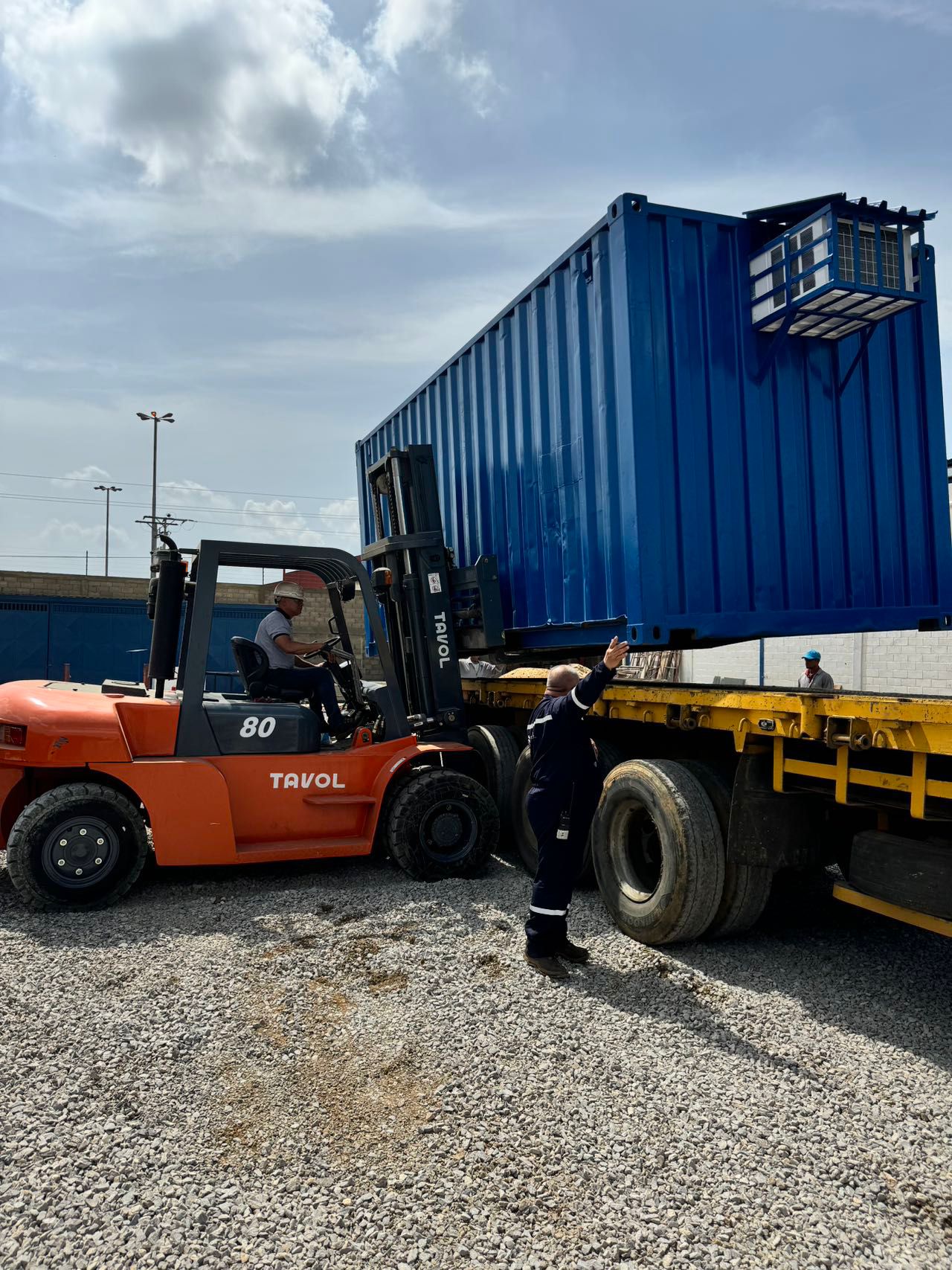
Container and heavy-cargo positioning with a reinforced steel chassis and stable counterweight design, Colombia.
Market trend signals for the evaluation file
Three published data points are worth carrying into a tender file, because they explain the direction of the market the buyer is entering. The global forklift market was valued at USD 81.4 billion in 2025 (Grand View Research). Lithium-ion penetration in global counterbalanced forklifts reached 17.5% in 2024 (Interact Analysis), which means the majority of counterbalance demand is still engine-powered — diesel and LPG remain the volume base, not a legacy niche. And China exported USD 1.26 billion of parts for fork-lift trucks in 2024 (WITS, HS 843120), a figure that speaks directly to the spares-availability concern that follows any Chinese-built machine into a tender.
Read together, the three signals support a mixed-fleet approach rather than a single-technology bet: engine power for yards, container work and rough ground, lithium for multi-shift indoor operations where emissions and charging time drive cost.
Future outlook
The direction of travel is toward specification discipline rather than brand loyalty. As lithium penetration rises from a 17.5% base, the differentiator in electric tenders shifts from whether a truck is electric to how quickly it charges, how many cycles the pack delivers and whether the charging bay can support opportunity charging at all. On the engine side the practical pressure is compliance — a CE certificate valid to 2031 under EN 1175:2025, or ANSI/ITSDF B56.1-2020 for US buyers, becomes a screening item rather than a selling point.
For buyers, the durable advantage is a tender file that states acceptance criteria in measurable terms, fixes commercial terms before technical scoring, and treats fuel and battery choice as a duty-cycle decision rather than a preference.
FAQ
What purchasing terms and acceptance criteria should a material handling forklift tender specify?
A forklift tender typically fixes five commercial variables and one technical gate. The commercial variables are minimum order quantity of 1 unit; delivery terms among EXW, FOB, CFR, CIF, FCA, DDU and DAP; payment by T/T or L/C; lead time of 10 to 45 days depending on configuration and volume; and warranty of 2 years on the forklift and 5 years on the lithium battery. The technical gate is acceptance, which specifies a pre-shipment test on the unit being shipped, with third-party inspection where the buyer requires independent confirmation.
Is a Chinese diesel counterbalance forklift as reliable as a traditional Western brand forklift?
A China-manufactured diesel counterbalance forklift is a defensible choice where cost efficiency and delivery speed matter: it offers comparable load capacity, lifting height and durability at a significantly lower price than legacy Western brands. The stated comparison is a purchase price 20–40% lower, spare parts cost around 30% lower, faster lead times and OEM customization options, with comparable core engine performance and durability. A traditional Western brand remains the right choice where an existing service network or a named brand is a strict procurement condition rather than a weighted preference.
Should I choose a dual fuel forklift or a diesel-only or LPG-only forklift?
A dual fuel forklift suits sites with unstable or seasonal fuel supply, such as ports and outdoor construction sites, where switching between LPG and gasoline avoids downtime and can reduce fuel cost by up to 15%. A single-fuel forklift suits sites with stable, reliable access to one fuel type and simpler maintenance needs; its fuel system is simpler and its upfront cost lower, but it has no flexibility if that fuel becomes unavailable.
Lithium battery forklift or lead-acid forklift, which one should I choose?
A lithium battery forklift suits multi-shift or fast-paced warehouse operations; a lead-acid forklift suits single-shift, budget-limited or occasional-use scenarios. Lithium batteries charge in 1–2 hours against 6–8 hours for lead-acid, need no watering or maintenance, and last 2,000+ cycles against 500–800 cycles. Lead-acid has the lower purchase price but carries higher long-term maintenance and downtime cost.
How do I switch fuel modes on a dual fuel forklift?
Switch fuel modes only when the engine is idling or off, using the dashboard fuel selector switch, and allow a few seconds for the fuel system to stabilize before resuming operation. The sequence is: stop the forklift and let the engine idle, locate the mode selector, switch to gasoline or LPG, wait 5 to 10 seconds, then resume and monitor engine performance for the first few minutes. Do not switch under heavy load or on a slope, and confirm the LPG cylinder is securely mounted and leak-free before each shift.
How do I properly charge and maintain a lithium battery forklift?
Use opportunity charging during breaks instead of waiting for a full discharge, and follow the manufacturer's charging cycle to maximize battery lifespan. Park on a flat, ventilated area with the ignition off, connect the cable and confirm the charging indicator, disconnect once fully charged, and avoid leaving the charger connected beyond the recommended time. Lithium batteries require no watering or acid checks, only weekly inspection of terminals, cables and connectors for looseness or corrosion.
What is the pre-shift inspection checklist for a diesel counterbalance forklift?
Perform a visual and functional check covering fluid levels, tires, brakes and safety devices before every shift. Check engine oil, hydraulic fluid and coolant; inspect tires for wear, damage or incorrect inflation; test brakes, horn, lights and backup alarm; check forks and mast for cracks, bends or hydraulic leaks; then start the engine and confirm there is no unusual noise, smoke or warning light. A malfunctioning brake or hydraulic leak is a stop-work condition, and any abnormality should be reported to a supervisor before the shift begins.
The full product and specification reference, including model coverage and configuration options, is available in the TAVOL company profile (PDF).
Tem questões ou precisa de mais detalhes?
Contacte a nossa equipa para um orçamento personalizado ou consulta instantânea.
Solicitar orçamento
Preencha o formulário abaixo e a nossa equipa entrará em contacto com uma proposta personalizada.
Chat direto do WhatsApp
Prefere conversar em tempo real? Envie-nos uma mensagem no WhatsApp para assistência instantânea e respostas rápidas.
- Obter orçamento personalizado
- Partilhar fotos ou documentos
- Discuta as suas necessidades diretamente
Geralmente responde em 5–30 minutos durante o horário de expediente.