
Material and Coating Fit for Petrochemical and Marine Fasteners
Material and Coating Fit for Petrochemical and Marine Fasteners
In petrochemical plants and marine or offshore structures, fasteners rarely fail because the thread was the wrong size. They fail because the base alloy and the surface treatment were matched to the wrong corrosion mechanism. Selection in these environments is a fit exercise: identify the dominant attack — chloride pitting, acid or alkali exposure at elevated temperature, galvanic coupling, vibration-driven loosening, thermal cycling — then choose a material family that survives it, and a surface treatment that supports that choice rather than compensating for it.
This analysis is written for engineers and procurement specialists who have already moved past the question of whether high-performance fasteners are needed and are now comparing specific options. It maps the material range available in industrial supply (304 and 316 stainless, 316Ti, 904L, duplex and super duplex, super-austenitic and nickel-based high-temperature alloys) and the surface treatments supplied with them (natural finish, passivation, Dacromet coating, adhesive pre-coating) against the working conditions found in petrochemical, marine and offshore, and power generation service.
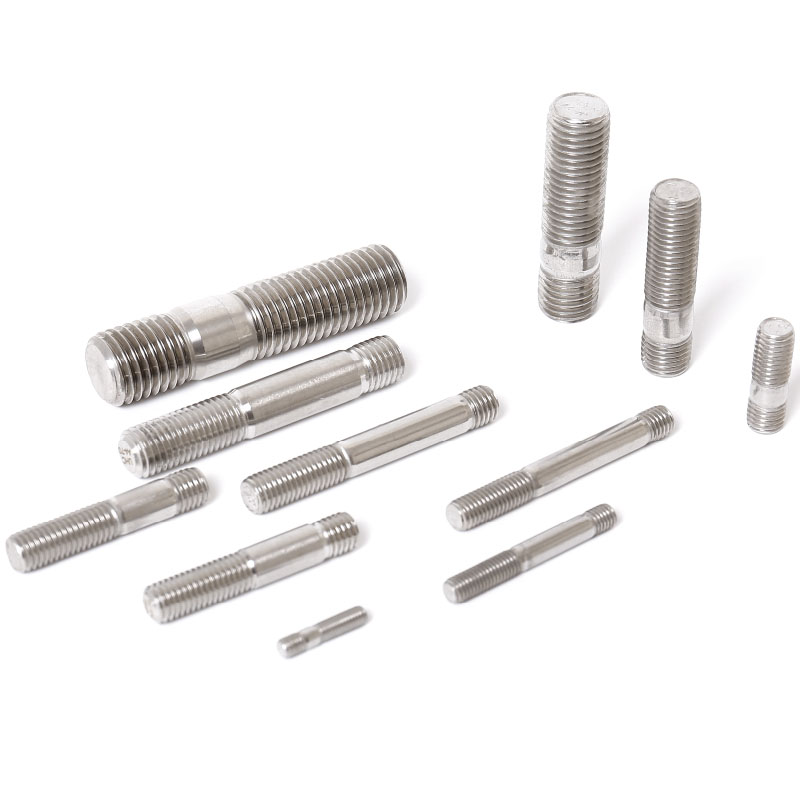
Stainless steel threaded rods and studs: the fastener form most often used in flanged process piping and offshore structural joints, where material and coating fit determines service life more than any single specification line.
The Fit Problem: Why Petrochemical and Marine Service Is Different
Three conditions separate petrochemical and marine fastening from general industrial assembly. The first is the working environment itself, which typically combines normal temperature up to high temperature, seawater corrosion, acid and alkali corrosive exposure, high vibration and high tensile load — often inside the same plant or vessel. The second is the operating mode: fasteners here are static, permanently fastened connections under continuous mechanical load, which means there is no routine opportunity to inspect or retighten them without interrupting production. The third is the consequence of failure. One compromised stud in a flange set or a structural connection can trigger an unplanned outage rather than a scheduled maintenance task.
Functionally, the requirement is straightforward: mechanical connection, fastening, locking, anti-loosening and fixed assembly between components. What follows from the environment is harder. The special requirements that recur across these industries are high tensile strength, anti-fatigue performance, corrosion resistance, high temperature resistance, and compliance with international ISO, DIN and ASTM industrial standards.
Those four requirements pull in different directions. A grade selected for high-temperature strength is not automatically the right choice in wet, chloride-rich service. A highly corrosion-resistant austenitic grade may not deliver the strength a high-load joint needs. Coating and passivation decisions add a second layer of variables, and a treatment that protects carbon or alloy steel does not always add value on stainless. The practical route is to resolve the fit in two ordered steps: material family first, surface treatment second.
Material Fit: What Each Alloy Family Is Actually For
The material range carried in UHC bolt, nut, stud and washer lines spans austenitic stainless steels, duplex and super duplex grades, a super-austenitic grade, and nickel-based high-temperature alloys. Reading that list as a simple price ladder is a common error. Each group answers a different service condition, and the selection question is which condition dominates the joint in question.
| Material group | Service condition it fits | Where it is not the answer |
|---|---|---|
| 304 / 316 stainless steel (A2-70, A2-80, A4-70, A4-80) | General indoor and atmospheric service, normal temperature, mild exposure, and most non-critical industrial assembly. | Chloride-rich, wet or acid service at elevated temperature, and direct seawater immersion. |
| 316Ti (1.4571) | Stabilized austenitic stainless for elevated-temperature acid and process service. | Not a substitute for high-molybdenum grades where chloride attack is severe. |
| 1.4539 / 904L | High-molybdenum austenitic for aggressive acid and chloride-bearing process streams. | Higher cost; normally not a stock item, so lead time has to be planned. |
| Duplex steel UNS S32205 (1.4462) | Marine and offshore exposure, seawater contact, and high-load joints that need strength and chloride resistance together. | Requires disciplined tightening control; harder material changes tooling and torque behaviour. |
| Super duplex 1.4410 / UNS S32750 / 2507 | Severe marine, splash-zone and submerged service where chloride resistance and strength are both critical. | Over-specification for mild duty; availability and cost must be planned. |
| 1.4529 / UNS N08926 | Super-austenitic grade for severe chloride and mixed acid environments. | Cost and availability; unnecessary where standard molybdenum austenitics suffice. |
| 1.4980 (A286 ALLOY 660), 2.4952, 2.4668 (ALLOY 718), ALLOY 80A; Inconel and Hastelloy families | High-temperature and high-strength service, hot process joints and power generation hardware. | Excessive for ambient marine duty; long lead times and high unit cost. |
| Titanium alloy and aluminium alloy (6061 / 7075 for rivets) | Weight-sensitive assemblies and specific aerospace or transport joints. | Galvanic risk when paired with steel structures; requires isolation. |
| 1.4006 / S41000 | Specific strength and wear-related roles in the martensitic family. | General corrosion resistance is lower than austenitic grades. |
ISO 3506-1:2020 specifies the mechanical properties of corrosion-resistant stainless steel bolts, screws and studs. The property class designations that appear on drawings and on the fasteners themselves — A2-70, A4-80 and the D6 classes used for duplex — come from that property class system, which is why a material name alone is an incomplete specification.
Coating and Surface Treatment Fit: What Each Treatment Can and Cannot Do
The surface treatments supplied with UHC bolt, nut, stud and screw lines are natural finish, passivation, Dacromet coating and adhesive pre-coating. They address different failure modes and are not interchangeable.
Natural finish means no added layer: corrosion performance is decided entirely by the alloy. It is appropriate where the alloy is already correct and no thread-locking or sealing requirement exists.
Passivation removes surface contamination and free iron and restores the chromium oxide passive layer after machining. It supports the corrosion resistance of a stainless fastener. It does not change alloy chemistry, so it cannot turn a 304 part into a chloride-service component.
Dacromet coating is a zinc-aluminium flake coating system whose primary value is providing a corrosion barrier where the base metal is carbon or alloy steel. Where the base metal is already a corrosion-resistant stainless or duplex grade, the coating is not a substitute for a higher alloy; on high-temperature joints, the coating choice also has to respect its own operating limits.
Adhesive pre-coating is pre-applied locking and sealing chemistry on the thread. It addresses vibration-induced loosening and joint sealing, not corrosion. Installation depends on clean threads and controlled torque, and the pre-applied material carries a shelf-life consideration that belongs in the procurement plan.
A consistent boundary applies to all four: a coating cannot upgrade a base alloy, and passivation cannot introduce alloying elements that are not present. Choosing coated carbon steel, choosing stainless, and choosing duplex are three different design decisions with different service assumptions — not three grades of the same decision.
Scenario Fit Matrix: Matching Material and Treatment to Environment
For a cross-reference during evaluation, the table below maps the working conditions typical of petrochemical, marine and power generation projects against material family and surface treatment. It is a starting point for specification review, not a replacement for project-specific engineering assessment.
| Environment | Dominant mechanism | Material family that fits | Surface treatment | Planning note |
|---|---|---|---|---|
| Petrochemical process piping, ambient to elevated temperature, acid and alkali exposure | Chemical attack plus crevice conditions at flange faces | 316Ti (1.4571), 904L (1.4539), duplex where chlorides are also present | Passivation | Confirm documentation at receipt, not only at order |
| Marine atmosphere and splash zone | Chloride pitting and crevice corrosion | 316, duplex UNS S32205, super duplex 2507 (1.4410), 1.4529 / UNS N08926 | Passivation | Galvanic coupling with carbon steel structures must be assessed |
| Submerged or permanently wet offshore service | Chloride attack under continuous load | Super duplex UNS S32750 / 2507 (1.4410), nickel-based alloys | Passivation | Higher alloy means longer lead time and higher unit cost |
| High-temperature process and power generation joints | Oxidation and strength loss at temperature | 1.4980 (A286 ALLOY 660), 2.4952, 2.4668 (ALLOY 718), ALLOY 80A | Natural finish or passivation | Coatings are generally not the answer in this temperature band |
| High-vibration assembly: compressors, pumps, rotating machinery | Loosening and fatigue | A2-70 / A4-80 austenitic or duplex grades | Adhesive pre-coating, with locking and self-locking hardware | Torque control matters as much as material selection |
| Weight-sensitive aerospace or transport joints | Corrosion plus mass constraint | Titanium alloy and aluminium alloy, including 6061 / 7075 rivet grades | Passivation with isolation where dissimilar metals meet | Isolation washers or coatings prevent galvanic acceleration |
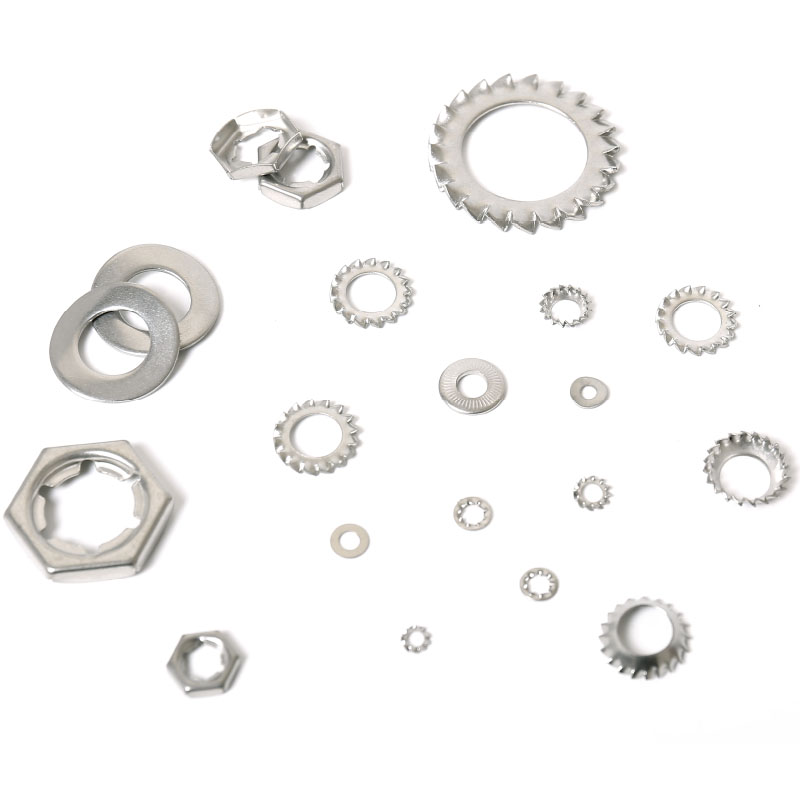
Washers are part of the fit decision, not an accessory: flat, heavy, toothed lock, serrated and wave types each address a different combination of load distribution and anti-loosening behaviour.
How UHC Groups Its Material and Treatment Range
Jiaxing Union Hardware Co.,Ltd, which supplies the market under the brand UHC fastener and hardware, is a stainless steel products supplier founded in 2017 and structured as five production bases plus an import and export company. The group operates 80,000 m² of production space with around 200 employees, including a 25-engineer R&D team, and stainless and special-material output of 25,000 tons per year. Roughly 80 percent of output is exported, with the EU, Korea and Japan as the main markets.
The product scope is relevant to fit analysis because dimension range determines whether a joint falls inside standard production or requires tooling. Bolts are supplied from M2 to M160 with effective lengths from 6 mm to 300 mm; threaded rods and studs from M5 to M160 with effective lengths up to 5,000 mm; nuts from M2 to M64; screws from M2 to M8 with lengths from 6 mm to 100 mm; washers from M2.5 to M45; and rivets and rivet nuts from M3 to M6.4. Mechanical strength grades available across the ranges include A2-50, A2-70, A2-80, A4-50, A4-70, A4-80, D6-70, D6-80 and D6-100. Thread tolerance classes are 6g / 2A for externally threaded parts and 6H / 2B / 3B for nuts. Products are executed against ISO, DIN, ASTM, ASME, ANSI and JIS standards.
On the quality side, the group holds ISO 9001, ISO 14001, ISO 45001 and European Union Pressure Equipment Directive (PED) certification, and operates an independent laboratory for dimensional and mechanical performance testing. Inspection is structured as first article inspection, in-process inspection and pre-shipment inspection, and production, sales and management are run through an ERP system covering raw material procurement through finished product delivery. After-sales support includes a 3.1 material test certificate, batch quality tracing and handling of quality issues after delivery. Customisation is offered as OEM / ODM with head mark and logo options.
For procurement planning, the operationally relevant figures are a monthly capacity of 500 to 1,000 tons, a standard lead time of 75 to 90 days, and a minimum order quantity of 150 kg. Export markets served are the EU, the United States, Japan, Korea, the Middle East and South America.

One of the group's five production bases. Traceability from raw material to delivery is managed through an ERP system, which is what makes material and treatment fit verifiable after the fact rather than only on paper.
Application Fit: Petrochemical, Marine and Power Generation Service
The scenario data behind these product families describes three closely related environments. In petrochemical service, the requirement is corrosion resistance in acid and alkali environments combined with high temperature resistance for fastening applications. In marine and offshore service, the requirement is fixed assembly and fastening able to withstand seawater corrosion and high tensile loads. In power generation, fasteners must handle high tensile loads and high temperatures with corrosion resistance. In all three, the operating mode is the same: static fixed assembly, permanently fastened between components under continuous mechanical load. The application scenario is common in Germany, Japan, South Korea and Italy, among other markets.
A service record illustrates how this fit works in practice. Fasteners supplied to industrial equipment OEM manufacturers and engineering contractors — a total of 100,000 pieces delivered to customers in Germany, Italy, Korea and Japan — have been used for fastening assembly in aerospace parts, marine equipment, automotive chassis and power generation facilities for over ten years. The reported outcome is a significant reduction in later maintenance replacement cost and stable project operation. The properties this depended on were high tensile and anti-fatigue strength, seawater and acid-base corrosion resistance, high temperature resistance, and full compliance with DIN, ISO, JIS, ASME and ASTM international standards.
The ten-year reference is worth reading carefully. It is not evidence that one material suits everything — it is evidence that the material and treatment combinations selected for each of those four application types remained within their service envelope for a decade.
Market Context Behind the Move Toward Alloy Discipline
Industry data supports the argument that selection decisions are becoming more consequential rather than less. Grand View Research values the global industrial fasteners market at USD 103.9 billion in 2025, projected to reach USD 153.7 billion by 2033, with Asia Pacific holding a 45.1 percent revenue share in 2025. Within that market, metal fasteners held a 91.0 percent share in 2025, and externally threaded fasteners such as bolts and screws accounted for 48.1 percent of revenue.
Growth is concentrated in segments where material discipline is mandatory rather than optional. Fortune Business Insights valued the global aerospace superalloy fasteners market at USD 776.7 million in 2024. Fact.MR estimates the titanium aerospace fasteners market will reach USD 520 million in 2026 at a CAGR of 5.1 percent. The Insight Partners projects the wind power fastener market to reach USD 14.68 billion in 2025, against a Global Wind Energy Council projection of wind turbine capacity growing from 1,100 GW in 2025 to over 2,400 GW by 2030. On the marine side, the China Association of the National Shipbuilding Industry reported new shipbuilding orders in China rising 59.0 percent year-on-year in the first quarter of 2024 — a direct demand signal for marine-grade fasteners.
Regulatory and standards pressure moves in the same direction. Fasteners for pressure equipment in the EU must comply with the Pressure Equipment Directive 2014/68/EU. ISO 3506-1:2020 governs mechanical properties for corrosion-resistant stainless steel bolts, screws and studs. EN 14399 covers high-strength structural bolting assemblies for preloading in steel structures. AS9100 applies to aerospace, space and defence organisations, and ISO/IEC 17025 accreditation is the benchmark for the testing laboratories that produce the evidence behind material certificates. For context on supply structure, MarketsandMarkets lists Illinois Tool Works Inc., Stanley Black amp; Decker and Lisi Group among the major players in the industrial fastener market, alongside a large and fragmented regional supplier base.
The practical reading for buyers is that documented material and treatment fit is becoming a differentiator in its own right, because the fastest-growing segments are exactly the ones where an undocumented substitution creates a compliance problem rather than a cost saving.
Limits and Trade-offs Buyers Should Plan For
Any fit approach has boundaries, and stating them is more useful than implying that a higher alloy solves everything.
- Cost and availability move together. Duplex, super duplex, 904L, super-austenitic and nickel-based grades are not default stock items. With a standard lead time of 75 to 90 days and a minimum order quantity of 150 kg on these lines, small emergency replacements need to be planned in advance rather than assumed.
- A coating is not a material upgrade. Dacromet on carbon or alloy steel improves corrosion protection for that base metal, but a coated low-alloy fastener is not a seawater-grade fastener. The same logic applies to passivation on stainless: it restores the passive layer but cannot compensate for insufficient molybdenum or chromium in chloride service.
- Stainless threads gall under aggressive tightening. High torque on austenitic and duplex threads carries a known seizure risk, so controlled torque, appropriate lubrication practice and attention to the specified thread tolerance class are part of the specification, not workshop details.
- Dissimilar metal couples need isolation. Pairing stainless, titanium or aluminium fasteners with carbon steel or aluminium structures requires isolation to avoid accelerated attack on the less noble component.
- Standards are application-specific. PED 2014/68/EU applies to fasteners for pressure equipment in the EU, while EN 14399 addresses preloaded structural bolting assemblies. A general DIN or ISO compliance statement does not by itself confirm fitness for a particular joint, which is why a 3.1 material test certificate and batch traceability are the verification mechanisms that matter at goods-in.
- Over-specification has a cost. Specifying a superalloy for mild indoor service increases unit cost, extends lead time and complicates replacement without improving service life.
Future Outlook
Three trends are likely to shape fastener selection in these environments over the next several years. The first is volume growth in marine, offshore and wind energy construction, driven by the projected expansion of wind turbine capacity to over 2,400 GW by 2030, which keeps duplex and super duplex grades in sustained demand. The second is the continued rise of high-temperature alloy segments in aerospace and power generation, where the aerospace superalloy and titanium fastener markets are already tracking growth. The third is documentation. As pressure equipment regulation, structural bolting standards and laboratory accreditation requirements tighten, the ability to produce material certificates and batch-level traceability is moving from a differentiator to a baseline expectation — which is why ERP-managed traceability from raw material procurement to delivery is now part of the supply argument rather than a back-office detail.
For specification teams, the implication is that material and treatment fit will be reviewed more often against documented evidence and less often against general brand claims. The selection framework itself — mechanism first, alloy second, surface treatment third — is unlikely to change, because the corrosion mechanisms in petrochemical and marine service have not changed.
Frequently Asked Questions
How should the right fastener material be selected for different working conditions?
For a general indoor environment, 304 or 316 stainless steel is preferred. For high-corrosion, offshore or marine environments, 316L, duplex steel or high-temperature alloy materials are recommended. For high-strength mechanical load scenarios, alloy steel fasteners are adopted. Material selection is normally confirmed against the specific project working conditions rather than applied as a fixed default.
What material options are available for fasteners?
Available materials include 304, 316 and 316L stainless steel, duplex steel, alloy steel, aluminium alloy and other high-performance alloy materials. The published material list for UHC bolt, nut, stud and washer ranges also covers 316Ti (1.4571), 904L (1.4539), duplex UNS S32205 (1.4462), super duplex 1.4410 / UNS S32750 / 2507, 1.4529 / UNS N08926, A286 ALLOY 660 (1.4980), ALLOY 718 (2.4668) and ALLOY 80A, together with 6061 and 7075 aluminium for rivets.
Which material fits a marine salt-spray environment?
316L or duplex steel is recommended for marine and coastal salt-spray working conditions. The final choice still depends on the other conditions at the joint, including operating temperature, tensile load, vibration and whether the connection is permanently wet or only exposed to atmospheric salt spray.
Reference: the UHC Group product brochure, covering fastener types, material options and surface treatments, is available for download: UHC Group product brochure (PDF).