
Matte TPU Paint Protection Film: A Buyer Discovery Guide
Matte TPU paint protection film is a thermoplastic polyurethane film that shields a painted surface from stone chips, abrasion and ultraviolet exposure while giving the panel a low-gloss, satin-style finish instead of the mirror reflection produced by conventional clear protection film.
The term is doing three jobs at once, and that is the source of most confusion in early-stage buying research. "TPU" describes the base material. "Paint protection" describes the function. "Matte" describes an optical outcome produced by the film's surface layer. A buyer who searches for a matte TPU film is therefore not choosing a single product — they are choosing a material family, a protection strategy and an appearance outcome, and those three decisions have to be reconciled before a specification makes sense.
This guide is written for the research stage: what the category actually covers, which attributes matter when reading a datasheet, how matte protection behaves compared with established alternatives, and where the practical limits sit.
What the Term "Matte TPU PPF" Actually Specifies
TPU — thermoplastic polyurethane — is an elastomeric polymer. In paint protection film it is chosen for elasticity and impact energy absorption, and because it can carry a top layer that supports surface recovery behaviour. This is what separates the modern TPU generation of protection film from earlier polyvinyl chloride (PVC) films, which are generally used where appearance change is the primary goal rather than long-term physical protection.
Matte, in this context, is a surface property, not an additive and not a paint. A matte film top layer scatters incoming light in multiple directions rather than reflecting it in a single dominant direction, which is why a matte panel reads as flat and non-reflective under direct light while the same paint under a glossy film reads as deep and mirror-like. The reduction in gloss is produced by controlled surface texture, and the degree of that reduction is what separates products described as matte, satin or silk. These labels are not standardised across the industry, so the descriptive name alone tells a buyer very little.
A second distinction matters just as much. A clear matte TPU film keeps the underlying paint colour and changes only the finish. A coloured TPU film changes colour and finish at the same time. Both sit inside the same product family — and the existence of both is why appearance and protection have stopped being separate purchase decisions in this category.
The Problem Matte Finishes Create for Owners
The growth of interest in matte protection film follows a specific ownership problem rather than a styling trend alone.
Matte and satin factory finishes are far less forgiving of conventional maintenance than gloss paint. Polishing, compounding and many traditional waxes tend to leave shiny patches on a matte surface, and those patches are difficult to blend back. Repair blending on matte paint is likewise harder to disguise than on gloss paint. The practical conclusion for an owner is that correction is expensive and prevention is cheaper — which pushes the decision toward a protective film before damage occurs, not after.
The second problem is that matte film changes the maintenance rules rather than removing them. Once a matte film is installed, abrasive polishing is generally off the table, and the cleaning routine has to be compatible with the finish for as long as the film stays on the vehicle. Buyers who evaluate matte film as "gloss film with a different look" frequently underestimate this, and it is the single most common gap between expectation and ownership experience.
The third problem is specification ambiguity. Matte variants are often less standardised across suppliers than gloss products, and buyers sometimes assume that a matte product inherits the performance data of its glossy counterpart. It does not follow automatically. Gloss level, top-layer construction and the resulting surface behaviour interact, so the matte version has to be evaluated on its own documented data.
The core research question: in a matte PPF purchase, the buyer is not comparing "film versus no film." They are comparing finish levels, top-layer behaviour and maintenance regimes — and then checking which supplier can reproduce the same result in repeat orders.
Reading a Matte TPU PPF Specification: The Attribute Stack
The secondary attributes that circulate around this topic — self-healing, anti-scratch, hydrophobic, yellowing-resistant, high-transparency, thick, coloured — are not independent features. They are layers of one specification, and each has a verifiable dimension.
| Attribute family | What it describes | What a buyer should verify |
|---|---|---|
| Self-healing | Top-layer behaviour in which light surface marks relax back once the film reaches a suitable temperature | The stated temperature and time conditions, and how the behaviour holds up after repeated heat cycles on a matte surface |
| Anti-scratch hard coat | A cured top layer that resists wash-brush and wipe marring | Hard-coat performance should be read together with the gloss level, because the same top layer controls both |
| Hydrophobic | Surface behaviour that supports easier cleaning and faster water shedding | Whether the property is built into the film construction or applied as a separate aftercare product |
| Yellowing resistance | Optical stability of the film under sustained UV exposure | The exposure test method and substrate used, not only the descriptive claim |
| High transparency | Low haze and low visual distortion in a clear film | Haze and clarity values measured on the finished film rather than on the base resin |
| Thickness | Combined thickness of base film, adhesive and top coat | Whether the figure is stated as total thickness or film-only, and how it affects conformability on complex curves |
| Coloured / finish variants | Pigmented TPU that changes appearance while still protecting the paint | Colour-stability data and the exact finish level, since matte and satin are not interchangeable in repair or maintenance |
The pattern is consistent across every row: the attribute name alone is not a specification. A matte film can be described with all seven terms and still differ from another matte film in gloss level, film construction and repeat-order consistency.
Where HOCHI PPF & Window Film Sits in This Category
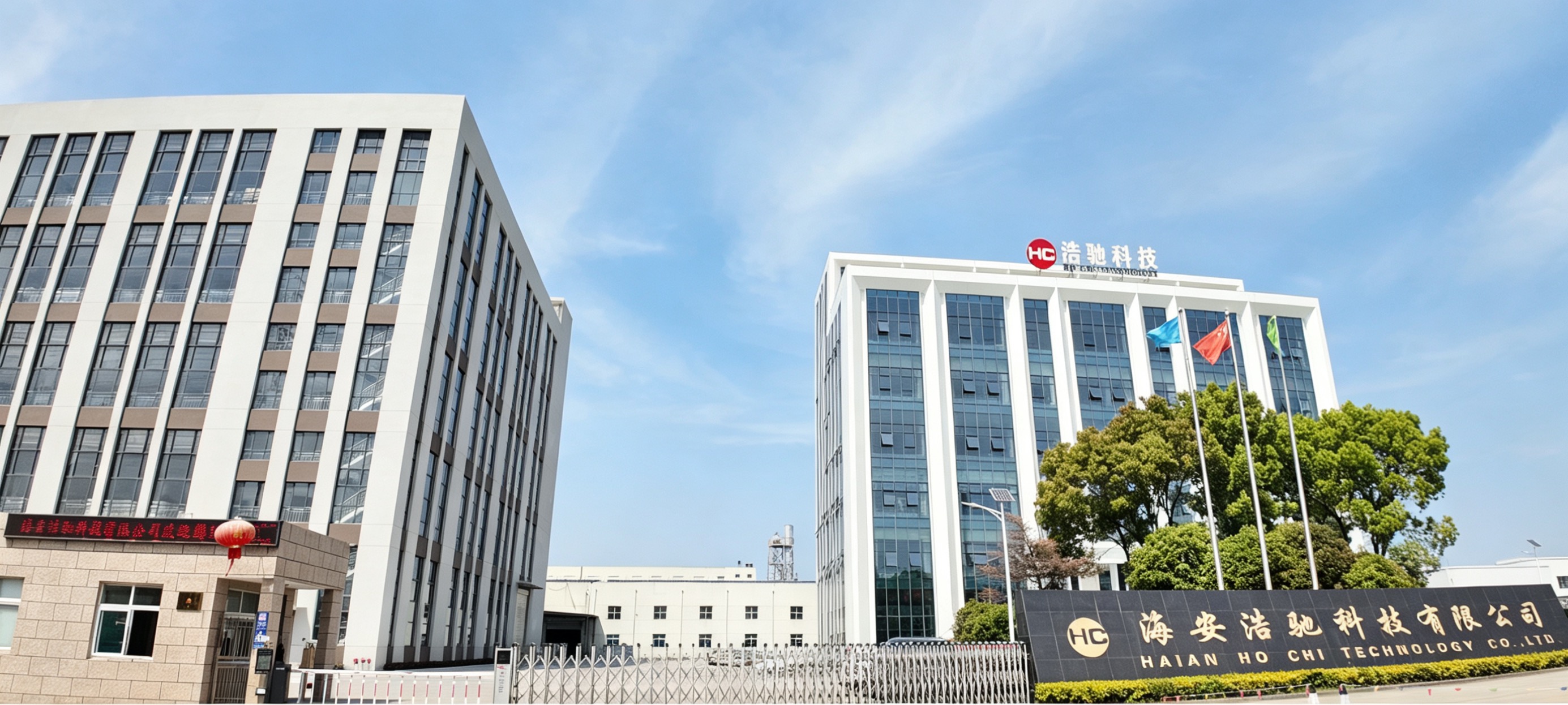
Haian Ho Chi Technology Co., Ltd. is a wholly-owned subsidiary of Shanghai Haochi Technology Co., Ltd. and a national-level specialised and innovative high-tech enterprise engaged in the research, development, production and sales of functional films. The company was established in 2009 and operates a site of 133,333 m² with more than 220 employees and an annual output of 48,000,000 M. Its R&D team comprises 100 engineers, and exports account for 60% of its business.
The company organises its business around a "1+3+N" group structure, with automotive window film as the core and car wraps, colour-changing films, architectural films, explosion-proof films and special protective film solutions integrated around it. Its stated product range includes nano-ceramic film, carbon film, original colour film, paint protection film, front layer film, iridescent film, architectural film, dyed film and explosion-proof film. Automotive paint protection is explicitly listed within the company's documented application scope.
On the technical side, the company states that its R&D is led by a Harvard University postdoctoral fellow and conducted in collaboration with institutions including the Chinese Academy of Sciences, East China University of Science and Technology and Nanjing University. It holds more than 50 patents, comprising 14 invention patents, 19 utility model patents and 18 software copyrights, and reports over 400 types of customised solar film products and over 200 types of customised colour-changing films.
Its stated qualifications include National High-tech Enterprise for nine consecutive years, national-level specialised and innovative "small giant" enterprise status, the Jiangsu Haochi New Nano Energy-Saving Thin Film Engineering Technology Research Center, Jiangsu Provincial Enterprise Technology Center, quality management system and environmental management system certification, and integration of informatisation and industrialisation management system certification.
Documented export markets include the Netherlands, Germany, the United Kingdom, France, Poland, Spain, Sweden, Norway, Italy, Denmark, Finland, Belgium, the Czech Republic, Slovakia, Hungary, Ukraine, Croatia, Ireland, Luxembourg, Portugal, Romania, Belarus, the United States, Brazil, Mexico, Chile, Colombia, Peru, Argentina, Uruguay, Ecuador, Bolivia, Australia, New Zealand, the UAE, Saudi Arabia, Qatar, Bahrain, Kuwait, Türkiye, Iraq, Syria, Uzbekistan, Singapore, Malaysia, Laos and Cambodia. Company reference: hochitech.net.
A boundary worth stating plainly: functional film performance is model-specific. The specification document currently published by the company covers its window and architectural film models, with model-level data such as visible light transmission, infrared cut and UV rejection values. A buyer evaluating a matte paint protection programme should request the current PPF datasheet rather than inferring PPF parameters from window film models, because the two product families solve different problems and are not interchangeable in specification.
Application Fit: Where Matte TPU PPF Is Used
The operating envelope documented for this manufacturer's automotive paint protection and film applications is a useful reference point, because it describes the conditions a film is expected to survive rather than the conditions it is tested in.
The stated working conditions include intense solar radiation, high UV exposure, high ambient temperature, humidity, road debris impact, stone chips, gravel abrasion and outdoor weathering across a range of approximately -30°C to 80°C. The documented function set for these applications includes 99%+ UV rejection, high infrared heat reduction, scratch resistance and thermal self-healing, anti-yellowing paint protection, glare reduction, HVAC energy efficiency improvement and glass shatter resistance — with paint protection and glass solar control serving different parts of the same vehicle.
The stated special requirements for the protective film applications are what a matte product should be judged against: high optical clarity, zero visual distortion, an anti-scratch hard coating, colour stability against fading, strong weatherability and residue-free adhesive removal. For matte films specifically, the first two requirements carry additional weight — visual distortion is more visible on a film whose surface already diffuses light, and any installation stretch mark or contamination becomes a permanent part of the appearance rather than something that can be polished out later.
Installation context is also documented and matters to the buyer's total cost: the matched equipment set includes a hot air gun, installation squeegees, a CNC film cutting plotter, DAP cutting software and a slip solution sprayer. These are professional tools. A matte finish raises the installation bar because corrective polishing is not available as a fallback, and this is a genuine difference from gloss film projects.
Matte TPU PPF Compared With Conventional Protection Options
| Option | Finish effect | Protection character | Maintenance implication |
|---|---|---|---|
| Matte TPU PPF | Diffuses light; converts a gloss panel to a matte or satin appearance | Removable sacrificial layer; supports chip and abrasion resistance with a self-healing top layer | Matte-safe cleaning; abrasive polishing and traditional waxes generally avoided |
| High-gloss TPU PPF | Enhances gloss and reflects light for depth over the paint | Same sacrificial logic with a higher-reflectivity surface | Light polishing is often possible; surface marks tend to be more immediately visible on a mirror finish |
| Vinyl colour-change wrap | Full appearance change, including colour | Thinner and styling-led; typically used where appearance change is the primary goal rather than long-term physical protection | Different adhesive and removal behaviour; finish restoration options differ |
| Ceramic coating or wax | No change to the panel's finish level | A bonded chemical layer rather than a removable sheet; does not absorb impact energy the way a film layer does | Requires reapplication over time; no sacrificial layer to replace independently of the paint |
Where matte film is genuinely harder
Matte protection film is not a strict upgrade over gloss film, and the honest comparison comes down to four limits.
- Sheen variation replaces scratch visibility. On a glossy surface, light damage appears as scratches in a reflective field. On a matte surface, the same damage often appears as a change in sheen — a smooth or shiny patch — which reads as a defect rather than as a mark. In some lighting conditions this makes minor surface damage more conspicuous, not less.
- The finish cannot be polished back. A gloss film can often be refined or lightly corrected. A matte film cannot, because polishing is precisely what removes the matte effect. Installation quality therefore becomes permanent, which raises the cost of a poor install.
- Self-healing is temperature-dependent. Top-layer recovery behaviour depends on the film reaching a suitable temperature, and it is generally slower in cold conditions. That matters in the colder markets within this manufacturer's documented export footprint, where vehicles operate below freezing for part of the year.
- Matte film preserves appearance, it does not correct it. Underlying paint defects are not removed by a clear matte film, and existing gloss variation in the paint can remain visible beneath it. Paint preparation before installation is a real cost item, not an optional step.
Decision rule: if the buyer's priority is the ability to restore the surface cosmetically over the life of the film, gloss film is the more forgiving choice. If the priority is preserving a matte finish that cannot be corrected by polishing at all, matte film is the appropriate category — accepted with its maintenance constraints rather than in spite of them.
What Is Changing in the Protection Film Market
Three shifts are visible from the supplier side, and they are consistent with how functional film manufacturers have structured their portfolios.
Protection and appearance have merged into one purchase. Manufacturers that once separated solar control film from decorative wrap now organise them within a single business group — as this manufacturer does with automotive window film as the core and car wraps, colour-changing films and special protective film solutions integrated around it. The buyer consequence is that a matte PPF enquiry is now also a colour, finish and texture enquiry.
Matte has moved from styling niche to finish-preservation requirement. As matte and satin factory finishes become more common across vehicle ranges, protection demand follows the finish rather than the brand tier. The buyers driving this demand are frequently not protecting a car they intend to modify, but one they intend to keep looking as delivered.
Cross-market exposure is driving wider operating envelopes. An export-oriented supplier serving a footprint that includes northern Europe and the Middle East faces the same product operating across very different UV loads, humidity levels and temperature bands. The documented -30°C to 80°C working range for automotive paint protection and film applications reflects that reality, and it is a more useful buying criterion than a single performance headline.
It is worth being careful about market-size framing here. Growth claims about matte PPF are frequently repeated without a traceable source, and none are needed to make the buying decision. What is verifiable is narrower and more useful: finish-driven protection demand exists, it is concentrated in aftermarket and detailing channels, and it places a maintenance-education burden on whoever sells the film.
What Buyers Should Expect Next
Gloss level will become a specification field, not a description. As matte products multiply, buyers will increasingly ask for numerical finish data and haze values rather than accepting "matte" as a category label. Suppliers able to document finish level consistently will have an advantage in repeat orders, where batch-to-batch appearance consistency matters more than a single sample.
Coloured and matte TPU will continue to converge. Colour-change capability and finish control are produced by the same coating and lamination competence, which is why manufacturers reporting large customised colour-film portfolios are also positioned to develop finish variants on request. A company documenting over 200 types of customised colour-changing films and over 400 types of customised solar film products is, structurally, a company that answers custom appearance briefs.
Maintenance will be sold with the film. The practical failure mode for matte PPF is not film failure but owner behaviour — abrasive washing, polishing, or the wrong cleaner. Buyers who plan the aftercare regime at the point of purchase will see fewer appearance complaints than those who treat matte film as a maintenance-free gloss substitute.
Thermal performance and colour stability will be judged together. A protective film that manages heat and UV exposure well but shifts in appearance has not solved the buyer's problem, and vice versa. The evaluation is converging on combined data: UV rejection alongside colour stability alongside finish consistency.
FAQ: Matte TPU Paint Protection Film
What is matte TPU paint protection film?
It is a thermoplastic polyurethane film whose top surface is engineered to scatter light and produce a low-gloss finish rather than a mirror reflection. It is installed over painted vehicle surfaces to absorb stone chips, abrasion and UV exposure while changing the panel's appearance from gloss to matte or satin. It is a removable film layer, not a coating and not a repaint.
How does matte TPU PPF differ from high-gloss TPU PPF?
The base material and the protection logic are the same; the difference is the surface layer and its optical behaviour. A high-gloss film is designed to transmit and reflect light for depth and clarity over the paint, while a matte film diffuses light to reduce reflectivity. Because they share a material family but behave differently at the surface, the purchase decision should rest on the finish level and the maintenance regime rather than on the material name alone.
Does matte TPU PPF self-heal?
Self-healing comes from the elastomeric top layer, in which light surface marks can relax back once the film reaches a suitable temperature. It applies to surface-level marks, not to cuts, tears or impact damage. The behaviour is temperature-dependent and is generally slower in cold conditions, which is relevant in markets where vehicles operate below freezing. Buyers should confirm the stated conditions for the specific matte product rather than assuming it behaves identically to a glossy counterpart.
Can matte TPU paint protection film be polished or waxed?
Abrasive polishing and traditional waxes are generally not appropriate for matte surfaces, because they can leave shiny patches that are difficult to blend back into the finish. Matte-safe cleaning products and gentle wash methods are normally recommended instead. This difference should be explained to the end customer before installation, because it defines the ownership routine for as long as the film remains on the vehicle.
What should a buyer verify before ordering matte TPU PPF in volume?
Confirm the finish level and how it is measured, the total film construction and how thickness is stated, the top-layer behaviour behind self-healing and anti-scratch claims, the UV and colour-stability test methods, adhesive and removal behaviour, and the recommended maintenance regime. Batch consistency across repeat orders matters as much as the appearance of a single sample, particularly for matte finishes where sheen variation is the most visible defect class.
Does HOCHI PPF & Window Film supply paint protection film?
The stated product range of Haian Ho Chi Technology Co., Ltd. includes paint protection film and front layer film alongside nano-ceramic film, carbon film, original colour film, iridescent film, architectural film, dyed film and explosion-proof film, and automotive paint protection is listed within the company's documented application scope. The availability of a specific matte finish and its parameters should be confirmed against the manufacturer's current PPF specification sheet rather than inferred from other product lines.
Reference: functional film specification document — https://cdn.socialarks.com/sbsp/25240/common/2026/0825/WINDW%20FILM%20HC%20SPECIFCATIONS.pdf