
Maximizing Project Performance: How to Select Porcelain Tiles for Different Environments
Selecting the right porcelain tile for a construction project requires matching technical performance to specific environmental and operational demands. For specifiers and procurement professionals evaluating porcelain tile for commercial, residential, or public infrastructure projects, understanding how product characteristics align with real-world conditions is essential to long-term value.
[IMAGE: Cover | industry scene] 
The Rising Need for Performance‑Matched Porcelain Tiles
Large‑scale projects—airports, shopping malls, hospitals, and municipal plazas—demand flooring materials that withstand heavy traffic, moisture, temperature swings, and chemical exposure. Traditional options like natural stone or standard ceramic tiles often fall short in either cost‑efficiency or durability. Porcelain tile offers a balance of high strength, low water absorption, and design flexibility, but not all porcelain tiles are engineered equally. The ability to match a specific product to a specific environment is becoming a decisive factor in project planning.
Monalisa’s Porcelain Tile Portfolio: Engineered for Versatility
Monalisa Group Co., Ltd. (“Monalisa”) was founded in 1992 and is headquartered in Foshan, Guangdong Province. It is a high‑tech listed company integrating R&D, creative design, production, and marketing of architectural ceramics. Monalisa operates three brands, multiple production bases, and offers a wide range of porcelain tile products designed for indoor and outdoor applications. The company has participated in key projects, including venues for the Beijing Olympic Games, the Guangzhou Asian Games, and the Hong Kong‑Zhuhai‑Macao Bridge. It was the designated ceramic tile supplier for the China Pavilion at Expo 2020 Dubai and the exclusive supplier for the 19th Asian Games Hangzhou 2022.
Two representative product models illustrate the range of capabilities:
- Model 120‑270FEG12207M (Homogeneous Body Tile, size 1200×2700×12mm, Matt / Natural stone face) – suited for both indoor and outdoor settings, especially where a natural stone aesthetic and high dimensional stability are required.
- Model 8FMB10032PM (Classic Stone, size 800×800×10mm, Glazed‑Polished) – ideal for high‑footfall commercial floors where gloss and cleanability are priorities.
[IMAGE: Diagram | product architecture] 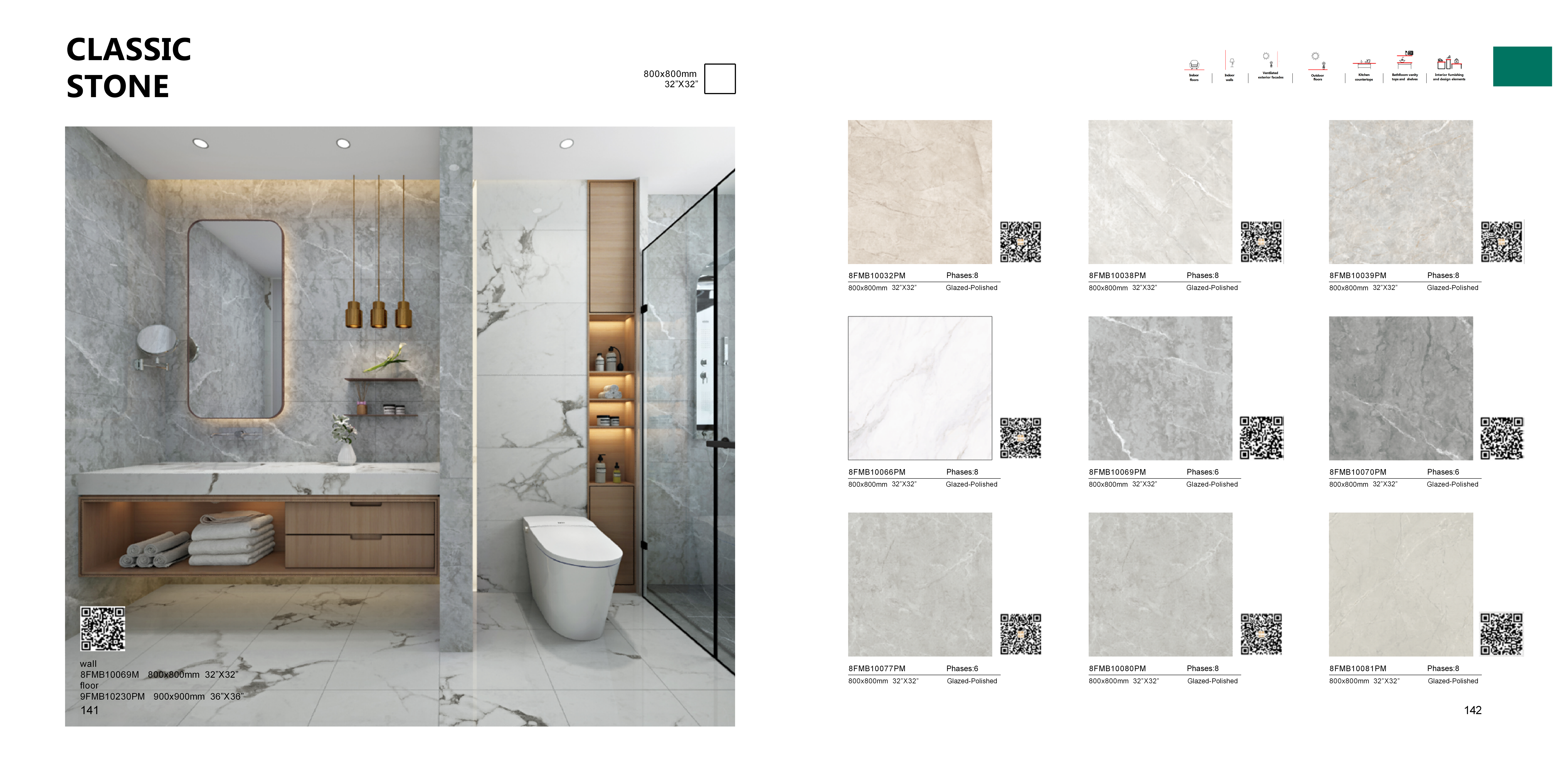
Technical Capabilities That Meet Project Specifications
Product 3220 (120‑270FEG12207M) operates in a static installation mode, being permanently fixed to the building substrate. It is designed for outdoor environments, including exposure to sun, rain, freeze‑thaw cycles (within –20°C to 40°C), standing water, and mild chemical corrosion. Under indoor conditions, it handles normal temperature, dry or humid environments (e.g., bathrooms, kitchens) with occasional exposure to mild acid/alkaline cleaners.
Key performance indicators for Monalisa porcelain tiles include water absorption ≤0.5% (meeting porcelain tile standards), abrasion resistance PEI 3–5, stain resistance Grade 5, and slip resistance R9–R11. For projects requiring certification, Monalisa holds ISO9001, ISO14001, and has obtained 15 certifications including CE standards for export markets.
Real‑World Application: Jogjakarta Airport, Indonesia
A concrete example of project‑specific porcelain tile selection is the Jogjakarta Airport project in Indonesia, where 80,000 m² of Monalisa porcelain tiles were installed. The project required a solution that could handle high passenger traffic, tropical humidity, and rigorous cleaning protocols. The chosen tile delivered a modern minimalist aesthetic, and the installation achieved 30% lower life‑cycle maintenance cost compared to alternatives. Furthermore, the tight‑joint installation method led to 15% savings on grouting materials and labor, while the breakage rate remained below 0.3%, reducing replacement losses significantly.
[IMAGE: Scene | application] 
Market Trends Driving Porcelain Tile Adoption
The global shift toward durable, low‑maintenance building materials has accelerated demand for porcelain tile in both public infrastructure and hospitality sectors. Projects increasingly specify anti‑slip porcelain tiles for wet zones, frost resistant porcelain tiles for outdoor plazas in colder climates, and large format porcelain tiles for seamless interior floors. Monalisa’s production capacity of 100 million square meters annually across 37 production lines enables consistent supply for large‑scale tenders.
Comparison with Conventional Flooring Solutions
Compared to natural stone, porcelain tile provides superior stain resistance, lower water absorption, and more consistent color across batches. It eliminates the need for sealing and periodic refinishing. Compared to standard ceramic tiles, porcelain’s higher density and lower porosity make it suitable for heavy‑duty commercial use. One honest limitation: achieving a fully stone‑like tactile surface (e.g., honed or textured) often requires specialized digital printing technology, which may restrict the range of available finishes compared to natural stone. However, advances in digital printed porcelain tiles have substantially closed the aesthetic gap.
Future Outlook
With ongoing investment in R&D (100‑person dedicated team and 892 patents as of June 2021), Monalisa continues to develop larger formats, thinner slabs, and enhanced surface technologies. The trend toward green building certifications and increased demand for CE certified porcelain tiles and ISO certified porcelain tiles will further encourage specification of performance‑validated products. As projects become more technically demanding, the ability to match porcelain tile parameters to environmental conditions will remain a core procurement competency.
Frequently Asked Questions
Q: What is the water absorption rate of Monalisa porcelain tiles?
A: Monalisa porcelain tiles have a water absorption rate of ≤0.5%, meeting the standard definition of porcelain tile. Some models achieve double‑zero absorption for specialized projects.
Q: Can Monalisa porcelain tiles be used outdoors in freeze‑thaw climates?
A: Yes. Model 120‑270FEG12207M is engineered for outdoor environments, including freeze‑thaw cycles within –20°C to 40°C, standing water, and mild chemical corrosion. It also meets freeze‑thaw stability requirements for cold‑climate projects.
Q: What surface finishes are available for commercial floor tiles?
A: Monalisa offers both glazed‑polished and matt / natural stone face finishes. Glazed‑polished options provide high gloss for retail spaces, while matt finishes deliver slip resistance and a natural look for hospitality and healthcare environments.
Q: How does the total cost of ownership compare to natural stone?
A: In the Jogjakarta Airport case, the porcelain tile solution achieved 30% lower life‑cycle maintenance cost, including savings on cleaning, sealing, and replacement. While the initial material cost may be comparable or slightly lower, the long‑term operational savings can be significant.
For detailed product specifications, technical data sheets, and project references, download the official corporate brochure: Monalisa Group Profile & Product Brochure (PDF)