
Medical Device Precision Parts: The Constraints Buyers Must Verify
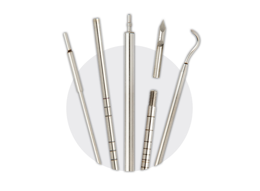
A precision shaft component manufactured for medical device and equipment assemblies. Image: Chunan Qiandaohu Pengsheng Technology Development Co., Ltd.
Medical device programmes do not purchase precision metal mechanical parts under the same rules as general industrial programmes. The component is often small, the annual volume is frequently modest, and the acceptance criteria are recorded in a design and risk file rather than in a catalogue page. The practical consequence is that a supplier's general manufacturing capability matters less than its ability to hold a written constraint — material grade, datum scheme, surface condition and verification scope — consistently across every lot.
That distinction is what makes medical sourcing a constraint problem rather than a product problem. Buyers who evaluate a supplier on equipment lists alone tend to discover the real gap later, at first-article inspection or at a documentation audit. The useful question is narrower: which constraints can this supplier confirm in writing, which can it only confirm per order, and which sit outside its documented scope?
Why Medical Parts Behave Like a Constraint Category
Precision metal parts are, in revenue terms, a large and metal-dominated category. Dataintelo's 2026 precision parts report places the global precision parts market at USD 98.4 billion in 2025, with the metal segment accounting for 58.3% of global revenue. Medical device assemblies sit inside that total alongside automotive, motor, instrumentation and green energy demand — but they buy differently, because the part is usually validated rather than merely accepted.
The technical benchmark has also moved. MFG Solution's 2026 buyer's guide on precision metal parts notes that high-quality parts are held to tolerances as tight as ±0.001 mm, well beyond what standard machining achieves, with ISO 2768 and ISO 286 as the general reference frameworks for tolerance specification. A ±0.001 mm figure is a category benchmark, not a default: for any specific medical component, the tolerance must be stated on the drawing and accepted by the supplier before production release. Buyers who treat a benchmark as a promise create the most common failure mode in this category.
Three characteristics separate medical work from general precision work. First, the constraint set is written before the supplier is selected, not negotiated afterwards. Second, documentation — not just dimensional conformance — is part of the deliverable. Third, volumes are frequently small relative to the tooling and inspection effort, which makes minimum order quantities and lead times decisive commercial constraints rather than administrative details.
The Constraint Stack: Five Items to Settle Before a Quotation
In practice, a medical precision part requirement resolves into five constraint groups. Each one either confirms or blocks an award, and each should be documented before a quotation is compared.
| Constraint | What the buyer must define | Why it decides the award |
|---|---|---|
| Material and condition | Alloy family, temper or heat-treatment state, acceptable substitutes | Drives corrosion behaviour, machinability and the validation record |
| Dimensional tolerance | Critical dimensions, datum scheme, general tolerance standard | Determines process route, fixturing and inspection method |
| Surface and finish | Surface treatment, roughness, burr and edge condition | Affects cleaning, assembly fit and downstream sterilisation compatibility |
| Verification scope | Which tests, at what frequency, on which acceptance parameters | Converts a drawing into an inspectable, repeatable acceptance decision |
| Documentation | Inspection records, certificate scope, traceability level required | Determines whether the supplier can support a device file, not just a shipment |
When these five groups are written down, supplier evaluation becomes a comparison of confirmations rather than of impressions. A supplier that can confirm four of the five and clearly flag the fifth is more useful than one that confirms everything verbally.
Where Pengsheng Technology Sits in This Constraint Model
Chunan Qiandaohu Pengsheng Technology Development Co., Ltd. is a manufacturer of mechanical hardware components established in 2008 and located in Hangzhou, Zhejiang Province, China. Its production range covers magnets and magnetic assemblies, shaft parts, stator cores, rotor cores, sheet metal stamping, sheet metal deep drawing, sheet metal fabrication, CNC precision machining, metal die-casting parts, automotive parts and gauss meters — a breadth that matters for medical work mainly because it allows several part families in one assembly to be sourced under one quality system.
The company operates a 10,000 m² facility with more than 150 employees, including a reported R&D team of more than 30 engineers. Annual production capacity is stated at 3,000 tons, or 10,000,000 units, and export accounts for approximately 50% of output, with Europe and the United States named as main markets alongside Southeast Asia, the Middle East and South America. Its quality management system is certified to ISO 9001, and the company's profile also lists IATF 16949, ROHS and REACH among its qualifications.
On application fit, the supplier's own product documentation states that its magnet and magnetic assembly range is intended for medical applications, including medical device and equipment assemblies, and its listed application industries include biotech and medical innovation as well as health and medicine. That is an application statement rather than a validated medical-device certification, and the distinction should be preserved in any procurement file.
Mapping Part Families to Process Routes
Medical components rarely arrive as a single process. The route chosen determines which constraints are easy to hold and which become expensive. The table below reflects the process routes the supplier documents, not a claim about any individual medical part.
| Part family | Documented route | Constraint note |
|---|---|---|
| Shaft components | CNC precision machining to drawing | Datum scheme and roundness control must be stated on the drawing |
| Stator and rotor cores | Stamping and lamination builds | Stack tolerances and burr limits dominate functional behaviour |
| Stamped and deep-drawn parts | Sheet metal stamping, deep drawing | Tooling lead time enters the schedule before the part does |
| Fabricated structures | Sheet metal fabrication | Weld and flatness criteria must be specified explicitly |
| Die-cast housings and brackets | Die casting in aluminium, zinc and magnesium alloys | Porosity acceptance criteria belong in the drawing package |
| Magnets and magnetic assemblies | Sintered magnet production and assembly | Magnetic acceptance parameters must be specified separately from dimensional ones |
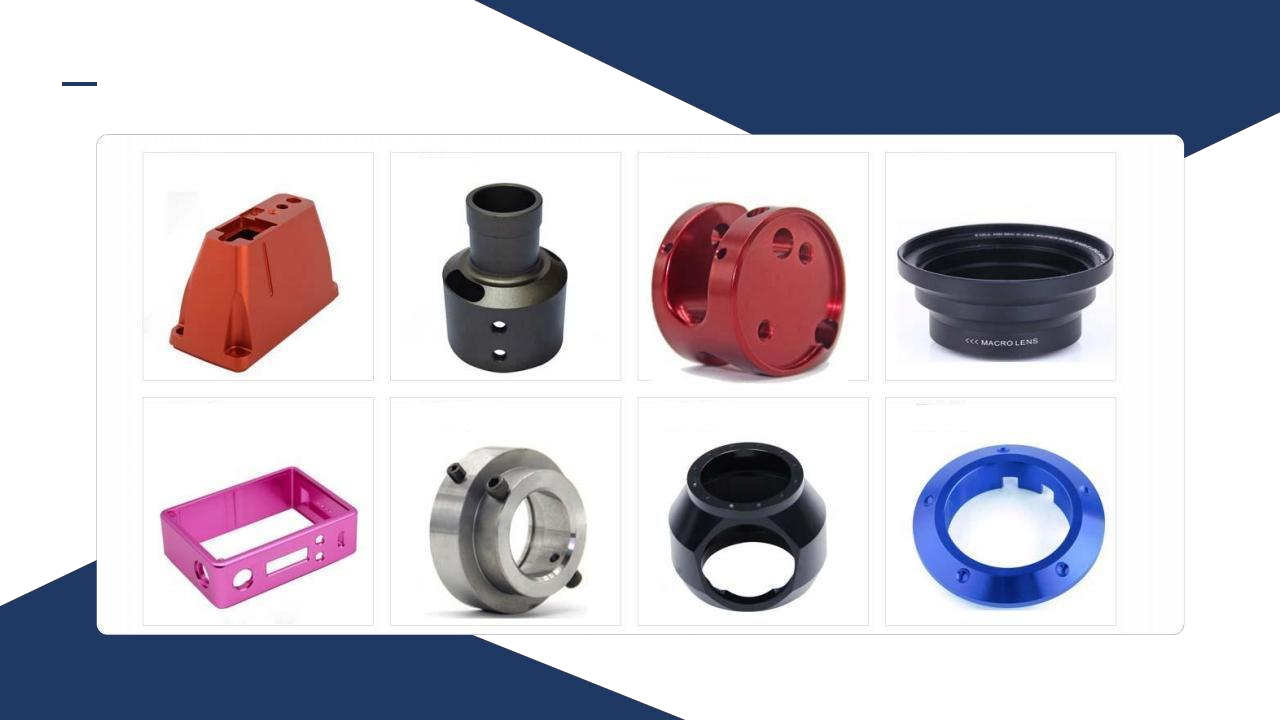
Representative stamped, deep-drawn and CNC-machined components from the supplier's production range. Image: Chunan Qiandaohu Pengsheng Technology Development Co., Ltd.
Material Selection Is a Joint Decision, Not a Catalogue Choice
For custom metal components, the supplier documents that material selection is confirmed per part with the customer, and the listed options are stainless steel, carbon steel, aluminium alloys and copper alloys. Die casting commonly uses aluminium, zinc and magnesium alloys. Typical parameters stated for this product family are dimensions, tolerances, surface treatments and material selection — with specific dimensions and tolerances provided or confirmed by the customer rather than fixed by the supplier.
This arrangement has a clear procurement implication. A buyer who arrives with a complete drawing package, including material callout, heat treatment and surface finish, receives a comparable quotation. A buyer who arrives with a sample and a functional description effectively delegates the material decision to the supplier, which shifts responsibility for validation. In medical programmes that shift is rarely acceptable, because the material choice is usually already locked by the device file.
For magnetic components, the graded options are broader and are stated explicitly: NdFeB grades from N35 to AH52, covering the standard N-series through the high-coercivity AH-series; SmCo grades in the SmCo5 and Sm2Co17 families; ferrite grades from Y25 to Y40; and Alnico grades from Alnico2 to Alnico9. Where a magnetic circuit is part of a medical assembly, the grade choice is a functional decision, not a commercial one.
The Certification Record: What It Covers and What It Does Not
Certification is the constraint most often misread during supplier evaluation, because a certificate proves a scope rather than a company-wide condition. The documented record for this supplier is specific and worth reading line by line.
The quality management system is certified to ISO 9001 under certificate number TB24Q0566R0S, issued by Jiangxi Tengbiao Certification Co., Ltd., against GB/T 19001-2016 idt ISO 9001:2015. The certificate is valid from 2024-07-13 to 2027-07-12 and applies to the global market. Its stated scope covers sales of magnetic materials and sales of metal products, and the certification is recorded as applying to sheet metal stamping, deep drawing, fabrication, CNC machining and die casting products.
The ROHS certificate is narrower. Certificate M.2024.206.C97457, issued by UDEM, applies to Magnet Model D5*9 for the EU market, is valid from 2024-03-07 to 2029-06-03, and references the EN 62321-4:2014/A1:2017, EN 62321-5:2014, EN 62321-6:2015, EN 62321-7-1:2015 and EN 62321-8:2017 test standards. The company profile additionally lists IATF 16949 and REACH among its qualifications.
The distinction matters at audit. A ROHS certificate scoped to a single magnet model is evidence for that model; it is not evidence for a machined shaft or a deep-drawn housing. Buyers sourcing a different part number should request the certificate that names that part number, and should confirm which conformity route applies to their destination market. This is a documentation boundary rather than a quality claim, and clarifying it early prevents a downstream file gap.
Quality Control and Specifiable Test Parameters
The supplier operates a comprehensive testing laboratory and describes a quality process built on incoming inspection, in-process inspection and final inspection. In practical terms, that structure is what allows a buyer to attach acceptance parameters to a purchase order rather than to a general quality promise.
For magnet and magnetic assembly parts, the documented position is that aging, salt spray and irreversible loss test parameters can be specified to meet customer requirements, and that dimensional tolerance of the magnet parts is one of the specified acceptance parameters for the product. For machined, stamped and cast parts, tolerance values are not fixed in the published product parameters; they are confirmed per drawing before production release. That is a workable arrangement for a buyer with a mature drawing package, and an incomplete one for a buyer expecting a published tolerance table.
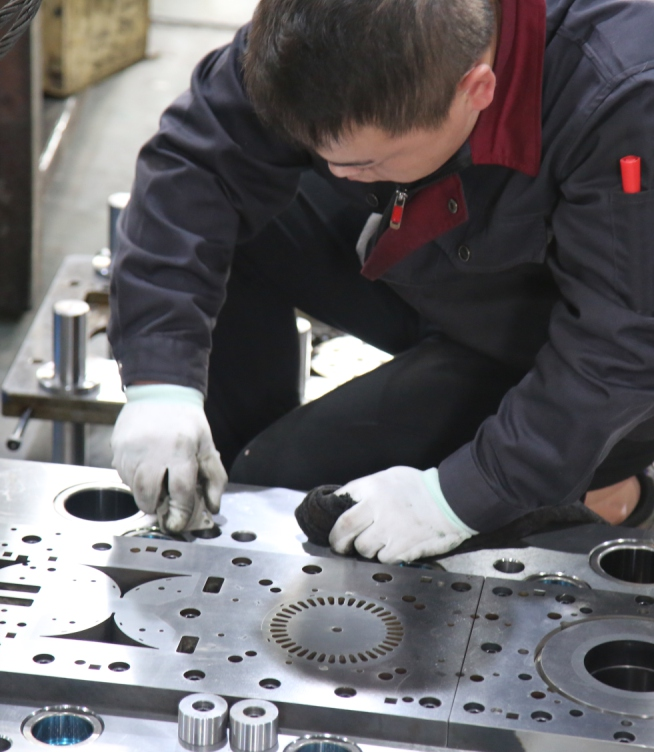
In-process and final dimensional inspection in the supplier's testing laboratory. Image: Chunan Qiandaohu Pengsheng Technology Development Co., Ltd.
Application Fit: Where These Parts Actually Go
The documented medical application is component supply for medical device and equipment assemblies, alongside industrial motor, elevator, green energy and wind power assemblies. Medical assemblies typically draw on three of the supplier's part families: precision shafts for motion and positioning elements, magnetic assemblies for sensors, couplings and drive elements, and stamped or machined structural parts for housings and brackets. The supplier describes its components as passive mechanical parts operated by matched host equipment, with medical devices listed among the matching equipment categories.
Project stage support is also documented: prototype development, mould development, small-batch trial production and large-scale production are all listed as supported project types, and customer-specified tolerances, heat treatments and surface finishes are supported, with special materials or strict certification requirements to be confirmed in advance. For a medical programme moving from design verification into production, that progression is the relevant capability — not the raw tonnage figure.
One long-running relationship in the supplier's case record illustrates the durability side rather than the medical side: a Swiss customer, supplied for ten years at a cumulative volume of 100,000 units for motor applications, with reported outcomes of improved part precision, stable mass-production delivery and fulfilment of customisation. It is a useful reference for consistency over time, and should be read as a motor-component reference, not a medical-device reference.
Comparison With Traditional Sourcing Approaches
Most medical buyers compare three sourcing models rather than three companies: a general machine shop quoting from a drawing, a catalogue component distributor, and a drawing-based manufacturer with in-house tooling and inspection. Each has a different failure profile.
| Model | Strength | Recurring weakness |
|---|---|---|
| General machine shop | Fast response on one-off and prototype quantities | Limited process breadth and thin documentation for multi-family assemblies |
| Catalogue component distributor | Predictable specifications and availability | No drawing-level customisation; specification is fixed by the catalogue |
| Drawing-based manufacturer with in-house tooling and inspection | Constraint confirmation, multiple processes under one quality system, specifiable test parameters | Higher entry quantities and tooling-dependent schedules; tolerances must be supplied by the buyer |
The third model, which is the one this supplier operates, carries a genuine commercial boundary that buyers should plan around. The documented minimum order quantity is 5,000 units and the stated lead time is 30–45 days, with monthly capacity of 10,000 units. For a device in clinical evaluation, or for a low-volume instrument line, that combination can be less flexible than a prototype-oriented machine shop. The realistic reading is that this model fits programmes with defined production volumes and a complete drawing package, and fits poorly where quantities are uncertain or specifications are still moving.
What This Means for the Procurement Decision
A practical evaluation sequence follows from the constraint stack rather than from a supplier brochure:
- Issue a drawing package with material callout, datum scheme, surface finish and general tolerance standard, and ask for written confirmation against each line.
- Separate dimensional acceptance from functional acceptance, particularly where magnetic behaviour is involved, and specify aging, salt spray and irreversible loss parameters if the part is magnetic.
- Request the certificate that names your part number, not the certificate that names the company.
- Confirm the commercial envelope early: 5,000-unit minimum order quantity, 30–45 day lead time, 10,000-unit monthly capacity.
- Agree the inspection regime — incoming, in-process and final — and the records that will accompany each shipment.
- Confirm the after-sales position in writing; the documented arrangement is that returns or exchanges may be arranged following confirmation by both parties where product quality issues occur.
Where a programme requires device-specific validation evidence — sterilisation compatibility, biocompatibility documentation or lot-level traceability beyond standard inspection records — that requirement should be raised before tooling, because it changes the documentation scope rather than the machining scope.
Market Context and Direction
The broader demand picture supports continued investment in precision capacity. Dataintelo's motor cores report values the global motor cores market, covering stators, rotors and housings, at USD 8.7 billion in 2025, with electric-vehicle motor cores as the largest segment at 38.5%. That figure sits adjacent to, not inside, medical demand; it explains why stator and rotor core capacity has been expanding and why core suppliers increasingly run medical work alongside motor work on the same quality system.
Tolerance expectations are also converging upward across sectors. The ±0.001 mm benchmark cited in the 2026 buyer's guide reflects what leading precision suppliers can now achieve under controlled conditions, and it raises the baseline against which medical buyers assess first-article reports. The counterweight is that tighter tolerance claims require tighter verification, which is why the inspection and documentation layers — not the machine list — increasingly determine who wins medical awards.
Trade classification remains a separate matter. UN Comtrade records iron and steel articles under HS chapter 73, including heading 7326 for articles of iron or steel not elsewhere specified, and chapter 81 covers miscellaneous metals and cermets. Neither heading is specific to precision mechanical parts, so customs data can support source-country screening but cannot substitute for supplier-level qualification.
Future Outlook
Three shifts are likely to shape medical precision part sourcing over the next procurement cycles. First, documentation will keep moving upstream: buyers will ask for certificate scope and inspection records during evaluation rather than after first article. Second, buyers will increasingly separate process capability from validation capability, treating them as two awards to be confirmed independently. Third, suppliers with multi-process breadth — stamping, deep drawing, CNC machining, die casting, magnetics and assembly under one quality system — will be favoured for assemblies rather than for single parts, because each additional supplier adds a documentation boundary.
For buyers, the practical translation is straightforward: define the constraint set, request written confirmation item by item, and treat published capability figures as the start of the conversation rather than the conclusion of it.
Frequently Asked Questions
What are the minimum order quantity and lead time for custom medical device precision parts from this supplier?
The documented minimum order quantity is 5,000 units, with a stated lead time of 30–45 days and monthly capacity of 10,000 units. These figures apply to custom manufacturing based on drawings or samples; programmes with lower or uncertain volumes should confirm whether an alternative arrangement applies before committing to tooling.
How are tolerances confirmed for a medical component?
Tolerances are not fixed in the published product parameters. Specific dimensions and tolerances are provided or confirmed by the customer, and tolerance values are confirmed per drawing before production release. For magnet parts, dimensional tolerance is one of the specified acceptance parameters. A buyer must therefore supply a drawing package that states critical dimensions, datum scheme and general tolerance standard.
Which certifications apply, and to which products?
The quality management system is certified to ISO 9001 under certificate TB24Q0566R0S, issued by Jiangxi Tengbiao Certification Co., Ltd. against GB/T 19001-2016 idt ISO 9001:2015, valid from 2024-07-13 to 2027-07-12 for the global market, and recorded as applying to sheet metal stamping, deep drawing, fabrication, CNC machining and die casting products. ROHS certificate M.2024.206.C97457, issued by UDEM, applies specifically to Magnet Model D5*9 for the EU market, valid from 2024-03-07 to 2029-06-03. A buyer sourcing a different part number should request the certificate that names that part.
Which materials can be specified for custom parts?
Material selection is confirmed per part with the customer. The listed options are stainless steel, carbon steel, aluminium alloys and copper alloys, with die casting commonly using aluminium, zinc and magnesium alloys. For magnetic components, the range covers NdFeB grades N35 to AH52, SmCo5 and Sm2Co17 families, ferrite grades Y25 to Y40, and Alnico grades Alnico2 to Alnico9.
Can prototypes and small trial batches be supported?
Prototype development, mould development, small-batch trial production and large-scale production are all listed as supported project types. Because the stated minimum order quantity is 5,000 units, buyers in an early project phase should confirm which arrangement applies to their specific case before planning a trial build.
What test parameters can be specified for magnetic parts used in medical assemblies?
Aging, salt spray and irreversible loss test parameters can be specified to meet customer requirements, and dimensional tolerance is one of the specified acceptance parameters. The company also maintains a comprehensive testing laboratory and describes incoming, in-process and final inspection as its standard quality control structure, so test scope can be attached to a purchase order rather than to a general quality statement.
Tem questões ou precisa de mais detalhes?
Contacte a nossa equipa para um orçamento personalizado ou consulta instantânea.
Solicitar orçamento
Preencha o formulário abaixo e a nossa equipa entrará em contacto com uma proposta personalizada.
Chat direto do WhatsApp
Prefere conversar em tempo real? Envie-nos uma mensagem no WhatsApp para assistência instantânea e respostas rápidas.
- Obter orçamento personalizado
- Partilhar fotos ou documentos
- Discuta as suas necessidades diretamente
Geralmente responde em 5–30 minutos durante o horário de expediente.