
Medical Manikin Compliance Criteria: Certification, Materials, and Procurement Factors
Medical training institutions, nursing schools, and simulation centers often evaluate manikins by price, appearance, or brand familiarity before checking whether the product actually meets procurement and compliance requirements. A more reliable approach is to assess certification coverage, material durability, functional alignment with the curriculum, and the supplier's ability to document quality control. This article explains those compliance and technical criteria, with reference to products and processes from Chongqing Scope Instrument Co., Ltd., a manufacturer based in Chongqing, China, that supplies medical manikins and other laboratory and training instruments.
The Challenge: Verifying Quality and Compliance in Medical Manikins
Medical manikins are used for emergency training, clinical skills practice, nursing education, and first-aid instruction. Buyers in this category—procurement officers, medical school administrators, distributors, and simulation lab managers—face a common problem: many suppliers claim that their products are suitable for medical teaching, but few provide verifiable documentation to support those claims.
Compliance checking matters because manikins are handled by students repeatedly, punctured with needles in injection and venipuncture training, exposed to cleaning agents, and used in high-pressure emergency drills. A product that cannot withstand repeated use, or that is made from materials of unknown quality, creates hidden costs: replacement frequency rises, training sessions are interrupted, and user confidence drops.
For international buyers, additional concerns include whether the manufacturer can provide the certificates needed for customs clearance, whether the product can be customized for local curriculum requirements, and whether the packaging meets export standards. These are not secondary issues. They are central to the purchasing decision.
What Compliance Documentation Should a Medical Manikin Supplier Provide?
Chongqing Scope Instrument Co., Ltd. states that it holds ISO9001, ISO14001, ISO45001, ISO13485, CE, and RoHS certifications. These certifications serve different purposes, and buyers should understand what each one indicates before including them in a supplier evaluation checklist.
- ISO9001 – Quality management system certification. It indicates that the manufacturer follows documented processes for production, inspection, and continuous improvement.
- ISO14001 – Environmental management system certification. It indicates that the manufacturer manages environmental responsibilities in a structured way.
- ISO45001 – Occupational health and safety management system certification. It indicates that the manufacturer addresses workplace safety risks.
- ISO13485:2016 – The internationally recognized standard for quality management systems in the design and manufacture of medical devices, including simulation manikins. This is the most relevant certification for buyers in the medical training sector.
- CE – A conformity mark indicating that the product meets applicable European health, safety, and environmental requirements.
- RoHS – A directive restricting the use of certain hazardous substances in electrical and electronic equipment.
For a buyer, the practical question is not whether a supplier lists certifications on its website, but whether the certifications can be verified and whether they match the destination market's expectations. Chongqing Scope states that official export certificates can be provided, including ISO9001, ISO14001, ISO45001, ISO13485, CE, and RoHS. It also states that additional customs clearance documents such as CO, Form E, and Form F can be provided when required.
Material and Construction: What to Verify Beyond the Label
Most medical manikins in Chongqing Scope's catalog are made of PVC. The company states that its products are made of PVC material, which ensures durability, resistance to deformation, and a high degree of authenticity. For buyers, material matters because it affects how often the manikin must be replaced and how well it holds up under repeated needle puncture, cleaning, and manipulation.
Different training tasks place different demands on materials:
- Injection and venipuncture models must tolerate hundreds or thousands of needle insertions without leaking or losing shape.
- CPR manikins must withstand repeated chest compressions at the correct depth range, typically 5–6 cm for adult models, without structural failure.
- Airway management models must allow intubation practice with realistic anatomical landmarks while surviving repeated insertion of instruments.
- Maternal and infant models must simulate soft tissue and perineal elasticity for childbirth training.
Chongqing Scope's product specifications reflect these functional requirements. For example, the SC-HS4 IV Injection Model uses imported thermoplastic elastic mixed rubber for skin and muscles, imported latex for nerves and blood vessels, and imported PVC for inner bones and joints. The product description states that it is cast from metal molds at high temperatures, with a realistic operating feel, durable surface, and resistance to deformation after disinfection and cleaning. The replaceable vein and skin design also addresses the practical issue of wear over time.
Similarly, the SC-H4T Training Mannequin uses imported plastic elastomer material, made by stainless steel mold injection and sintered at high temperature. The specification notes that the texture is durable and that needle traces remain invisible after repeated use. For a training institution, this type of detail is not cosmetic—it directly affects the useful life of the product.
Functional Compliance: Matching the Manikin to the Training Task
Compliance is not limited to certificates and materials. A manikin that does not support the required training functions is non-compliant in a functional sense, even if it carries the right labels. Buyers should map each training scenario to the specific manikin type and verify that the model supports the required procedures.
CPR Training Manikins
CPR manikins are among the most widely purchased medical training products. They are used to teach chest compressions, artificial respiration, and airway management. Chongqing Scope offers several CPR models with different levels of feedback and assessment capability.
The SC-CPR100A is a basic training manikin with simulated airway opening, visible chest rise and fall during artificial mouth-to-mouth respiration, manual chest compression with a correct depth of 5–6 cm, a 30:2 compression-to-ventilation ratio, and an alarm function. It is designed for training rather than assessment.
The SC-CPR480 adds an advanced display controller with dynamic barcode indicator lights for compression depth, digital counting, voice prompts, assessment operation modes, pupil response checking, and carotid artery pulsation simulation. The correct compression depth is displayed in the 5–6 cm area, and the correct tidal volume is displayed in the 500 ml–600 ml range. It also supports thermal printing of operation results, which is useful for formal assessment and record-keeping.
The SC-CPR160 is an infant CPR manikin. It includes digital counting, indicator light display, voice prompts, and real-time feedback on compression position, compression intensity (with a correct threshold of ≥4 cm for an infant), and insufflated tidal volume (correct range 30–50 ml). It supports both training and assessment operation modes.
For buyers, the key point is that CPR manikins are not interchangeable across age groups. An infant CPR manikin must be selected for pediatric training, and an adult model for adult CPR certification programs.
Nursing and Injection Training Models
Nursing education requires repeated practice of injection techniques, venipuncture, catheterization, and patient care procedures. Chongqing Scope offers several models in this category, each targeting specific skills.
The SC-HS3 is an arm injection model that simulates injection, blood transfusion, and blood sampling. It includes deltoid muscle injection, a realistic penetration feel, blood flashback when insertion is correct, and replaceable veins and skin. The replaceable design is particularly important for institutions that run high-volume training.
The SC-HS4 is an electronic arm venipuncture model with an electronic alarm device. It provides feedback when the needle correctly penetrates a blood vessel and when the needle pierces a vessel incorrectly. This allows instructors to assess technique objectively rather than relying on student self-reporting.
The SC-HL is a three-layer injection training model—skin, subcutis, and muscle—designed for intradermal, hypodermic, and intramuscular injection practice. Its wearable design makes it convenient for students to practice on a model worn by a peer or instructor.
The SC-H4T focuses on intramuscular injection with accurate anatomical landmarks, including the proximal femur, greater trochanter, anterior superior iliac spine, posterior superior iliac spine, and sacrum. The left buttock is removable, allowing students to observe internal structures such as the gluteus medius, gluteus maximus, sciatic nerve, and vascular structures. It supports three types of intramuscular injection training: dorsoventral hip, hip, and bone lateralis.
Clinical Puncture and Intubation Models
Advanced clinical skills require models that replicate anatomical landmarks and provide feedback on correct and incorrect technique.
The SC-J5S is a tracheal intubation model with multiple electronic feedback functions. It alerts when excessive tooth pressure is applied, displays correct airway insertion, expands both lungs when the airway is correctly intubated, and displays an alarm with stomach expansion when the esophagus is incorrectly intubated. It also shows one normal pupil and one dilated pupil for comparison, and indicates the cricothyroid membrane puncture site.
The SC-L66 supports closed drainage operation training for pneumothorax and hydrothorax after chest trauma. It has two windows on the right side of the chest to display anatomical structures, and allows puncture decompression and drainage exercises on the left thorax. The color, volume, and viscosity of the chest drainage fluid can be adjusted, which makes the model more realistic for different training scenarios.
The SC-CK817 is a clinical puncture manikin with accurate anatomical landmarks, including the suprasternal notch, the upper edge of the sternal manubrium, and the anterior superior iliac spine. It supports anterior superior iliac spine puncture training and sternal manubrium puncture training. The simulated bone marrow cavity can be penetrated with an obvious hollow feeling, and bone marrow can be extracted. The skin and simulated bone marrow cavity are replaceable.
The SC-CK20135 is a knee injection training model that simulates the appearance and internal structure of an adult leg, including the tibia, collateral ligament, cruciate ligament, patellar ligament, fat pad, meniscus, and synovial sac. It can be used to teach patient positioning and palpation techniques related to knee arthrocentesis.
Maternal, Infant, and Pediatric Models
Obstetric and pediatric training requires models that simulate anatomical changes during labor, delivery, and newborn care. These models are more complex and typically more expensive than basic CPR manikins, so procurement decisions require careful verification of functional coverage.
The SC-F50 is a gynecology manikin designed for basic technical training in obstetrics. It includes a simulated lower body of a pregnant woman, two fetus models, an attached umbilical cord, and a placenta. The cervical examination model simulates six stages of cervical dilation and fetal head descent, from a closed cervix with the fetal head at station -5 to full dilation at 10 cm with the fetal head at station +5. The childbirth model has a soft and elastic perineum, a transparent abdominal wall, and simulated skin for observing delivery demonstrations.
The SC-F55-1 is a more advanced maternal and infant training model. It includes a mechanical transmission device for childbirth simulation, adjustable fetal heart rate from 80 to 180 beats per minute, and the ability to simulate cephalic presentation, breech presentation, airway obstruction, umbilical cord around the neck, and placenta previa. It also supports fetal heart sound auscultation, Leopold's maneuvers practice, prenatal cervical change modules, vulvar suture practice, tracheal intubation, and pregnant CPR training based on the 2020 International CPR Guidelines. Newborn functions include nasogastric intubation, gastric lavage, scalp vein puncture, arm vein puncture, and newborn CPR.
The SC-H140 is a pediatric training model with movable head, neck, and limbs, replaceable chest skin for baby boy and girl versions, infant cephalic vein puncture, umbilical cord venipuncture, oral and nasal intubation care, gastric lavage, enema, catheterization, ostomy drainage, deltoid and gluteal muscle injections, and overall care skills such as bathing, breastfeeding, changing clothes, and diaper changing.
Anatomy and Teaching Models
Anatomy models are used in medical education to teach structure and function. They are not typically subjected to the same wear as injection or CPR models, but they must be anatomically accurate and durable enough for classroom handling.
The SC-A1010 is a natural adult skull model with an active chin, a cut cranium, and a suture. It is divided into three parts and made of PVC. The SC-A1041 is a torso model that can be divided into 23 pieces, including trunk, female chest cover, head, eyeball, brain, spinal nerve, lungs, heart, liver, kidney, stomach, intestines, and male and female reproductive organs. The female reproductive organs include a fetus in the uterus. The model is 85 cm tall and placed on a plastic seat.
The SC-A1025 is a knee joint model showing flexion, extension, and inward/outward rotation. It is natural size, placed on a plastic seat, and measures 12 × 12 × 33 cm.
Quality Control and Manufacturing Evidence
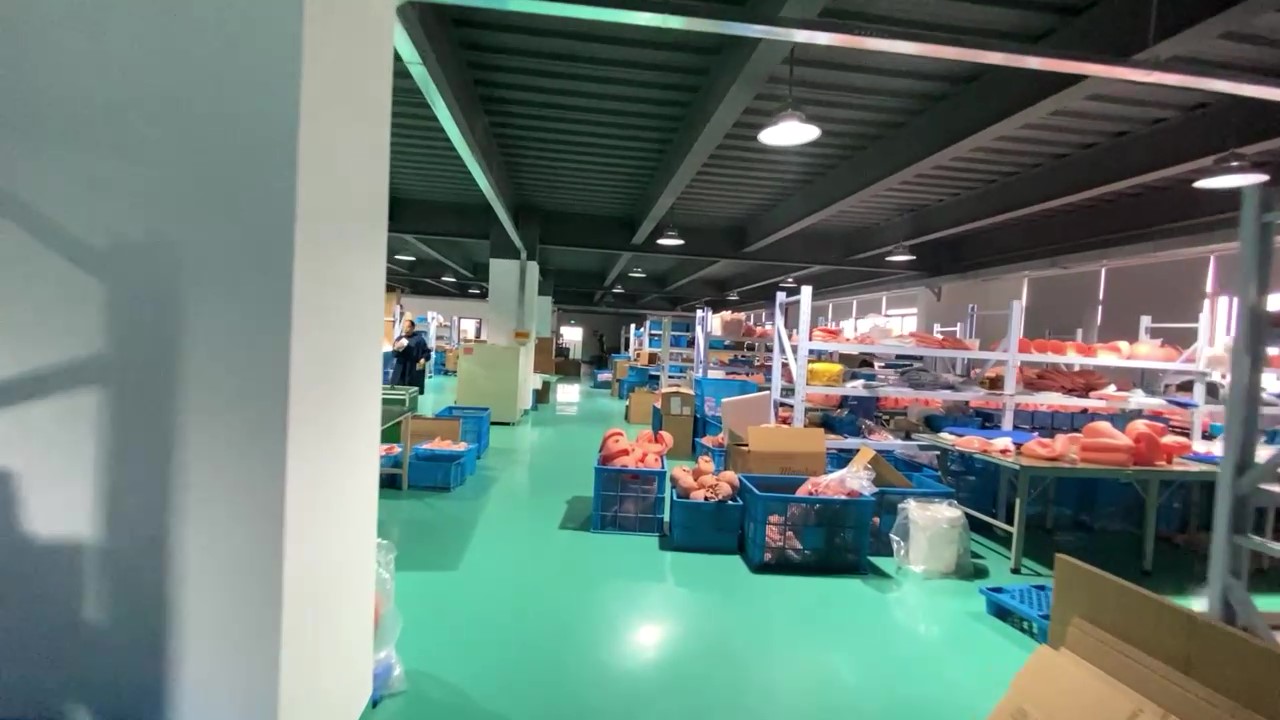
For buyers who cannot physically inspect products before ordering, manufacturing evidence is a critical part of compliance verification. Chongqing Scope states that its factory is 5,000 m², with more than 100 employees, an annual output of 30,000 units, and a research and development team of 20 engineers. These figures give buyers a general sense of the company's production scale.
The company also states that more than 50% of its output is exported, with main markets in Europe, Southeast Asia, the Middle East, South America, and Africa. Export-focused production often means that the manufacturer is familiar with international documentation requirements, packaging standards, and quality expectations.
Chongqing Scope describes its export packaging as neutral, without logos, using cardboard boxes or wooden boxes prepared in accordance with export standards. Neutral packaging is relevant for distributors who plan to brand the product themselves. The availability of additional customs documents such as CO, Form E, and Form F is also a practical advantage for international buyers.
How Chongqing Scope Compares with Established Global Competitors
The medical manikin and simulation market includes several well-known global players, including Laerdal Medical, CAE Inc., Gaumard Scientific, and Kyoto Kagaku. These companies are recognized for high-fidelity simulation technology, comprehensive curricula, and strong brand presence in medical education.
Chongqing Scope occupies a different position in the market. It is a Chinese manufacturer focused on medium- and high-volume supply of training manikins, anatomy models, and nursing skill models for medical schools, training institutions, and distributors. Its value proposition is not based on competing with the full-fidelity simulation ecosystems of global brands, but on providing functional training products with clear specifications, certification documentation, customization options, and export support.
Where the Comparison Matters in Procurement
The right choice depends on the buyer's objectives. A large university hospital with a simulation center and a dedicated simulation technology budget may prefer to invest in high-fidelity simulators from established global brands. A regional nursing school equipping a new skills lab, or a distributor supplying multiple training institutions, may find that mid-range manikins with verified certifications and realistic functionality offer a better fit for the budget and the curriculum.
One clear limitation of Chongqing Scope's product range must be acknowledged: it does not offer the full range of advanced, high-fidelity simulation systems available from global leaders. For example, it does not offer screen-based simulators, immersive virtual reality training environments, or advanced patient simulators with complex physiological modeling. Its catalog is centered on task trainers, anatomical models, CPR manikins with feedback capabilities, and maternal-infant training systems. These products are appropriate for skills-based education, but not for every type of simulation-based training.
Market Trends Affecting Manikin Procurement
Several verified market trends are relevant to buyers evaluating manikin suppliers.
The global medical simulation market was valued at USD 1.9 billion in 2025 and is projected to reach USD 6.7 billion by 2033, according to Grand View Research. This growth reflects increasing investment in simulation-based education and training across medical schools, hospitals, and emergency response organizations.
Healthcare anatomical models, including medical manikins, held the largest market share—approximately 41.4%—in the medical simulation sector in 2025, according to the same source. This suggests that physical models remain central to simulation-based learning, even as digital technologies expand.
The training manikins market volume was estimated at 1.2 million units in 2024, with projections to reach 2 million units by 2028, according to Global Insight Services. This indicates sustained demand for physical training products.
Regionally, North America dominated the healthcare simulation market in 2024 with a revenue share of approximately 45–48%, while the Asia-Pacific region is the fastest-growing market, with an expected CAGR of 18.2% through 2033. For buyers in Asia-Pacific, this means both growing local demand and increasing competition among suppliers.
Regulatory developments also affect procurement. China's National Medical Commission has mandated simulation labs for the accreditation of all new medical schools as of 2024–2025, according to Market Research Future. This regulatory push increases the volume of manikins required in the Chinese market and reinforces the importance of verified quality standards.
Practical Procurement Checklist for Medical Manikins
Buyers at the Research and Evaluation stage can use the following checklist to compare suppliers and shortlist candidates.
| Evaluation Factor | What to Verify | Why It Matters |
|---|---|---|
| Certification documentation | ISO9001, ISO14001, ISO45001, ISO13485, CE, RoHS | Confirms the manufacturer has formal quality, environmental, safety, and medical device management systems. |
| Material and construction | PVC, elastomer, latex, replaceable skin and veins | Affects durability, hygiene, and total cost of ownership. |
| Training function coverage | CPR, injection, intubation, puncture, maternal care, anatomy | Ensures the product supports the specific curriculum or training program. |
| Feedback and assessment features | Digital counters, voice prompts, barcode indicators, printing | Improves objectivity in student assessment and reduces instructor workload. |
| Export and customs support | CO, Form E, Form F, neutral packaging | Reduces friction in international purchasing and customs clearance. |
| Customization capability | ODM, appearance and function customization, MOQ 20 units | Allows distributors and institutions to match local branding and curriculum needs. |
Customization and Supply Chain Considerations
Some buyers are not purchasing manikins for their own institution but are sourcing on behalf of distributors or resellers. For these buyers, the supplier's customization capability and production lead time are as important as product quality.
Chongqing Scope's capability unit states that it offers ODM services, with customization of the appearance and functions of products, a monthly capacity of 3,000 units, a lead time of 30–45 days, and a minimum order quantity of 20 units. Quality control is described as factory quality inspection, and the after-sales policy includes a 1-year warranty with online support. Export markets include Europe, the Middle East, Southeast Asia, North America, South America, Russia, and Africa.
For distributors, the ability to customize appearance and functions makes it possible to align products with local market preferences or institutional requirements. The stated MOQ of 20 units is relatively accessible for small and mid-sized distributors testing a new product line. The 30–45 day lead time provides a practical reference for inventory planning.
Compliance and Stock Manikin Sourcing: A Case Reference
Case data from the corpus includes one documented reference: a medical manikin distributor in India purchased 500 units of manikins for medical teaching applications over a one-year period. The result is recorded as stable operation, with the highlights being customization and durability. The case was selected as a reference for how a distributor-scale order can be fulfilled with a focus on customized products and long-term functional stability.
Limitations and Boundary Conditions
Every procurement decision involves trade-offs. The main limitation of mid-range manufacturers like Chongqing Scope is the lack of a fully integrated high-fidelity simulation ecosystem. Buyers who need advanced patient simulators with real-time physiological responses, virtual reality integration, or complex multiparameter monitoring should evaluate global simulation specialists rather than mid-range manikin suppliers.
A second limitation is that certification presence does not guarantee that every individual product has been tested to the same standard. Buyers should request product-specific documentation, inspect factory audit reports when possible, and, for large orders, consider third-party inspection before shipment.
A third limitation is that the stated production capacity and lead times are indicative rather than contractual commitments until included in a formal agreement. Buyers planning large or time-sensitive orders should confirm capacity, lead time, and warranty terms in writing before placing an order.
Future Outlook: What Buyers Should Expect
Several developments are likely to shape medical manikin procurement in the coming years. The continued expansion of simulation-based medical education, driven by curriculum requirements and accreditation standards, will sustain demand for physical training models. The Asia-Pacific region, with its high growth rate, will see increasing competition among manufacturers and distributors. Buyers can expect a wider range of mid-priced products with feedback features that were previously available only in high-end models.
At the same time, as certification requirements become more standardized, suppliers without documented quality management systems will face growing barriers in institutional procurement. Buyers should expect to see certification documentation become a standard part of request-for-quotation processes.
The trend toward blended simulation—combining physical manikins with digital assessment tools—also suggests that buyers should prioritize products that can integrate with learning management systems or generate quantitative assessment data. CPR manikins with electronic monitoring, such as the SC-CPR480, are an early example of this trend in the mid-range market.
Frequently Asked Questions
What certifications should a medical manikin manufacturer hold?
A medical manikin manufacturer should ideally hold certification to ISO 13485:2016, which is the internationally recognized standard for quality management systems in the design and manufacture of medical devices, including simulation manikins. Other relevant certifications include ISO9001 for quality management, ISO14001 for environmental management, ISO45001 for occupational health and safety, CE for European conformity, and RoHS for restriction of hazardous substances. Chongqing Scope states that it holds all of these certifications and can provide official export certificates.
What materials are commonly used in medical manikins?
PVC is the most commonly used material in Chongqing Scope's manikin and anatomy model range. The company states that PVC ensures durability, resistance to deformation, and a high degree of authenticity. Some injection and venipuncture models use additional materials such as imported thermoplastic elastic mixed rubber for skin and muscles, imported latex for nerves and blood vessels, and imported PVC for inner bones and joints.
What is the difference between a basic CPR manikin and an assessment-capable CPR manikin?
A basic CPR manikin such as the SC-CPR100A supports training of chest compressions and artificial respiration, with visible chest rise and an alarm function. An assessment-capable model such as the SC-CPR480 adds electronic monitoring of compression depth, tidal volume, compression position, pupil response, and carotid artery pulsation, as well as voice prompts, digital counting, and thermal printing of operation results. Assessment-capable models are better suited for formal testing and certification programs.
What is the difference between a medical manikin and a medical simulator?
The distinction is primarily one of fidelity and scope. Medical manikins, such as the task trainers and anatomical models described in this article, are physical models used to practice specific skills. Medical simulators typically refer to more advanced systems that reproduce physiological responses, often with software-driven scenarios and real-time feedback. Some advanced manikins, particularly those with electronic monitoring, occupy the boundary between these two categories.
Can medical manikins be customized for branding or curriculum needs?
Yes. Chongqing Scope offers ODM services with customization of product appearance and functions. The stated minimum order quantity for ODM is 20 units, with a monthly production capacity of 3,000 units and a lead time of 30–45 days. Logo printing and label customization can also be arranged.
Download the Chongqing Scope corporate brochure for product and capability details.
Tem questões ou precisa de mais detalhes?
Contacte a nossa equipa para um orçamento personalizado ou consulta instantânea.
Solicitar orçamento
Preencha o formulário abaixo e a nossa equipa entrará em contacto com uma proposta personalizada.
Chat direto do WhatsApp
Prefere conversar em tempo real? Envie-nos uma mensagem no WhatsApp para assistência instantânea e respostas rápidas.
- Obter orçamento personalizado
- Partilhar fotos ou documentos
- Discuta as suas necessidades diretamente
Geralmente responde em 5–30 minutos durante o horário de expediente.