
Medical Miniature Bearing Compliance: P4 Precision and SUS440
Medical Miniature Bearing Compliance: P4 Precision and SUS440
A miniature bearing stops being a commodity part the moment it is specified into a medical or dental device. In a dental handpiece turbine or a handheld diagnostic instrument, the bearing is a wear component inside a product that must behave consistently across thousands of units and several production years. In that setting, compliance is not a marketing claim — it is a set of documentable properties: the precision class the bearing is manufactured to, the material grade and how it is verified, the rated temperature and speed envelope, and the quality-system evidence a supplier can present during qualification.
The commercial weight behind that requirement is measurable. Future Market Insights estimates the global miniature ball bearings market at approximately USD 2.25 billion in 2025, driven by demand in medical devices and robotics. Estimates vary between research houses — Precedence Research places the market near USD 2.89 billion and IMARC Group around USD 2.0 billion — which is a useful reminder that category-level figures are directional, while part-level compliance evidence is what determines whether a device can actually be built and shipped.
This reference examines the compliance and qualification questions surrounding miniature bearings in medical and dental applications. It uses INB's documented specifications — P4 precision, SUS440 stainless steel, an operating range down to -50 °C and up to 160 °C on its high-speed dental series, and limiting speeds up to 400,000 rpm — as a working benchmark, then sets that benchmark against the questions buyers should ask of any supplier, including global peers such as SKF, NSK, NTN and MinebeaMitsumi.
Why Miniature Bearings Are a Compliance Category
Three technical variables decide whether a small bearing is medical grade in a practical engineering sense, and each one has a standard behind it.
Precision class. Miniature bearing precision is governed by globally recognised systems, including ABMA ABEC grades 1 to 9, ISO 492 classes P0 to P2, and DIN 620. In the ABEC system, higher numbers correspond to tighter tolerances. Because the naming systems do not map one-to-one, a buyer comparing a P-class bearing with an ABEC-class bearing should compare tolerance tables rather than grade names.
Material grade. Stainless steel — specifically 440C — is the material most frequently identified as the primary choice for miniature bearings used in medical and food-processing applications, where resistance to moisture and chemical exposure is essential. Material selection also determines how a bearing behaves after repeated cleaning cycles, which matters for instruments that are handled and reprocessed rather than replaced.
Operating envelope. Temperature range and limiting speed define where a bearing can physically be used. Dental handpiece bearings, for example, run at intermittent high speed in a clean environment, and the bearing must tolerate that duty without excessive heat build-up or noise.
Beneath those three variables sits documentation. A precision grade that cannot be evidenced, a material grade that cannot be certified, and a speed rating that cannot be traced to a test or a documented calculation are all weak links in a device qualification file. This is why miniature bearing procurement in medical supply chains tends to be document-led rather than price-led.
What P4 Precision Actually Controls
P4 is a precision class positioned at the tighter end of the ISO 492 ladder. Where a P0-class bearing is a general-purpose part, a P4-class bearing is manufactured to closer tolerances on bore, outer diameter, width and running accuracy — the parameters that determine how smoothly a shaft rotates inside a housing.
The effect scales down rather than up. On a bearing with a 3.175 mm bore, a tolerance that would be negligible on a 50 mm bearing becomes a significant fraction of the part's own dimensions. That is why high-precision miniature bearings are typically specified in high-speed miniature bearing applications: runout, radial play and surface finish translate directly into vibration, acoustic noise and friction heat at the spindle.
Buyers evaluating small-format parts — including thin-wall miniature bearing designs and small miniature bearing sizes in the 4 mm to 7 mm outer diameter range — should therefore treat the precision grade as a measurement claim rather than a label. It should be supported by a dimensional inspection report generated on the supplier's own metrology equipment or by an independent laboratory, and it should reference the instruments used.
SUS440 Stainless Steel and the Medical Material Question
SUS440 is the material designation published in INB's specifications for its dental handpiece bearing models. The designation belongs to the 440-series martensitic stainless steel family, the same family that includes 440C, which industry material guidance identifies as the primary choice for moisture- and chemical-resistant miniature bearings in medical and food-processing equipment.
For procurement teams, the practical point is verification rather than nomenclature. Family designations can cover more than one hardening route and hardness range, and hardness in turn affects load capacity, wear life and dimensional stability. A material certificate — ideally traceable to the steel mill batch — is the document that closes this gap, because it establishes what the bearing is actually made of rather than what the catalogue says it is made of.
Corrosion behaviour deserves the same treatment. Stainless steel resists moisture and typical cleaning media, but a buyer using aggressive chemical disinfection or repeated autoclave cycles should confirm compatibility against the specific media used at the point of care. Corrosion resistance is a function of grade, hardness and surface condition together, not of the word stainless alone.
INB's Documented Position on Medical and Dental Bearings
Ningbo City Jingyin Electromechanical Technology Co., Ltd. is a bearing manufacturer based in Ningbo, Zhejiang Province, China, established in 2014 and operating under its own INB bearing brand, also established in 2014. The company's stated focus is the domestic Chinese medical device and micro-motor sectors. Its manufacturing facility covers 2,000 square meters, and the workforce of approximately 30 employees includes an R&D team of 10 engineers and three senior engineers with long experience in the bearing industry. Annual output is stated at 6,000,000 units, and export business accounts for approximately 5% of total sales.
The company's operational baseline is documented rather than asserted. Production is carried out in accordance with the ISO 9001 quality management system. Standard high-precision bearings are produced with bore diameters from 2 mm to 8 mm in precision grades from P6 to P4. Inspection equipment on site includes hardness testers, roundness meters, profilometers, roughness measuring equipment and microscopes — the toolset required to evidence a precision claim on a small part rather than simply state it.
Four published models show how those capabilities appear as part numbers.
| Model | Size (mm) | Precision | Limiting speed | Operating temperature | Material | Application |
|---|---|---|---|---|---|---|
| SR133TL | 2.38 × 4.762 × 2.38 | P4 | 200,000 rpm | -40 °C to 150 °C | SUS440 | Dental handpiece |
| SMR74TL | 4 × 7 × 2 | P4 | 200,000 rpm | -40 °C to 150 °C | SUS440 | Dental handpiece |
| SMR144ZTLP4 W2.38 | 3.175 × 6.35 × 2.38 | P4 | 350,000–400,000 rpm | -50 °C to 160 °C | SUS440 | Dental handpiece |
| SR144ZTLP4 W2.78 | 3.175 × 6.35 × 2.78 | P4 | 350,000–400,000 rpm | -50 °C to 160 °C | SUS440 | Dental handpiece |
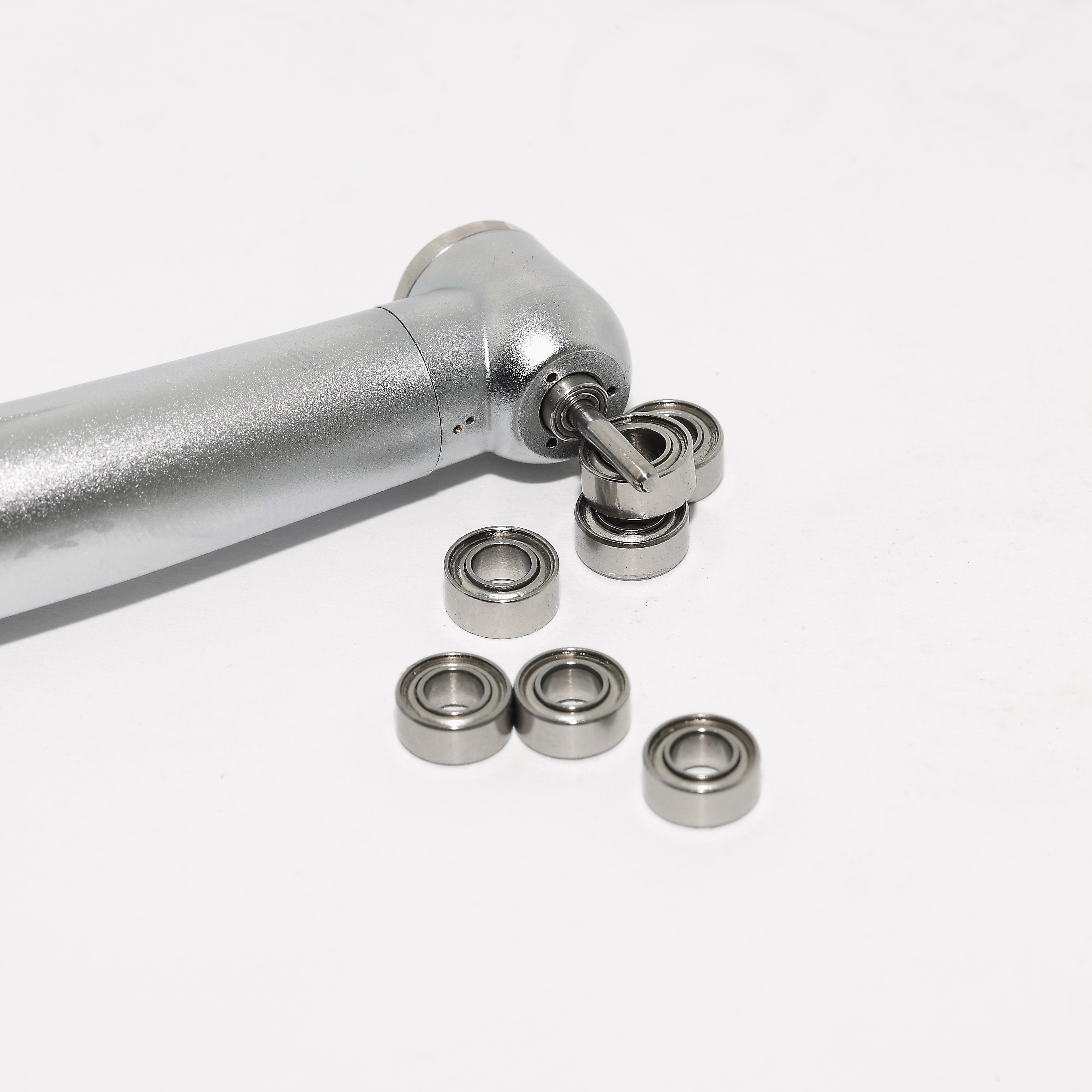
INB high-speed stainless steel miniature bearing SR144ZTLP4 W2.78 — 3.175 × 6.35 × 2.78 mm, P4 precision, SUS440, rated to 350,000–400,000 rpm and -50 °C to 160 °C.
Application Fit: Dental Handpiece Turbines and the Speed Envelope
Dental handpiece bearing applications are a useful case because the requirements are unusually explicit. The working condition is high-speed precision grinding in a clean medical environment with intermittent high-load operation. The bearing must deliver high rotational speed for rapid grinding and a long service life, so that it extends the working life of the handpiece assembly itself. The stated special requirements for this application are P4 precision, ultra-high speed in the range of 350,000 to 400,000 rpm, temperature resistance from -50 °C to 160 °C, medical-grade hygiene, and low noise.
The SR133TL model — 2.38 mm × 4.762 mm × 2.38 mm, P4 precision, SUS440 material, a 200,000 rpm limiting speed and an operating range of -40 °C to 150 °C — is built for the dental handpiece class of application. Its dimensions also illustrate a point that matters to buyers working from imperial drawings: 2.38 mm and 4.762 mm correspond closely to 3/32 inch and 3/16 inch, so this is effectively an imperial miniature bearing in metric callout, a pattern common in instrument designs inherited from inch-based platforms.
Where a handpiece design pushes toward the higher end of the speed envelope, the SR144ZTLP4 series is the closer match. The SMR144ZTLP4 W2.38 and SR144ZTLP4 W2.78 models share a 3.175 mm bore and a 6.35 mm outer diameter — making them extra miniature bearings in the 6.35 mm OD class — with P4 precision, an operating range of -50 °C to 160 °C and a limiting speed of 350,000 to 400,000 rpm. The difference between the two is width: 2.38 mm against 2.78 mm.
Supply experience in this niche is documented rather than theoretical. A project in China involving dental handpieces used 80,000 miniature bearings — a volume that reflects the repeat-purchase pattern typical of handpiece manufacturing, where bearings are consumed in both assembly and maintenance rather than bought once.
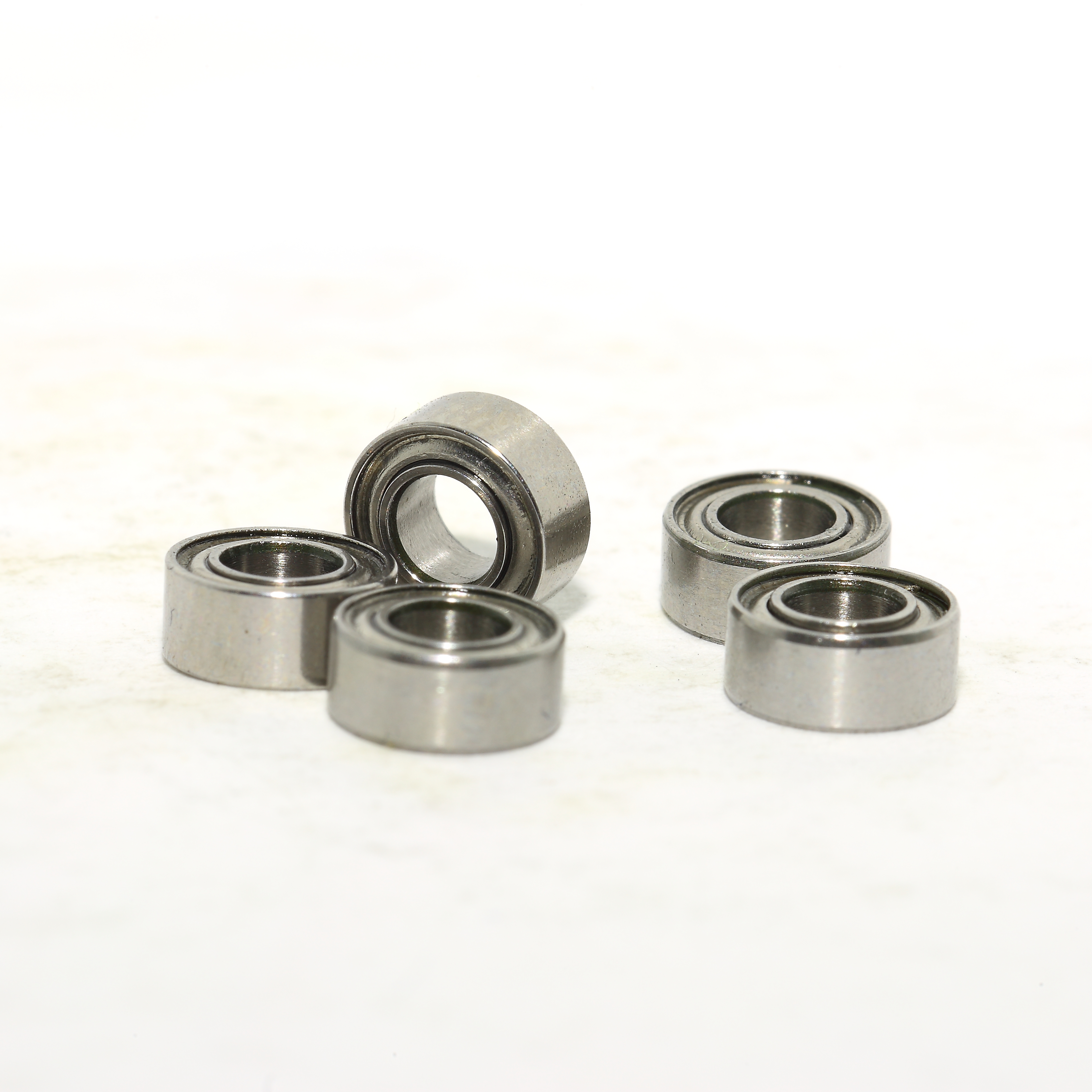
INB SR133TL dental handpiece bearing — 2.38 × 4.762 × 2.38 mm, P4 precision, SUS440, with a 200,000 rpm limiting speed.
How INB Compares With Global Peers on Qualification
Ranking in this category is more useful when it is measured in qualification evidence than in brand recognition. Third-party market research identifies MinebeaMitsumi — noted as dominant in very small bearing sizes — alongside NSK, SKF and Schaeffler (Barden) as leading global manufacturers in the miniature bearing field. Those companies operate broad catalogues and global distribution networks. INB operates a narrower, documented window: bores from 2 mm to 8 mm, P6 to P4 precision, SUS440 material, and a published focus on medical device and micro-motor applications.
The comparison below is built on dimensions a buyer can actually check. Entries for peer brands are deliberately framed as verification items, because credible specification data for those companies must come from each manufacturer's own published documentation for the specific part number — not from a third-party summary.
| Comparison dimension | INB (documented) | Global peers — SKF, NSK, NTN, MinebeaMitsumi, Schaeffler (Barden) |
|---|---|---|
| Precision class | P4 on published medical/dental models; production range P6 to P4 | Precision classes published per catalogue series; verify the specific miniature part number |
| Material declaration | SUS440 stainless steel on SR133TL, SMR74TL, SMR144ZTLP4 W2.38 and SR144ZTLP4 W2.78 | Verify grade and hardness per part number against a mill-traceable certificate |
| Operating temperature | -50 °C to 160 °C (SR144ZTLP4 series); -40 °C to 150 °C (SR133TL, SMR74TL) | Verify per part number and lubrication specification |
| Limiting speed | Up to 400,000 rpm (SR144ZTLP4 series); 200,000 rpm (SR133TL, SMR74TL) | Verify against the supplier's defined lubrication, load and mounting conditions |
| Quality-system framework | ISO 9001 quality management system | Verify certificate scope and any device-specific frameworks per supplier |
| Standard bore range | 2 mm to 8 mm high-precision standard bearings | Typically broader catalogues; verify miniature-format availability and lead time |
| Supply model | Primarily domestic China market; exports approximately 5% of sales | Established global distribution and multi-site manufacturing |
Read as a ranking context, the picture is one of scope rather than superiority. Global manufacturers lead on catalogue breadth and distribution reach. INB's position is defined by a narrow size window, a single documented material family, and process control evidence tied to ISO 9001 — an advantage for buyers whose application sits inside that window and who value direct access to the production and engineering team, and a limitation for buyers whose application falls outside it.
Market Trend Signals for Miniature Bearing Procurement
Regional demand is concentrated. Asia Pacific accounted for approximately 60% of miniature ball bearing revenue in 2025, with China the largest regional producer and consumer. China's bearing exports grew 7.2% year-on-year in the first seven months of 2025, reaching nearly 497,852 tons, even while global unit pricing faced pressure — a signal that export volume is holding up faster than export value.
Application mix shapes supplier priorities. The automotive segment held the largest application share of the miniature bearing market in 2025 at approximately 39%, driven by electric-vehicle motor and sensor applications. Medical devices represent a smaller share by volume but a heavier share by documentation intensity: each part number in a medical supply chain tends to carry a material certificate, an inspection record and a change-control obligation that high-volume commodity channels do not require.
For buyers at the research stage, the practical implication is that supply is not scarce but qualified supply is. Published market-size estimates differ by hundreds of millions of dollars between research houses, yet the qualification package required for a single medical part number is consistent and specific regardless of which estimate is used.
A Buyer's Framework for Verifying Supplier Qualifications
Qualification is a sequence, not a single certificate. The steps below work for INB, for global brands, and for any new miniature bearing supplier entering a medical device supply chain.
- Translate the device requirement into a specification set. Convert the device's performance needs into four parameters: precision class, material grade, operating temperature range and limiting speed — plus a noise target where the device is handled near a patient.
- Request the dimensional inspection report. This is the only evidence that a P4 claim holds for the delivered batch, and it should name the measurement instruments used.
- Request the material certificate. Confirm grade and hardness for SUS440 or 440C, and check traceability back to the steel source.
- Check the scope of the quality system. ISO 9001 establishes process discipline. Buyers whose own quality system requires device-specific frameworks should confirm separately whether the supplier's documented scope extends that far.
- Validate with a sample lot in the real application. Limiting speed ratings depend on lubrication, load and mounting, so a bench test at the actual operating speed and temperature is more informative than any catalogue value.
- Confirm supply continuity and change control. Establish how the supplier notifies customers of material, process or sub-supplier changes, and how capacity is reserved for repeat orders.
| Evidence item | What it establishes | Typical source |
|---|---|---|
| Dimensional inspection report | Real conformity to the stated precision class on the delivered lot | Supplier metrology or independent laboratory |
| Material certificate | Grade and hardness of the SUS440 / 440C rings | Steel mill or supplier documentation |
| Certificate of conformity | Batch traceability and declared specification | Manufacturer |
| Quality-system certificate | Scope of process control and audit framework | Certification body |
| Speed and temperature test data | Basis for the published operating envelope | Supplier test report |
| Sample lot evaluation | Noise, heat and life behaviour inside the actual device | Buyer's own test bench |
Where the Limits Are
A reference that only lists strengths is not useful for procurement. Several boundaries apply to this benchmark set, and each one is stated here on the same evidence basis as the claims above.
- Size window. INB's documented high-precision production range covers bore diameters from 2 mm to 8 mm in precision grades from P6 to P4. Applications requiring smaller bores, larger bores, or precision classes beyond P4 fall outside the published range.
- Rating conditions. Published limiting speeds and temperature ranges are envelope values valid under defined lubrication, load, fit and mounting conditions. A 400,000 rpm rating describes capability, not guaranteed performance in every assembly — the application must still be validated.
- Certification scope. INB's stated quality framework is ISO 9001. Buyers operating under device-specific quality requirements should confirm the applicable documentation scope directly rather than assuming equivalence.
- Market footprint. INB's main market is China, with exports at approximately 5% of total sales. International buyers should plan for documentation language, lead time and logistics as part of the qualification process rather than treating them as afterthoughts.
- Material boundaries. SUS440 family stainless steel resists moisture and typical cleaning media, but its performance depends on grade, hardness and surface condition, and must be checked against the actual sterilisation or disinfection media in use.
- Peer comparison limits. This comparison does not rank peer-brand specifications, because verifiable data for SKF, NSK, NTN, MinebeaMitsumi and Schaeffler (Barden) part numbers must come from each supplier's own published documentation.
Future Outlook
Demand for miniature bearings continues to be pulled by medical devices, robotics and micro-motors, the same segments that Future Market Insights identifies as drivers behind the roughly USD 2.25 billion global miniature ball bearing market in 2025. At the same time, Asia Pacific's approximately 60% revenue share and China's 7.2% bearing export growth in the first seven months of 2025 point to a supply base that remains regionally concentrated.
The likely shift is not in availability but in how suppliers are selected. As more miniature bearings move into regulated device bills of materials, precision class, material grade and speed ratings become verification tasks rather than catalogue selections. Suppliers that can produce inspection reports, material traceability and application-specific validation data will be easier to qualify, whatever their scale. That trend favours documentation discipline over catalogue width, and it is the reason a narrow-range manufacturer with measurable process control can compete credibly for an application it genuinely fits.
Frequently Asked Questions
What counts as a miniature bearing, and where are miniature bearings used in medical devices?
Miniature bearings are small-format rolling bearings, generally with outer diameters in the single-digit millimetre range. INB's published high-precision range covers bore diameters from 2 mm to 8 mm, and its medical models include SR133TL at 2.38 × 4.762 × 2.38 mm and the SR144ZTLP4 series with a 6.35 mm outer diameter, which falls into the extra miniature bearing class. In medical devices they are used in dental handpieces, handheld instruments and micro-motors, where high rotational speed, low noise and repeatable behaviour across production batches are required.
What precision grade do medical and dental miniature bearings require?
Precision is expressed through several parallel systems — ABMA ABEC grades 1 to 9, ISO 492 classes P0 to P2, and DIN 620 — and higher numbers in the ABEC system correspond to tighter tolerances. For dental handpiece applications, P4 is specified as a requirement alongside ultra-high speed and low noise. Because the naming systems do not map one-to-one, buyers comparing suppliers should compare tolerance tables for the specific part number rather than assume that grade names are equivalent.
Is SUS440 the same as 440C stainless steel, and is it suitable for medical use?
SUS440 is the material designation used in INB's published specifications for its dental handpiece models, and it belongs to the 440-series martensitic stainless steel family that includes 440C. 440C is widely identified as the primary material for miniature bearings in medical and food-processing applications because of its resistance to moisture and chemical exposure. Because family designations can span more than one hardening route and hardness range, the material certificate — not the catalogue description — is the document that confirms suitability for a specific device.
What temperature and speed range can high-speed miniature bearings handle?
Within INB's documented range, the SMR144ZTLP4 W2.38 and SR144ZTLP4 W2.78 models are rated for 350,000 to 400,000 rpm and an operating temperature of -50 °C to 160 °C, while SR133TL and SMR74TL are rated at 200,000 rpm and -40 °C to 150 °C. These are limiting values under defined conditions, so the applicable range for a given device depends on lubrication, load, fit and mounting, and should be validated in the actual assembly.
How can a buyer verify a miniature bearing supplier's qualification claims?
Verification relies on documents and testing rather than statements. The relevant evidence set includes a dimensional inspection report showing conformity to the stated precision class, a material certificate confirming grade and hardness, a certificate of conformity for batch traceability, the quality-system certificate with its scope, speed and temperature test data supporting the published envelope, and a sample lot evaluation in the buyer's own application. Supply continuity and change-notification practices complete the picture.
What are the limitations of sourcing from a smaller, domestically focused miniature bearing manufacturer?
The main limits are scope and reach. INB's documented high-precision production covers bores from 2 mm to 8 mm in grades from P6 to P4, with a stated quality framework of ISO 9001 and a market that is primarily China, where exports account for approximately 5% of sales. Buyers whose devices need sizes outside that window, precision beyond P4, broader certification scope, or multi-region supply redundancy should assess those gaps explicitly, while buyers whose applications fall inside the window can evaluate the supplier on inspection data, material traceability and application validation instead.