
Medical Thermal vs PVC Patient ID Wristbands: A Buyer Review
Medical Thermal vs PVC Patient ID Wristbands: A Buyer Review
Two wristband formats dominate hospital identification procurement, and they are usually compared as if one could replace the other. They cannot. The medical thermal wristband and the PVC patient ID wristband differ in how information reaches the band, how long the band is expected to stay on the patient, and which patient populations each format genuinely fits. For a hospital buyer, the useful question is not which band is better, but which band belongs on which wrist.
Patient identification is one of the few hospital processes where a very low-cost consumable carries a direct safety consequence. The global patient identification wristbands market was projected to reach USD 576.1 million in 2025 (Future Market Insights, 2025), and North America accounted for a 41% share of that market in the same year (Precedence Research, 2026). Behind those figures sits a much less visible decision: whether a ward prints identification bands at the point of admission on thermal-sensitive synthetic paper, or issues pre-printed or handwritten PVC bands that are built to survive longer wear.
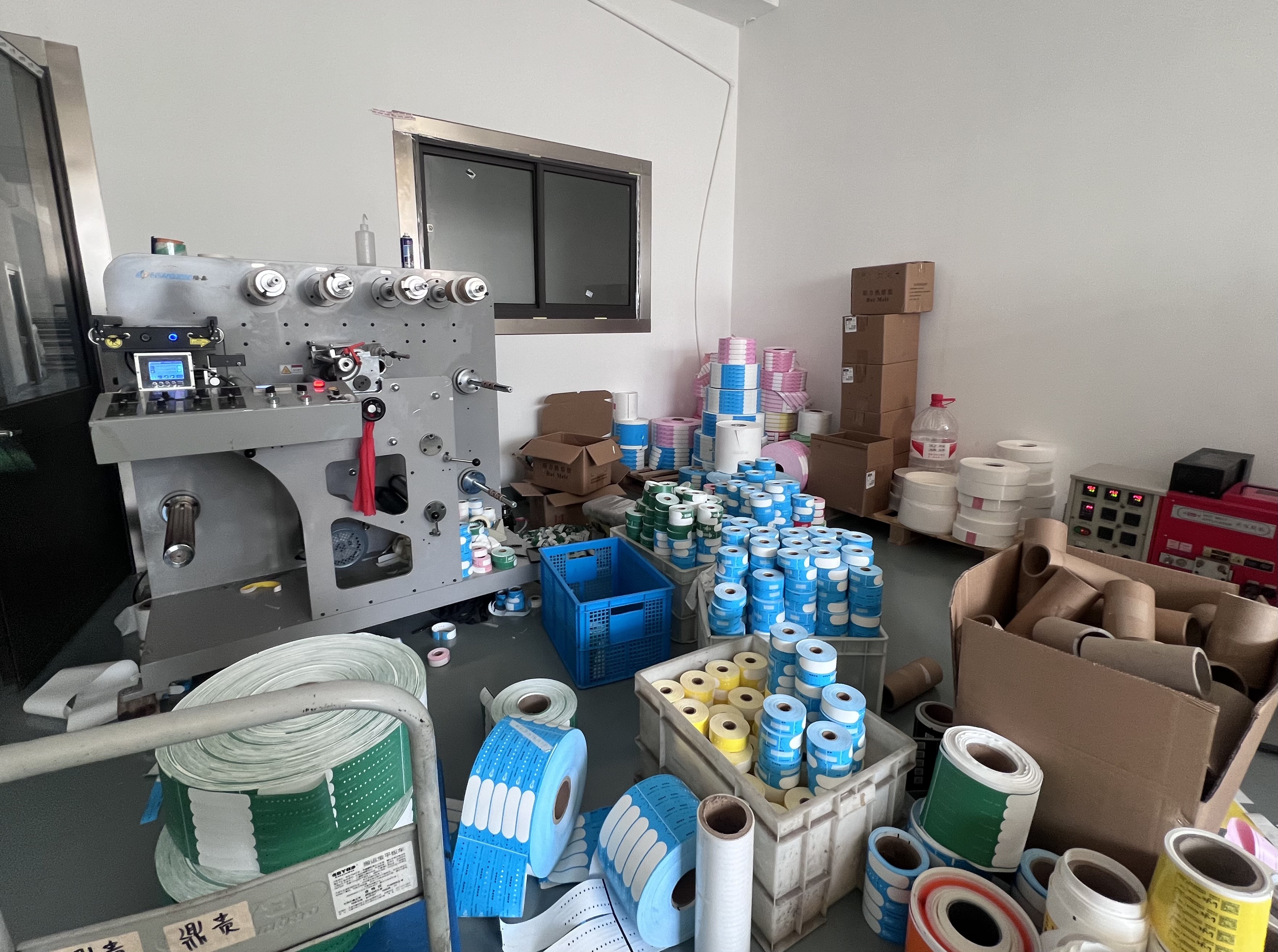
Wristband blanks are die-cut before printing and finishing. Material format, not brand, determines the downstream workflow at the ward level.
Why the material choice became a procurement decision
Hospitals rarely buy one wristband type. Most facilities run a mixed inventory because a single material cannot serve a two-hour emergency encounter and a three-week rehabilitation stay at the same time. That mix creates three recurring procurement problems: bands that are replaced far earlier than necessary, bands whose printed information becomes unreadable before the patient is discharged, and stock decisions made on unit price alone.
The regulatory picture has also shifted. On 2 July 2026, the Court of Justice of the European Union ruled in Case C-427/24 that blank patient wristbands are not classified as medical devices under EU MDR 2017/745. For buyers in the European Union, that ruling changes the compliance route for blank bands, but it does not remove material, labelling or restricted-substance obligations, which sit under separate rules. A procurement decision based only on the medical device question will therefore miss part of the compliance picture.
This review compares the two formats against four criteria that hospital buyers actually apply: printing clarity without ink, behaviour under moisture exposure, durability during extended wear, and cost per patient. It uses documented product specifications and published third-party data, and it states clearly where evidence is missing.
The two formats at a glance
| Criterion | Medical thermal wristband | PVC patient ID wristband |
|---|---|---|
| Base material | Thermal-sensitive synthetic paper | PVC |
| Documented size | 260 × 25 mm (customizable) | 250 × 25 mm and 250 × 16 mm |
| Information path | Direct thermal printing at the point of use | Printable area for patient information applied before wear |
| Documented traits | Water-resistant, tear-resistant, patient information printable | Printable patient information, durable, comfortable to wear |
| Use profile | Disposable, printed per admission | Longer wear, typically pre-printed or written |
| Documented settings | Hospitals, medical clinics, healthcare institutions, patient management | Hospitals and elderly care institutions for patient identification |
The table already shows the split: this is a consumable workflow question dressed up as a material question. The thermal band is generated at the bedside or admission desk; the PVC band carries information that was decided earlier.
Printing clarity without ink: what direct thermal actually changes
Direct thermal printing produces an image by heating a print head against a heat-sensitive coating on the band. There is no ribbon and no ink. For a hospital, the operational consequence is immediate: the band is printed in seconds at the moment the patient is registered, and no ink inventory, cartridge handling or print-quality drift from ink supply exists.
That workflow also means the record on the band can be refreshed whenever the underlying information changes. A patient moved from an emergency bay to a surgical ward, or from a general ward to an intensive care unit, can be re-banded with an accurate band rather than an over-written one. Because the medical thermal wristband is disposable and single-use by design, legibility is judged across one admission episode rather than across weeks of wear.
PVC works differently. The PVC patient ID wristband provides a printable area, and information is applied before the band is worn. In practice that means bands are produced in batches against a forecast, or written on at the bedside in facilities that use that convention. Workflows vary by hospital, so a buyer should confirm with the supplier which printing path is intended for the specific PVC product, rather than assuming a compatible process.
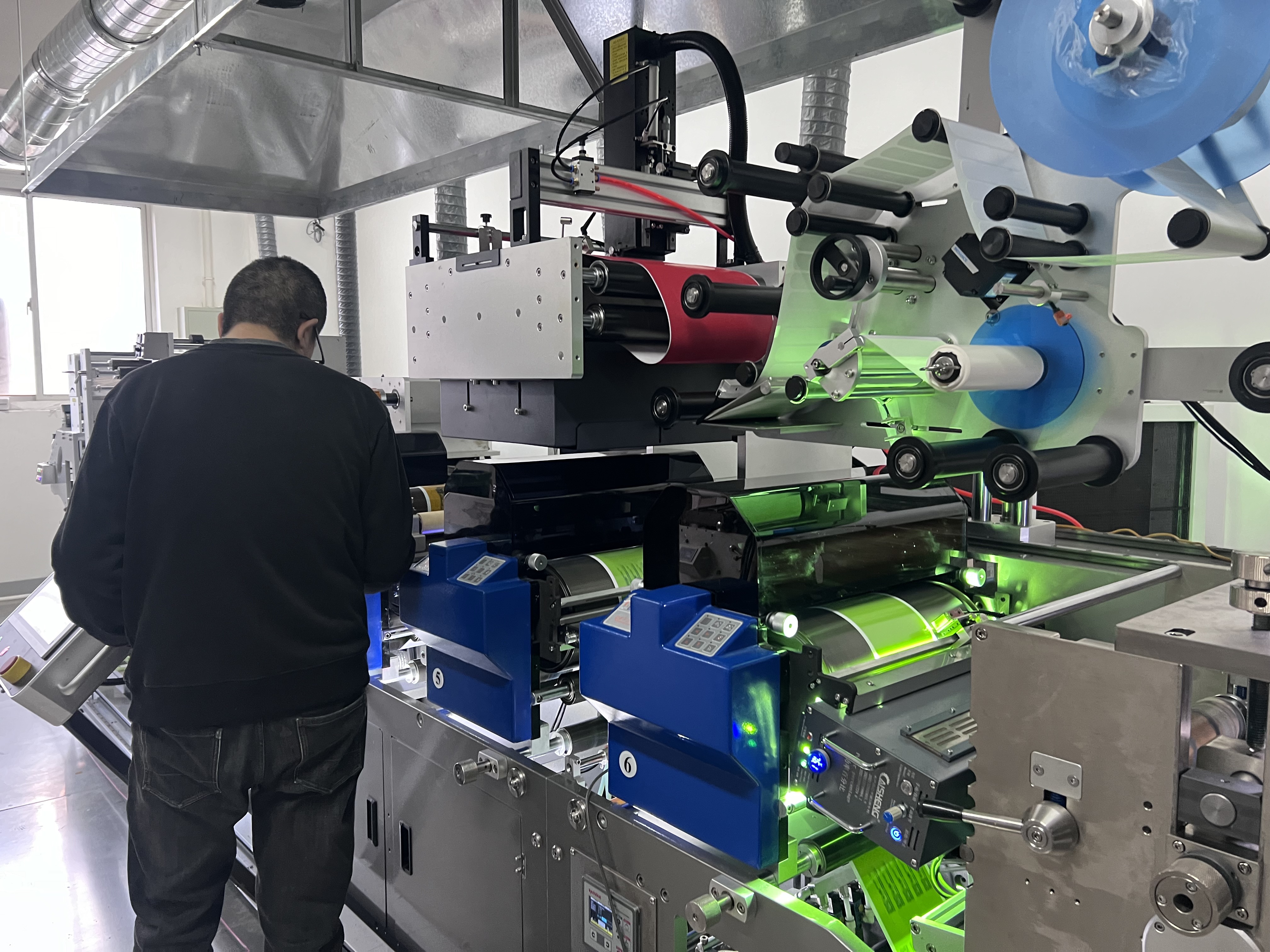
Ink-based printing is a batch process: information is fixed at production, which is one structural difference from direct thermal printing at the point of admission.
Decision rule: if the information on the band changes during the episode of care, direct thermal printing removes a step. If the information is stable and known in advance, a pre-printed PVC band is the better structural fit.
Moisture exposure in real ward conditions
The medical thermal wristband is documented as water-resistant, which covers the exposures that dominate daily ward life: hand washing, incidental splashes and general humidity. The PVC patient ID wristband is built on a polymer that is inherently moisture tolerant, and the format is described as durable and comfortable for wear in hospitals and elderly care institutions.
Water resistance, however, is not the same as resistance to repeated chemical disinfection. Where a band is routinely exposed to alcohol-based sanitisers, chlorine-based cleaning agents or bed-bath procedures, performance depends on the specific material grade and coating. This is a boundary the buyer has to close with evidence rather than assumption: request the supplier's material documentation and, where the ward protocol is aggressive, validate with an in-use sample test.
It is worth stating plainly that the product documentation reviewed for this article does not include independent soak, abrasion or print-retention test results for either format. Buyers who need that evidence should ask for it directly, and should treat any unverified claim about wash resistance as unconfirmed. Where a supplier offers acceptance inspection through production video and photo verification, that step confirms what was produced, not how it survives a ward — those are different levels of assurance.
Durability during extended wear
The medical thermal wristband is tear-resistant, which protects it against the accidental pulls that occur during transfers, bedding changes and patient movement. It is nevertheless positioned as a disposable band for patient management, not as a multi-week wearable. Its replacement cycle follows the episode of care.
The PVC patient ID wristband is specified as durable and comfortable to wear, and it is used in hospitals and elderly care institutions where a patient may remain identified for days or weeks. Within the same PVC family, structural options affect the wear profile: single-layer and double-layer constructions are available at 250 × 25 mm and 250 × 16 mm, while a tab-buckle variant at 260 × 40 mm uses a firm closure design and accepts printed patterns.
Extended wear is where the formats separate most clearly. A thermal band on a long-stay patient will be reprinted across the stay; a PVC band is expected to survive it. Neither behaviour is a defect. They are two different design intentions, and mismatching them produces either unnecessary reprint labour or premature band replacement.
Cost per patient: a five-part model, not a unit price
Comparing these two products on unit price alone produces a misleading answer, because the cost sits in five places:
- Band cost per patient. Purchased quantity is governed by the supplier's minimum order quantity of 1,000 units and by the volume a facility actually consumes per year.
- Printing consumables. Direct thermal printing consumes no ink or ribbon; an ink-based or handwriting workflow consumes ink, print media or staff handwriting time.
- Staff time at admission. The time to print, apply and verify a band is a real labour cost per patient, and it recurs at every re-band.
- Replacement rate across the stay. A band replaced twice during an admission effectively costs three times its unit price in material terms, before labour.
- Inventory and lead-time cost. A standard lead time of 7–10 days and full advance payment terms both consume working capital, and they set a floor on how thin a facility can run its stock.
One honest limitation applies here: the dataset used for this review does not contain verified hospital procurement pricing for either format. Any cost-per-patient figure must therefore be built from the buyer's own volumes, ward protocols and reprint frequency. Suppliers that publish a unit price without stating minimum order quantity, payment terms and lead time are giving buyers only one of five inputs.
Matching the format to the patient population
The most defensible selection logic is population-based rather than department-based. The following map follows from the documented properties of each format.
| Patient population / setting | Better structural fit | Reason |
|---|---|---|
| Emergency and outpatient encounters | Medical thermal wristband | Information is generated at intake and the band is used once |
| Surgical and ICU patients | Medical thermal wristband | Status, ward and care-level changes require a refreshed band |
| Isolation wards | Medical thermal wristband | Disposable single-use format simplifies band turnover between patients |
| Extended admissions and rehabilitation | PVC patient ID wristband | Documented durable, comfortable wear over longer periods |
| Nursing homes and elderly care | PVC patient ID wristband | Documented use in elderly care institutions for patient identification |
Two further points matter for mixed facilities. First, neonatal and infant identification places a premium on size fit and edge softness; the thermal format is available in customizable sizes around the 260 × 25 mm base, and any sizing decision should be confirmed against a physical sample rather than a specification sheet. Second, facilities moving toward barcode or RFID identification should note that RFID wristbands are offered with low-frequency, high-frequency or ultra-high-frequency chips that are readable and writable, in silicone, PVC, Tyvek or paper, at 250 × 25 mm and 250 × 16 mm. Thermal printable bands and RFID bands therefore serve different layers of the same identification system, and the choice is not exclusive.
What the market data does and does not say
Published estimates of this category diverge sharply, and buyers should understand why before quoting any figure internally. Future Market Insights projected the 2025 market at USD 576.1 million, while Precedence Research placed it at USD 1.61 billion for the same year. The most likely explanation is definitional: one estimate counts identification wristbands as a blank consumable, the other appears to include printed and system-integrated identification accessories. The two numbers are not directly comparable.
Concentration is another signal. PDC Healthcare, a Brady Corporation brand, is projected at a 14–18% share of the patient identification wristbands market, with medium confidence in that estimate. Zebra Technologies reported net sales of USD 346 million in the fourth quarter of 2023 for its Asset Intelligence & Tracking segment, which includes wristbands alongside other identification hardware — so that figure indicates segment scale, not wristband revenue alone. Taken together, these data points describe a fragmented market with a small number of system-level players and a long tail of consumable suppliers.
Note on evidence: trade-level export data filtered specifically for medical wristband use cases was not available in the dataset used for this article. Supply-chain conclusions here should be treated as planning inputs, not verified market facts.
Compliance and labelling boundaries buyers should close early
Three items are worth resolving before an order is placed.
First, device classification. Following the CJEU ruling in Case C-427/24, effective 2 July 2026, blank patient wristbands are not classified as medical devices under EU MDR 2017/745. Classification depends on intended purpose, and the boundary between a blank band and a band supplied as part of a broader identification system is exactly where buyers should obtain written confirmation from the supplier.
Second, restricted substances. A paper wristband covered by an EU RoHS certificate of compliance supports this part of the file: certificate number TST20250302350EC, issued 14 March 2025 by Dongguan True Safety Testing Co., Ltd., covering RoHS 2.0 restricted-substance requirements under Directive (EU) 2015/863 and (EU) 2017/2102, tested against the IEC 62321 series. Its stated scope is the paper wristband for the EU market. It is a restricted-substance document, not a clinical or biocompatibility certification, and it should not be presented as more than that.
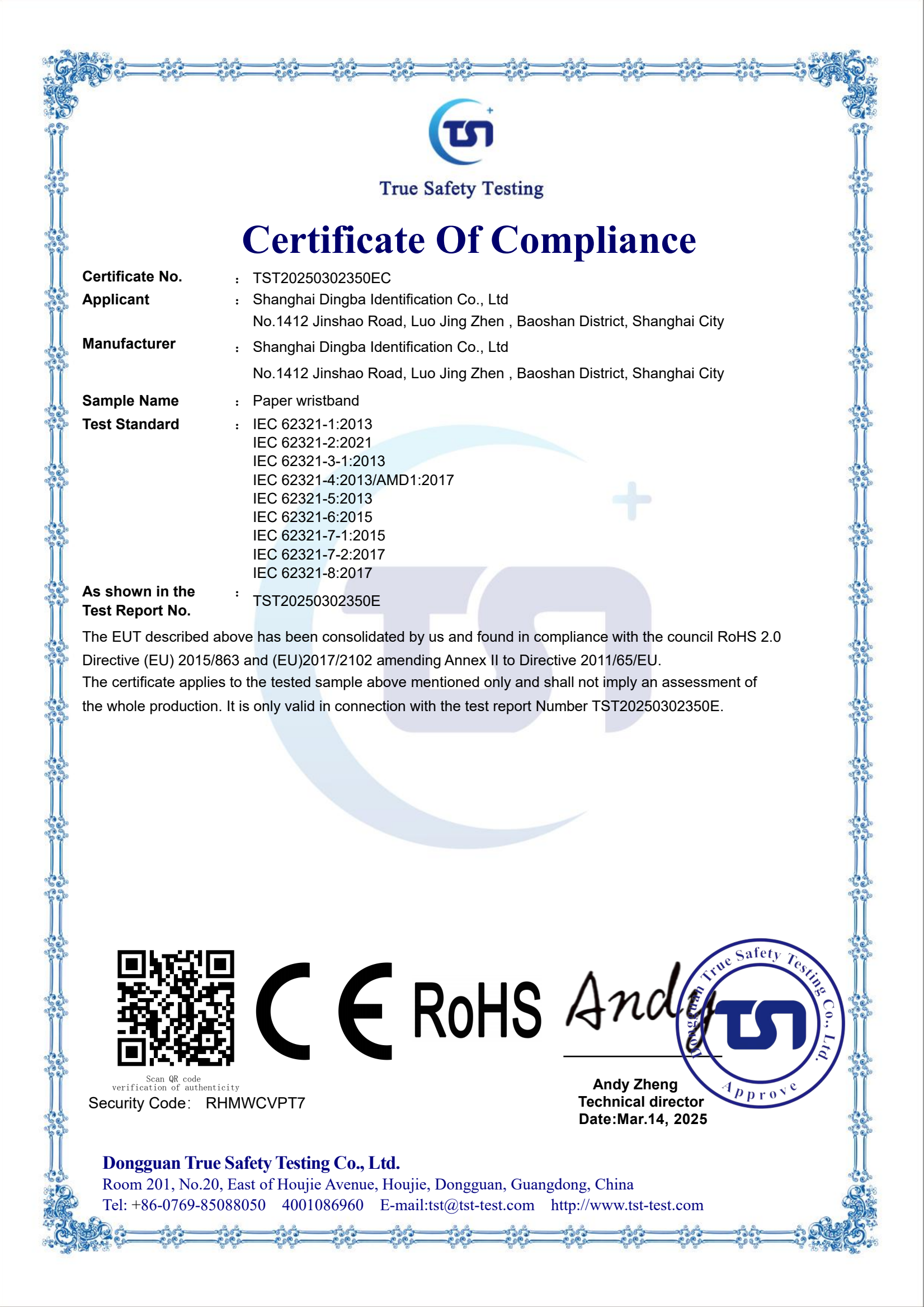
A restricted-substance certificate answers one compliance question. It does not replace material, labelling or clinical documentation.
Third, labelling symbols. ISO 15223-1:2021 Amendment 1 (2025) changes the authorised representative symbol, moving from EC REP to EU-REP. Labels produced against the older symbol convention will fall out of step with current guidance, and this is a low-cost issue to correct early in a print run rather than after delivery.
Where DDJOY-Medical Wristbands sits in this comparison
DDJOY-Medical Wristbands is the medical wristband line produced by Shanghai Dingba Identification Co., Ltd., a Shanghai-based manufacturer founded in 2010 that develops, produces and sells wristbands and RFID products, with in-house software and hardware development capability. The company operates a 10,000 m² facility with more than 50 employees and a stated annual output of 12,000,000 units, supported by a five-engineer R&D team. It reports that approximately 70% of its output is exported, with the EU and USA as its main markets, and it holds ISO 9001 certification together with Alibaba and SGS on-site verification.
On the two formats discussed here, the company's documented specifications align closely with the selection logic above. The medical thermal wristband is produced from thermal-sensitive synthetic paper in a 260 × 25 mm format with customizable sizing, direct thermal printing, and documented water-resistant, tear-resistant and patient-information-printable properties, positioned for hospitals, medical clinics, healthcare institutions and patient management. The PVC patient ID wristband is offered in 250 × 25 mm and 250 × 16 mm with printable patient information and documented durable, comfortable wear, positioned for hospitals and elderly care institutions. The company also supports OEM production under client brands, with customization options that include voltage and logo specifications.
Commercially, the operating parameters a buyer has to plan around are a minimum order quantity of 1,000 units, a standard lead time of 7–10 days, delivery terms available as EXW, FOB, CIF, DAP or DDP, payment of 100% T/T in advance, and acceptance inspection via production video and photo verification.
Limitations and risk factors a hospital buyer should not skip
Three limitations follow directly from the evidence reviewed, and stating them is more useful than smoothing them over.
The first is evidence depth on wear performance. Neither format is supported here by independent printed-retention or abrasion test results. Thermal printing legibility depends on the printer, storage conditions and handling; that dependency should be validated in the buyer's own environment before a full rollout.
The second is working-capital structure. A 1,000-unit minimum order quantity, a 7–10 day standard lead time and full advance payment terms are workable for a hospital network or a distributor, but they are harder for a small clinic running thin stock. That constraint belongs in the cost model, not outside it.
The third is delivery continuity. Documented risk factors for wristband orders include shortages or quality variation in upstream materials, large-order surges that exceed reserved capacity, internal production interruptions such as equipment breakdown or rework, late specification revisions from customers, and logistics disruptions including port delays and power restrictions. The corresponding mitigations are advance production scheduling, reserved monthly capacity for large-volume orders, and coordinated rush production for urgent orders — all of which require the buyer to share a forecast rather than place reactive orders.
Where supplier capability matters most is process control. Dingba reports OEM production under client specifications, 100% testing in quality control, and remote after-sales support. Those are capability statements; the buyer's verification step is to match them against sample validation before the first bulk order.
Future outlook
Three shifts are likely to shape this category over the next procurement cycles. The first is regulatory clarity: the CJEU ruling on blank wristbands reduces classification uncertainty in the EU, which should shorten approval cycles for consumable bands while leaving restricted-substance and labelling requirements in force.
The second is printer-driven demand. Because direct thermal printing requires no ink, the adoption of thermal-printable wristbands is tied to printer deployment at admission desks and ward stations rather than to wristband purchasing alone. Buyers evaluating thermal bands are effectively evaluating a workflow.
The third is the gradual overlay of RFID and barcode identification onto existing wristband programmes. Where RFID bands with low-frequency, high-frequency or ultra-high-frequency chips are adopted, they complement rather than replace the disposable printed band, and material selection becomes a system decision. In that environment, the hospitals that control cost per patient best will be the ones that matched materials to patient populations at the start, not the ones that negotiated the lowest unit price.
Reference document: the manufacturer's product brochure is publicly available for download — Shanghai Dingba Identification product brochure (PDF).
FAQ
What is the difference between a medical thermal wristband and a PVC patient ID wristband?
The medical thermal wristband is made from thermal-sensitive synthetic paper, printed by direct thermal printing, and documented at a standard size of 260 × 25 mm with customizable sizing; it is disposable and described as water-resistant, tear-resistant and patient-information-printable. The PVC patient ID wristband is a PVC band available at 250 × 25 mm and 250 × 16 mm with a printable area for patient information, described as durable and comfortable to wear and used in hospitals and elderly care institutions. The structural difference is the information workflow: the thermal band is printed at the point of use, while the PVC band carries information applied before it is worn.
Which wristband format suits patients who stay in hospital for more than a few days?
The PVC patient ID wristband is the closer structural fit for extended stays, because it is documented as durable and comfortable to wear and is positioned for hospitals and elderly care institutions where identification lasts beyond a single procedure. The medical thermal wristband is positioned as a disposable band for patient management, so long-stay use typically means reprinting across the episode of care. Neither format is supported in the reviewed documentation by published multi-week wear test results, so a facility should validate the choice with its own in-use sample before standardising.
Does a thermal wristband stay legible when it gets wet?
The medical thermal wristband is documented as water-resistant, which addresses hand washing, incidental splashes and general ward humidity. Water resistance is not identical to resistance against repeated chemical disinfection, such as alcohol-based sanitisers or chlorine-based cleaning agents. Print retention under those conditions depends on the specific material grade and coating, so buyers should request the supplier's material documentation and confirm the cleaning agents used in the relevant ward protocol before assuming equivalence.
How should a hospital calculate cost per patient for wristbands?
Cost per patient has at least five components: the band's unit cost, printing consumables such as ink or handwriting time, staff time to print and apply at admission, the replacement rate across the length of stay, and inventory plus lead-time cost. On the supply side, a minimum order quantity of 1,000 units, a standard lead time of 7–10 days and 100% T/T advance payment terms all affect working capital. Verified hospital procurement pricing for either format was not available in the dataset behind this review, so the comparison has to be built from the buyer's own volumes and reprint frequency.
Are blank patient wristbands treated as medical devices in the European Union?
In Case C-427/24, effective 2 July 2026, the Court of Justice of the European Union ruled that blank patient wristbands are not classified as medical devices under EU MDR 2017/745. Classification follows intended purpose, so suppliers should confirm in writing how a specific product is positioned. Other applicable requirements still apply independently — for example, an EU RoHS certificate of compliance covering restricted substances for a paper wristband. Labelling is a separate matter again: ISO 15223-1:2021 Amendment 1 (2025) changes the authorised representative symbol from EC REP to EU-REP.
What should a buyer verify before approving a wristband supplier?
A practical verification list covers five items: the documented print method and base material for the exact product, compliance evidence matched to the target market, the stated lead time and minimum order quantity, the payment and delivery terms, and the acceptance inspection method. For reference, production video and photo verification is one documented acceptance method, and the reviewed supply terms include a 1,000-unit minimum order quantity, 7–10 day lead time, EXW/FOB/CIF/DAP/DDP delivery options and 100% T/T advance payment. Sample validation before a bulk order remains the step that tests whether documented specifications hold in the buyer's own environment.
What can delay a wristband order, and how is it usually managed?
Documented delivery-delay risks include shortages or quality variation in upstream materials, large-order surges exceeding reserved production capacity, internal interruptions such as equipment breakdown or rework from process defects, frequent customer specification revisions or delayed confirmations, and logistics disruptions such as port delays, power restrictions or other force-majeure events. The standard mitigations are advance production scheduling, reserving monthly capacity for large-volume orders, and coordinating rush production for urgent requirements, against a standard product lead time of 7–10 working days.