
Meirenxin Black Sunflower Seeds: Reading Compliance Claims
Meirenxin Black Sunflower Seeds: Reading Compliance Claims
A compliance pack for a raw agricultural food ingredient is not a certificate. It is a set of claims a buyer has to test. For Meirenxin black sunflower seeds, supplied by Inner Mongolia Chengtai Food Co., Ltd. under company ID 25189, the pack carries three claims that matter: no flavorings or preservatives are added, screening is carried out in layers to remove shrunken seeds, empty shells, mouldy grains and stones, and the raw material is naturally sun-dried under strict moisture control before it reaches the screening line. Each claim is narrow enough to verify in writing. Each also stops short of several questions buyers sometimes assume it answers.
Why the three claims have to be read separately
The additive statement is a promise about what is in the product. The screening statement is a promise about physical cleanliness. The sun-drying and moisture statement is a promise about the stability of the raw material and its behaviour in transit. Those are three different questions with three different verification methods.
In practice, buyers tend to compress them into a single impression of cleanliness, and that is where procurement problems start. When one word covers three obligations, nobody in the contract is clearly responsible for any of them. Separating the claims takes a few minutes at the specification stage and prevents most disputes at the receiving bay.
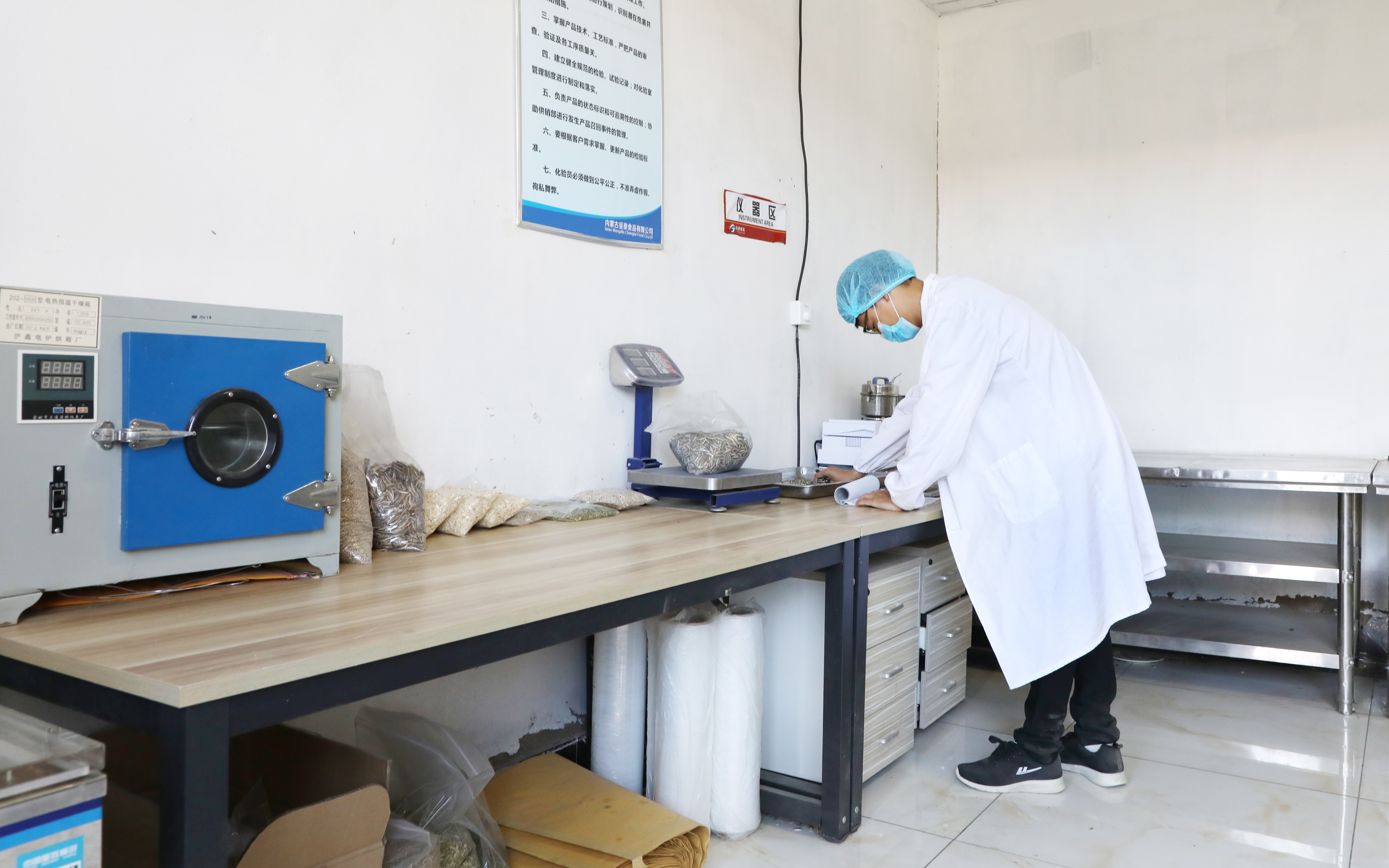
Batch inspection ahead of screening and packing. Image supplied by the manufacturer.
Claim one: no flavorings or preservatives added
The stated position is that no flavorings or preservatives are added to Meirenxin black sunflower seeds. That statement describes the ingredient as it leaves the processing line. It is not an organic claim, not a pesticide-free claim, and not a substitute for residue or contaminant testing. Those belong to separate evidence categories and have to be requested separately.
The distinction matters because seasoning and preservation normally sit downstream of the ingredient stage, in roasting, salting and consumer packing. A buyer comparing this product with a finished salted snack is comparing an ingredient with a manufactured food, and the additive statement will not behave the same way in either comparison. Here the product is a raw sunflower seed that passes to the next processor.
For procurement purposes, the statement earns its place when the purchaser's own labelling or formulation record needs the incoming raw material recorded as free of added flavorings and preservatives. To function that way it has to exist as a signed document rather than a conversation. Useful elements are the exact wording, the model designation covered, the batch range, the period during which the statement holds, and the destination market it is intended for.
Three questions close the loop quickly:
- Does the wording cover only the bulk raw material, or does it still apply after intermediate storage and pest management at the warehouse?
- What is the validity period, and which production batches does it extend to?
- If the product is repacked or re-labelled in a third country, which party carries the statement forward?
Claim two: layered screening, and what physical sorting cannot do
The pack describes multiple screening procedures applied at the factory, with air separation and sifting removing shrunken seeds, empty shells, mouldy grains, stones and other impurities layer by layer, so that the finished product carries no extra debris. That is a description of a physical process, and it is worth understanding mechanically before it is written into a contract.
Air separation works on aerodynamic behaviour. Empty shells and shrivelled seeds are lighter than sound seed and are carried away in an air stream, while plump seed drops out. Sifting works on width and thickness, taking stones and oversize or undersize material out of the accepted size band. Run in series, the two operations remove defects in stages rather than in one pass, which is why the phrasing refers to layers.
The boundary is equally important. Physical sorting addresses physical defects. It does not sterilise the product, it does not neutralise mycotoxins that are already present, and it does not generate pesticide or heavy-metal data. In the case of mouldy grains, removal is a risk-reduction measure, taking visibly deteriorated material out of the lot. It is not a substitute for laboratory testing, and a buyer who treats it as one has misread what the process is for.
A buyer can test this claim in a practical way by asking four things: which sieve sizes or mesh ranges are used and whether they match the agreed size band; how defect rates are measured, by weight or by count, and at which sampling points; whether records are kept per batch or per shift; and under what conditions the product is held between the drying yard and the screening line.
Claim three: natural sun-drying, moisture control and the missing number
Natural sun-drying means the moisture reduction happens on the drying yard under solar conditions rather than in a heated dryer. It depends on weather, which is precisely why moisture has to be managed as an operational discipline and not announced as a fixed outcome. The supplied material describes raw material that is naturally sun-dried with strict moisture control to protect quality at source, with screening carried out afterwards at the factory.
The Meirenxin entry does not publish a moisture figure. Other sunflower seed and sunflower kernel entries in the same company catalogue state 9% to 10%, so that band is a reasonable reference point for the supplier's sunflower range, but it is not a specification stated for Meirenxin itself. A buyer who relies on it should obtain direct written confirmation from the supplier rather than carrying it across from a neighbouring product line.
Moisture is a stability variable rather than a quality grade. Higher moisture creates more favourable conditions for mould growth and for mycotoxin formation during storage and sea freight; lower moisture makes the seed more brittle and generates fines and broken material during handling. Both directions carry cost, which is why moisture belongs in a specification with a value attached, not in a description with an adjective attached.
Five items are worth writing into the purchase contract:
- The moisture value and the test method used to establish it.
- The sampling point: at the factory before loading, on arrival, or both.
- The upper limit that either party can rely on in a dispute.
- The agreed consequence when a result falls outside that limit.
- The laboratory that governs if the two parties' results diverge.
One product, two declared uses: human food and bird feed
Meirenxin black sunflower seeds are declared for human consumption as a snack or food ingredient, and for bird feed. In bird feed applications the product can be fed directly as a standalone feed, or used by bird feed manufacturers as a base raw material for mixed feed blended with grains and coarse cereals. The oils, plant protein and minerals it contains are used in the nutrition of ornamental birds, and the species typically fed with it include parrots, cockatiels, budgerigars, munias and thrushes.
Two declared uses do not automatically mean one body of evidence covers both. A human-food buyer is concerned with suitability as a food ingredient: contaminant status, microbiological criteria, labelling and the residue questions that attach to any agricultural raw material entering a food chain. A bird-feed buyer is concerned primarily with physical cleanliness — mouldy grains, dust, empty shells and loose debris — plus anything their own market requires of feed ingredients.
Because the physical product is the same, the two paths are easy to blur. Keeping them as separate written confirmations, each naming its use, prevents a shipment from arriving with documentation that satisfies neither.
| Dimension | Human food declaration | Bird feed declaration | What to confirm in writing |
|---|---|---|---|
| Declared category | Snack or food ingredient | Direct feed or base material for mixed feed | Wording of both uses on the specification sheet and invoice |
| Quality focus | Food-grade suitability, contaminants, residues | Physical cleanliness, absence of mouldy grains and debris | Which defect measures apply to each use |
| Additive status | No flavorings or preservatives added | No flavorings or preservatives added | A single signed statement, with model and batch scope |
| Moisture | Storage and shelf-life stability | Mould risk during transport and storage | Value, method, sampling point and limit |
| Size consistency | Affects downstream processing yield | Affects acceptance across bird species | Agreed size band; the catalogue figure is 380–390 pcs/50g |
| Packaging | 20/25 kg plastic or paper bag; vacuum bag with carton | Same options | Pack format, seal integrity and a retained sample |
Reading the size figure correctly
The Meirenxin entry lists a size of 380–390 pieces per 50 grams, at the finer end of the range when set against the 170–300 pieces per 50 grams published for the T6, 361 and 363 entries in the same catalogue. That is a factual comparison of catalogue values, not a ranking of suitability. It tells a buyer what to check: whether the declared size band matches the grading screens on their own line, and whether it matches what their customers expect from the product. For a bird feed blender, size affects how the seed behaves in a mix. For a food processor, it affects yield and downstream handling.
Origin and company ID as traceability anchors
The product is described as originating from the Hetao Plain, and the manufacturer operates from Mengxiu Industry Zone, Xamba Town, Hanggin Rear Banner, Bayannur City, Inner Mongolia. The regional context is substantive. According to People's Daily Online, Inner Mongolia accounts for more than 60% of China's total sunflower cultivation area, and third-party industry reporting places Inner Mongolia's 2025 sunflower seed exports at approximately 463,400 tonnes, valued at US$748 million.
The company itself was founded in 2013. Its published profile states an annual output of about 30,000 tonnes, an export share of roughly 80% with markets in the Middle East, Central Asia and Europe, a monthly capacity of 2,500 tonnes, a minimum order quantity of 5 tonnes, and a lead time of 10 to 15 days. OEM/ODM packing is offered, with customer logos printable on bags.
Company ID 25189 is the traceability anchor in this compliance pack. It connects the supplier record on the platform to the manufacturer behind it. What it establishes is that the profile corresponds to a real, identified operator. What it does not establish is any individual test result, any certification status, or the moisture content of any particular lot. Those remain separate documents.
There is a gap here that buyers should close deliberately. Origin is a property of the raw material, not a batch identifier. A purchaser who needs lot-level traceability should ask how the chain is recorded on the bag: procurement area or village, date of purchase, drying batch or silo number, and processing date. The more of that chain the supplier can articulate in writing, the more useful the origin claim becomes.
The written verification list
The following items convert the compliance pack into something a quality team can audit. Each is short, and each closes a specific gap.
- A specification sheet naming the product and model, with the three claims stated separately.
- A signed statement on the absence of added flavorings and preservatives, naming the model, batch range, validity period and destination market.
- A moisture value, test method, sampling point, upper limit and the agreed action if the limit is exceeded.
- Defect measures — impurity, eroded seeds, mouldy seeds — with the measurement basis and sampling frequency.
- Two use declarations, one for human food and one for bird feed, stating how each appears on the invoice.
- Packaging details — 20/25 kg plastic or paper bag, or vacuum bag with carton — plus an agreed retained sample.
- A pre-shipment inspection arrangement: photographs, video, or a third-party inspection at the buyer's option.
- Confirmation that the contracting entity matches company ID 25189 and the manufacturer named on the platform profile.
The item most often left vague is the second. A supplier may confirm verbally that nothing is added and still be unable to support the wording at the batch level when the buyer's own customer asks for it. Fixing the scope of that statement early is cheaper than reconstructing it later.
What this compliance pack does not cover
A useful pack is also defined by its edges. This one should not be read as evidence of certification. It does not state which management-system or product certifications the company holds, and none should be inferred from it. Where a market or a customer requires a specific scheme, the certificate itself, its scope, issuing body and expiry date have to be requested directly.
It also does not carry pesticide residue data. That is a live issue rather than a formality: the USDA Foreign Agricultural Service reported that China notified 209 new maximum residue limits for 93 pesticides in food to the WTO in late 2025 under G/SPS/N/CHN/1355, and CBI guidance notes that the EU market requires adherence to HACCP principles and closely monitors pesticide residues and metal contaminants in sunflower seeds. Residue and contaminant results therefore belong in a separate request, addressed to the destination market.
Microbiological limits and heavy-metal data follow the same logic. And the ongoing revision of China's nut and seed food quality standard, GB/T 22165, is background context for how roasted seed products are defined and specified; it is not a compliance result for any individual supplier or lot.
None of these gaps makes the three stated claims weaker. It means the pack answers three questions well and leaves the rest to separate documents. Buyers who understand which is which avoid both over-trusting the pack and dismissing it.
Why ingredient-level documentation is being scrutinised more closely
Two third-party data points frame the commercial context. The USDA Foreign Agricultural Service estimates global sunflower seed production at 55.05 million metric tons for the 2025/2026 marketing year, and Grand View Research reports that roasted sunflower seeds accounted for 65.9% of global packaged sunflower seed industry revenue in 2024, with Europe holding a 29.6% revenue share of that packaged market.
The implication is structural rather than promotional. A large share of demand runs through roasting and consumer packing, and the operators in that chain carry labelling and testing obligations that begin at raw material intake, not at the packing line. A supplier able to produce model-level documentation on additives, screening and moisture reduces friction at that handover. That is an expectation about process fit, not a claim about outcomes.
Conclusion: reading the pack as a checklist
The compliance profile of Meirenxin black sunflower seeds is useful precisely because it is bounded. It states that no flavorings or preservatives are added, that air separation and sifting remove shrunken seeds, empty shells, mouldy grains and stones in layers, and that the raw material is naturally sun-dried under strict moisture control before screening. It does not state a certification, a residue result, or a moisture number.
Read against those boundaries, the pack becomes an inspection list rather than a reassurance. Agree the moisture value, method and sampling point in the contract. Split the human-food and bird-feed declarations into two written confirmations. Match company ID 25189 and the manufacturer's name to the contracting entity, and ask how the lot chain is recorded on the bag. A buyer who does those four things has used the pack for what it is: a starting point for verification, not a replacement for it.
The manufacturer's company profile, including product documentation, can be downloaded here: Inner Mongolia Chengtai Food Co., Ltd. company profile (PDF). The corporate website is www.ctsunfood.com.
FAQ
What does "no flavorings or preservatives added" mean on Meirenxin black sunflower seeds?
It means that no flavoring or preservative has been added to the raw sunflower seed as it leaves the processing line. It does not address pesticide residues, heavy metals or microbiological status, which are separate evidence categories. Buyers should obtain the statement in writing, naming the model designation, the batch range covered and the period during which it applies.
How does layered screening remove shrunken seeds, empty shells and mouldy grains?
Air separation removes light material — empty shells and shrivelled seeds — in an air stream while sound seed drops out, and sifting separates stones and out-of-band material by width and thickness. Running the operations in series removes defects in stages. Physical sorting improves visible cleanliness, but it does not sterilise the product and does not replace laboratory testing for mould or residues.
What documents should a human-food buyer request compared with a bird-feed buyer?
A human-food buyer should request documents supporting suitability as a food ingredient, including contaminant, residue and microbiological data alongside the specification sheet. A bird-feed buyer should request physical cleanliness data — mouldy grains, dust and debris — and written confirmation of whether the product will be fed directly or used as a base for mixed feed. Both should request the same signed additive statement, since the physical product is identical.
How should moisture be specified when the product entry gives no figure?
Put a moisture value, test method, sampling point and upper limit into the specification sheet, together with the action to take if a result exceeds the limit. Other sunflower seed and kernel entries in the same catalogue state 9% to 10%, but the Meirenxin entry does not publish a number, so any target should be confirmed in writing. Moisture governs stability in storage and sea freight, which is why it belongs at value level rather than as a general description.
What do the Hetao Plain origin and company ID 25189 actually establish?
The origin statement places the raw material in the Hetao Plain region, where the manufacturer is located at Xamba Town, Hanggin Rear Banner, Bayannur City, Inner Mongolia. Company ID 25189 links the platform supplier record to that manufacturer. Neither establishes a test result for a specific lot or a certification status. For lot-level traceability, buyers should ask how the chain from procurement through drying and processing is recorded on the bag.
Tem questões ou precisa de mais detalhes?
Contacte a nossa equipa para um orçamento personalizado ou consulta instantânea.
Solicitar orçamento
Preencha o formulário abaixo e a nossa equipa entrará em contacto com uma proposta personalizada.
Chat direto do WhatsApp
Prefere conversar em tempo real? Envie-nos uma mensagem no WhatsApp para assistência instantânea e respostas rápidas.
- Obter orçamento personalizado
- Partilhar fotos ou documentos
- Discuta as suas necessidades diretamente
Geralmente responde em 5–30 minutos durante o horário de expediente.