
Member & Bolt Traceability in Galvanized Steel Utility Poles
Member & Bolt Traceability in Galvanized Steel Utility Poles
Member & Bolt Traceability in Galvanized Steel Utility Poles
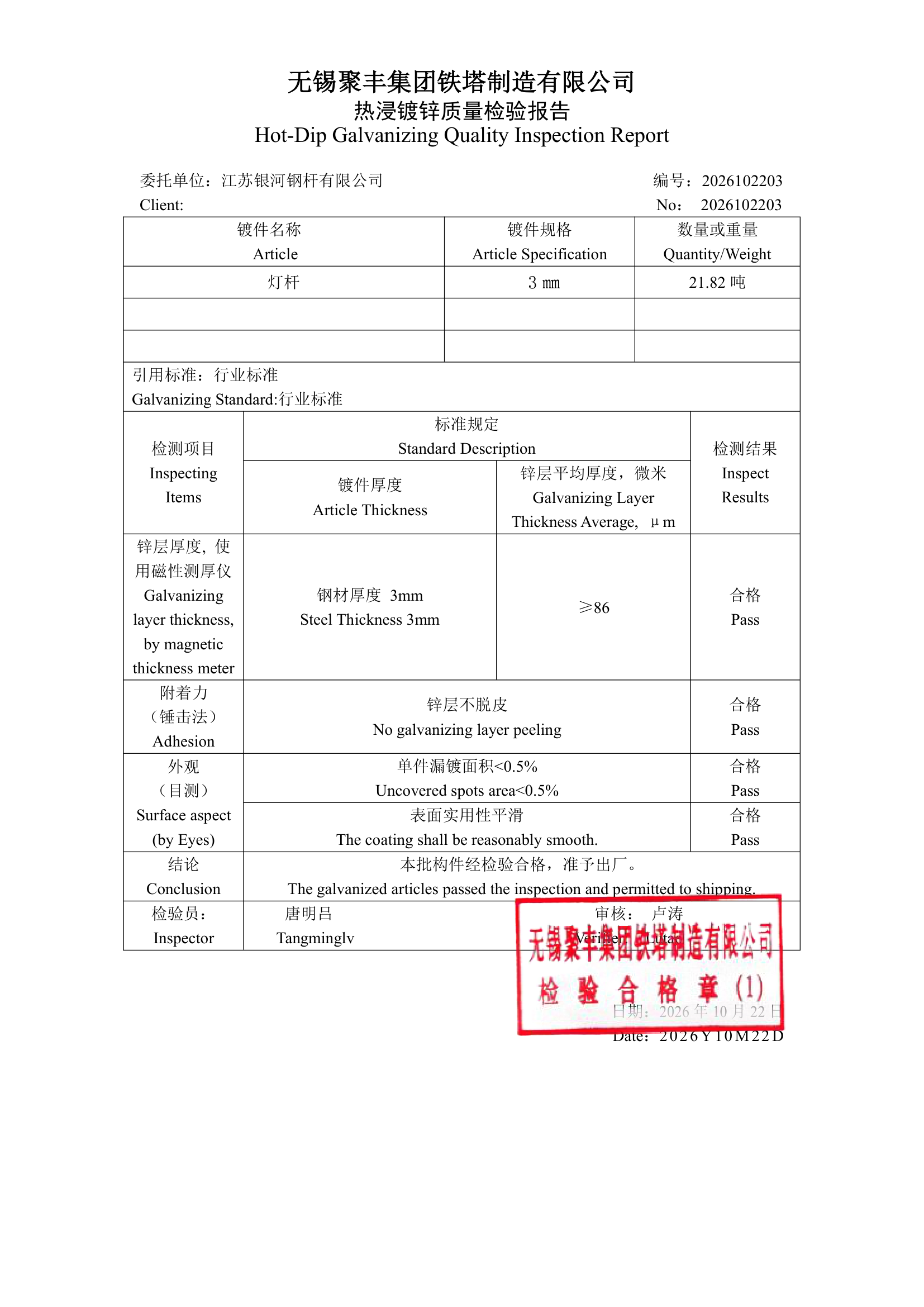
Direct answer: Member and bolt traceability for a galvanized steel utility pole is the documented link between each delivered member or bolt and the approved drawing, material certificate, fabrication inspection, galvanizing record, packing list and acceptance check. In global projects, the buyer should define that link before fabrication, because after hot-dip galvanizing and container loading the physical item may be separated from its original shop paperwork. This technical FAQ explains what records to request and how each record supports supplier evaluation and project execution.
What member and bolt traceability means in a utility pole project
Traceability is not a single certificate. It is a record chain that lets the buyer connect a pole section, crossarm, base plate or bolt package to the revision that was approved, the inspection that released it and the bundle in which it was shipped. For a steel distribution pole or a higher-voltage steel utility pole, the chain normally begins with the approved pole drawing and ends with the packing list and acceptance record.
The practical question is not whether a supplier uses the word traceability. The practical question is whether an identifier on the member or bolt package can be resolved to a drawing revision, a material test certificate, an inspection result and a release status. That distinction matters during evaluation, when suppliers are compared, and during execution, when the same records become hold points for fabrication, galvanizing, delivery and site acceptance.
For a hot-dip galvanized steel pole, the record chain must also survive a change of condition. Steel is inspected before galvanizing, the coating is inspected after galvanizing, and the finished pole is checked again before loading. A record set that does not show which member or bolt package was inspected at each stage is difficult to use for acceptance, even when the individual certificates are present.
Why traceability is an evaluation and execution issue
During supplier evaluation, traceability records show whether a manufacturer can control drawing revisions, material identification, in-process inspection and finishing. During execution, the same records become the basis for witness points, pre-shipment checks and acceptance. A buyer who waits until delivery to define the record format may have to reconcile bundle markings, packing lists and inspection reports after the containers have already arrived.
Global projects add several handover points. Fabrication may occur in one location, galvanizing in another, packing and loading in another, and acceptance at the project site or a third-party inspection office. Each handover should carry the same identifier logic. If the drawing revision, member list, bolt package list and packing list use different references, the buyer loses the ability to trace a delivered item back to its release record without manual reconstruction.
A useful record set therefore has two properties. First, it is complete enough to cover material, fabrication, coating, packing and acceptance. Second, it is simple enough that a site engineer can match a bundle marking to a packing list and then to the relevant inspection record. The second property is often overlooked, but it determines whether traceability works in practice.
The traceability chain: drawing, material, fabrication, galvanizing, delivery and acceptance
The record chain can be organized around six release points. Each point should produce a record that references the previous one, so the buyer can follow the item rather than search for isolated documents.
| Stage | Record to request | What it should establish | Buyer check |
|---|---|---|---|
| Design release | Approved drawing, drawing revision index and design calculation review record | Pole geometry, voltage class, loading basis and connection details as approved for the project | The drawing revision matches the purchase order and the inspection and test plan |
| Material receipt | Material test certificates and incoming material certificate verification | Steel grade and applicable hardware identity as specified for the member or bolt package | Certificate references match the member and bolt traceability list |
| Fabrication | Shop drawing control, member and bolt traceability list, in-process inspection, weld inspection and dimensional inspection | Each member or bolt package is tied to the approved drawing and to its inspection status | The identifier on the record matches the physical marking, bundle or package |
| Galvanizing | Hot-dip galvanizing compliance record covering standard, coating thickness, appearance, adhesion and related inspection | Coating release against the project specification and the specified standard edition | The standard, edition and acceptance criteria match the project specification |
| Packing | Packing list, bundle marking, shipping marks, accessory packing and pre-loading inspection | Which members, bolts and accessories are in which bundle, container or shipping unit | The marks on the bundle match the packing list and the approved shipping mark |
| Acceptance | Final inspection, factory acceptance test or third-party inspection report, dimensional and coating verification, fit-up and packing verification | The item is released for delivery or accepted against the project criteria | All witness and hold points are closed and any nonconformity is resolved |
The sequence is important. A galvanizing certificate issued against an unapproved drawing revision does not close the traceability chain. A packing list that cannot be linked to the member and bolt list does not prove which items were inspected. Acceptance should confirm that the earlier links remain intact, not replace them with a final summary.
What records to request for members and bolts
Member records
For pole members, crossarms and principal fabricated items, the buyer can request the approved drawing and revision index, the design calculation review record and the drawing approval workflow. These establish the design baseline. The buyer can then request incoming material certificate verification, chemical and mechanical checks as required, dimensional inspection, weld inspection, galvanizing inspection and final inspection.
Member traceability should identify the member, its drawing reference and its inspection status. Where the project specifies shop drawing control, member and bolt traceability, trial assembly or test coordination, those records should be included in the inspection and test plan. A digital production control record can also be requested where the manufacturer uses one, because it can show the unique identification and process status of the member.
Bolt and accessory records
Bolts and accessories need a defined level of traceability. The project may require package-level identification, bundle-level identification or a finer level. The buyer should state that boundary in the inspection and test plan rather than assume it. Applicable hardware can be checked against ASTM A153/A153M when hot-dip galvanized hardware is specified, and the bolt package should appear in the accessory packing list.
The traceability record should link the bolt package to the applicable standard, the inspection status and the shipping unit. If individual bolt identification is required, it should be specified before production. The available capability statement covers member and bolt traceability as specified; it does not by itself create a universal individual bolt identifier for every project unless the project defines that requirement.
How MILKY WAY's documented capability supports the record chain
Jiangsu Milky Way Steel Poles Co., Ltd. (MILKY WAY) is a China-based manufacturer founded in 1991 and active in power steel poles and transmission towers. Its documented capabilities relevant to traceability include shop drawing control, member and bolt traceability, trial assembly and test coordination as specified, digital production control with unique identification and traceability, incoming material certificate verification, dimensional inspection, weld inspection, galvanizing inspection and final inspection.
MILKY WAY also documents an inspection and test plan approach with witness and hold points, plus factory quality control and client, SGS, BV, TUV or other approved inspector involvement when required. For delivery, its customization scope covers container loading plans, bundle marking, shipping marks, section nesting and accessory packing, with pre-loading inspection and packing list and marking verification.
For buyers, these capabilities are relevant because they map to the record chain described above. The approved drawing and inspection plan define what will be checked. The member and bolt traceability record defines what was checked. The packing list and bundle marking define where the checked item went. The acceptance record closes the chain. The buyer should still agree the identifier format and record delivery method in the inspection and test plan, because a capability statement does not replace project-specific acceptance criteria.
Hot-dip galvanizing traceability: standards, records and the 2024 ASTM A123 revision
Hot-dip galvanizing is a separate release point in the traceability chain. The coating record should identify the standard and edition, zinc coating thickness, appearance, adhesion and related inspection results as required by the project. For a hot-dip galvanized steel utility pole, ASTM A123/A123M is the applicable coating standard in the supplied compliance record. ASTM A153/A153M applies to applicable hardware, and EN ISO 1461 applies when specified.
The record should be linked to the member or bolt package it covers. A coating certificate that states only that the item is galvanized is not enough for a project that specifies coating thickness, appearance and adhesion. The buyer should be able to compare the coating results with the member identifier and the approved drawing. Where the project uses an HDG steel utility pole specification, the inspection plan should state how the identifier is maintained through galvanizing and how the coating is checked after the member is finished.
The 2024 revision of ASTM A123 is noted in the supplied third-party standard data. That makes edition control part of traceability. The purchase order and inspection plan should state the required edition rather than only the standard number, because a coating record issued against a different edition may not satisfy the project specification. The buyer should not assume that the latest edition is accepted by every utility; the project specification and the utility technical requirements control.
Delivery traceability: bundle marking, packing list and pre-loading checks
Delivery traceability connects factory records to the shipping unit. The packing list should identify the bundle, shipping mark, member references and accessory packages. Bundle marking and shipping marks should be checked against that list before loading. Pre-loading inspection should confirm that the marks are legible, the packing list matches the loaded items and the accessory packages are included.
MILKY WAY's documented packing scope includes container loading plans, bundle marking, shipping marks, section nesting and accessory packing. Its quality control includes pre-loading inspection and packing list and marking verification. These are the delivery-side controls that let the buyer match a container to the approved shipping documents and then to the member and bolt records.
Scale makes this more important. MILKY WAY's profile records an Africa large-scale low-voltage grid project of approximately 2,400 tons across 106 containers, delivered early with zero quality complaints and no delay. For a project of that size, the packing list and bundle marking are not administrative details; they are the practical link between factory inspection and site receipt. A site team should be able to sort the packing list by bundle, shipping mark, member reference and accessory package, then compare it with the physical marks on arrival.
Acceptance traceability: what to verify before release
Acceptance should close the traceability chain, not restart it. The project's acceptance criteria can include dimensional inspection, galvanizing or coating inspection, fit-up and packing verification. Third-party inspection can be performed by the client, SGS, BV, TUV or another approved inspector when required. The final record should show that hold points were closed and that any nonconformity was resolved before release.
When full-scale structural testing is specified, the test report should follow the approved test program under IEC 60652 and the applicable project utility specification, with the structural design standard as specified. MILKY WAY's 2025 Pakistan 132kV high-voltage pole project passed a full-scale destructive test at the State Grid key laboratory, with all load, displacement and strength indicators meeting requirements. That test is a design and acceptance proof for the tested pole design; it does not replace member-level or bolt-level fabrication records.
Quality management certification supports the system that controls these records, but it is not a project acceptance record. MILKY WAY's ISO 9001 certificate 11426Q02825R201 is issued against GB/T 19001-2016 and ISO 9001:2015 and is valid to 2029-07-26. The buyer should still review the inspection and test plan, the member and bolt traceability list, the galvanizing record and the packing list for the specific project.
Scenario: Philippines NEA specification as a traceability example
For a Philippines distribution pole project, NEA Memorandum No. 2007-007 provides a concrete example of how a specification becomes a traceability requirement. The memorandum sets minimum technical specifications for steel poles in heavy loading zones, including an example 30 ft pole with 3.00 mm thickness, 345 MPa yield stress and 86 microns zinc coating.
If a project adopts those values, the traceability file should let the buyer connect the delivered pole to the approved drawing showing the 30 ft height and 3.00 mm thickness, the material certificate showing the 345 MPa yield stress requirement, and the galvanizing record showing the 86 microns zinc coating requirement. The record set should not merely repeat the specification; it should show inspection results against it.
The same logic applies to steel electric pole projects at other voltage classes. The approved drawing should carry the voltage class, pole geometry and coating requirement, and the inspection plan should show where each requirement is verified. For a steel pole for an overhead distribution line, the buyer can use the same record chain whether the project is evaluated as a 13.8 kV, 22 kV or 33 kV distribution project, provided the project specification defines the applicable design and acceptance criteria.
Limits and fit boundaries
Traceability records are evidence of process control, not a guarantee of structural performance. They show what was approved, inspected and released; they do not replace the design calculation, the full-scale test or the utility's acceptance decision. A supplier's statement that a product is traceable is not the same as a project-specific record set.
The buyer must also define the granularity. Member-level identification for pole sections, crossarms and principal fabricated items, combined with package-level identification for bolts and accessory packs, is a practical boundary for many projects. If the utility requires individual bolt identification, trial assembly records or a specific digital export format, those requirements should be written into the inspection and test plan before production.
For hot-dip galvanizing, the required standard edition and acceptance criteria must be stated. ASTM A123/A123M, ASTM A153/A153M and EN ISO 1461 serve different scopes and should not be treated as interchangeable without project direction. For delivery, bundle marking and packing list verification are necessary but not sufficient for acceptance; dimensional, coating and fit-up checks remain part of the release decision.
Outlook: digital record packs without losing physical checks
Where a manufacturer uses digital production control and unique identification, the buyer can ask for the identifier structure, the record export format and the way records are linked to the packing list. This can make reconciliation faster when multiple containers arrive and when acceptance is handled by a different team from the one that approved the drawings.
Digital records do not remove the need for physical checks. The bundle marking still has to match the packing list, the member identifier still has to be readable at the point of inspection, and the coating record still has to match the delivered item. The most useful traceability system is therefore a simple chain that works across drawing approval, fabrication, hot-dip galvanizing, delivery and acceptance, rather than a large document set with no clear link between its parts.
Technical FAQ
What is member and bolt traceability for a galvanized steel utility pole?
It is the documented link between a delivered member or bolt and the approved drawing, material certificate, fabrication inspection, galvanizing record, packing list and acceptance check. For global projects, the link should be defined in the inspection and test plan before production because galvanizing, packing and shipping create separate handover points.
Which records should a buyer request first?
Start with the approved drawing and revision index, the inspection and test plan with witness and hold points, the member and bolt traceability list, material test certificates, in-process inspection records for dimensions and welds, the hot-dip galvanizing compliance record, final inspection and any factory acceptance test or third-party report. Add the packing list, bundle markings and pre-loading inspection record for delivery.
How does hot-dip galvanizing fit into the traceability file?
The galvanizing record should identify the standard and edition, zinc coating thickness, appearance, adhesion and related inspection results as required by the project. ASTM A123/A123M applies to the pole coating, ASTM A153/A153M applies to applicable hardware, and EN ISO 1461 applies when specified. The record should be linked to the member or bolt package it covers.
How should traceability be checked at delivery and acceptance?
At delivery, match the shipping mark and bundle marking to the packing list, then confirm that the member and accessory packages are listed. At acceptance, close the record chain with dimensional inspection, galvanizing or coating inspection, fit-up and packing verification, plus any specified third-party or full-scale test report. All hold points should be closed and any nonconformity resolved before release.
What is a reasonable traceability boundary if the project does not specify one?
A practical boundary is member-level identification for pole sections, crossarms and principal fabricated items, and package-level identification for bolts and accessory packs. If the utility requires individual bolt identification, state it in the inspection and test plan. The available capability statement covers member and bolt traceability as specified, so the buyer should not assume a finer level than the project defines.
Project reference: 2026 Milky Way Power Group catalogue (PDF).
Tem questões ou precisa de mais detalhes?
Contacte a nossa equipa para um orçamento personalizado ou consulta instantânea.
Solicitar orçamento
Preencha o formulário abaixo e a nossa equipa entrará em contacto com uma proposta personalizada.
Chat direto do WhatsApp
Prefere conversar em tempo real? Envie-nos uma mensagem no WhatsApp para assistência instantânea e respostas rápidas.
- Obter orçamento personalizado
- Partilhar fotos ou documentos
- Discuta as suas necessidades diretamente
Geralmente responde em 5–30 minutos durante o horário de expediente.