
Men's Leather Shoes Procurement FAQ: Goodyear Welt, MOQ & QC
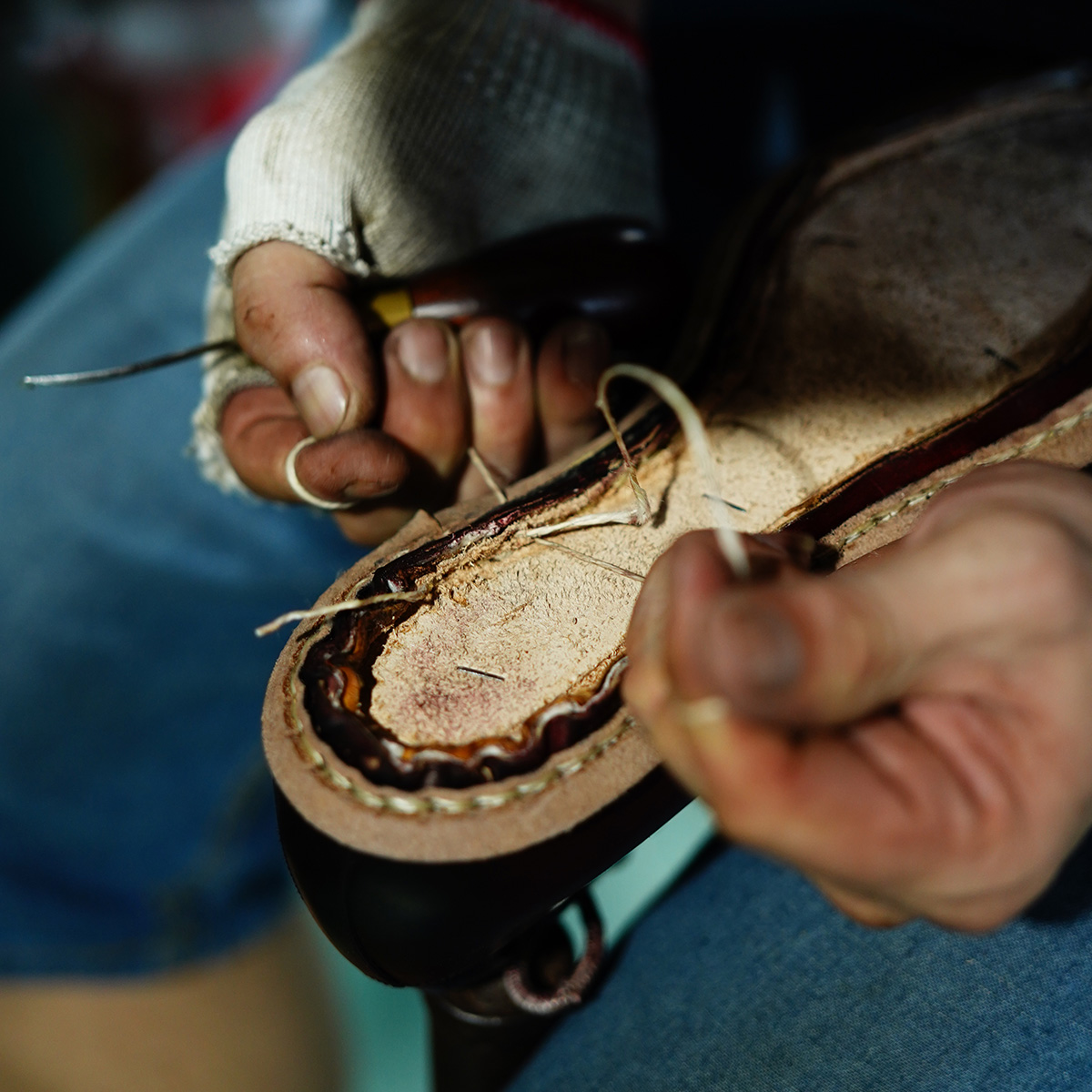
Goodyear welted construction — the stitched welt that joins the upper to the insole and allows the outsole to be replaced.
An independent procurement reference for buyers evaluating Goodyear welted men's leather shoes — covering materials, construction, MOQ, lead times, quality control and commercial terms.
Men's leather shoes are among the largest and most durable categories in global footwear. In 2024, the global leather footwear market was valued at USD 150.7 billion, with the male segment accounting for 54.1% of the total share, according to Grand View Research. Men's leather shoe sales volume exceeded 780 million pairs that year — 41.3% of the total men's footwear industry — while formal shoes represented approximately 40% of men's leather shoe sales volume.
Those figures describe a market, not a supplier. For buyers in the evaluation stage, the decisions that determine whether an order succeeds are narrower and more technical: which construction the shoes use, which materials go into the upper, lining and outsole, what the minimum order quantity is, how long production takes, how quality is verified, and what commercial terms apply.
Yangjiang Hengxin Shoes Co., Ltd. is a men's leather footwear manufacturer founded in 2011 in Yangjiang, Guangdong, China. The company operates a 5,000㎡ factory with approximately 100 employees, an annual output of about 400,000 pairs and a 10-person R&D team, and exports around 70% of its production to the EU, USA, Canada, Africa, Asia and Australia. Specialising in Goodyear welted men's shoes, it produces Oxfords, Derbys, Brogues, Monks and Loafers and offers OEM and ODM services. This FAQ answers the questions buyers most often raise when evaluating a supplier of this kind.
Why These Questions Surface at the Evaluation Stage
The gap between a supplier's presentation and its production reality is where most sourcing risk sits. A men's leather formal shoe can be built in several ways — Goodyear welted, Blake stitched or cemented — and each method changes durability, resoleability, tooling cost and production time. Material choices shift the same equation: a full grain upper ages differently from a corrected-grain upper, and the lining and insole determine how the shoe behaves after months of wear.
Because those variables are fixed before an order is placed, evaluation-stage buyers tend to ask the same handful of questions. What exactly is inside the shoe? What is the smallest order that can be placed? How long will it take? How will the buyer know the shipment matches the approved sample? The rest of this article answers those questions in the order a buyer would normally ask them.
Materials: What Goes Into the Shoe
Men's leather shoes from Yangjiang Hengxin Shoes Co., Ltd. are built around three material decisions that buyers can specify directly.
- Upper: full grain cow or calfskin
- Lining and insole: full grain cow leather
- Outsole: rubber or leather
The same specification applies to the reference models M205-B02 and F8-NS58, both described by the manufacturer as handmade men's leather shoes. The company sources premium Italian and Argentinian leathers and finishes much of its output with a hand-coloured patina, a process it states has been refined through three iterations of technological innovation.
| Component | Specification | What it means for the buyer |
|---|---|---|
| Upper | Full grain cow / calfskin | The outer surface retains the natural grain; it is the grade most often specified when the target market expects long service life. |
| Lining / insole | Full grain cow | Affects moisture handling and shape retention after repeated wear. |
| Outsole | Rubber or leather | Rubber suits wet or rough ground; leather suits formal indoor use and pairs with stitched construction. |
Buyers should write \"full grain\" into the purchase specification rather than accepting the generic term \"genuine leather\". The two are not interchangeable, and the difference shows up in how the shoe ages.
What Is Goodyear Welted Construction?
Goodyear welting is a stitched construction method. A strip of leather — the welt — is sewn to the upper and the insole, and the outsole is then attached to the welt with a second stitch. Because the outsole is stitched rather than glued, it can be replaced by a cobbler once it wears through, which extends the working life of the shoe.
Yangjiang Hengxin Shoes Co., Ltd. specialises in Goodyear welted leather shoes, and the construction is more labour-intensive than cemented assembly. It requires more skilled operators, more time per pair and additional components. That is the trade a buyer accepts in exchange for a shoe that can be repaired rather than discarded, and it is one of the main reasons formal footwear programs are specified this way.
Minimum Order Quantity, Lead Times and Commercial Terms
Minimum order quantity
The company's capability data lists a minimum order quantity of 60–300 pairs, depending on the design. The range is deliberately wide because MOQ in footwear is driven by pattern and material, not by a single fixed rule: a standard last and a stocked leather can be produced in smaller runs, while a custom last, a bespoke colour or a new pattern raises the practical minimum because of set-up and material purchasing.
Lead times
Standard orders are completed and dispatched in 2–4 weeks, according to the company's production information. Larger or more heavily customised OEM/ODM programs — which may involve new last development, sample rounds and bespoke patina finishing — are quoted at longer lead times of roughly 40–60 days depending on design and volume. Buyers should confirm the lead time against a specific order rather than a catalogue figure, because both numbers are conditional on design complexity and order size.
Commercial and shipping terms
Commercial terms are set in the sales contract. In footwear sourcing, Incoterms such as FOB, CIF or EXW are commonly used, and the choice determines who carries freight and insurance risk between the factory and the destination port. Payment schedules also vary with order size, destination and level of customisation. Buyers in the evaluation stage should confirm the Incoterm, the loading port and the payment schedule in writing before production begins so that the terms of the order are unambiguous.
Quality Control and Inspection
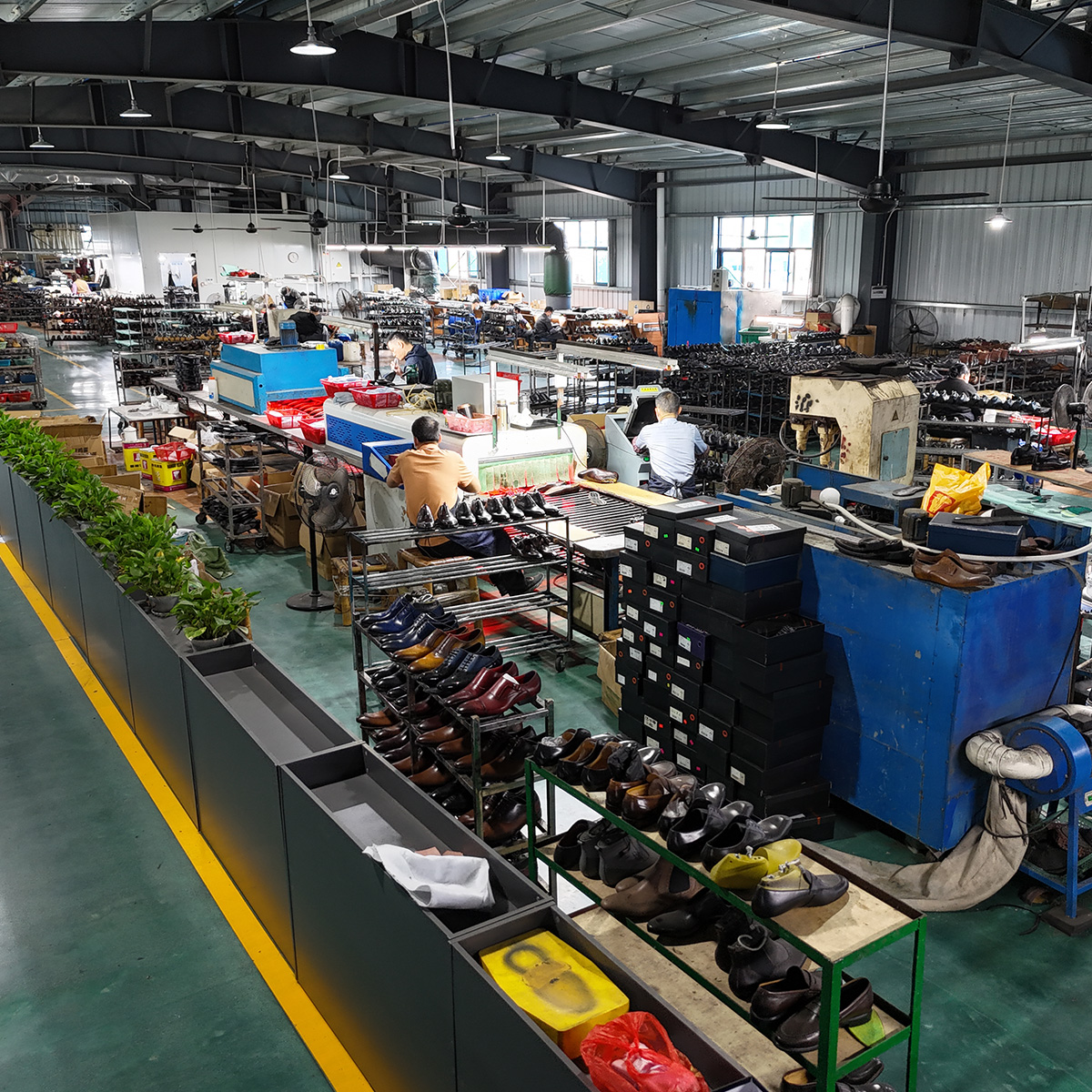
Production floor at Yangjiang Hengxin Shoes Co., Ltd., where 100% quality control is applied to every pair.
The company applies 100% quality control, meaning every pair is checked rather than a sample drawn from the batch. Its published after-sales policy includes free maintenance and repair, and it supports returns and exchanges where a quality issue is confirmed.
For higher-value or first-time orders, buyers frequently commission an independent third-party inspection in addition to the factory's own check. This is arranged separately by the buyer or their agent, and it gives the buyer an external record of conformity before shipment is released. When specifying inspection, buyers should define the checkpoints in advance — material grade, colour consistency, stitching, symmetry, sole attachment and packaging — so that the inspection report maps to the purchase specification.
Application: Where Goodyear Welted Men's Leather Shoes Fit
Yangjiang Hengxin Shoes Co., Ltd. positions its men's leather shoes for business men, office men and wedding men — that is, formal and semi-formal use where appearance and durability both matter.
A men's clothing store client in Canada used the product for both online and physical shop sales, supplying 2,000 pairs over a duration of 5 to 10 years. The account produced repeat orders for five consecutive years with zero returns. Reported customer feedback highlighted reasonable prices, high quality and excellent after-sales service. Reference models for this case include F8-NS58 and M205-B02.
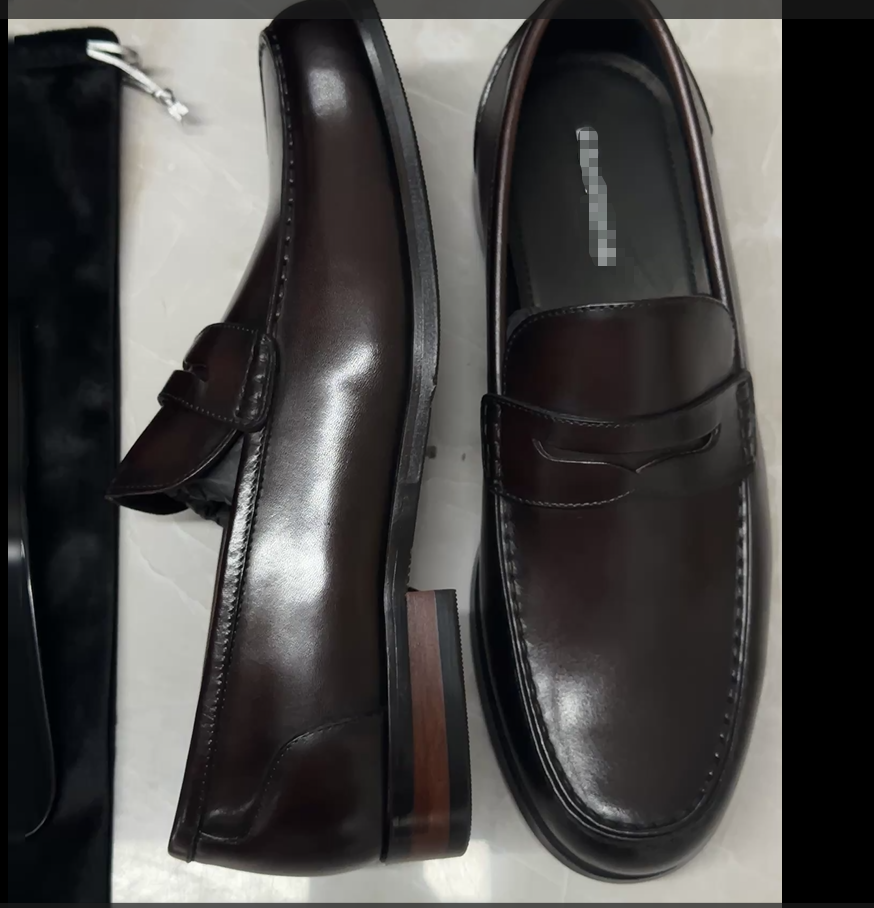
Men's leather shoes produced for a Canadian men's clothing store, a 2,000-pair program with repeat orders across five consecutive years.
Read carefully, the case says more about fit than about scale. A retail program that reorders for five consecutive years with zero returns suggests that the specification was stable and reproducible — the attribute evaluation-stage buyers are usually trying to verify.
Market Trend: What the Data Says About Men's Leather Shoes
Several published data points frame how the category is developing.
- Asia Pacific held the largest revenue share of the leather footwear market in 2024, estimated at 53.9% (Grand View Research).
- Formal shoes accounted for approximately 40% of men's leather shoe sales volume as of 2024.
- Sustainable leather practices accounted for roughly 28% of global leather production for footwear in 2024.
- ISO 9001:2015 is the primary international quality management system adopted by leather footwear manufacturers for process consistency (ISO TC/137 Footwear).
- Top luxury players in the leather footwear market include LVMH Group, Prada S.p.A. and Hermès International (Mordor Intelligence).
For evaluation-stage buyers, these signals point in one direction. Formal demand remains a substantial share of the men's leather shoe market; the largest concentration of production value sits in Asia Pacific; and process-based quality management is the recognised reference standard. Buyers should therefore expect a supplier to describe quality in process terms — inspection points, control steps, after-sales handling — rather than only in product terms.
Goodyear Welted vs. Cemented Construction: The Trade-Offs Buyers Accept
| Criterion | Goodyear welted | Cemented |
|---|---|---|
| Assembly | Welt stitched to upper and insole; outsole stitched to the welt | Upper and outsole bonded with adhesive |
| Resoleability | Yes — the outsole can be replaced | Limited — resoling is difficult once bonded |
| Production time | Longer; more skilled labour | Shorter; simpler assembly |
| Unit cost | Higher | Lower |
| Weight and break-in | Generally heavier; breaks in over time | Lighter; more immediate comfort |
| Best fit | Formal shoes intended for a long service life | Cost-driven or fast-turn programs |
Goodyear welting is not the right answer for every order, and it would be misleading to present it as a free upgrade. It is more expensive and slower to produce than cemented construction, it generally produces a heavier shoe, and it demands more skilled labour to assemble. The company's minimum order quantity of 60 pairs — which depends on design — also means that buyers who want to test a market with a handful of pairs should first discuss sampling through the company's sample customisation service rather than assume a full production run. Buyers should treat Goodyear welting as a deliberate specification for durability-oriented programs, not as a default.
Future Outlook
The direction of the category appears to run towards durability and documentation. Repairable construction, traceable material sourcing and process-based quality systems are the points most likely to appear in buyer specifications over the next few years, and the sustainable-leather share of production gives an indication of how quickly those expectations are moving.
For buyers, the practical consequence is that supplier selection will depend less on brand claims and more on process evidence: how a shoe is built, how it is checked, and whether it can be repaired. Manufacturers that already work in stitched constructions and documented quality control are structurally better placed to answer those questions than suppliers whose output is built entirely around glued assembly.
Frequently Asked Questions
Which materials are used in men's leather shoes from Yangjiang Hengxin Shoes Co., Ltd.?
The upper is full grain cow or calfskin, the lining and insole are full grain cow leather, and the outsole is rubber or leather. The same specification applies to the reference models M205-B02 and F8-NS58. The company sources Italian and Argentinian leathers and applies hand-coloured patina finishes on part of its output.
What is Goodyear welted construction, and why does it matter for formal shoes?
Goodyear welting is a stitched construction in which a leather welt is sewn to the upper and insole, and the outsole is then stitched to the welt. Because the outsole is stitched rather than glued, it can be replaced when it wears out, which extends the shoe's service life. Yangjiang Hengxin Shoes Co., Ltd. specialises in Goodyear welted leather shoes.
Which product models can buyers reference when evaluating?
Two reference models are M205-B02 and F8-NS58. Both are described as handmade men's leather shoes using a full grain cow or calfskin upper, full grain cow lining and insole, and a rubber or leather outsole. Both are positioned for business, office and wedding use.
What is the minimum order quantity for men's leather shoes?
The minimum order quantity is 60–300 pairs, depending on the design. The figure varies because custom lasts, bespoke colours and new patterns require additional set-up and material purchasing compared with standard designs. Buyers should confirm the MOQ against the specific design they intend to order.
What are the typical lead times?
Standard orders are completed and dispatched in 2–4 weeks according to the company's production information. Larger or more heavily customised OEM/ODM programs are quoted at roughly 40–60 days depending on design and volume. Lead time should be confirmed against a specific order because it depends on design complexity and order size.
How is quality controlled and inspected?
The company applies 100% quality control, so every pair is checked rather than sampled. Its after-sales policy includes free maintenance and repair and supports returns and exchanges for confirmed quality issues. Where an external record is required, buyers commonly arrange an independent third-party inspection through their own agent before shipment.
What OEM and ODM services are available?
Yangjiang Hengxin Shoes Co., Ltd. offers OEM/ODM one-stop services covering last-making, alterations, repairs and sample customisation. The factory maintains an independent sample room and a team of four professional shoe designers, and it holds more than 500 bespoke styles in its portfolio, including hand-patina, staining and brushing finishes.
What commercial and shipping terms should buyers confirm before production?
Incoterms such as FOB, CIF or EXW are commonly used in footwear sourcing, and the choice determines who carries freight and insurance risk. Payment schedules also vary with order size, destination and customisation. Buyers should confirm the Incoterm, loading port and payment schedule in writing before production starts.
What after-sales support is provided?
The company's stated after-sales policy includes free maintenance and repair, as well as support for returns and exchanges where a quality issue is confirmed. In the Canadian retail case, the account reported repeat orders for five consecutive years with zero returns, and customer feedback cited after-sales service among the reasons for continued ordering.
Men's leather shoes are a specification-driven purchase. The questions in this FAQ — materials, construction, MOQ, lead time, inspection and terms — are the variables that decide whether an order is repeatable, and they are best answered with written specifications and a defined inspection routine rather than with general assurances.