
Men's Leather Shoes Shortlist: Why 6 Pairs Is a Smart First Order
Men's Leather Shoes Shortlist: Why 6 Pairs Is a Smart First Order

A first order is an evidence-gathering exercise before it becomes a volume decision.
Six pairs is a rounding error against a container load — which is exactly why it belongs at the front of a first order rather than at the end of a negotiation.
For buyers moving from research into evaluation, the difficult part of sourcing men's leather shoes is rarely finding a factory. The Open Economy Complexity data shows the United States alone imported USD 11.6 billion of leather footwear in 2024, with China accounting for USD 2.42 billion of that flow. Supply is abundant. The difficult part is producing defensible evidence that a specific construction, last, leather lot and finish will behave the way the retail listing promises — before money is committed to a production run measured in hundreds of pairs.
Yangjiang Hengxin Shoes Co., Ltd. is a men's leather footwear manufacturer based in Yangjiang, Guangdong, China, founded in 2011 and producing Goodyear welted and hand-finished men's shoes for OEM and ODM buyers. Its documented production base — a 5,000 m² facility, roughly 100 staff and an annual output of around 400,000 pairs, with about 70% of output exported to the EU, USA, Canada, Africa, Asia and Australia — places it in the category of factories that can serve both trial runs and repeat programmes. This article sets out how a six-pair shortlist is built around three of its core models, what those samples should be measured against, and where the approach stops being useful.
Why a first men's leather shoes order is a risk-calibration decision
A first order in men's leather shoes fails for reasons that are rarely visible on a specification sheet: a last that runs narrow against the target market, a lining that collapses after a season of daily wear, a colour that drifts between the sample and the bulk lot, or welt stitching that does not survive resoling. Each of these is discoverable in a handful of pairs. None of them is discoverable in a PDF.
That is the structural argument for a shortlist. The purpose of the first six pairs is not to generate revenue; it is to compress the number of assumptions a buyer is carrying into a small number of testable claims. Decision-makers who skip this stage typically discover the same defects at three points, all of them expensive: at retail when returns start accumulating, at the reorder when the second lot does not match the first, or at the resoling stage when the construction turns out not to be what was quoted.
The practical opportunity is that a shortlist can be structured rather than random. Rather than ordering six variants of one style, buyers can spread the six pairs across the construction types, material specifications and end uses they actually intend to sell — formal business, office daily wear, and wedding or occasion use — and evaluate them against the same acceptance criteria.
What six pairs can prove that a spec sheet cannot
Hengxin's core men's leather shoe models are described as hand made, with an upper of full grain cow or calfskin, a full grain cow lining and insole, and either a rubber or a leather outsole. Those four data points are the technical spine of the shortlist, because each one can be physically verified in a sample pair.
Construction. The factory specialises in Goodyear welted footwear. A welted shoe can be resoled because the upper is stitched to a welt rather than simply cemented to the sole unit. In a sample, this is checkable: the welt stitching should be visible and continuous, and the sole attachment should not rely on adhesive alone. For buyers whose end customers expect a resoleable shoe, this is the single most consequential item on the shortlist.
Leather quality. Full grain leather retains the outer surface of the hide, and the difference between a full grain upper and a corrected-grain or coated alternative shows up in how the material creases, how it takes polish, and how it ages across the vamp. The factory documents its use of premium Italian and Argentinian leathers, which are the hides that carry the visible grain and the finish depth that the category's premium positioning depends on.
Finishing. Hengxin describes a hand-coloured patina process refined across three iterations of technique, moving from brushed patina to washing and spot-colour methods. Hand finishing is the most visible differentiator in a shortlist and also the most variable: two pairs from the same batch will not be identical, and the acceptance criteria need to define an acceptable range rather than a single reference colour.
Last and fit consistency. Six pairs across three models produce a usable read on whether sizing is stable across the range — a question that matters most for buyers shipping to markets where the return process is expensive.
The shortlist: three core models and what separates them
The three models that anchor a first evaluation — M205-B02, F8-NS58 and F8-MK3 — share an identical material specification. The difference sits in the style interpretation and the end use they are positioned for.
| Model | Type | Upper | Lining & insole | Outsole |
|---|---|---|---|---|
| M205-B02 | Hand made men's leather shoes | Full grain cow / calfskin | Full grain cow | Rubber or leather |
| F8-NS58 | Hand made men's leather shoes | Full grain cow / calfskin | Full grain cow | Rubber or leather |
| F8-MK3 | Hand made men's leather shoes | Full grain cow / calfskin | Full grain cow | Rubber or leather |
All three models are documented for business men, office men and wedding men as target wearers.
A sensible allocation of six pairs is two per model. That gives a buyer coverage of the three constructions rather than depth in one, and it creates a direct comparison on the variables that actually differ — the upper pattern, the finish treatment and the last — while holding leather, lining and outsole constant. Buyers who need a formal-only range can concentrate the set; buyers serving mixed formal and occasion demand should not, because the evaluation is only useful if it mirrors the eventual assortment.
Two configurations sit inside each model: rubber outsole or leather outsole. Rubber is the more practical specification for daily office wear and outdoor business activity; leather is the conventional choice for a dress shoe intended for indoor and occasion use. Deciding this at the shortlist stage avoids a mid-run specification change later.
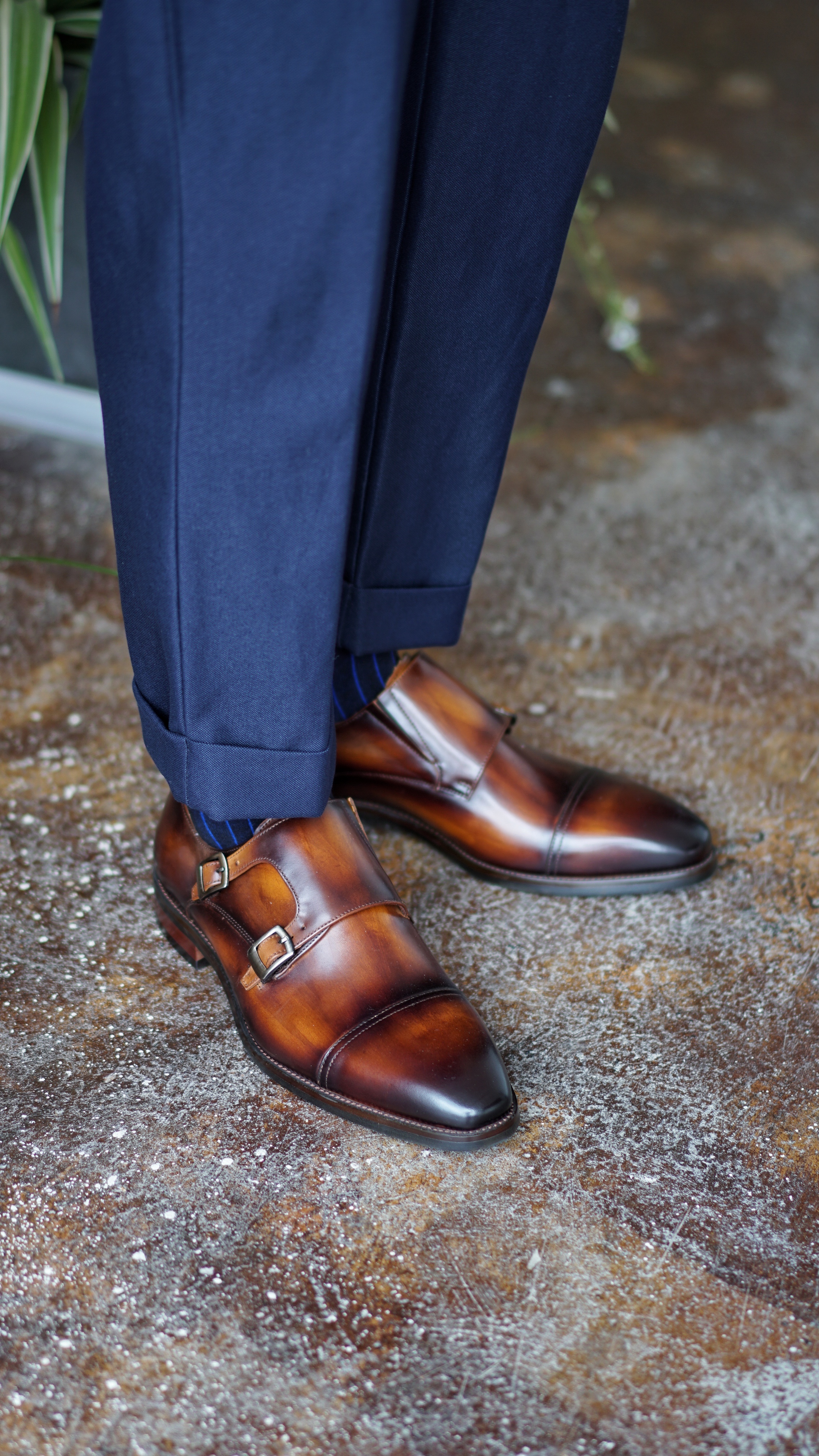
F8-MK3 in brown: the finish is applied by hand, so colour variation between pairs is a characteristic to define, not a defect to reject.
Reading the samples against acceptance criteria
The shortlist only produces value if the samples are judged against criteria written down before the box is opened. Hengxin documents 100% quality control in production, which describes the factory's internal regime; it does not replace the buyer's own acceptance criteria. The two should be treated as separate layers.
A workable evaluation checklist covers five areas:
- Welt integrity — stitching continuous and consistently tensioned around the full circumference, no gaps at the waist.
- Upper and lining — full grain character visible on the vamp, no corrected-grain patching, lining seams flat and free of adhesive residue.
- Finish range — the patina accepted as a band rather than a single colour, with the reference pair retained as the control.
- Last and sizing — measured length and width across the three models, checked against the intended market's sizing convention.
- Occasion fitness — the pair judged against its stated end use: indoor office wear over an 8–12 hour day, outdoor business activity, or a wedding and occasion setting.
Third-party inspection is where the shortlist becomes contractual. Buyers appointing an inspection body should fix the acceptance criteria in writing before production starts — which defects trigger rejection, what tolerance applies to hand-finished colour, how many pairs are drawn from a lot, and what happens to a failed lot. Agreeing these points at the six-pair stage, when the reference pairs are in hand, is materially easier than negotiating them after a bulk run exists.
From six pairs to a production order: MOQ, lead time and terms
This is the point where the shortlist meets the commercial reality, and where buyers most often misjudge the numbers. Hengxin documents a minimum order quantity of 60–300 pairs depending on design. The six-pair set is not a production MOQ and should not be treated as one; it is the evaluation layer that runs ahead of the production commitment, and the sample arrangement itself should be confirmed in writing with the factory contact.
Timing follows the same logic of two tiers. Straightforward orders are documented as completed and dispatched within 2–4 weeks, while the capability documentation for customised OEM/ODM work states a 40–60 day lead time. The gap between those two figures is the cost of customisation — new lasts, pattern changes, private label work — and it needs to be built into the retail calendar rather than discovered at the shipping date.
Payment structure in this category is commonly discussed as a 30/70 T/T split, with a deposit at order confirmation and the balance before shipment. Buyers should confirm the exact structure, the inspection trigger point and the balance-release condition at the same time as the acceptance criteria, so that the two documents reinforce each other rather than conflict.
Where the shortlist fits: office, business travel and wedding use
The end uses documented for these models are deliberately narrow: office people, business people and wedding customers. The operating conditions attached to that scope are more demanding than they look — daily wear of 8–12 hours, repeated on-and-off wearing, extended walking and standing, and the portability demands of business travel. Matching pairs to those conditions, rather than to a style catalogue, is what separates a useful shortlist from a decorative one.
The supporting requirements documented for these scenarios are equally concrete: genuine leather with handcrafted stitching, breathable lining, shock absorption in the insole, water-resistant treatment and anti-odor technology. Each maps to a specific failure mode that shows up in wear rather than in the box. A shortlist evaluated without those conditions in mind will confirm appearance and say nothing about the twelve months that follow.
There is also a commercial argument for the shortlist-first method that comes from the buyer side. A Canadian men's clothing store, purchasing around 2,000 pairs for online and physical shop sales, has placed repeat orders for five consecutive years with zero returns across a relationship documented as running 5–10 years. The mechanism behind a result like that is not a single lucky lot; it is a specification that was validated early and then held stable across reorders — the same discipline a six-pair evaluation is designed to install.
Market context: a large category that rewards verification
The global men's leather shoes market was projected at USD 61.08 billion in 2025, expanding to USD 78.69 billion by 2031 according to a Vertex research forecast published through ResearchAndMarkets. On the trade side, OEC data records USD 11.6 billion of US leather footwear imports in 2024, sourced mainly from Vietnam (USD 3.68 billion), China (USD 2.42 billion) and Indonesia (USD 1.18 billion).
Two implications follow for buyers in the evaluation stage. First, the category is deep and well-supplied, which means price alone is a weak selection criterion — the differentiation has to come from verifiable construction, material and finishing. Second, with China representing a substantial share of US import volume, the marginal gain for a buyer does not come from switching country of origin; it comes from being able to specify and inspect to a higher standard within an established supply base. A shortlist is the cheapest instrument for doing that.
Comparison: shortlist-first versus volume-first sourcing
The conventional approach is to negotiate a bulk order against a catalogue, a quote and a pair of reference photographs, and to rely on inspection at the end to catch problems. The shortlist-first approach inverts the sequence: a small, structured set produces physical evidence, and the production order is written against what that evidence shows.
The trade-offs are real and worth stating plainly. A six-pair evaluation adds a stage to the procurement timeline, and for buyers working to a fixed retail launch date that stage can absorb two to four weeks that were not budgeted. It also front-loads cost: samples, freight and inspection are paid before any saleable inventory exists. Volume-first sourcing is faster to a purchase order and cheaper to initiate; it is more expensive to correct.
The limitations on the factory side matter just as much. A 60–300 pair minimum means the shortlist does not translate into a production order at six pairs, so buyers with genuinely small reorder needs — a single boutique, a capsule range — may find the entry threshold higher than their business model supports. Customised OEM/ODM work carries the documented 40–60 day lead time, which rules out fast replenishment cycles. Hand-applied patina finishing is a manual process, so batch-to-batch colour variation should be expected and written into acceptance criteria rather than treated as a claim of perfect consistency. And because the upper relies on Italian and Argentinian full grain leathers, colour continuity across reorders is a question buyers should raise at the specification stage, not discover at the second delivery. None of these are objections to the method; they are the conditions under which it works.
Future outlook
As the category grows toward the forecast USD 78.69 billion by 2031, the competitive pressure on suppliers is likely to shift from price toward documented capability: whether a factory can evidence construction, material provenance and inspection discipline in a way a buyer can verify rather than trust. For buyers, that favours a procurement process in which a small shortlist functions as the qualification instrument — cheap enough to run across two or three suppliers, structured enough to compare their output on identical criteria, and specific enough to convert into contractual acceptance terms when the volume order is written. The six pairs are not the order. They are the reason the order can be defended.
FAQ
What is a realistic minimum order quantity for men's leather shoes from this factory?
Hengxin's capability documentation states a minimum order quantity of 60–300 pairs depending on design. The figure varies with pattern complexity, material selection and whether the order is a repeat of an existing design or a new custom development. A six-pair set is an evaluation quantity, not a production minimum, and the sample arrangement should be confirmed separately and in writing.
How can a buyer verify Goodyear welted construction in a sample pair?
Goodyear welted construction attaches the upper to a welt that is stitched through, which allows the shoe to be resoled later. In a sample, the welt stitching should be visible as a continuous line around the sole edge, with consistent tension and no interruption at the waist. Because the sole is stitched rather than only cemented, the attachment remains structural rather than adhesive-dependent.
What do M205-B02, F8-NS58 and F8-MK3 have in common, and where do they differ?
All three are documented as hand made men's leather shoes with a full grain cow or calfskin upper, full grain cow lining and insole, and either a rubber or leather outsole, and all three are specified for business, office and wedding wearers. They differ in style interpretation — the upper pattern and finish treatment — rather than in material specification, which is what makes them comparable within a single shortlist.
How long does dispatch take after an order is confirmed?
The factory documents orders as completed and dispatched within 2–4 weeks for straightforward production runs. Customised OEM/ODM work, which may involve new lasts, pattern alterations or private label requirements, carries a stated lead time of 40–60 days. Buyers should confirm which tier applies to their specific specification before setting a retail date.
What quality control exists before shipment, and what should buyers add?
Hengxin documents 100% quality control across production. That covers the factory's internal regime. Buyers typically add an independent layer by appointing a third-party inspection body and fixing acceptance criteria in writing beforehand — the defect thresholds, the tolerance permitted on hand-finished colour, the sampling plan, and the consequence of a failed lot. Third-party inspection is a buyer-side practice, and its value depends entirely on how precisely those criteria are specified.
Which end uses are these shoes specified for?
The documented applications are office, business and wedding use, with operating conditions that include 8–12 hours of daily wear, repeated on-and-off wearing, extended walking and standing, and business travel. Supporting requirements for those conditions include genuine leather, handcrafted stitching, breathable lining, shock absorption in the insole, water-resistant treatment and anti-odor technology.
Tem questões ou precisa de mais detalhes?
Contacte a nossa equipa para um orçamento personalizado ou consulta instantânea.
Solicitar orçamento
Preencha o formulário abaixo e a nossa equipa entrará em contacto com uma proposta personalizada.
Chat direto do WhatsApp
Prefere conversar em tempo real? Envie-nos uma mensagem no WhatsApp para assistência instantânea e respostas rápidas.
- Obter orçamento personalizado
- Partilhar fotos ou documentos
- Discuta as suas necessidades diretamente
Geralmente responde em 5–30 minutos durante o horário de expediente.