
Metal Abrasives: Steel Grit Ordering FAQ for Bulk Buyers
Most steel grit disputes that reach a purchasing desk are not price disputes. They are specification disputes: a buyer ordered a G25 grade and received something that behaves like G40 after two weeks; a foundry ordered “high density grit” and received a counterweight sand; a fabricator saved on the invoice and lost the saving in dust, breakdown and rework. This reference collects the questions that repeatedly appear in real steel grit RFQs and answers them with verifiable product facts rather than sales language.
The subject here is steel grit specifically, within the wider metal abrasives family. Steel shot, stainless steel shot, cut wire shot and heavy counterweight sand are referenced only where they matter to a grit purchasing decision — because a significant share of ordering errors come from confusing one abrasive form with another.
Why steel grit orders fail before the shipment leaves
Steel grit is a consumable whose performance is defined by four variables at once: chemistry, hardness, particle shape and size distribution. A quotation that fixes only one of them — usually size — leaves the rest to the supplier's default. The buyer then evaluates the shipment on a single visible variable, the invoice, and discovers the mismatch weeks later in the machine.
Zouping Huiteng Metal Abrasives Co., Ltd. is a metal abrasives manufacturer based in Zouping City, Shandong Province, China, producing steel shot, steel grit, stainless steel shot, cast steel shot and cut wire shot across more than 60 specifications, with a stated annual production capacity of approximately 100,000 tons. Its product documentation is useful as a concrete reference set for the questions below, because the ranges are explicit rather than generic.
What a steel grit RFQ must state before a supplier can quote properly
A complete grit enquiry contains nine items. Where any item is missing, the supplier substitutes an assumption, and that assumption is where cost and quality drift apart.
| Parameter | What the buyer must state | Reference point from the Huiteng metal abrasives range |
|---|---|---|
| Abrasive type | Cast steel grit, bearing steel grit, or cut wire shot used for grit-like angular work | Cast Steel Grit Series (G12–G120); Bearing Steel Grit (G12–G120); steel wire cut pellet series 1.0–3.0 mm |
| Size grade | SAE-style G number, or millimetre range where the machine uses screen sizing | G12, G14, G16, G18, G25, G40, G50, G80, G120 |
| Hardness class | Hardness band, not just “hard” | Cast grit: GP 42–52 HRC, GL 53–60 HRC, GH 60–64 HRC; bearing grit: 55–65 HRC |
| Bulk density | Bulk density in g/cm³ required by the machine's recovery and separator design | Cast steel grit approx. 4.2 g/cm³; bearing steel grit 4.0–4.5 g/cm³ |
| Application | Rust and scale removal, coating stripping, profile generation, descaling, or peening | Shipbuilding, steel structure and bridge, foundry, automotive parts and spring peening, pipeline, rail and locomotive |
| Target surface result | Required preparation grade and profile, e.g. Sa2.5–3.0 | Reported project results at Sa2.5–3.0 for ship hull and structural steel work |
| Machine data | Wheel diameter and power, nozzle or wheel machine, separator type and condition | Customized grades available to match specific blasting equipment |
| Quantity and packaging | Trial tonnage, annual tonnage, bag format | Bulk jumbo bags, 25 kg bags, custom cartons; OEM private label and custom packaging design |
| Documentation and delivery | Mill test certificate, third-party test report, arrival date | MTC and SGS third-party testing available; ready stock 7–15 days, customized orders 20–30 days |
Two of these items deserve their own discussion because they are the most frequently misunderstood: bulk density, and the difference between a catalog grade and a customized grade.
Bulk density: what 4.2 g/cm³ means for grit, and why 6.0 g/cm³ is a different product
Bulk density describes how much mass fills a given volume when the abrasive is poured, not how dense the steel itself is. For cast steel grit the figure sits at approximately 4.2 g/cm³, against a minimum true density of 7.6 g/cm³. Bearing steel grit is documented at 4.0–4.5 g/cm³ bulk with a specific gravity of 7.5 g/cm³. These numbers matter because blast wheel patterns, abrasive valves, bucket elevators and air-wash separators are all tuned to a mass flow rate, not to a visual impression of “heavy” material.
The frequently asked question about density grades reaching 6.0 g/cm³ has a precise answer that prevents a costly mis-order. Bulk density of 3.8–6.0 g/cm³ is offered in heavy ballast sand — a cast iron and steel grit mixture used for elevator counterweights, construction machinery counterweights, bridge and foundation ballast and ship ballast, supplied in 0.1 mm to 5 mm particle sizes with true density above 7.0 g/cm³ and moisture below 0.5%. It is not a blasting abrasive and will not behave like one in a blast wheel. Buyers who ask for “6.0 density grit” are usually describing a counterweight application, and buyers who ask for “counterweight sand that cleans steel” are describing two different products.
Custom sizes and hardness: what can actually be tailored
Particle size and grade range are the most customizable elements of a steel grit order. The documented customization scope covers material type, particle size and grade range, hardness between HRC 40 and 65, chemical composition, and packaging. In practice this means a buyer is not restricted to a single catalog grade; the question is whether the requested deviation is a standard deviation or a genuine custom run.
Standard grades carry a minimum order of 1 ton. Customized grades carry a minimum order of 3 tons and a production window of 20–30 days, against 7–15 days for ready stock. That gap is the real cost of customization and should be planned into project schedules rather than discovered at the shipping date.
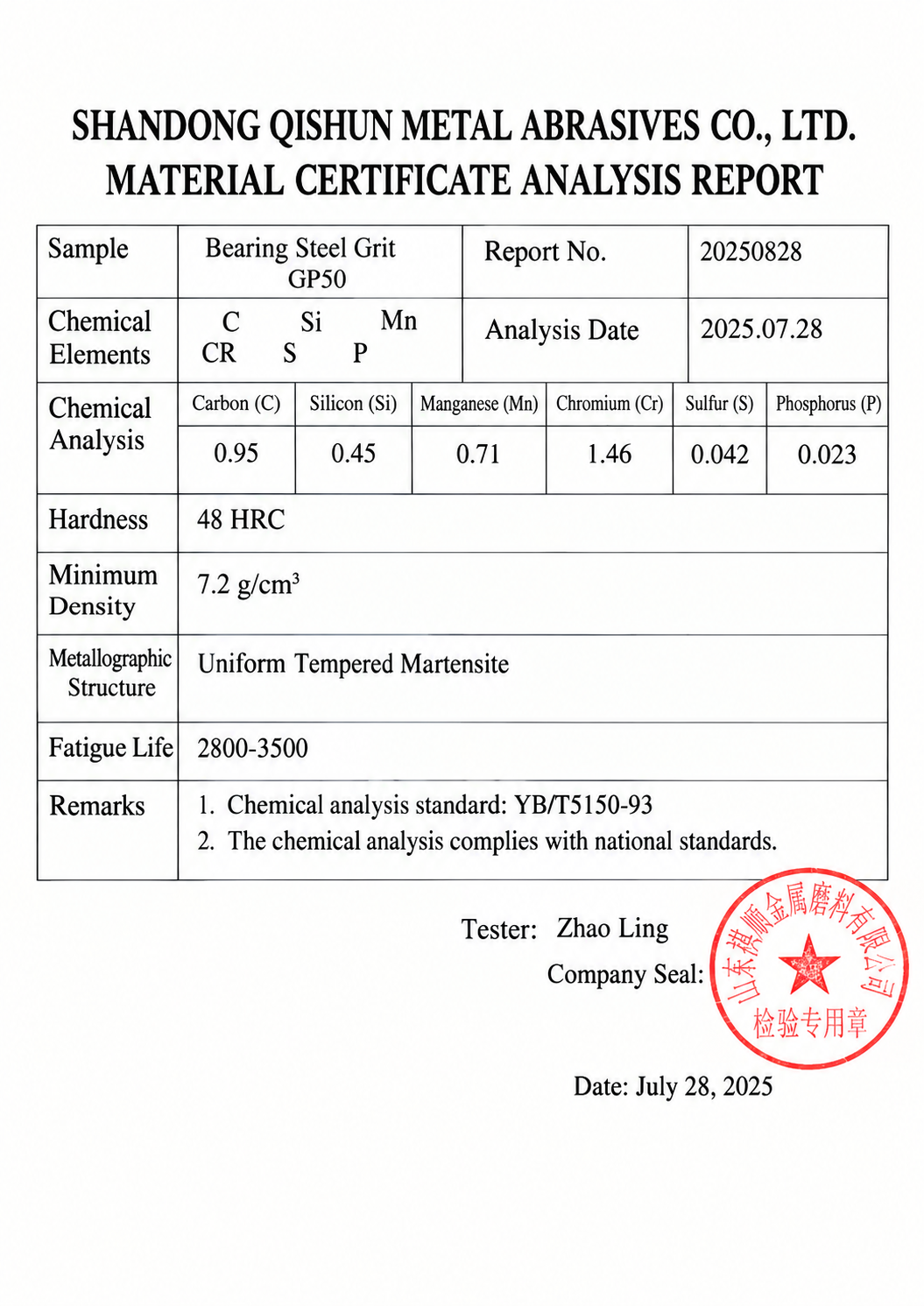
Hardness selection deserves more attention than it usually receives. Cast steel grit is documented in three bands — GP at 42–52 HRC, GL at 53–60 HRC, and GH at 60–64 HRC. The hardest band is not automatically the best choice. A GH grade applied to thin sheet or to a low-power wheel produces brittle fracture and short media life, while a GP grade applied to heavy mill scale removes material more slowly and increases passes. Bearing steel grit, crushed from GCr15 / 100Cr6 bearing steel, is documented at 55–65 HRC with a stated recyclable life of 2500+ cycles; cast steel grit is documented at a fatigue life of 2000–2500 cycles.
Cut wire shot belongs in the same conversation when the requirement is angular but the tolerance for size variation is tight. The steel wire cut pellet series is supplied from 1.0 mm to 3.0 mm, with tire cord cutting at 1.0, 1.2, 1.5, 1.5×1.5 and 2.0 mm, and steel strand cutting at 2.0, 2.5 and 3.0 mm, at 44–53 HRC and a stated life of 3300–3600 cycles. Where a buyer is choosing between grit and cut wire, the trade-off is angular cutting aggression versus dimensional consistency and life.
Where the savings from cheap grit actually go
Low-priced grit is not a fraud in itself; there are legitimate cost differences between producers. The risk lies in what is usually removed to reach the price: chemistry control, screening accuracy, and hardness consistency. Three failure patterns are consistently reported by buyers who switch back to a controlled grade.
1. Faster breakdown and higher consumption
Abrasive that breaks down prematurely has five common causes, and two of them sit with the product rather than the machine: hardness mismatch, where an abrasive that is too hard becomes brittle, and poor batch quality, where impurities cause breakdown two to three times faster than a controlled chemistry. A cheaper grit that lasts half as long is not cheaper per hour of blasting.
2. Dust, fines and separator overload
Inconsistent screening leaves an excess of fines in the delivered material. Those fines do not clean; they load the dust collector, raise filter replacement frequency, and reduce visibility in the booth. Over time they also disturb the air-wash separator, which begins returning broken particles to the wheel instead of rejecting them — a self-reinforcing decline in performance that buyers often attribute to the machine rather than the media.
3. Size drift and profile inconsistency
If the delivered size distribution is wider than the stated grade, the resulting surface profile varies across the workpiece. For coating work this is the most expensive failure of all, because profile variation shows up as premature coating failure long after the abrasive invoice has been paid. A 100% batch inspection regime covering particle size sieve analysis, hardness testing, chemical composition analysis and microstructure inspection is the control that prevents this, and it is one of the first things a discount offer tends to omit.
Standards and paperwork: what to ask for, and what a certificate actually covers
Standards are the part of a grit order most often cited and least often read. ISO 11124-3:2018 specifies requirements for high-carbon cast-steel shot and grit supplied for blast-cleaning processes, covering hardness, density, defect and structural requirements and chemical composition across defined grades. SAE J444 covers cast shot and grit size specifications for peening and cleaning. Buyers working to aerospace, automotive or class-society requirements frequently cite SAE J441 and SAE J827 in RFQs as well.
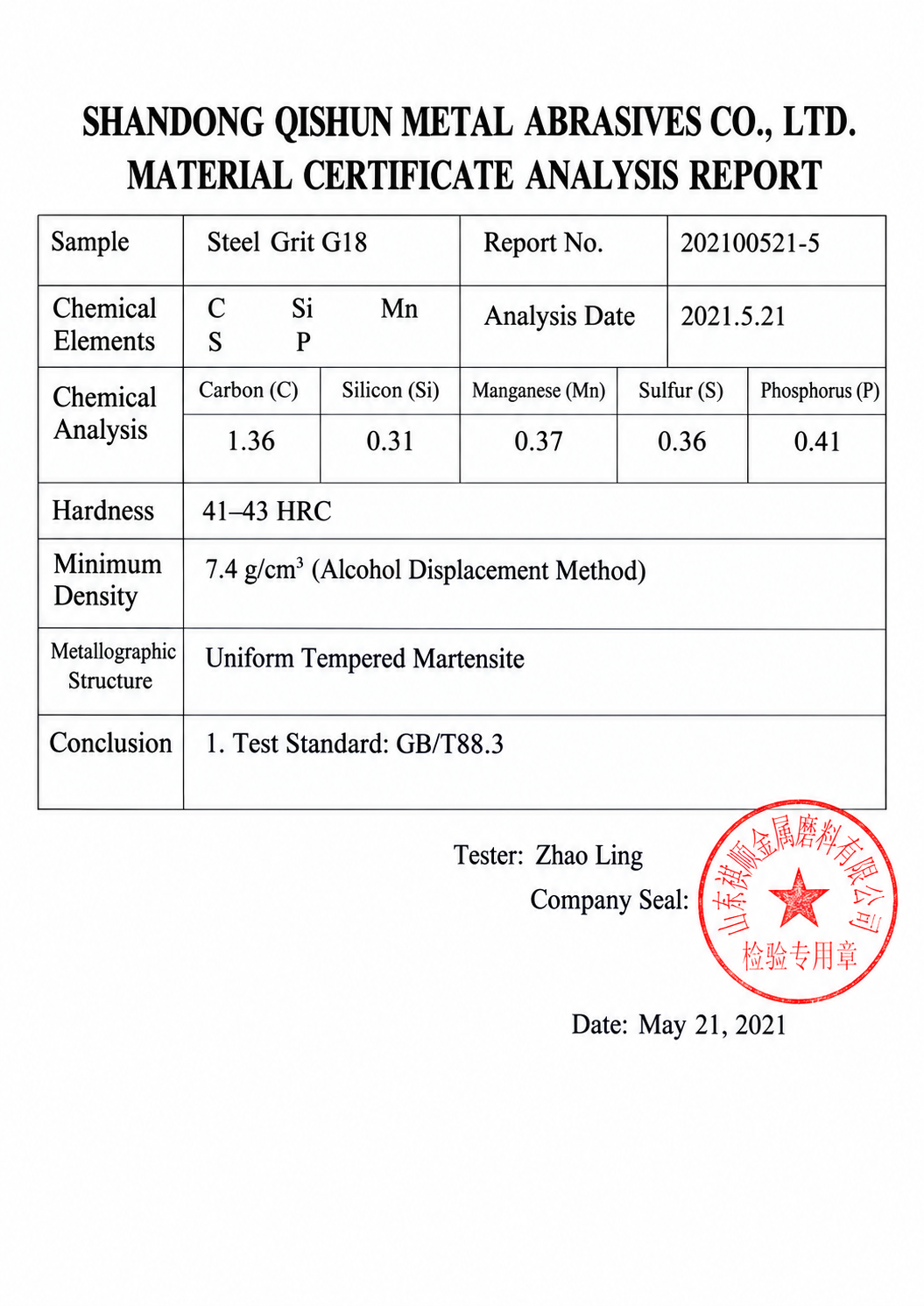
The practical point is that a standard cited in an enquiry does not become a product property until a certificate confirms it. Huiteng issues mill test certificates against JB/T8354-1996, YB/T5150-93 and GB/T88.3 for steel shot, steel grit, reinforced grinding shot, wire cut shot, molding sand and bearing steel grit, with SGS third-party testing available. Where an RFQ cites SAE J441, SAE J827, ISO 11124-3 or SAE J444, the correct action for a buyer is to request the specific certificate and test report that maps to the cited standard for the specific grade ordered, before the purchase order is released — not to assume that a general quality claim covers it.
Reuse, loss and the number that actually decides cost
Steel grit is a recyclable medium, and the recycling rate is where total cost is decided. Documented recyclable life is 2500+ cycles for bearing steel grit and 2000–2500 cycles for cast steel grit. The comparative logic is straightforward: a recyclable steel medium working through a machine's recovery system for thousands of cycles displaces a very large volume of single-use disposable abrasive, and the savings appear as fewer material purchases, fewer refills, lower waste disposal, fewer dust collector filter replacements, and more consistent surface quality that reduces rework.
A related question arises in foundry work: does reuse of buried box sand cause high losses? Buried box sand is documented as having strong toughness and resistance to high temperature thermal impact, and as not easily powdering after repeated pouring. Under normal casting conditions the reuse rate is high and loss is low, with continuous savings on sand cost. The operating discipline is the same as for grit: after use, sieve out dust and broken fine particles, return the intact particles to the box burial and compaction cycle, and periodically top up with new sand to maintain stable volume.
That pattern — remove the fines, keep the sound particles, top up the balance — is the single most useful operational idea a grit buyer can carry from one product family to another in the metal abrasives range.
Application fit: matching the grade to the job
Application-driven selection is more reliable than grade-number habit. For ship hull and structural steel blasting, angular grit in the G25–G40 band is the common choice, because it strips old paint, heavy rust and mill scale aggressively and creates an angular anchor profile for coating adhesion; a final pass with steel shot in the S330–S460 band can smooth the surface. For heavy ferrous foundry castings with stubborn molding sand, grit in the G18–G25 band is typical; lighter or precision castings are usually cleaned with shot in the S330–S550 band to avoid damaging fine surfaces. Automotive gear and spring peening uses much smaller shot, in the S70–S230 band, where controlled intensity matters more than cutting speed.
These application clusters are not hypothetical for this supplier. Documented field use of the metal abrasives range covers shipbuilding and ship repair, structural steel and bridge fabrication, automotive parts and surface treatment, foundry, abrasive distribution, shot blasting equipment integration, elevator counterweight manufacturing, construction anti-floating engineering, construction machinery and forklift manufacturing, fitness equipment manufacturing, and heavy equipment counterweight production. Project supply scale is documented at 100 tons per order with annual supply above 500 tons, and reported outcomes include consistent Sa2.5–3.0 preparation grade, improved coating adhesion and paint lifespan, reduced abrasive consumption in the region of 15–20% compared with a previous supplier, and a five-year record without quality complaints on the referenced supply relationship.
Market context: why grit specification discipline is becoming a purchasing norm
The commercial research available for this category points in one direction. The global metal abrasives market is valued at USD 6.7 billion in 2025 and is projected at USD 7.1 billion in 2026, with steel-based abrasives holding an 89.9% share of the material segment in 2025 and Asia Pacific accounting for 56.0% of global revenue in the same year (Grand View Research). The narrower steel shot sub-segment was valued at USD 1.664 billion in 2025 with a projection of USD 2.5 billion by 2035, and global steel shot consumption reached 6.8 million metric tons in 2025.
Two implications follow for grit buyers. First, supply concentration in Asia Pacific is structural, so supplier qualification rather than supplier discovery is where procurement effort earns its return. Second, in a market of this scale, the difference between a controlled grade and an uncontrolled one is a specification decision made at the RFQ stage, not a negotiation outcome.
Steel grit against traditional disposable media: the honest comparison
Compared with silica sand or copper slag, steel grit is a recoverable medium rather than a single-use one. Disposable media shatter on first impact and go straight to the dust collector; steel grit is captured by the elevator and air-wash separator, with only broken fines rejected and intact particles returned to the hopper. The consequences are lower material purchase volume, lower waste disposal cost, fewer filter replacements, and a more stable surface result.
The boundary conditions are equally real, and buyers should plan for them:
- Higher unit price. The case for steel grit rests on total cost of ownership across thousands of cycles, not on the first invoice. A buyer who cannot operate a recovery system will not see that return.
- Machine dependency. Grit performance depends on a functioning separator. A worn or misadjusted air-wash separator leaves fines in circulation and accelerates consumption regardless of media quality.
- Shorter life than cut wire in high-cycle peening. Cast steel grit is documented at 2000–2500 cycles, bearing steel grit at 2500+, and cut wire shot at 3300–3600 cycles. Where the requirement is continuous peening intensity rather than cutting aggression, grit is not the lowest-consumption option.
- Customization lead time. Non-standard grades require a 3-ton minimum and 20–30 days, which does not suit an urgent maintenance shutdown.
Future outlook
Three developments are likely to shape steel grit purchasing over the next several years. Documentation is becoming the differentiator: as ISO 11124-3 and SAE sizing specifications become standard RFQ language, the supplier who can produce a mapped certificate quickly will win business that price alone cannot hold. Second, grade rationalisation is likely to increase as buyers consolidate around fewer, better-controlled specifications instead of chasing the widest catalog. Third, the consumption metric is shifting from cost per ton to cost per square metre of correctly prepared surface, which favours consistent screening and chemistry over aggressive pricing. For a manufacturer operating medium-frequency induction melting, centrifugal atomization, secondary quenching and tempering with 100% batch inspection, that shift is favourable; for a buyer, it makes the specification checklist above a more valuable document than any quotation comparison.
FAQ: steel grit ordering questions
What is the difference between steel shot and steel grit, and which one should the order specify?
Steel shot is spherical, produced by atomising molten steel into round particles, and is used for shot peening, surface strengthening and gentle cleaning of thin or precision parts; its round shape resists impact breakdown, which supports longer life. Steel grit is produced by crushing hardened shot into angular fragments, and its sharp edges cut heavy rust, mill scale and old paint aggressively while creating an angular profile that improves coating adhesion. It breaks down faster than shot but removes material more quickly. The order should specify shot where the objective is peening or a rounded profile, and grit where the objective is aggressive cleaning and an angular anchor pattern.
Which grit grade suits ship hull blasting compared with foundry casting cleaning?
For ship hull and steel structure blasting, angular grit in the G25–G40 band is used to remove old paint, heavy rust and mill scale and to create an angular profile in the 50–100 micron range for coating adhesion, optionally followed by a pass with S330–S460 steel shot to smooth the surface. For foundry work, heavy ferrous castings with stubborn sand are typically cleaned with grit in the G18–G25 band, while lighter non-ferrous or precision castings are cleaned with shot in the S330–S550 band to avoid damaging fine surfaces. Abrasive size must also match blast wheel capacity, since larger particles require more power.
Can the bulk density and particle size of heavy sand and steel grit be customized?
Yes, within defined product families. Heavy ballast sand is offered in multiple bulk density levels from 3.8 to 6.0 g/cm³ with particle sizes from 0.1 mm to 5 mm, and its particle size supports customization for applications such as elevator counterweights, construction machinery counterweights and construction anti-floating work. Steel grit customization covers material type, particle size and grade range, hardness between HRC 40 and 65, chemical composition and packaging. The documented selection sequence is to confirm the density parameter required by the component design, select the matching particle size specification, run a small trial batch, and move to bulk supply after the trial passes inspection.
Does reuse of buried box sand cause high losses?
Buried box sand is documented as having strong toughness and resistance to high temperature thermal impact, and as not easily powdering after repeated pouring, which gives a high reuse rate and low loss under normal casting conditions. The practical cycle is to sieve out dust and broken fine particles after sanding, return intact particles to the box burial and compaction cycle, and periodically replenish new sand to keep the sand volume stable. Screening operations require dust removal protection, and waste sand should be disposed of according to solid waste management regulations.
Why does an abrasive sometimes break down too fast and consume too much?
Five causes are commonly identified. Abrasive hardness may be too high for the application, making particles brittle; particle size may be mismatched with blast wheel capacity; batch quality may be poor, with impurities causing breakdown two to three times faster; the air-wash separator may be worn or misadjusted, leaving fines in circulation; and blast wheel RPM may be set too high. The recommended sequence is to check hardness against the application, verify particle size against the wheel's recommended range, run a side-by-side test with a fresh sample, inspect and clean the separator and vibrating screen, and then check wheel RPM against the machine specification.
What minimum order, lead time, documentation and sample terms apply to a steel grit order?
The documented minimum order is 1 ton for standard grades and 3 tons for customized grades. Ready stock orders ship within 7–15 days, while customized orders take 20–30 days. Documentation includes mill test certificates issued against JB/T8354-1996, YB/T5150-93 and GB/T88.3, with SGS third-party testing available on request. Samples of 1–5 kg are provided free of charge for on-machine testing, with courier freight normally borne by the buyer and sample preparation taking 3–5 working days; testing two or three grades is the usual approach for a first-time specification.
How does the recyclability of steel abrasive change the total operating cost calculation?
Steel grit and shot are recovered by the machine's elevator and air-wash separator after each blast cycle, with only broken fines removed and intact particles returned to the hopper; documented recyclable life is 2500+ cycles for bearing steel grit, 2000–2500 cycles for cast steel grit, and 3300–3600 cycles for cut wire shot. Disposable sand and copper slag shatter on first impact and go directly to the dust collector. Because the medium is reused, the cost structure shifts from material purchase volume toward equipment condition, separator maintenance and screening discipline — which is why the lowest-priced grit is rarely the lowest-cost grit.
Tem questões ou precisa de mais detalhes?
Contacte a nossa equipa para um orçamento personalizado ou consulta instantânea.
Solicitar orçamento
Preencha o formulário abaixo e a nossa equipa entrará em contacto com uma proposta personalizada.
Chat direto do WhatsApp
Prefere conversar em tempo real? Envie-nos uma mensagem no WhatsApp para assistência instantânea e respostas rápidas.
- Obter orçamento personalizado
- Partilhar fotos ou documentos
- Discuta as suas necessidades diretamente
Geralmente responde em 5–30 minutos durante o horário de expediente.