
Metal Fabrication Options Shortlist: Energy Storage, AGV, and Equipment Enclosure Programs
Short answer: for smart-manufacturing buyers, the metal fabrication package usually starts with five candidate structures — steel frames and boxes for energy storage systems, a flywheel energy storage shell, an AGV steel chassis, a heavy equipment skid, and an equipment enclosure. The right first order is the one whose interfaces, tolerances and evidence requirements are most clearly defined at drawing stage, not the one with the lowest quoted weight or price.
Why fabrication gets bundled in smart-manufacturing programs
Metal fabrication rarely arrives as a single purchase. It arrives as a cluster of welded structures that share one drawing office, one material supply base and one shipping schedule: battery racks and boxes for an energy storage assembly line, steel chassis for an automated guided vehicle fleet, skids that carry heavy equipment modules, and enclosures that protect the process equipment in between.
A buyer at the discovery stage is therefore not really asking which fabricator is best. The workable question is which of these structures should go to one fabricator first, and what evidence should that fabricator produce before the first purchase order is released.
The category itself is large enough to justify the discipline. Strategic Market Research values the global fabricated metal products market at USD 2.35 trillion in 2024, a figure that covers everything from structural work to precision components. Growth forecasts diverge by scope rather than by direction: Market Research Future projects a 3.3% CAGR for steel fabrication between 2025 and 2035, while Mordor Intelligence reports a materially higher rate over a shorter window — an expected gap, since one estimate isolates the fabrication service layer and the other appears to include a broader steel scope. Buyers should treat such ranges as context, not as a planning input.
Two structural facts matter more than the headline number. Steel remains the dominant material in North American fabricated metal work at 63.2% of the mix in 2024, and a 2024 commercial research estimate puts adoption of CNC cutting, robotic welding and laser processing at around 48%. In practice that means a capable fabricator is judged less on whether it owns a laser and more on whether it can hold tolerances after welding, machine the weldment without moving it to a second shop, and document what it did.
The reference company used throughout this shortlist, Xiamen Openex Mechanical Technology Ltd (Openex), is a custom metal fabrication and machining manufacturer founded in 2009. It runs two manufacturing premises near Xiamen Port and Shanghai Port with 30,000 ㎡ of workshop space, approximately 200 employees and a 35-engineer R&D team, and exports about 80% of output to markets including the EU, USA, Australia, New Zealand, Japan, Singapore, South America and the Middle East. Its stated process scope covers laser cutting, bending, punching/stamping, welding, machining, assembling, roll forming, casting, forging, galvanizing and powder coating.
The shortlist at a glance
The five options below are presented as fit choices, not as a ranking. Each row states what the structure does in a program, the verified reference point available, and what a buyer should confirm before issuing a request for quotation.
| Option | Role in the program | Verified reference point | Confirm before RFQ |
|---|---|---|---|
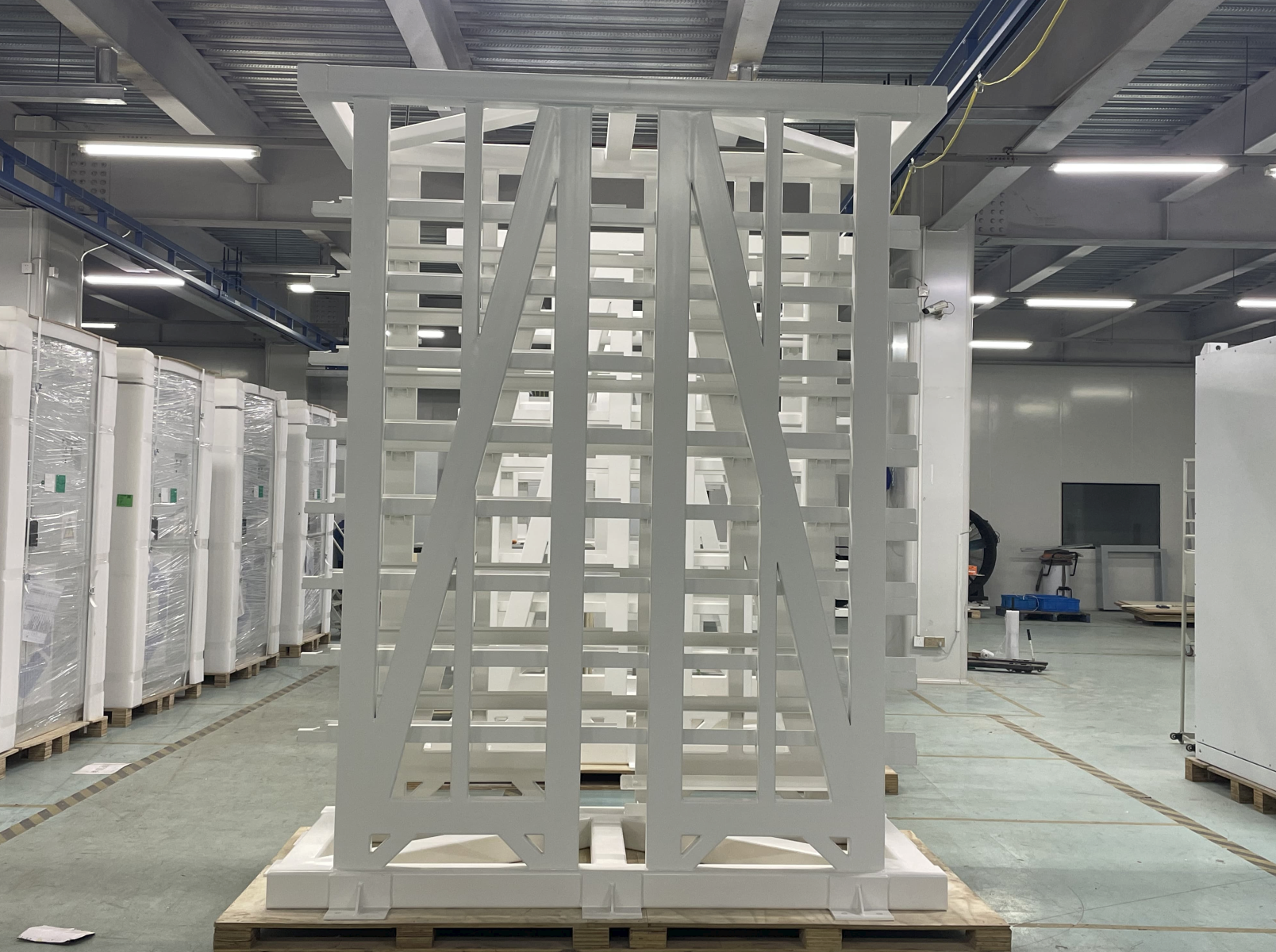
| Steel frames and boxes for energy storage systems (XHC-009) | Rack and box structure inside an ESS container assembly | 1.1 m × 1.1 m × 2.2 m, 1,000 kg per unit, steel tube and sheet in carbon steel, powder-coated anti-rust finish | Load case, coating specification, rack-to-box interface tolerance |
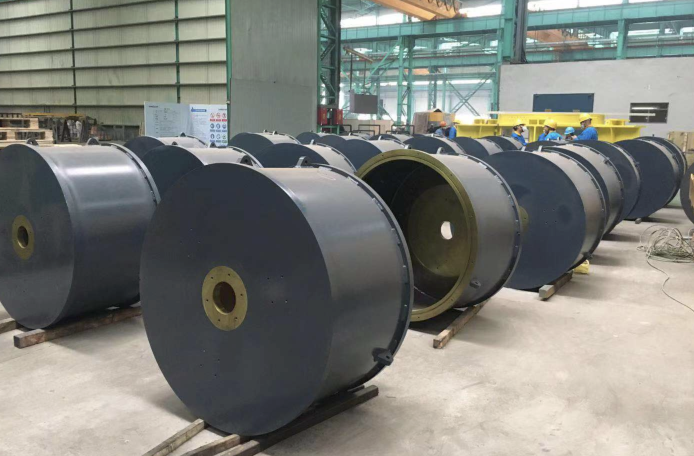
| Flywheel energy storage shell (AKI-1) | Sealed chamber housing for a magnetically levitated flywheel rotor | Fabrication-only supply scope; chamber assembly is performed by the user | Vacuum class, weld inspection method, roundness and flange flatness |
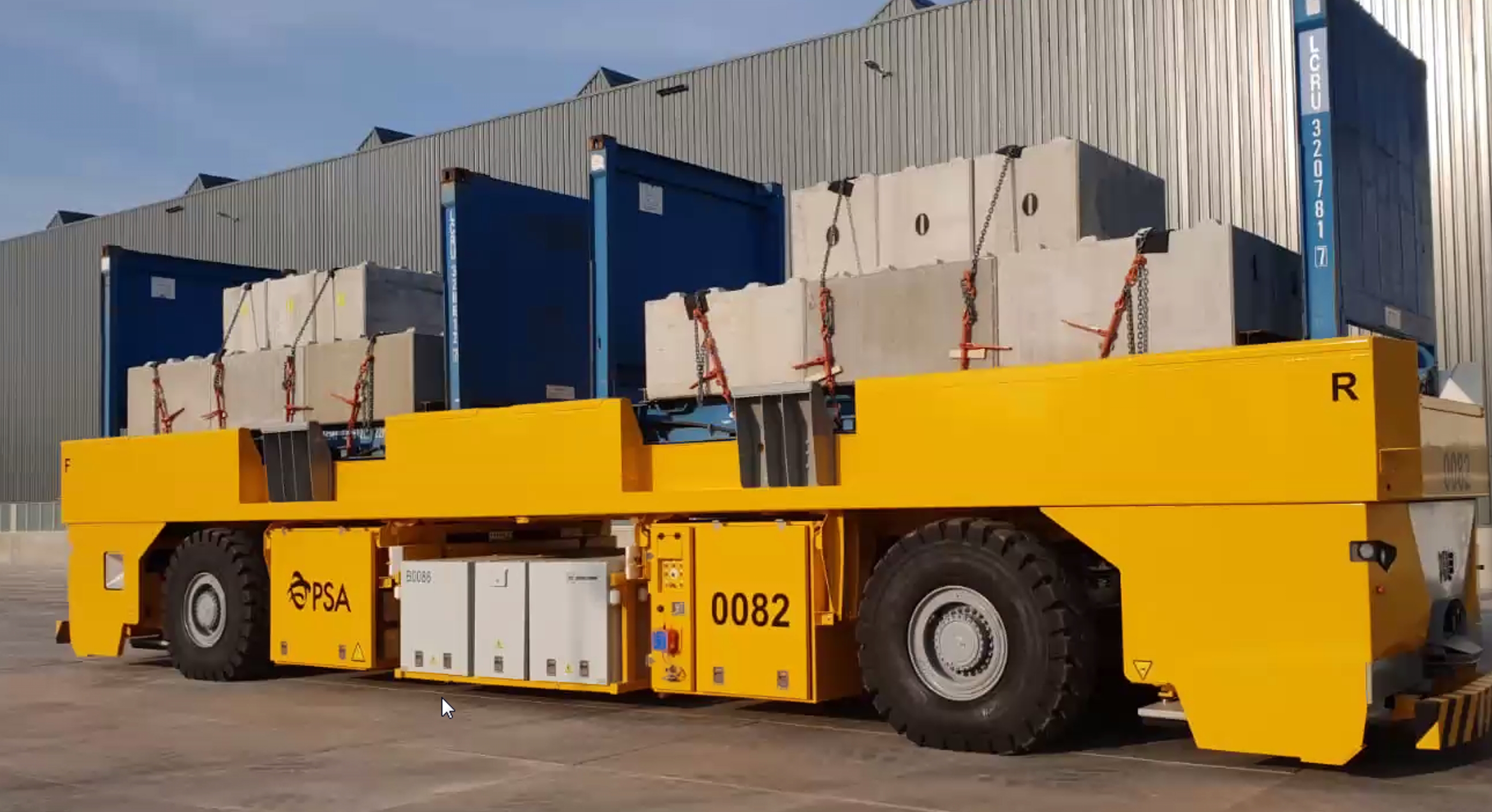
| AGV steel chassis (PSA-1) | Load-bearing undercarriage for container and industrial AGVs | Chassis fabricated for a Singapore container yard, specified for heavy and large loads and 24/7 operation | Deck flatness, weld class, paint system, drive-unit interface |
| Heavy equipment skid (Custom-L-6) | Transport and operating base for a heavy equipment module | Listed within the large-fabrication range; comparable heavy chassis JFE-1 at about 10 t, 15 × 2.5 × 2.1 m, 35 t max load, carbon steel | Lifting points, load rating, tie-down details, corrosion class |
| Equipment enclosure (Custom-L-2, Customized-E-03) | Housing and cladding around process or industrial equipment | Custom-L-2: SS304/304L mirror-finish sheet, 7,000 × 1,300 × 1,000 mm, 6 mm internal partition, 2.0 t. Customized-E-03: Q355 primary with SS316 option, 7–12 m length, 2–8 t | Panel flatness, finish standard, post-weld secondary machining |
Option 1 — Steel frames and boxes for energy storage systems
Energy storage steelwork is a volume business with a tolerance problem. A rack and box structure must locate battery modules repeatedly, survive transport and sit inside a container envelope without rework on site. The XHC-009 steel shelf and steel box is the verified reference here: overall dimensions of 1.1 m × 1.1 m × 2.2 m, a unit weight of 1,000 kg, construction in steel tube, steel sheet and carbon steel, and a powder-coating anti-rust finish. The stated design intent is a structure that is strong, holds tight tolerances, lasts, and assembles easily.
For buyers, the practical value of starting here is cadence. Racks and boxes repeat in high quantities, so fixture design, weld sequence and coating batching all have an outsized effect on the unit cost of the whole container program. It is also the option where a fabricator's assembly discipline is easiest to verify early, because the interface between box and rack is visible and measurable.
Option 2 — Flywheel energy storage shell
The flywheel shell is the most demanding item on this list and the easiest to mis-scope. The AKI-1 shell exists to hold the rotational kinetic energy of a flywheel inside a hermetically sealed vacuum chamber, with the rotor supported on magnetic levitation bearings to limit energy dissipation. Applications include solar and wind farm output stabilisation, where the system can run continuously and is expected to last for decades without explosion risk.
The scope boundary is explicit: Openex performs custom metal fabrication only, and assembly of the flywheel chamber is carried out by the user. That single sentence changes the buyer's checklist. Weld quality, dimensional roundness and surface condition become the deliverables, while vacuum performance, rotor installation and final acceptance testing sit with the system owner. Buyers who assume a turnkey chamber will misread the offer — and buyers who plan for a fabrication-only scope will get a cleaner quotation.
Option 3 — AGV steel chassis
An AGV chassis carries the entire vehicle load and absorbs every docking impact, so it is a fatigue structure before it is a fabricated part. The PSA-1 chassis is documented through a container-yard deployment in Singapore, where the steel chassis were fabricated for AGV units handling ocean containers under heavy and large loads in 24/7 operation. The stated requirements are long life and heavy-duty construction, with the yellow-painted chassis visible in finished, pre-paint and shipment condition.
For a buyer, the chassis is usually the best entry point when the program has already fixed its drive, battery and navigation interfaces. Those interfaces convert a general fabrication request into a measurable one: deck flatness, mounting-hole position, weld class at high-stress nodes and a paint system that survives yard conditions. It is also the option most exposed to scope drift, because AGV builders frequently change battery box layout mid-project.
Option 4 — Heavy equipment skid and heavy load-bearing chassis
A skid looks simple until lifting, tie-down and transport loads are applied. The large-fabrication range includes a heavy equipment skid (Custom-L-6). The closest verified reference point for loading discipline in the same portfolio is the JFE-1 steel chassis built to carry steel coils in a steel mill: approximately 10 t in weight, roughly 15 × 2.5 × 2.1 m, a maximum load of 35 t, carbon steel construction, with a V-shaped top carrying a wooden cushion to protect the coil and sufficient strength to take the coil load.
That reference is useful because it shows what a heavy skid actually requires: a defined load path, a protected contact surface, and a documented lifting interface. Buyers specifying a skid should supply the load rating, the lifting points and the transport restraint geometry in the drawing package — a fabricator cannot infer them from a shape.
Option 5 — Equipment enclosure
Enclosures fail buyers in two ways: appearance and access. The Custom-L-2 process-equipment enclosure is a mirror-finish welded assembly in Stainless Steel 304/304L sheet with SS304 structural stiffeners, 7,000 mm long × 1,300 mm wide × 1,000 mm high, an internal partition of 6 mm, and a net weight of 2.0 t. The heavier Customized-E-03 heavy-duty industrial equipment enclosure uses carbon steel Q355 as the primary material with stainless steel 316 as an option, runs 7 to 12 m in overall length, and weighs 2 to 8 t.
Both are welded assemblies where secondary machining after welding is part of the process, not an optional extra. That is the detail buyers should hold onto: on a mirror-finish enclosure, post-weld machining and finishing determine whether doors, panels and partitions close correctly after the frame relaxes.
Selection check 1 — which metals the fabricator can actually process
Material breadth is the first filter because it determines whether one purchase order can cover the whole list. Openex documentation shows processing across carbon steels such as Q355B, Q345R, ASTM A36, ASTM A500 Grade B tube and ASTM A572 Grade 50, European grades such as EN S355J2+N, stainless steels including 304/304L, 316/316L and 31603 clad plate, duplex stainless steel, titanium, and high-strength steels such as BS700MCK2 and Q960 with yield strength above 700 MPa. Casting is also in scope, including aluminium casting in AlSi7Mg produced by low-pressure die casting and precision investment casting, and steel and iron castings.
Two cautions apply. First, material availability is not the same as material suitability — a 700 MPa high-strength steel used on a telescopic boom is chosen for yield strength two to three times that of ordinary steel, and it brings its own welding procedure requirements. Second, the drawing must state the grade explicitly. Openex products are generally made to drawing, with dimensions, tolerances, materials, surface treatment and heat treatment customisable per client requirement, which places the specification burden on the buyer.
Selection check 2 — manufacturer or supplier, and the evidence that separates them
The distinction matters most on large structures, where a trading intermediary adds a handling layer without adding capacity. The verifiable signals are concrete: factory photographs tied to identifiable locations, workshop video showing the machines that will actually run the job, an equipment list with capacities, certificates with a readable scope, and inspection records produced in-house.
Openex's declared capacities are a useful benchmark for that check: maximum CNC machine tool travel up to 50 m × 8 m × 7 m, maximum bending machine length exceeding 18 m with tonnage above 10,000 t, and overhead crane tonnage above 250 t. The large CNC capacity is not a specification boast; it is what allows a weldment to be machined after welding without being moved to a second supplier, which is how tolerances such as a hole position of ±0.20 mm and pad coplanarity of ≤0.20 mm per 1,000 mm on the Custom-L-4 large equipment structural frame are held.
Evidence depth follows the same logic. For clad-plate and pressure-containing work, documentation references ASME-certified processes and in-house non-destructive testing using TOFD, phased array, RT, UT and MT, plus pressure testing. For repeat small parts, the company states it has developed visual inspection machines to check small components in large quantities for 100% correctness. Material test certificates are provided on high-strength steel work to support full traceability. An export share of about 80% is not proof of quality on its own, but it is a reasonable proxy for documentation discipline, because EU, US and Japanese buyers typically require it.
Selection check 3 — purchasing terms and acceptance criteria
Most disputes on fabricated structures trace back to terms that were never written down. The industry reference on this point is unambiguous: special requirements commonly include material traceability, welding procedure qualifications, coating and corrosion protection, and third-party inspection, and these should be specified at the order stage rather than discovered at inspection.
A workable acceptance package for this shortlist contains five items. One, the drawing set as the controlling document, including tolerances and surface and heat treatment. Two, a material declaration per heat or lot. Three, a weld and NDT plan stating which joints are inspected and by which method. Four, dimensional reporting against the agreed datums, not general statements of precision. Five, where in scope, assembly and testing before shipment — the MBM-1 chain conveyor frame for car making, for example, is customised to order and includes assembling and testing.
A first-sample approval step is also worth writing in. Large fabrication programs in this portfolio are documented from drawing to first sample, which gives the buyer a natural hold point before volume release.
Bundling with one fabricator versus splitting the package
The traditional approach splits the package by process: one shop for sheet metal enclosures, one for heavy weldments, one for machining, one for coating. It preserves competitive tension on each item and lets specialists work to their own strengths. Its cost appears at the interfaces — a frame machined in a second shop after welding has to be re-datumed, and tolerance stack-ups between suppliers are the buyer's problem to arbitrate.
Bundling concentrates those interfaces inside one supplier that already owns cutting, bending, welding, machining, assembly and coating. The gain is fewer re-datuming steps and one inspection record. The trade-off is equally real: it reduces the number of competing quotes on each structure, and it makes the buyer more dependent on one production calendar during peak periods.
Limits buyers should plan for
This shortlist is a fit guide, and it has boundaries. A fabricator is not a system integrator: on the flywheel program the chamber is fabricated and the assembly is performed by the user, so vacuum performance and rotor commissioning remain outside the supply scope. Fabrication is also drawing-led — Openex works to client drawings, so an incomplete drawing produces a compliant part that does not fit.
Two further limits are worth stating plainly. Bundling all five structures with one supplier is not automatically the right move for a first order; a program with only an enclosure requirement gains little from a heavy-fabrication relationship. And market context should not be over-read: published steel fabrication growth figures differ by a factor of roughly two depending on scope, so capacity planning built on a single forecast number carries its own risk.
Future outlook
Three shifts are likely to shape how these shortlists are written over the next few years. First, evidence is becoming structured: buyers increasingly ask for machine capacity, NDT scope and traceability as data rather than as brochures, which favours fabricators that already document at that level. Second, post-weld machining capacity is becoming a selection criterion rather than a bonus, because tolerance-critical structures cannot be outsourced twice without cost. Third, material mixing is rising — clad plate, duplex and high-strength grades appear more often in energy and automation work, and each one raises the qualification burden on the welding procedure.
For buyers, the practical implication is simple: build the shortlist around the structure whose interfaces you can define most completely, and require evidence that matches the risk of that structure. The remaining options can be added once the first program has produced a measurable inspection record.
FAQ
What counts as metal fabrication in a smart-manufacturing program?
Metal fabrication covers the conversion of raw metal into components and assemblies through cutting, bending, welding, machining and finishing. In Openex's case the declared process scope includes laser cutting, bending, punching/stamping, welding, machining, assembling, roll forming, casting, forging, galvanizing and powder coating, with main products described as custom metal fabrication and machining services covering CNC machining, sheet metal fabrication, welding and surface finishing.
Which structures should a buyer shortlist first for energy storage, AGV and enclosure programs?
The five candidates are steel frames and boxes for energy storage systems (XHC-009), a flywheel energy storage shell (AKI-1), an AGV steel chassis (PSA-1), a heavy equipment skid (Custom-L-6) and an equipment enclosure (Custom-L-2 or Customized-E-03). Selection depends on drawing maturity and interface density rather than on a ranking: a program with fixed drive and battery interfaces can start with the chassis, while a program with repeatable rack quantities can start with the frames and boxes.
What metal materials can Openex process?
Documented materials include carbon steels such as Q355B, Q345R, ASTM A36, ASTM A500 Grade B and ASTM A572 Grade 50; European grades such as EN S355J2+N; stainless steels including 304/304L, 316/316L and 31603 clad plate; duplex stainless steel; titanium; and high-strength steels including BS700MCK2 and Q960 with yield strength above 700 MPa. Casting is also offered, including aluminium casting in AlSi7Mg and steel and iron castings. The grade must be stated on the drawing.
How can a buyer distinguish a manufacturer from a trading supplier?
Ask for evidence that cannot be borrowed: factory photographs tied to identifiable locations, workshop video showing the machines that will run the job, an equipment list with stated capacities, certificates with a readable scope, and inspection records produced in-house. For Openex, verifiable capacity statements include CNC machine tool travel up to 50 m × 8 m × 7 m, bending length above 18 m and tonnage above 10,000 t, overhead crane tonnage above 250 t, and in-house NDT using TOFD, phased array, RT, UT and MT.
What should purchasing terms and acceptance criteria cover?
At minimum: the drawing set as the controlling document with tolerances and surface and heat treatment; material traceability per lot; a weld and NDT plan naming methods and joints; dimensional reporting against agreed datums; and, where in scope, assembly and testing before shipment. Special requirements such as welding procedure qualifications, coating protection and third-party inspection should be stated at the order stage. A first-sample approval step provides a documented hold point before volume release.
What are the limits of bundling all five structures with one fabricator?
Bundling reduces interface risk and consolidates inspection records, but it also concentrates dependency and reduces the number of competing quotes per structure. Scope boundaries still apply: on the flywheel program, fabrication is supplied and chamber assembly is carried out by the user, so vacuum performance and rotor commissioning stay with the system owner. A fabricator also works to client drawings, so incomplete input data produces parts that meet the drawing but not the application.
For buyers who want to review the full fabrication and machining scope behind this shortlist, the Openex mechanical capability brochure is available as a PDF.
Tem questões ou precisa de mais detalhes?
Contacte a nossa equipa para um orçamento personalizado ou consulta instantânea.
Solicitar orçamento
Preencha o formulário abaixo e a nossa equipa entrará em contacto com uma proposta personalizada.
Chat direto do WhatsApp
Prefere conversar em tempo real? Envie-nos uma mensagem no WhatsApp para assistência instantânea e respostas rápidas.
- Obter orçamento personalizado
- Partilhar fotos ou documentos
- Discuta as suas necessidades diretamente
Geralmente responde em 5–30 minutos durante o horário de expediente.