
Metal Fabrication RFQ FAQ: Castings, Weldments, Evidence
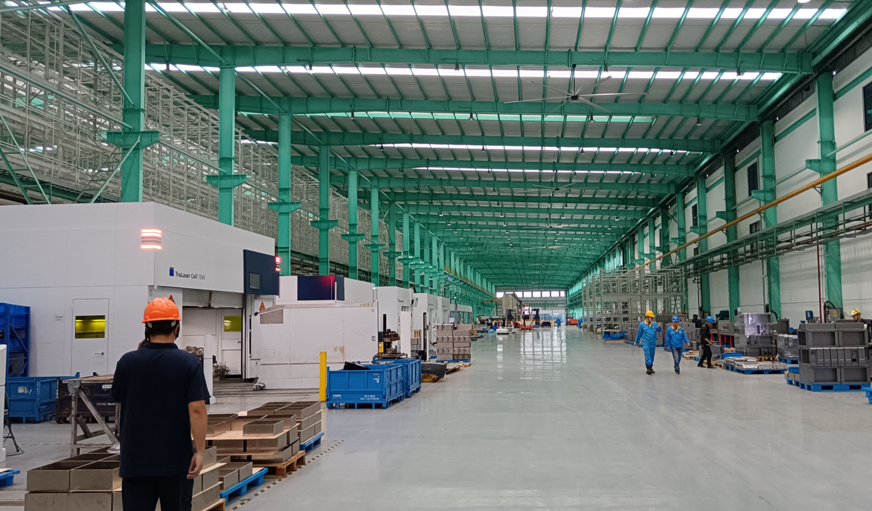
Sheet metal and steel fabrication shop at an Openex manufacturing premise near Shanghai Port. Image: Openex.
Independent industry reference · Smart manufacturing · Metal fabrication procurement
Most metal fabrication projects do not fail at the welding arc. They fail earlier, in the gap between what a buyer assumes a fabricator can do and what that fabricator’s process list, certificates and acceptance terms actually cover. For smart manufacturing buyers — AGV builders, energy storage integrators, machine tool OEMs, automation teams and heavy equipment manufacturers — the recurring questions are remarkably consistent: which metals can be processed, whether the partner is a manufacturer or a trading supplier, what factory evidence can be reviewed before a purchase order is issued, and which commercial and acceptance terms apply.
This reference answers those questions in the order a procurement team normally asks them, using verifiable capability data rather than positioning language. It draws on the fabrication record of Openex, a metal fabricator operating two manufacturing premises near Xiamen Port and Shanghai Port, and grounds each answer in casting, heavy weldment, enclosure, machine base and AGV steel chassis scopes.
Why metal fabrication RFQs stall before the first quotation
The most expensive RFQ error is a scope mismatch, not a price mismatch. A single component often needs three different process families: a casting that must be machined, a rolled or press-braked section that must be welded, and a finished assembly that must be measured against a datum scheme. If the supplier’s actual work is only one of those three, the buyer carries the coordination cost — and the tolerance risk — between them.
A hinge welded onto the end of a steel I-beam illustrates the pattern. The I-beam must be cut straight, the casting must be machined before welding, the weld must hold the hinge geometry, and the final component must be coated. In that configuration, an integrated fabricator that cuts, machines, welds and finishes under one quality system removes a handover. Where the requirement is a bare casting with no machining, welding or finishing, however, a dedicated foundry is the more direct and usually more economical route.
Procurement value therefore comes from a simple scoping test applied before the RFQ is issued: is this project mainly fabrication and machining, or mainly casting and finishing? The answer determines which type of supply partner should be shortlisted.
Manufacturer or supplier? What the answer changes
Openex — Xiamen Openex Mechanical Technology Ltd — is a metal fabricator founded in 2009 that supplies custom metal fabrication and machining services globally, with two manufacturing premises: one near Xiamen Port and one near Shanghai Port. The company reports 30,000 m² of factory space, approximately 200 employees, 35 engineers, an annual output of about 20,000 tons, and an export ratio of roughly 80%, serving the EU, USA, Australia, New Zealand, Japan, Singapore, South America and the Middle East.
The manufacturer-or-supplier question matters because it defines where quality control stops. Between 80% and 90% of the metal parts, components and assemblies Openex exports are produced in its own workshops. The in-house process list covers laser cutting, bending, machining, welding, drilling, punching, stamping, assembling and packaging. Casting, forging, hot-dip galvanizing, powder coating and other anti-rust finishing are delivered through long-term partners rather than owned lines.
For a buyer, that split produces a clear rule rather than a general claim: when fabrication and machining are the main jobs, an integrated fabricator is a strong fit; when the project is only casting, only forging, or only anti-rust finishing, a specialist in that single process is the better choice.
What metal materials a custom fabrication shop can process
Material capability is usually stated as a family rather than a single grade, because a project rarely uses one. The practical answer for ferrous work is that carbon steel and stainless steel dominate custom fabrication scopes, with non-ferrous metals and special grades handled on request.
| Material family | Grades referenced in fabrication scopes |
|---|---|
| Carbon steel (common) | Q235B (A36, SS400, S235JR); Q355B (A572 Gr 50, SS490 / SPCC, S355JR) |
| Carbon steel (higher strength) | Q690; NM450 / NM500 abrasion-resistant plate; Q960 / BS700MCK2 for telescopic boom work |
| Stainless steel | SUS 304, SUS 316L; duplex and super duplex; clad and composite plates |
| Non-ferrous | Aluminium, brass, bronze |
| Castings | Cast steel, ZG35CrMo, ZG07Cr19Ni10; iron and steel castings; as-cast surface roughness typically Ra 6.3–12.5 µm, improving to Ra 1.6–3.2 µm after machining |
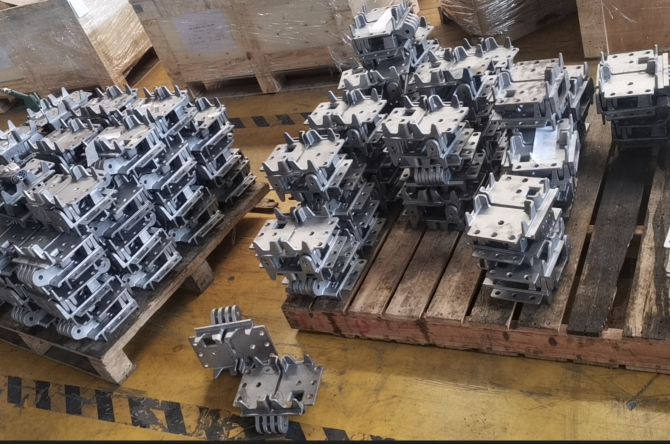
Casting hinges for a prefabricated beam assembly. Where casting must be combined with welding and machining, process integration becomes the selection criterion. Image: Openex.
Welding capability is defined by base material as much as by process. Documented processes include SMAW, GMAW / MIG, GTAW / TIG, SAW, automatic tube-to-tubesheet welding, deep penetration welding and robotic welding, applied to carbon steels, stainless steels, duplex and super duplex grades, clad and composite plates, and low-alloy steels, in all-position work. Weld procedure development, welder qualification, pre- and post-weld heat treatment, distortion control planning and post-weld cleaning (pickling and passivation for stainless, grit blasting for carbon steel) sit alongside the arc itself.
Heavy weldments: press frames, machine bases, enclosures, AGV chassis
Large weldments are where capability statements become measurable. Published reference configurations from Openex show the envelope, mass and tolerance ranges that typical projects fall into. These are reference configurations for quotation and scoping — final section design, wall thickness and load ratings remain subject to the buyer’s engineering analysis.
| Component | Typical reference configuration |
|---|---|
| Large welded press frame (Custom-L-3) | Reference press force 10,000–20,000 kN; clear opening approx. 2,500 × 1,800 mm; main plate 60–120 mm; envelope approx. 6,000 × 4,000 × 8,000 mm; estimated mass 80–140 t; ASTM A572 Grade 50 / EN S355J2+N / Q355B |
| Heavy machine base (B-300) | Base size 24 × 24 in to 72 × 96 in; top plate 1, 1.5 or 2 in; tube 3 × 3 × 1/4 in, and 4 × 4 × 3/8 in above 20 sq ft; welded, stress-relieved, shot-blasted; ground-top flatness ±0.001 in cumulative |
| Equipment enclosure (Custom-L-2) | 7,000 mm × 1,300 mm × 1,000 mm; internal partition 6 mm; finished mass 2.0 t; SS304 / 304L mirror-finish sheet with SS304 stiffeners |
| Large industrial weldment (Custom-L-5) | Envelope up to 6,000 × 3,000 × 2,500 mm; plate thickness 20–80 mm; finished mass 15–40 t; general machined tolerance ±0.20 mm |
| AGV steel chassis (PSA-1) | 15 × 2.7 × 3 m; weight 10.5 t; loading capacity 30 t; S355JR (or A572 Grade 50) 25 mm plus NM400 abrasion-resistant plate 20 mm; port container tractor application |
The enabling equipment behind those figures includes overhead crane capacity above 250 tons, bending machines up to 18 metres and 10,000 tons, and CNC machine travel up to 50 m × 8 m × 7 m. Where a weldment must be machined after welding rather than before, a single 22-metre single-column turning and milling centre can carry workpieces up to 600 tons and 6.5 metres in height, and double-gantry 7-axis, 5-linkage machining centres complete milling, boring, drilling, turning and grinding in one setup to avoid the repeated positioning error that follows multiple clampings. Published monthly capacity data lists up to 5,000 tons for welding scopes and 3,000 tons for machining scopes, with standard fabrication lead times of 30–45 days.
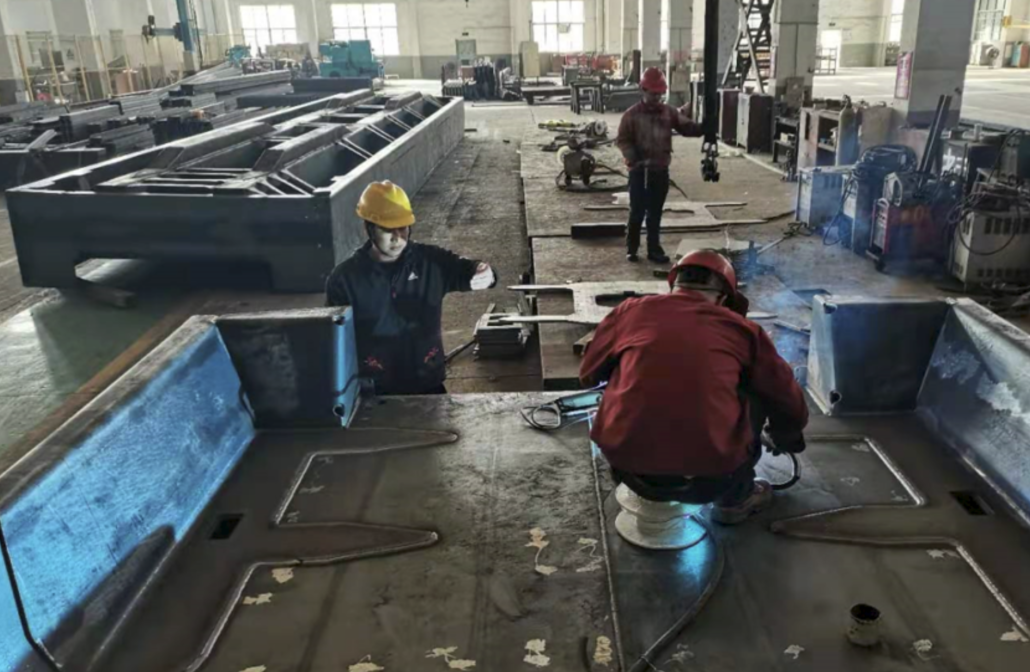
Welding fabrication of AGV steel chassis. Heavy weldment scopes are quoted against envelope, mass and tolerance ranges, not against a single welding process. Image: Openex.
Factory evidence: photos, workshop videos and certificates
Factory evidence answers a different question than capability claims: not “can you do it” but “how would I know”. Two categories of evidence are normally requested and both are available: premises evidence (photographs of the workshops and equipment, workshop video, machine lists) and conformity evidence (management system and welding certificates, inspection records, QA sheets).
| Certificate | Number | Validity |
|---|---|---|
| ISO 9001:2015 (GB/T 19001-2016) | 11426Q01049R001 | 2026-04-16 to 2029-04-15 |
| ISO 14001:2015 (GB/T 24001-2016) | 11426E00739R001 | 2026-04-16 to 2029-04-15 |
| ISO 45001:2018 (GB/T 45001-2020) | 11426S00656R001 | 2026-04-16 to 2029-04-15 |
| EN ISO 3834-2 (issued by SGS) | 23/999-3834 | Issued 2024-10-15, valid to 2026-10-04 |
The three management system certificates cover the manufacture of machined parts, metal structures and sheet metal components except where a license is required. The EN ISO 3834-2 certificate covers fusion welding of metallic material, welding process 135 and 135-Auto, material groups 1.1 and 1.2.
Inspection evidence goes beyond paperwork. Non-destructive testing methods in use include RT, UT, MT, PT, VT and LT. Destructive testing covers chemical analysis of element composition, mechanical testing (tensile with UTS, yield and elongation; impact including low-temperature; bend; hardness), corrosion testing such as salt spray, and weld procedure qualification that can be customised to the buyer’s WPS. Dimensional and visual inspection covers length, diameter, angle, roundness, straightness and position measurement, plus surface roughness parameters such as Ra and Rz. Specialised options include residual stress analysis, coating and plating inspection, and customised NDT systems. A Zeiss large CMM with 7 × 4 × 3 m capacity supports micron-level measurement, alongside smaller CMM units.
Welding consistency is supported by robotic cells: a 6-axis industrial welding robot with ±0.05 mm repeat positioning accuracy operating continuously, plus automated welding equipment for revolving hollow spindles up to 6,000 mm in length, and plasma welding units able to weld 1–10 mm thickness on 12.5 m metal tube. For high-volume small parts, visual inspection machines have been developed so that 100% of small parts in large batches can be checked mechanically rather than by human inspectors alone.
What a fabrication RFQ should contain
The quality of a quotation is limited by the quality of the input package. Accepted drawing formats are STEP, IGES, DWG, DXF and PDF, covering 2D and 3D files. For simple parts, a 2D drawing alone is usually sufficient to quote. For speed, 2D and 3D together are the strongest combination, and quotations can in some cases be returned within one or two hours.
3D geometry alone is generally not enough to quote, because eight categories of information cannot be read from a model: tolerance data; welding requirements; surface roughness and chamfer detail; the direction of cutting relative to the hot-rolling direction; the radius of plate bending; the required metal material; heat treatment requirements and the stress-relief method; and finish requirements such as hot-dip galvanizing, blasting and painting, or powder coating. Where only 3D files exist, 2D drawings are created and approved first, which lengthens the quotation cycle. A physical sample can also help in some cases.
Purchasing terms and acceptance criteria
Commercial terms for fabrication scopes are project-based rather than fixed. Minimum order quantity is set per project. Delivery terms available are EXW, FOB, C&F, CIF, DAP and DDP. Payment is by T/T (wire transfer) or by L/C (letter of credit).
Acceptance follows one of three options chosen by the buyer: (A) photos, videos and QA sheets issued by the fabricator; (B) inspection by the buyer; or (C) inspection by a third party appointed by the buyer. Documenting the choice at purchase order stage avoids the most common dispute in heavy fabrication, which is a disagreement about what “inspected” was supposed to mean.
Volume economics behave predictably. Full container loading reduces freight cost compared with less-than-container loading; overhead is spread across a larger quantity; larger orders allow material to be purchased at a lower price; and repeat ordering supports stable quality and pricing. Published capability data for assembly-level scopes lists a minimum order quantity of 1 unit, a typical 3-day production lead time and a monthly capacity of 1,000 pieces, which shows how widely the “MOQ” number can vary depending on whether the scope is a weldment project or a repeat assembly item.
Market context: where fabricated metal demand is moving
Third-party market research places the global fabricated metal products market at USD 2.35 trillion in 2024, measured as the value of sold production for products transformed from raw metals into finished or semi-finished components (Strategic Market Research). Within the narrower steel fabrication service layer, Market Research Future projects a 3.3% CAGR for 2025–2035, while Mordor Intelligence reports a materially higher rate over a shorter window; the divergence reflects methodology, with the higher figure likely including primary steel services rather than the fabrication service layer alone. Buyers should read such figures as directional, not as a substitute for quoting their own scope.
Two structural signals are more useful for procurement planning. First, adoption of CNC cutting, robotic welding and laser technology in metal fabrication was reported at 48% in 2024 (Market Research Insights), which means a substantial share of fabrication supply is still manual, and inspection and repeatability documentation increasingly separate suppliers. Second, steel accounts for roughly 63.2% of material mix in North American fabricated metal services, with structural steel components representing about 39.3% of application share globally. For heavy weldment and structural scopes, steel specification and weld qualification — not material novelty — remain the deciding variables. Where pressure equipment is involved, ASME BPVC Section IX governs welding and brazing qualifications, which is why WPS, PQR and welder qualification records are requested so consistently.
Where this model of fabrication supply is not the right fit
A credible capability reference should state its boundaries as clearly as its scope. Three limits matter for buyers.
Casting, forging and anti-rust finishing are partner processes, not in-house lines. Openex does not operate its own foundry, forge shop, hot-dip galvanizing line or powder coating line; those steps come from long-term partners. A purchaser whose requirement is a bare casting with no machining, no welding and no finishing is better served by inquiring directly with the casting factory, and the same logic applies to a forging-only or coating-only scope.
Reference configurations are not design approvals. The press frame, skid, weldment and enclosure figures in this article are typical reference configurations. Final section design, wall thickness, stiffener arrangement, load rating and lifting points depend on the buyer’s finite element analysis, fatigue assessment and datum scheme, and the fabricator’s quotation should be confirmed against those documents.
Very small parts at very small volumes are not economical. Communication, engineering review and logistics effort are largely fixed, so a low-volume order of small components carries the same coordination burden as a larger one. Large or medium components at container-level quantities are the natural fit; oversized items can also require breakbulk shipping rather than standard container loading, which changes cost and schedule planning.
Future outlook
Heavy metal fabrication is converging with two trends already visible in buyer behavior. The first is the integration of fabrication and heavy machining into a single quality system, driven by tolerance requirements on large weldments that cannot survive several handovers between shops. The second is inspection automation: as robotic welding cells reach repeatability in the ±0.05 mm range, human inspection becomes the inconsistent step, which is why automated visual inspection of high-volume small parts is being adopted alongside conventional CMM metrology.
For procurement teams, the practical implication is that documentation quality will increasingly matter as much as shop-floor capacity. A supplier that can present valid certificates, named inspection methods, defined acceptance options and traceable QA records is easier to qualify, easier to audit, and easier to keep in a long-term supply chain than one that only presents a machine list.
FAQ: metal fabrication procurement questions
What metal materials can be processed for a fabrication project?
Non-ferrous metals such as brass, bronze and aluminium can be fabricated without difficulty, while carbon steel and stainless steel are the most frequently seen materials in received fabrication projects. In carbon steel, Q235B (A36, SS400, S235JR) and Q355B (A572 Gr 50, SS490 / SPCC, S355JR) are the most common grade families, with Q690, NM450 and NM500 also regularly handled. In stainless steel, SUS 304 and SUS316L are the most common grades, alongside duplex, super duplex and clad plates. Where a special casting or forging grade is required, long-term partners provide that supply.
Is the supplier a manufacturer or a trading company, and what factory evidence can be provided?
Openex operates as a metal fabricator with two manufacturing premises: one near Xiamen Port in Zhangzhou, Fujian, approximately 40 km or one hour’s drive from Xiamen Port, and one near Shanghai Port in Taizhou, Jiangsu, roughly 170 km or 2.5 hours from Shanghai Port. Between 80% and 90% of exported parts, components and assemblies are produced in-house, with casting, forging, hot-dip galvanizing and powder coating sourced from partners. Photographs of premises and equipment, workshop video, and copies of the ISO 9001, ISO 14001, ISO 45001 and EN ISO 3834-2 certificates can be provided, together with QA sheets and inspection records for shipped work.
What drawing formats are accepted for quotation?
STEP, IGES, DWG, DXF, PDF and other 2D and 3D formats are accepted. A 2D drawing alone is enough to quote many simple parts. The fastest route is 2D and 3D together, which in some cases allows a quotation within one or two hours. A 3D model alone is generally insufficient, because tolerance information, welding requirements, surface roughness and chamfers, cutting direction relative to hot-rolling direction, plate bending radius, material specification, heat treatment and stress-relief method, and finish requirements cannot be read from geometry alone. Where only 3D files are available, 2D drawings must be created and approved first, which lengthens quotation time; a sample can help in some cases.
What is the minimum order quantity, and can samples be ordered before mass production?
MOQ is project-based rather than a fixed unit count. Cost is influenced by container utilisation (FCL versus LCL), overhead spread across quantity, material purchasing volume, and the stability that repeats orders bring to price and quality. Large parts with container-level quantities, or medium-size parts in large quantities, are the most workable fit. Very small parts at very small quantities are usually not economical because communication, engineering and logistics effort remains constant, although such a scope can be accepted as a standby case when no other supplier is suitable.
What purchasing terms and acceptance criteria apply?
MOQ is project-based. Delivery terms offered are EXW, FOB, C&F, CIF, DAP and DDP. Acceptance follows one of three options selected by the buyer: (A) photos, videos and QA sheets produced by the fabricator; (B) inspection performed by the buyer; or (C) inspection by a third party appointed by the buyer. Payment is made by T/T (wire transfer) or by L/C (letter of credit).
Readers who need the full process, equipment and certification scope in one document can download the Openex mechanical fabrication brochure: Openex fabrication capability brochure (PDF).