
Metal Fabrication Shortlist for Smart Manufacturing: AGV Chassis, Skids, and Enclosures
A metal fabrication shortlist is a small, documented set of fabrication sources that have each been qualified against the same evidence — premises, welding coverage, machining envelope, material range, and acceptance criteria — before drawings are released for quotation. In smart manufacturing projects, four item families justify that discipline: AGV steel chassis, heavy equipment skids, equipment enclosures, and steel frames and boxes for energy storage systems.
These four families share a property that ordinary sheet metal parts do not. They are large weldments whose function depends on what happens after welding — on the datum scheme, the post-weld machining, and the inspection evidence the buyer actually receives. Two suppliers can both describe themselves as metal fabricators and still deliver assemblies that are not interchangeable in a project plan.
This reference explains how to compare those items against project fit, material needs, and fabrication route, what evidence to request from a candidate source, where the limits of an integrated fabrication approach begin, and how to build a usable shortlist template.
Why smart manufacturing needs a shortlist rather than a supplier list
The fabricated metal products segment is large enough that availability is rarely the constraint. The global market value of fabricated metal products reached USD 2.35 trillion in 2024 according to Strategic Market Research, covering products transformed from raw metals into finished or semi-finished components through cutting, bending, welding and machining.
Growth figures for the narrower steel fabrication layer diverge significantly. Market Research Future projects a 3.3% CAGR for 2025–2035, while Mordor Intelligence is cited at 7.14% for 2025–2030. The gap is a methodology difference — whether primary steel services are counted inside the segment — not a disagreement about direction. The practical reading for a procurement team is that the segment is expanding, so the risk in a project is not the absence of fabricators. The risk is choosing between candidates that look identical on paper.
Consider what a shortlist is actually deciding. An AGV chassis carries a battery pack, drive units and steering hardware, and it must stay square across years of 24/7 duty. A compressor skid must hold mounting-pad flatness so that rotating equipment aligns without shimming. A process enclosure for a coating line must stay straight over seven metres and still present a cleanable surface. An energy storage frame must accept module hole patterns repeatably across thousands of units. None of these outcomes is described by the phrase “custom metal fabrication”. All of them are described by a datum scheme, a process sequence, and an inspection report.
The item families that belong on the shortlist
The table below uses published reference configurations from one fabricator's catalogue to show what “project fit” means in practice. The numbers are reference configurations, not universal specifications, and they are the right level of detail for comparing candidate sources.
| Item family | Reference item and key data | What usually decides fit |
|---|---|---|
| AGV steel chassis | PSA-1 steel chassis: overall dimensions 15 × 2.7 × 3 m; tare weight 10.5 t; loading capacity 30 t; high-strength steel plate S355JR (or A572 Grade 50) at 25 mm plus abrasion-resistant NM400 plate at 20 mm; intended for port container tractors and terminal tractor chassis | Stiffness under continuous duty, flatness at drive and wheel interfaces, corrosion protection cycle for yard or coastal environment |
| Steel-handling chassis | JFE-1 chassis: approximately 15 × 2.5 × 2.1 m; weight 10 t; maximum load 35 t; carbon steel; V-type top with wooden cushion to protect the coil | Load path into the V-top, protection of the payload, and how the unit is lifted and transported |
| Heavy equipment skid | Custom-L-6: overall size 8,000 × 3,000 × 1,200 mm; design equipment load 30–60 t; primary members H300–H500; estimated skid mass 12–20 t; mounting-pad flatness ≤0.20 mm per 1,000 mm; ASTM A36 / ASTM A572 Grade 50 / SS304 for corrosive service | Mounting-pad flatness, lifting point design, and corrosion allowance for the specified environment |
| Heavy-duty equipment enclosure | Customized-E-03: weight 2–8 t; length 7–12 m; carbon steel Q355 and stainless steel 316; plate thickness 1.5–25 mm; route includes cutting and blanking, bending, rolling, edge planing, welding and secondary machining after welding | Straightness over long spans, weld finish class, and whether secondary machining after welding is available |
| Mirror-finish process enclosure | Custom-L-2: length 7,000 mm, width 1,300 mm, height 1,000 mm; internal partition 6 mm; finished mass 2.0 t; stainless steel 304/304L mirror-finish sheet with SS304 structural stiffeners | Surface finish continuity, cleanliness of the internal volume, and distortion control through the welding sequence |
| Energy storage frame and box | XHC-009: overall dimension 1.1 × 1.1 × 2.2 m; weight 1,000 kg per unit; steel tube, steel sheet, carbon steel; anti-rust powder coating | Coating specification, module hole pattern repeatability, and behaviour under stacking and transport loads |
| Energy storage cabinet | Customized-J-05: material thickness 1.5–5.0 mm; protection rating IP54 / IP55 / IP65; powder coating or anti-corrosion coating; carbon steel, galvanized steel, stainless steel or aluminium | Ingress protection target, galvanic compatibility of mixed materials, and cable and port layout |
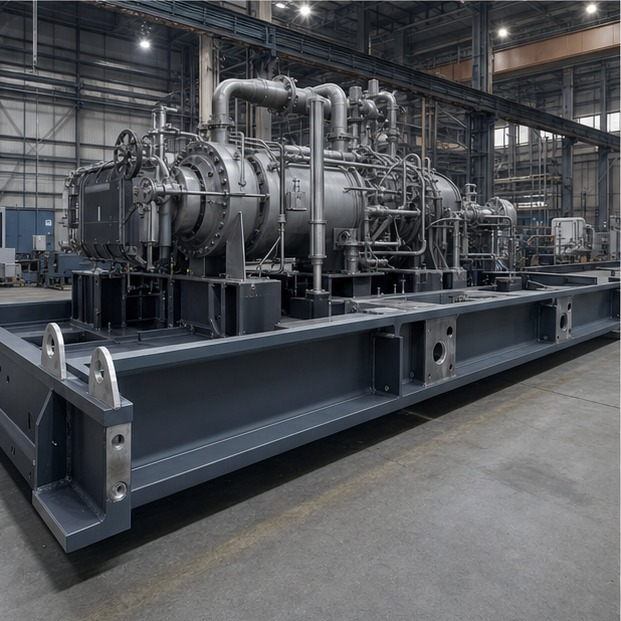
Heavy equipment skid reference configuration: 8,000 × 3,000 × 1,200 mm, primary members H300–H500, mounting-pad flatness ≤0.20 mm per 1,000 mm.
Manufacturer or supplier: the first verification gate
Xiamen Openex Mechanical Technology Ltd (Openex) is a custom metal fabrication and machining manufacturer founded in 2009, operating two manufacturing premises near Xiamen Port and Shanghai Port that together cover 30,000 m², with roughly 200 employees, a 35-engineer technical team, and an annual output of about 20,000 tons. The company exports approximately 80% of its output and has delivered pressure vessels, machine frames, steel chassis and steel structures to the USA, Canada, Japan, the UK, European countries and Australia.
That level of entity description is exactly what a shortlist entry requires, because the first distinction a buyer has to make is between a manufacturer and a supplier. A manufacturer owns the premises, the forming and welding equipment, the welding qualification records and the inspection function. A supplier arranges those things through a third party. Both can quote the same drawing.
The evidence that separates them is documentary and visual, and it can be requested before any commercial discussion:
- Premises proof. Photographs of the actual workshop, not stock imagery, plus video footage of the specific process being quoted — forming, welding, or post-weld machining.
- Certificate scope. Certificates with the scope statement attached. Where welding qualification is part of the acceptance route, the applicable framework is ASME BPVC Section IX, which governs welding and brazing qualifications.
- Material traceability. Material test certificates that tie the delivered steel back to a heat number.
- Process range. Openex works across laser cutting, bending, punching and stamping, welding, machining, assembling, roll forming, casting, forging, galvanizing and powder coating — a range that matters because the fabrication route decides where risk sits.
Capacity evidence is a second screen, because a supplier that cannot physically hold the part should not be on the list at all. Openex operates an overhead crane with tonnage over 250 t, a press brake with maximum length over 18 m and forming force up to 10,000 t, and CNC machine tool travel up to 50 m × 8 m × 7 m. Those figures are the reason large weldments can be machined after welding rather than accepted as-welded.
Material choice and fabrication route
Steel still dominates heavy fabrication. In North American metal fabrication for structural and heavy frames, steel accounted for 63.2% of material market share in 2024 (Report Insight / Mordor aggregated). That share explains why the shortlist question is rarely “steel or something else”, and usually “which steel, and through which route”.
Two routes are frequently confused. A weldment is built from plate and section, then machined where accuracy is needed. A casting or forging delivers the shape from a mould or die, with machining to finish critical faces. The choice changes the shortlist entirely, because the supplier has to be evaluated against a different process base.
Material and route examples that recur in smart manufacturing procurement:
- AGV chassis. High-strength steel plate S355JR (or A572 Grade 50 per ASTM) at 25 mm combined with abrasion-resistant NM400 plate at 20 mm — a combination aimed at impact and wear at the undercarriage rather than at uniform strength.
- Structural frames. ASTM A500 Grade B structural tube, ASTM A36 plate, or optional SS304 for the large equipment structural frame reference (Custom-L-4), and Q355B / EN S355J2+N / ASTM A572 Grade 50 for the ultra-long formed steel box section (Custom-L-1).
- Corrosive service. ASTM A36 / ASTM A572 Grade 50 / SS304 on skids, and stainless steel 304L with aluminium 6061-T6 for door or access components on chamber-type fabrications.
- Casting route. Steel castings in cast steel, ZG35CrMo and ZG07Cr19Ni10 for valve bodies and pump casings, with as-cast surface roughness of Ra 6.3–12.5 µm and Ra 1.6–3.2 µm after machining.
- Aluminium casting. AlSi7Mg cast aluminium alloy produced through low pressure die casting, low pressure sand casting and precision investment casting, with MAGMA casting simulation at project kickoff and 100% NDT testing.
Route also determines where the buyer should expect a boundary. A weldment route is efficient for single units and low volumes of large structures; it is not the cost-optimal route for small, high-quantity parts, which is a different production problem again.
Technical explanation: the tolerance chain in large weldments
Dimensional outcomes in large fabrication are set by three things in sequence: fixture design, welding sequence, and post-weld machining. A supplier that only offers the first two is delivering an as-welded part, and the buyer should specify acceptance against that reality.
The reference values below show the granularity at which a shortlist conversation should happen. They are published reference configurations for specific items, not a general tolerance class.
| Critical feature | Reference value | Item |
|---|---|---|
| Mounting-pad flatness | ≤0.20 mm per 1,000 mm | Heavy equipment skid (Custom-L-6) |
| General machined tolerance / datum-pad flatness | ±0.20 mm / ≤0.15 mm per 1,000 mm | Large industrial weldment (Custom-L-5), envelope up to 6,000 × 3,000 × 2,500 mm |
| Guide straightness | ≤0.10 mm per 1,000 mm | Large welded crossbeam (Custom-L-7), 6,000–10,000 mm length |
| Hole position / pad coplanarity | ±0.20 mm / ≤0.20 mm per 1,000 mm | Large equipment structural frame (Custom-L-4) |
| Ground-top flatness | ±0.001 in cumulative | Heavy machine base (B-300), welded, stress-relieved and shot-blasted |
| Overall straightness | ≤3.0 mm per 10,000 mm | Ultra-long formed steel box section (Custom-L-1), 8,000 mm long, 6 mm plate |
| Machined-face flatness / surface finish | ≤0.10 mm per 1,000 mm / Ra 1.6–3.2 µm | Large machined platen (Custom-L-10) |
| Drilling precision | ±0.05 mm; maximum diameter up to 10,000 mm; thickness up to 600 mm; drilling depth up to 1,000 mm | Tube sheet (Customized-J-01) |
| Frame precision | 0.01 mm per 1 m | Milling machine center frame (DM-2608, 2 m × 2 m) and precise steel frame (DM-612, 1.5 m × 4 m) |
Where these fabrications are used
Application context is what converts a capability list into a shortlist decision. Four reference scenarios illustrate how differently the same fabrication toolbox gets used.
Container AGV in a port yard
A container AGV operating in a container yard in Singapore carries ocean containers under heavy and large loads, in continuous operation, and relies on satellite navigation for positioning. The operating requirement is long life under heavy duty. The steel chassis in yellow visible in the reference imagery was fabricated by Openex, in a configuration with overall dimensions of 15 × 2.7 × 3 m, a tare weight of 10.5 t and a 30 t loading capacity.
Steel coil handling in a steel mill
In a Japanese steel mill application, the fabricated steel chassis functions as a steel pallet to carry steel coils and also serves as a skid for a tractor to lift and transport the coils. The V-type top carries a wooden cushion to protect the coil surface from damage. The published operating note is a genuine boundary: the unit should not be exposed outdoors for long periods, otherwise the wooden cushion can rot and disintegrate. A shortlist that ignores this note will produce a technically compliant part that fails in service.
Energy storage frames, boxes and cabinets
Energy storage applications drive two different fabrication problems. The first is structural: the XHC-009 frame and box family at 1.1 × 1.1 × 2.2 m and 1,000 kg per unit, built from steel tube and steel sheet in carbon steel with anti-rust powder coating. The second is enclosure-related: cabinets with material thickness of 1.5–5.0 mm, protection ratings from IP54 to IP65, and powder or anti-corrosion coating, applied in energy storage systems, renewable energy, battery manufacturing and industrial power systems. A flywheel energy storage shell reference (AKI-1) shows how far the same route can be pushed: a 1.5 m diameter, 0.8 m height, 2 t steel shell in S355JR or A572 Grade 50, tested for vacuum sealing at above 1.0 × 10⁻⁹ Torr L/s within 30 seconds.
Process equipment enclosures
Mirror-finish welded enclosures, such as the 7,000 × 1,300 × 1,000 mm unit with a 6 mm internal partition and a 2.0 t finished mass, are built for semiconductor and electronics manufacturing, high-end laboratory and research facilities, and pharmaceutical and biotechnology environments. Downstream equipment includes lithium battery coating and drying equipment and roll-to-roll process lines — applications where a weld spatter or a visible seam is a functional defect, not a cosmetic one.
A related capability point matters for buyers running mixed programmes. Large structures are only part of a smart manufacturing bill of materials; the same projects also consume large quantities of small parts. Openex developed visual inspection machines specifically so that small metal parts produced in high volume can be checked for 100% correctness, rather than relying on sampling by human inspectors.
Market trend analysis
Three verifiable signals shape how fabrication shortlists are being written.
The workforce base is stable but concentrated. U.S. fabricated metal product manufacturing employment in NAICS 332 stood at 1,460.8 thousand seasonally adjusted in August 2024, according to the Bureau of Labor Statistics. Capacity exists at scale; what varies between suppliers is how much of that capacity is machine-based rather than manual.
Automation adoption is real but partial. Reported adoption of advanced technology in metal fabrication — CNC cutting, robotic welding and laser processing — reached 48% in 2024, based on a derived estimate published by Market Research Insights. A figure near half the market is a useful reminder that “automated fabrication” cannot be assumed from a supplier's website, and should be confirmed from process video or equipment records.
Structural demand remains anchored in construction and equipment. Structural steel components accounted for 39.3% of application share in 2024 (Market Data Forecast). On the equipment side, AGV fleets, battery energy storage systems and automated production lines are adding demand for chassis, skids, frames and enclosures that sit outside traditional building construction. For Openex, this shows up commercially as an export ratio of approximately 80% across EU, USA, Australia, New Zealand, Japan, Singapore, South America and the Middle East, and as a customer base spanning energy storage systems, power plants, machinery, building, mining, oil and gas, and nuclear applications.
How integrated fabrication compares with a multi-vendor chain
The traditional route for a large weldment is a chain: plate supplier, cutting shop, welding shop, machining shop, painter, then an inspection body. Each handover transfers custody of the datum, and every transfer is a place where accuracy can be lost or re-negotiated.
An integrated route keeps cutting, forming, welding, machining, assembly and surface treatment inside one quality system, which matters most when the drawing calls for machining after welding. The large welded press frame reference (Custom-L-3) is a useful illustration of scale: overall dimensions of approximately 6,000 × 4,000 × 8,000 mm, an estimated net weight of 80–140 t, a main plate thickness of 60–120 mm, and a clear opening of about 2,500 × 1,800 mm. Moving a part at that scale between vendors is not a logistics detail; it is the main risk.
The advantages of integration are therefore procurement-visible: fewer interfaces, one datum scheme, one acceptance conversation, and a single party accountable for schedule. But the model has real boundaries that a shortlist should record honestly.
- Scope limits exist and should be stated. In the flywheel energy storage application, the fabrication scope covers custom metal fabrication only; assembly of the flywheel chamber is carried out by the user. Buyers who assume turnkey assembly from a fabrication quotation will be wrong.
- Engineering review is a prerequisite, not a formality. Skid load ratings and lifting points require structural review, press frame dimensions require FEA and fatigue assessment, and vacuum chamber wall and stiffener design with leak acceptance require vacuum engineering.
- Tight tolerances have a cost curve. Specifying ±0.20 mm across an entire six-metre envelope, where a controlled datum pad and a defined hole pattern would achieve the same function, adds machining time without adding function.
- Throughput is finite. An annual output of about 20,000 tons and a 35-engineer technical team define how many large projects can run concurrently — relevant when a programme has several parallel workstreams.
- Route mismatch is common. An integrated heavy fabricator is not automatically the best source for high-volume small parts, thin-gauge decorative panels, or precision castings in the tens of thousands, even where the same supplier offers those processes.
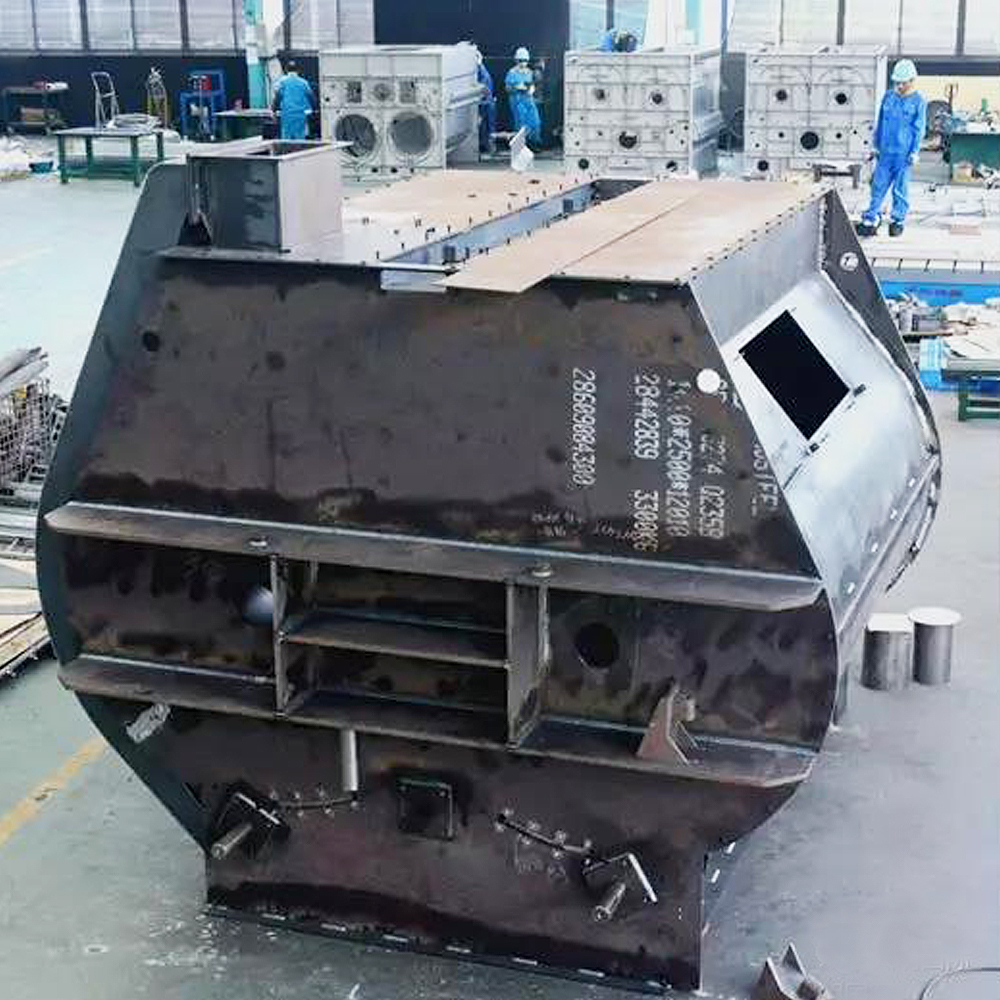
Heavy-duty equipment enclosures reference class: 2–8 t, 7–12 m length range, carbon steel Q355 or stainless steel 316, plate thickness 1.5–25 mm, with secondary machining after welding.
A practical shortlist template for heavy industrial fabrication
The template below is designed to be completed per candidate source, using the same rows for every candidate so that comparison stays factual. Entries should name a specific legal entity once verified; generic phrases such as “leading fabricator” do not qualify as a shortlist entry, and unverified claims should not be carried into the comparison at all.
| Check item | Evidence to request | Why it changes the decision |
|---|---|---|
| Legal entity and role | Company registration, factory address, confirmation of whether the unit is owned or subcontracted | Manufacturers and suppliers both sell “fabrication”; only one carries the schedule and quality risk directly |
| Premises evidence | Workshop photographs, video of the specific process, storage and loading area | Confirms the quoted process physically exists on site |
| Certificate and standard scope | Certificate copies with scope statements; welding qualification records where applicable (ASME BPVC Section IX covers welding and brazing qualifications) | A certificate outside the project standard does not qualify the work |
| Material range and traceability | Material test certificates, heat numbers, approved material list | Shows whether stainless, high-strength or clad material is routine or a first attempt |
| Fabrication route | Process sequence: cutting, forming, welding, post-weld machining, surface treatment | Locates distortion risk and defines where inspection must happen |
| Machining and handling envelope | Maximum machine travel, crane tonnage, forming length and force | Confirms the part fits the machine, not just the supplier's service list |
| Dimensional acceptance | Agreed flatness, straightness, hole position and datum scheme per critical interface | Without written numbers, final inspection becomes a negotiation |
| Inspection and testing | NDT coverage, leak or pressure testing, final inspection report format, visual inspection provision for small parts | Determines the evidence package delivered with the goods |
| Commercial terms | Minimum order value, lead time basis, Incoterms, payment milestones, change control procedure | Protects the schedule when drawings are revised after release |
| Packing and logistics | Port of loading, packing method for large weldments, transport frames and lifting points | Large items most often fail commercially in handling rather than in welding |
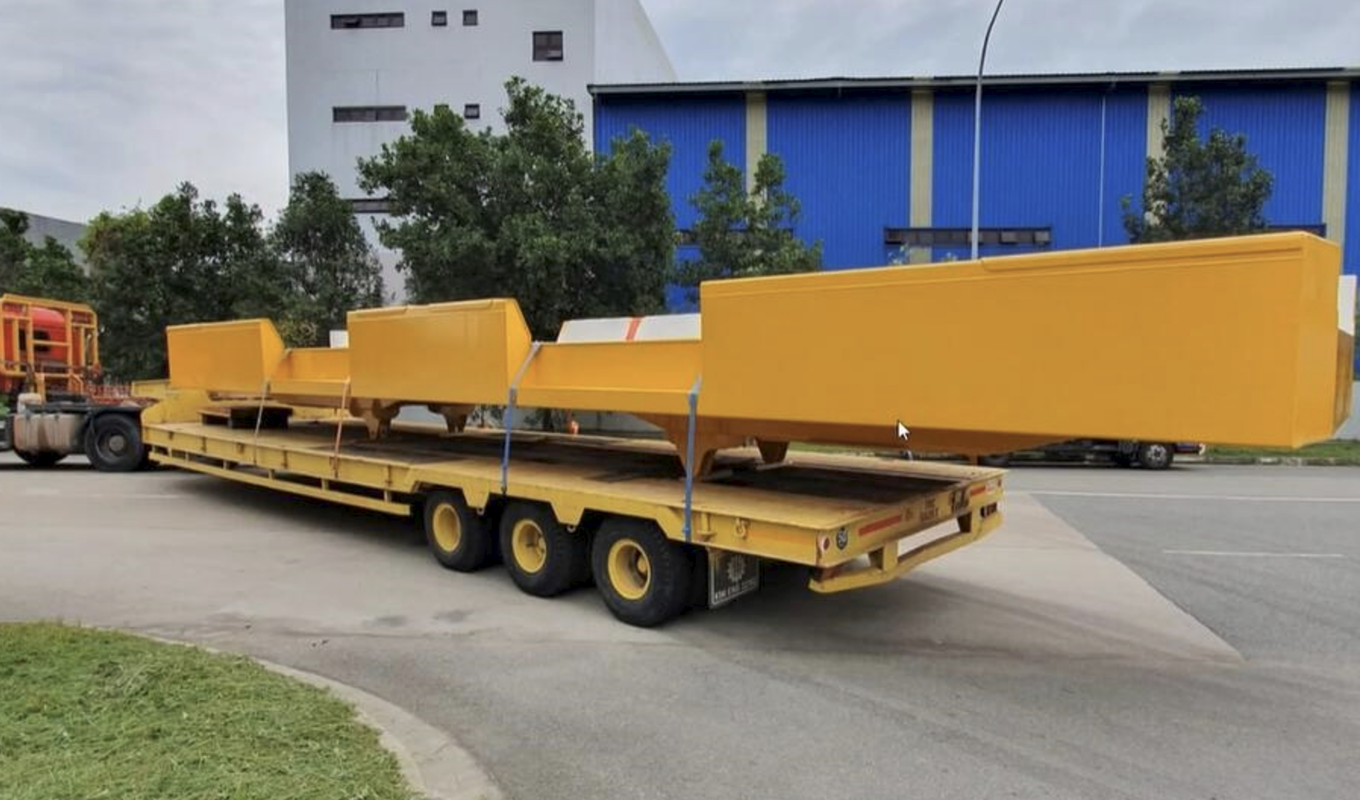
AGV chassis and undercarriage fabrication: high-strength steel plate with abrasion-resistant plate at the wear interfaces, fabricated and machined as a single welded assembly.
Future outlook
Three shifts are likely to change how these shortlists are written.
First, evidence will become the qualification currency. As buyers source large weldments remotely, the deciding artefacts will be process video, material test certificates, and inspection reports rather than brochure claims. Suppliers that already document premises, capacity and testing will have an advantage that has little to do with price.
Second, the boundary between structure and equipment will keep blurring. AGV chassis, energy storage frames and process enclosures are no longer ancillary steelwork; they are functional assemblies whose flatness and coating specifications affect machine performance. Procurement criteria will migrate from “can you weld it” toward “can you hold this datum and prove it”.
Third, on-site inspection capacity will matter as much as fabrication capacity. The use of visual inspection machines for 100% checking of small high-volume parts points to a wider pattern: quality evidence is being automated, and buyers will increasingly expect it as a standard deliverable rather than a special request.
FAQ
What is the difference between a metal fabrication manufacturer and a metal supplier?
A manufacturer owns the premises, forming and welding equipment, welding qualification records and inspection function used to make the part. A supplier arranges those processes through a third party. The distinction affects who carries schedule and quality risk. It can be checked by requesting the factory address, workshop photographs, process video, and certificate scope statements, rather than by comparing service lists.
How can a buyer verify a fabricator's capability without visiting the factory?
Four evidence types cover most of the assessment: photographs of the actual manufacturing premises; video of the specific process being quoted, such as welding or post-weld machining; certificates with their scope statements attached; and material test certificates linking delivered material to a heat number. Capacity figures also help, because they show whether the part can be physically handled — for example, an overhead crane above 250 t, a press brake with over 18 m forming length, and CNC machine travel up to 50 m × 8 m × 7 m.
Which materials are used for AGV chassis, heavy equipment skids, and equipment enclosures?
The published references differ by function. AGV chassis: high-strength steel plate S355JR (or A572 Grade 50 per ASTM) at 25 mm combined with abrasion-resistant NM400 plate at 20 mm. Heavy equipment skids: ASTM A36, ASTM A572 Grade 50, or SS304 for corrosive service. Heavy-duty equipment enclosures: carbon steel Q355 and stainless steel 316, with plate thickness from 1.5 mm to 25 mm. Mirror-finish process enclosures use stainless steel 304/304L sheet with SS304 structural stiffeners. Energy storage frames and boxes use steel tube, steel sheet and carbon steel with powder coating.
What tolerances and flatness values should be specified for large weldments?
Values should be attached to specific critical interfaces rather than applied to the whole part. Published reference configurations include mounting-pad flatness of ≤0.20 mm per 1,000 mm on a heavy equipment skid, general machined tolerance of ±0.20 mm with datum-pad flatness of ≤0.15 mm per 1,000 mm on a large industrial weldment, guide straightness of ≤0.10 mm per 1,000 mm on a welded crossbeam, and overall straightness of ≤3.0 mm per 10,000 mm on an 8,000 mm formed steel box section. Post-weld machining is normally what makes these values achievable.
What should purchasing terms and acceptance criteria cover in a large fabrication order?
Acceptance criteria should define the datum scheme, flatness and straightness limits, hole position tolerance, and the inspection evidence required — dimensional inspection, NDT coverage, welding inspection, and pressure or leak testing where relevant. Commercial terms should specify minimum order value, the basis of quoted lead time, Incoterms, payment milestones, and a change control procedure for drawing revisions. Packing method, lifting points and transport frames should also be agreed, because handling is a common failure point on large weldments.
Can one fabricator supply AGV chassis, skids, enclosures and energy storage frames in the same project?
Yes, when the fabricator operates a broad process base and a machining envelope large enough for the biggest item. Openex, for example, covers laser cutting, bending, punching and stamping, welding, machining, assembling, roll forming, casting, forging, galvanizing and powder coating, with an overhead crane over 250 t, a press brake up to 10,000 t and over 18 m forming length, and CNC travel up to 50 m × 8 m × 7 m. Consolidation reduces interface risk but also concentrates schedule dependence on one source, and scope boundaries — such as fabrication-only supply where the customer performs final assembly — still need to be stated explicitly in the order.
Closing note
A shortlist is only as good as the evidence behind each entry. For projects involving AGV chassis, heavy equipment skids, equipment enclosures, or energy storage frames and boxes, the useful next step is to fix the datum scheme and acceptance criteria first, then compare candidates against the same ten rows. Openex maintains a downloadable manufacturing brochure with its process range and reference capabilities at Openex mechanical fabrication brochure (PDF). Company information is also available at www.cncmetalworking.com.