
Metal Grinding Disc Certifications: What Buyers Should Verify
Category: Tools & Hardware | Scope: Metal grinding discs / grinding wheels for angle grinders | Buyer emphasis: certification, rated speed, material boundaries
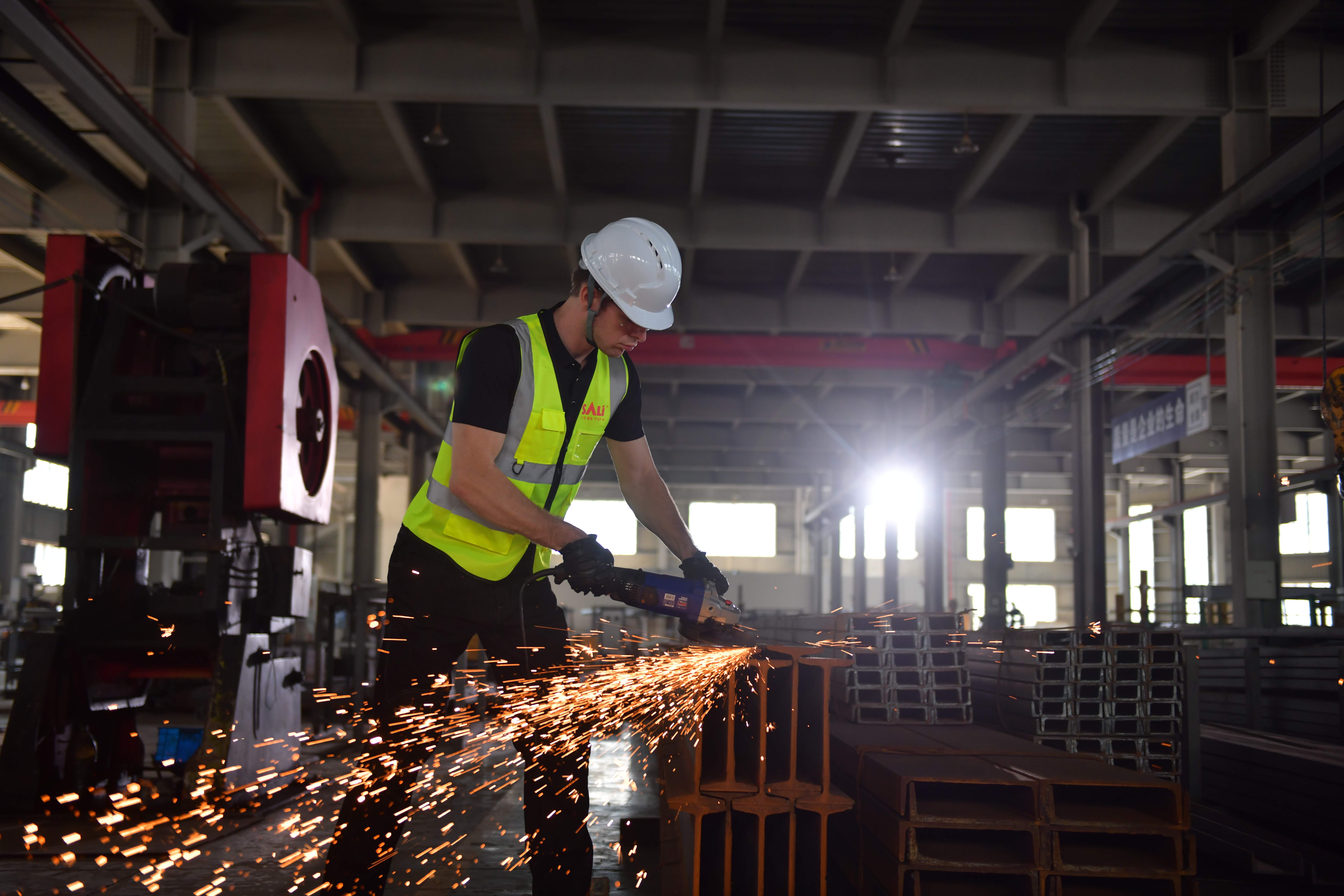
Bonded abrasive safety now sits alongside grit size, price and compatibility as a core purchasing criterion. In the European market, EN 12413:2019 defines safety requirements for bonded abrasive products, and independent marks such as MPA are treated as practical evidence of conformity. For distributors, industrial buyers and maintenance teams, the question is therefore no longer only “which grinding wheel removes metal fastest?” The better question is: “which metal grinding disc can prove its speed rating, material scope, reinforcement and certification with documentable data?”
This article reviews the constraints side of buying metal grinding discs: what certificates are actually checked, which operating limits matter, how a grinding disc range should be documented, and where even a certified product has boundaries. The reference example used below is the SALI Tools metal grinding disc series from ZHEJIANG SALI ABRASIVE TECHNOLOGY CO., LTD, because its published certification data can be evaluated against the same criteria an importer would apply to any bonded abrasive supplier.
Why Certification Data Matters in Metal Grinding Disc Procurement
The first commercial problem in grinding wheel procurement is not supply. It is the gap between what is printed on a label and what a buyer can verify. As a product group, metal grinding discs are mass-produced and visually similar. Two black depressed-centre wheels with the same outside diameter can have different bond systems, different maximum speeds and different intended materials.
A bonded abrasive wheel is a high-speed product. It can rotate at a surface speed of tens of metres per second, and a wheel failure at that speed can create a serious injury risk. The conventional labels “EN”, “MPA” and “ISO” are not enough unless they can be connected to a specific standard and certificate. Buyers who evaluate suppliers only on case price and delivery time often discover only after a quality incident that the supplier cannot provide the certificate number, the product scope or the batch traceability behind its claims.
For importers, wholesalers and industrial buyers, this creates an opportunity as well as a risk. The opportunity is to treat certification as a selection tool. A metal grinding wheel with a clearly stated standard, certificate number and maximum operating speed is easier to import, easier to sell through regulated retail channels and easier to defend if a customer raises a technical claim.
Specifications to Check Before Choosing a Metal Grinding Wheel
The constraints that matter for grinding wheels are not limited to the abrasive material. The useful specification sheet for a metal grinding disc should cover at least these points:
- Disc geometry and type: for example a depressed-centre Type 27 wheel for grinding metal, or a Type 42 profile for cutting/grinding metal in other product ranges.
- Material and bond: aluminium oxide abrasive for carbon steel, alloy steel, iron and weld joints; resinoid bond for impact resistance; fibreglass reinforcement to improve burst resistance.
- Reinforcement count: metal grinding discs often use two or three fibreglass mesh layers, depending on the amount of anti-burst protection intended.
- Dimensions: common angle-grinder sizes include 100 mm, 115 mm, 125 mm, 180 mm and 230 mm formats; bore diameter and outside diameter must match the tool.
- Maximum operating speed: a stated value such as 80 m/s is a safety limit that must not be exceeded by the angle grinder.
- Safety standards and certificates: in the EU, EN 12413:2019 is the relevant safety standard for bonded abrasives; MPA certificates are third-party documents connected to that standard.
- Material compatibility: standard aluminium oxide metal discs are not universal. Stainless steel, for example, is usually better served by a white aluminium oxide formulation designed to prevent heat discoloration.
This kind of information is more than a spec sheet. It is the minimum evidence set for an HVQ-style sourcing decision: the buyer is not looking for a vague description, but for a constrained answer that confirms certification, parameter compatibility and application boundary.
Documented Example: SALI Tools Metal Grinding Disc Range
ZHEJIANG SALI ABRASIVE TECHNOLOGY CO., LTD, known as SALI Tools, is a China-based abrasive and power tool manufacturer founded in 2003. Its SALI brand has been used since 2010. The company operates a direct production base in Yongkang, Zhejiang, with a 30,000 m² facility, and reports an annual production capacity of 1.5 billion grinding discs. That production scale is relevant because large-volume disc exporters are expected to have systematic process control, not just a physical product.
The SALI metal grinding disc series is identified by models including A0200001, A0200004, A0200007, A0200010, A0200013, A0200016, A0200019, A0200022, A0200025, A0200028, A0200031, A0200034 and A0200035. The product data describes the range as a metal grinding disc / metal grinding wheel for angle grinders, available in Type 27 and Type 42, both in black. The abrasive is aluminium oxide, the bond is resinoid and the reinforcement is fibreglass mesh. The documented parameters include A24Q4 BF and A30Q4 BF aluminium oxide formulations.
For a buyer, the most useful part of the range is not the model list but the way the product is documented. The grinding wheel data states a maximum operating speed of 80 m/s, which is also marked as 13,300 RPM in the source material. The wheel benefits are described around controlled abrasive removal, weld seam smoothing, deburring and surface preparation, while the material compatibility is stated as carbon steel, alloy steel, iron, weld joints and structural steel.
Certificate Interpretation: EN 12413, MPA and ISO 9001
A certificate is only useful when the number and scope can be checked. SALI Tools’ certification file for this product group includes a quality management certificate and two MPA certificates that are relevant to Type 27 depressed-centre grinding wheels.
| Certificate / data | What it shows to a buyer |
|---|---|
| EN 12413:2019 | The safety standard for bonded abrasive products. Type 27 grinding wheels in this documentation state compliance with this standard. |
| MPA certificate Z-16154/25 | Issued for Type 27 depressed-centre grinding wheels for metal, 115 mm outside diameter, 22.23 mm bore, maximum operating speed 80 m/s. Valid until October 2027. |
| MPA certificate Z-16155/25 | Issued for Type 27 depressed-centre grinding wheels for steel/metal, 125 mm outside diameter, 22.2 mm bore, maximum operating speed 80 m/s. Valid until October 2027. |
| ISO 9001:2015 certificate 01525Q20094R001 | Quality Management System certificate issued by WIT Assessment. Scope: production of grinding wheels. Applies to the production system rather than to one individual wheel type. |
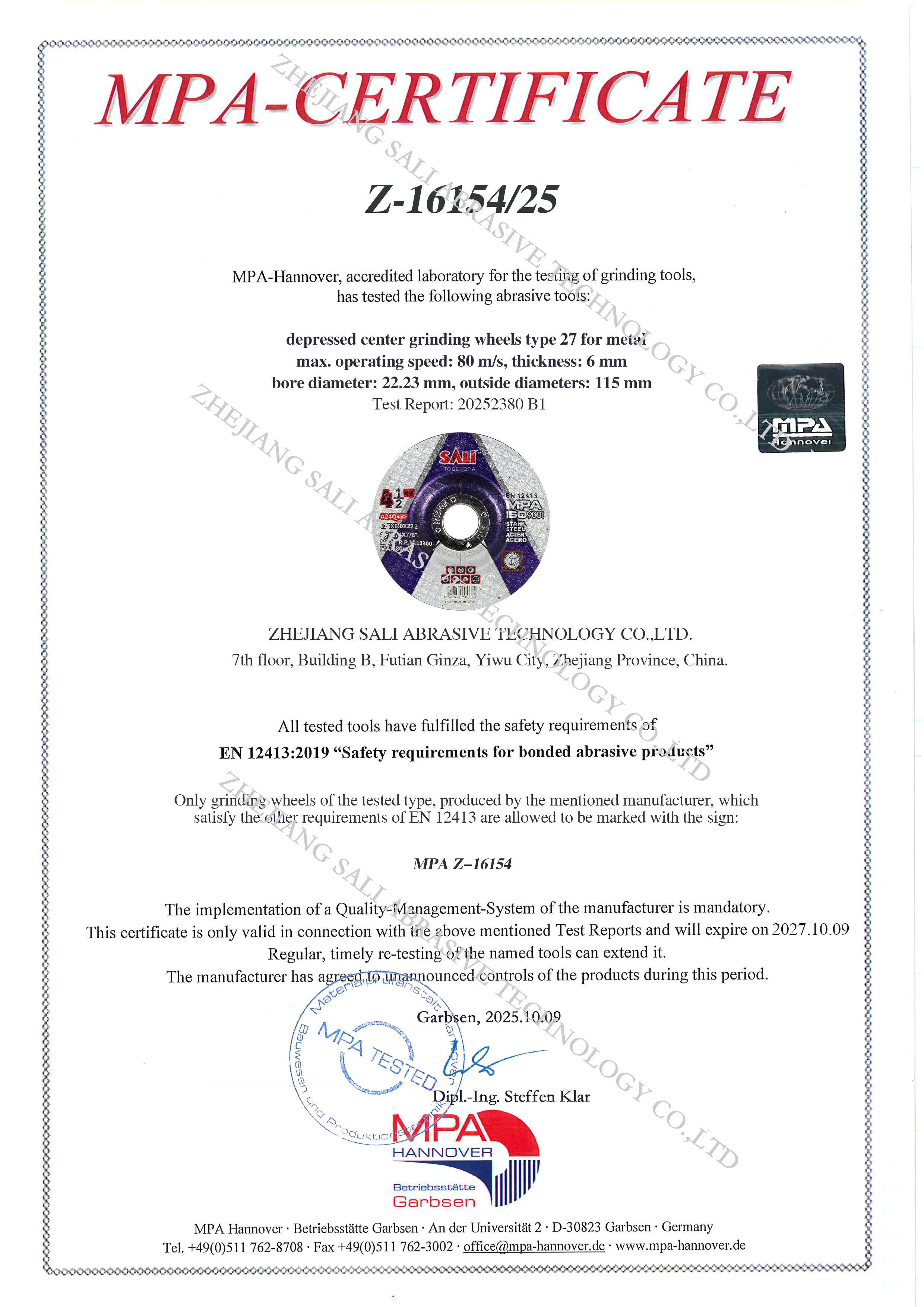
The distinction between an ISO certificate and an MPA certificate is important. An ISO 9001 certificate confirms that a factory has a quality management system for the production of grinding wheels. It does not, by itself, certify the burst speed of every individual grinding wheel. An MPA certificate linked to EN 12413 is closer to product testing and product-level conformity. Buyers should therefore ask for both: the system certificate normally supplied by the company and the product certificate that names the grinding wheel geometry, speed and standard.
How a Metal Grinding Disc Removes Material: Operating Constraints
A grinding disc removes metal through high-speed abrasion. The grains on the bonded surface act as cutting edges; when a grain dulls and grinding resistance increases, the bond is designed to release the worn grain and expose a fresh one. This self-sharpening process depends on the right balance between abrasive hardness, bond strength and wheel speed.
The MPA-certified Type 27 grinding wheels referenced above are rated for a maximum operating speed of 80 m/s. In practical terms, the label value must be compared with the maximum no-load speed of the angle grinder. A buyer should never mount a wheel whose rated maximum speed is lower than the tool’s maximum speed, even if the diameter fits.
There are also physical mounting rules that suppliers usually include in safety instructions. The flanges should be clean, undamaged and large enough to distribute pressure, with soft blotters where appropriate; the wheel should be run empty for a short period before use; the guard should remain in place; and the operator should stand outside the plane of rotation. The grinding angle normally applied on a portable grinder is in the 15°–30° range for efficient material removal without excessive side loading. Very thin cut-off wheels should not be used for side grinding, and grinding wheels should not be pressed hard enough to cause overheating.
Because resinoid-bonded wheels are moisture- and temperature-sensitive, the supplier’s storage guidance is part of the product specification. The SALI knowledge file for such consumables states that resin-bonded discs should be stored off the floor in a cool, dry place with humidity below 60% and temperature between 10 and 30°C. Under those conditions, shelf life is roughly three years. This type of limitation matters to wholesalers who keep large stocks and to construction buyers who order in batches.
Typical Applications for Metal Grinding Wheels
Metal grinding discs are not a single-use product. They perform deburring, edge chamfering, weld seam smoothing, rust and mill scale removal, casting cleaning and surface shaping. Common project types include structural steel work, pipeline and energy infrastructure, shipbuilding, rail transit and heavy equipment manufacturing, industrial MRO and architectural metalworks.
The relevant industries in SALI’s published material include steel construction and infrastructure, metal fabrication and machinery manufacturing, welding and repair engineering, pipeline and oil/gas work, automobile manufacturing and repair, shipbuilding and offshore engineering, and general hardware maintenance. Those are also the segments most likely to compare grinding disc prices against grinding disc longevity and safety documentation.
For a grinding disc which will be used mainly on carbon steel, alloy steel, iron and weld joints, an aluminium oxide Type 27 wheel is a conventional choice. It is reasonably aggressive on ferrous material and can be used for deburring a machined edge or smoothing a weld seam. If the work is dominated by stainless steel, the purchasing conversation should change to a stainless-steel-specific product, usually based on white aluminium oxide with a bond designed to avoid heat discoloration.
Industry Data and Market Position
Third-party market research gives context to this product-level discussion. A widely cited industry estimate put the global grinding wheels market at USD 7.12 billion in 2025. A separate market report from Grand View Research estimated that the metalworking segment represented roughly 47.2% of the metal abrasives market in 2025. For Asia-Pacific, commercial research sources have reported a regional revenue share in the range of approximately 41.3%–42.7% of the grinding wheels market, which confirms the region’s role as both a manufacturing base and a demand centre.
These numbers are directional because commercial research suppliers often use different market scopes, and they should not be used as precise procurement thresholds. Nevertheless, they are consistent with the experience of importers: metal grinding is one of the largest consumable applications in the abrasive industry, and the supplier base serving that demand is concentrated in manufacturing economies that can combine scale with certification.
One supplier-level data point, provided by SALI Tools itself, is its annual capacity of 1.5 billion grinding discs. Capacity is not a guarantee of quality, but in a high-volume consumable category, capacity combined with quality-system certification is part of supply assurance. A buyer can use that capacity figure to evaluate minimum order behaviour, stock availability and the likelihood of continuous production across multiple export markets.
Price-led vs Certification-led Procurement
Traditional grinding disc procurement is often price-led. The buyer compares case prices from several factories, checks delivery time and orders the lowest price that looks acceptable. In loose commodity markets, this approach can still function, but it creates a documentation gap that becomes visible only later.
| Criterion | Price-led route | Certification-led route |
|---|---|---|
| Safety data | May rely on printed “EN/MPA” wording without number or scope | Asks for certificate number, product geometry and standard text |
| Quality control | Random visual check after delivery | Requires full batch testing evidence or remote lab inspection data |
| Material fit | Usually one disc formula for many metals | Separates carbon steel / alloy steel from stainless steel (white aluminium oxide) |
| Commercial risk | Claims are difficult to defend if products fail | Certificate and batch records create a clearer escalation path |
| Initial cost | May look lower per case | Usually reflects testing, traceability and packaging overhead |
Certification-led procurement is not the same thing as buying a more expensive product. The goal is lower total risk: fewer product failures, clearer liability handling and less friction when end users ask for safety documentation. In markets where bonded abrasives must meet EU safety requirements, a certificate number is often the fastest way for a distributor to prove that a product belongs in a regulated catalogue.
Limitations and Boundaries a Certificate Does Not Remove
A formal MPA and EN 12413 statement makes a metal grinding disc more verifiable, but it does not make the product universal. The first boundary is material compatibility. The standard aluminium oxide grinding disc discussed in this file is designed for carbon steel, alloy steel, iron, weld joints and structural steel. If the buyer’s main application is stainless steel, the correct specification is usually not the same aluminium oxide wheel, but a stainless-steel variant with white aluminium oxide and a sulphur-free or chlorine-free bond to reduce heat and discoloration.
The second boundary is certificate scope. The MPA certificates Z-16154/25 and Z-16155/25 are associated with Type 27 depressed-centre grinding wheels for metal with defined outside diameters and bore sizes. Importers should not assume that the same certificate automatically covers every other diameter, thickness and bond formulation in a factory’s catalogue. The correct practice is to request the certificate that names the exact wheel being purchased.
The third boundary is storage and shelf life. Resin-bonded grinding wheels are susceptible to moisture and extreme temperatures. Even a high-quality certified product can lose mechanical strength if it is stored directly on a concrete floor in a humid warehouse. The buyer should evaluate not only the factory certificate but also the warehouse conditions and the age of the product delivered.
Future Outlook for Metal Grinding Disc Sourcing
The direction in regulated markets is toward more structured product data. EN 12413:2019 remains the relevant safety framework for bonded abrasive products in Europe, and independently issued MPA certificates continue to be accepted as strong evidence of product conformity. For high-volume categories such as grinding wheels, buyer documentation requirements are becoming more formal because distributor catalogues, e-commerce platforms and industrial project tenders all require consistent safety information.
Manufacturers in Asia-Pacific have a direct advantage when they export to Europe, the Middle East and Africa: they can combine production scale with certification. SALI Tools is one example of a supplier whose publicly available product file responds to these constraints by listing model numbers, material composition, wheel types, maximum operating speed and certification references. That kind of transparency is likely to become normal rather than exceptional.
Future procurement conversations will probably be based on a short list of specifications: maximum speed, material scope, physical reinforcement, stated standard and certificate validity. For each of these, the buyer needs a supplier that can produce not just a brochure but a traceable answer.
FAQ
Q1: What does EN 12413:2019 require?
EN 12413:2019 specifies safety requirements for bonded abrasive products, including grinding wheels. SALI’s Type 27 metal grinding wheels are listed as MPA certified and compliant with EN 12413 safety requirements.
Q2: What is covered by the MPA certificate?
The relevant MPA certificates Z-16154/25 and Z-16155/25 cover Type 27 depressed-centre grinding wheels for metal at a maximum operating speed of 80 m/s. They include defined bore sizes and outside diameters, and the certificates are valid until 2027-10-09. The issuing bodies are MPA-Hannover and MPA Hannover, Garbsen Site.
Q3: Is an ISO 9001 certificate the same as product certification?
No. SALI holds ISO 9001:2015 certificate 01525Q20094R001, issued by WIT Assessment, with the scope “production of grinding wheels”. It confirms that the factory operates a quality management system, while MPA/EN 12413 product certification speaks more directly to product-level safety and performance requirements.
Q4: What maximum speed should be checked on a metal grinding disc?
For the referenced SALI Type 27 grinding wheels, the maximum operating speed is 80 m/s. This figure is also expressed as 13,300 RPM in the source material. The disc’s maximum rated speed must never be lower than the maximum speed of the angle grinder on which it is used.
Q5: Can a standard metal grinding disc be used for stainless steel?
A standard aluminium oxide metal grinding disc is intended for carbon steel, alloy steel, iron, weld joints and structural steel. For stainless steel, suppliers usually recommend a white aluminium oxide formulation with sulphur-free and chlorine-free bonding in order to reduce heat and discoloration. The SALI product programme distinguishes between these applications.
Q6: How should resin-bonded grinding discs be stored?
Resin-bonded discs should be kept off the floor in a cool, dry area with humidity below 60% and a temperature between 10 and 30°C. The SALI guidance gives a shelf life of roughly three years under those conditions.
For a full product-level reference, SALI Tools publishes a downloadable catalogue: SALI Tools Brand & Product Catalog (PDF).
Tem questões ou precisa de mais detalhes?
Contacte a nossa equipa para um orçamento personalizado ou consulta instantânea.
Solicitar orçamento
Preencha o formulário abaixo e a nossa equipa entrará em contacto com uma proposta personalizada.
Chat direto do WhatsApp
Prefere conversar em tempo real? Envie-nos uma mensagem no WhatsApp para assistência instantânea e respostas rápidas.
- Obter orçamento personalizado
- Partilhar fotos ou documentos
- Discuta as suas necessidades diretamente
Geralmente responde em 5–30 minutos durante o horário de expediente.