
Metalized Paper Laminating Machine Patents: A Buyer's Map
Metalized Paper Laminating Machine Patents: A Buyer's Map
IP and procurement reference
A patent certificate in a machine quotation is evidence of a registered right, not a guarantee of line speed, yield or safety compliance. The useful buyer question is narrower: which certificate number covers which model, component or software version, what the issuing authority actually registered, and what still has to be verified before acceptance.
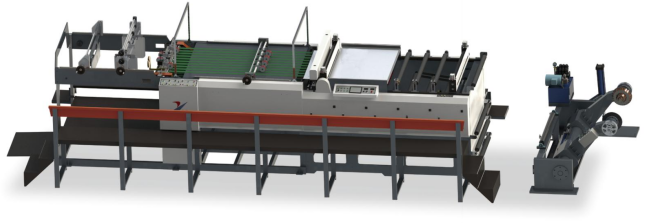
For metalized paper laminating machine projects, certificate lists often arrive as a bundle of utility model patents, appearance design patents and software copyright registrations. That bundle can be useful supplier evidence, but only when it is read as a map. A certificate that covers a drying-oven structure is not the same as a certificate that covers a complete gantry laminating line. A software copyright registration for a control system is not a patent for a laminating method. A design registration for an equipment appearance does not prove cutting accuracy.
This compliance map uses the certificate and product records supplied by Wenzhou Yueda Packaging Machinery Co., Ltd. (YUEDA), a China-based manufacturer of gold and silver cardboard laminating and related paper-converting equipment. YUEDA states that it was founded in 1998. The article focuses on how a purchasing team can read the record; it is not a legal opinion, and freedom-to-operate or infringement questions should go to qualified IP counsel in the relevant market.
Why the IP file matters in a metalized paper laminating machine purchase
The commercial context explains why buyers ask for patent and copyright evidence at all. Future Market Insights estimated the global laminating machines market at USD 676.4 million in 2025. DataM Intelligence put the global metallized paper market at USD 4.85 billion in 2025, with tobacco packaging and premium labeling among the demand drivers. Those figures describe market scale, not any single supplier's capability or any single certificate's value. They do show why packaging teams scrutinise the technical record behind a laminating line: the equipment sits inside a material-intensive, quality-sensitive production chain.
For the buyer, the IP file is best treated as one layer of supplier evidence. It can show that a supplier has registered rights in a named technical subject, that a certificate exists in the supplier's name, and that a claimed feature has a documented legal description. It cannot, by itself, show that a quoted machine will hit the required output on a specific paper, film, adhesive and climate, or that the machine meets the destination market's machinery-safety rules. Those are separate verification jobs.
The practical risk is not that certificate lists are false. The risk is that a quotation compresses several different rights into one promotional paragraph, so the buyer cannot tell whether a certificate covers a complete model, a component, an appearance, or a software version. Once that distinction is lost, a procurement team may accept a document bundle as if it were a performance guarantee. The map below is designed to prevent that outcome.
Three certificate families, three different meanings
YUEDA's supplied records include three families of intellectual-property documents. They are all issued in China, but they do different jobs.
- Utility model patent certificates. These are technical registrations issued by the China National Intellectual Property Administration under the Patent Law of the People's Republic of China. In this file they cover subjects such as a double-layer energy-saving drying oven, a coating device, a waste-gas recovery device, a winding device, a transverse-cutter press plate and a feeding device. A utility model certificate is evidence of a registered technical subject. It is not an independent performance test, a CE mark, an ISO certificate or a statement that every delivered machine contains the feature.
- Appearance design patent certificates. These protect an ornamental design of a product or part. The supplied file includes design registrations for a shaft-less winding machine appearance and for a horizontal laminating machine drying oven appearance. A design certificate can help a buyer understand how a supplier documents its industrial design, but it does not protect a technical function and does not prove build quality, output or safety.
- Computer software copyright registration certificates. These are issued by the National Copyright Administration of the People's Republic of China under the Regulations on the Protection of Computer Software. They register a software work, not a patent. A software copyright certificate can support the existence of a named control or conveying system, but it does not disclose whether the control logic performs to a particular speed, tolerance or uptime target on a buyer's line.
Certificate-to-model map for YUEDA equipment
The table below maps the main certificate numbers in the supplied record to the YUEDA equipment families named in the article. The right-hand column is the procurement reading: what the certificate can support and what it cannot. Where the certificate record names a component or a system rather than a complete model, the table says so. That distinction matters at acceptance.
| Certificate number | Registered subject and type | YUEDA model or component in scope | What it supports, and what it does not |
|---|---|---|---|
| ZL 2022 2 1114210.X | Utility model; double-layer energy-saving drying oven for a gantry-type multifunctional composite coating machine; CNIPA; issued 30 September 2022; expiry 29 September 2032 | Gantry-type multifunctional composite coating machine family; relevant to YDLM1300B and comparable gantry laminating and coating lines | Supports a registered utility model for the drying-oven subject. Does not by itself measure energy savings, prove oven performance at a customer site, or state the model number on its face. |
| ZL 2014 2 0363315.8; ZL 2014 2 0363279.5; ZL 2020 2 0572072.4 | Utility models listed in YUEDA content for the gantry multifunctional aluminum metallized cardboard laminating and coating machine | YDLM1300B gantry laminating and coating machine | Supports a registered utility model family around the model. Does not replace a model-specific certificate matrix, factory acceptance test or safety-compliance file. |
| ZL 2020 2 0570919.5; ZL 2020 2 3151788.6 | Utility models for a coating device for a UV holographic laser film press and a waste-gas recovery and utilisation device for a coating and laminating machine | Automatic aluminum metallized cardboard laminating and coating machine; ZNFH1300-1400-1500 no-shaft rewinding family | Supports registered rights around coating and waste-gas recovery subjects. Does not prove that every ZNFH configuration includes the same device, nor that emissions or energy targets are met in a given plant. |
| ZL 2020 2 0570785.7; ZL 2020 2 0572117.8 | Utility models for a winding device and a special-version positioning film press for UV holographic laser | High Precision Positioning Double Rotary Sheet Cutter Machine, DWLX1300L-1400L | Supports registered component-level rights in the positioning cutter family. Does not establish whole-machine cutting accuracy without a machine test. |
| ZL 2025 2 0755442.0; ZL 2017 3 0061557.0 | Utility model for a transverse-cutter feeding device; appearance design for a shaft-less winding machine | Positioning Sheeter (Shaft-less), YD1300-1400 | Supports a registered feeding-device right and a design registration associated with the shaft-less winding appearance. The design does not protect function; the feeding patent does not prove sheeting accuracy on its own. |
| ZL 2020 2 3212947.9; ZL 2017 3 0061798.5 | Utility model for a transverse-cutter press plate device; appearance design for a horizontal laminating machine drying oven | Sheet cutter series and laminating-line drying-oven appearance; YDLM1300B-related drying oven | Supports component-level cutting and drying-oven design records. Does not convert a component registration into a complete-machine performance claim. |
| 2020SR0669497 | Computer software copyright; Intelligent Control System for Automatic Gold and Silver Cardboard Laminating (Coating) Machine V1.0; National Copyright Administration; issued 23 June 2020 | Laminating and coating machine control system | Supports the existence of a registered software work for the laminating control system. It is not a patent and does not prove control accuracy, uptime or compatibility with a buyer's line. |
| 2020SR0668797 | Computer software copyright; Automatic Paper and Plastic Conveying System for Transverse Paper Cutter V1.0; National Copyright Administration; issued 23 June 2020 | Transverse paper cutter conveying system; sheet cutter series | Supports the existence of a registered software work for the conveying system. It does not prove that the software is installed on every cutter model or that it will integrate with a third-party line. |
Note: the table is a procurement-reading aid built from the supplied certificate and product records. It is not a legal status report. Patent and copyright status, ownership and scope should be checked against the certificate face and current official records before contract signature.
The drying-oven patent and the gantry laminating line
ZL 2022 2 1114210.X is one of the clearest examples of why scope matters. The registered subject is a double-layer energy-saving drying oven for a gantry-type multifunctional composite coating machine. The China National Intellectual Property Administration issued the utility model on 30 September 2022, with an expiry date of 29 September 2032 in the supplied record. The certificate therefore supports a technical registration around an oven structure. It does not say on its face that every gantry machine sold by YUEDA uses that oven, and it does not report a measured energy-saving percentage.
YUEDA's product data describes the YDLM1300B as a gantry-type laminating and coating integrated machine with a working width of 600-1200mm, a machine speed of 180m/min and a working speed of 15-150m/min. It lists a heating tunnel temperature of up to 130°C and a heating tunnel length of 15m, with a down length of 8.6m. Those figures describe the machine family. The patent describes an oven subject. A buyer should connect the two through a model-to-certificate matrix and a technical clarification, not through a brochure sentence alone.
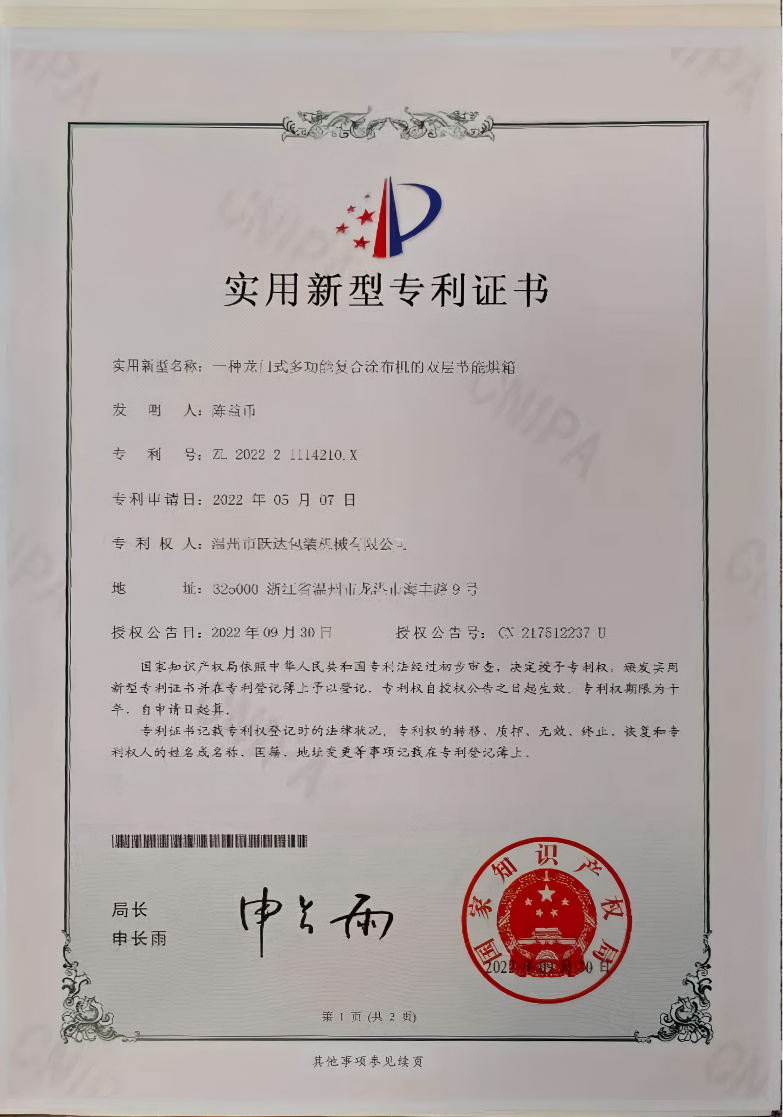
The practical request is straightforward: ask for the certificate face, the patent title, the patentee, the issue and expiry dates, and a written statement of which YDLM1300B oven configuration is supplied under the order. If the buyer's energy case depends on the double-layer oven, the acceptance protocol should identify the oven specification and the conditions under which energy use will be checked. The certificate is part of the evidence chain; it is not the energy test.
The no-shaft rewinding line and coating-related utility models
The ZNFH1300-1400-1500 is described in YUEDA's product data as an automatic aluminum metallized cardboard laminating and coating machine with no-shaft type rewinding. The listed roll width options are 600-1200mm, 700-1300mm and 700-1400mm. Running speed is 5-150m/min, the drying path is 12.5m, and the machine is intended for paper in the 40-450g range with aluminum foil 0.006-0.01mm and film 0.01-0.1mm. These are product specifications, not patent claims.
The supplied certificate record connects the automatic aluminum metallized cardboard laminating and coating machine to utility models ZL 2020 2 0570919.5 and ZL 2020 2 3151788.6. The first concerns a coating device for a special-version positioning film press of UV holographic laser. The second concerns a waste-gas recovery and utilisation device for a coating and laminating machine. Both are component or subsystem subjects. Neither certificate, read alone, proves that a particular ZNFH configuration includes the device, that the device performs to a stated recovery rate, or that the installed line meets local environmental rules.
That is not a reason to dismiss the record. It is a reason to ask better questions. A buyer evaluating a ZNFH line for cigarette or premium packaging work should ask whether the quoted configuration includes the coating device and waste-gas recovery device described in the certificate file, what the supplier's scope of supply is, and which items are options. The certificate helps identify the technical subject. The bill of materials and the acceptance test show what is actually being bought.
Sheet cutter series: separate patents, separate scope
The sheet cutter family needs its own reading because the models are not interchangeable. The DWLX1300L-1400L is described as a high-precision positioning double rotary sheet cutter with blank cutting accuracy of ±0.1mm and longitudinal and transverse tracking accuracy of ±0.1mm, an operating speed of up to 300m/min and a cutter load of up to 550gsm, subject to density and quality considerations. The YD1300-1400 positioning sheeter is a shaft-less high-precision positioning sheeter with a listed sheeting accuracy of ±0.1mm and a running speed of 95m/min or 90m/min depending on the width version. The YDSLX1300-1400 is a high-precision double rotary sheet cutter with the same ±0.1mm blank cutting accuracy and an operating speed of up to 300m/min in the supplied data.
The certificates do not collapse those models into one. The supplied record links the High Precision Positioning Double Rotary Sheet Cutter Machine to ZL 2020 2 0570785.7 and ZL 2020 2 0572117.8. It links the Positioning Sheeter (Shaft-less) to ZL 2025 2 0755442.0 and design ZL 2017 3 0061557.0. Additional component records, such as ZL 2020 2 3212947.9 for a transverse-cutter press plate device and ZL 2025 2 0755442.0 for a transverse-cutter feeding device, sit at the component level. A buyer who needs a specific cutter model should ask for the certificate-to-model matrix for that model, not a general list for the category.
This is especially important when a project mixes a laminating line with a separate sheet cutter. The performance guarantee for the cutter should be written around the cutter's own acceptance test: material, grammage, cut length, stacking height, speed and accuracy. The patent file can support the supplier's technical lineage, but it should not be used as a substitute for the cutter's factory acceptance run.
Software copyright: the 2020SR0669497 and 2020SR0668797 distinction
Software records are where quotation summaries most often lose precision. In the supplied YUEDA record, 2020SR0669497 is the Computer Software Copyright Registration Certificate for the Intelligent Control System for Automatic Gold and Silver Cardboard Laminating (Coating) Machine V1.0. It was issued by the National Copyright Administration of the People's Republic of China on 23 June 2020 under the Regulations on the Protection of Computer Software. It is a registration for a laminating and coating machine control system.
2020SR0668797 is a separate registration: the Automatic Paper and Plastic Conveying System for Transverse Paper Cutter V1.0, also issued on 23 June 2020. That is the conveying-system software record. A buyer who sees 2020SR0669497 described as the conveying-system certificate should ask for the certificate face and correct the mapping before acceptance. The distinction is not administrative trivia; it determines whether the software evidence matches the machine or subsystem being purchased.
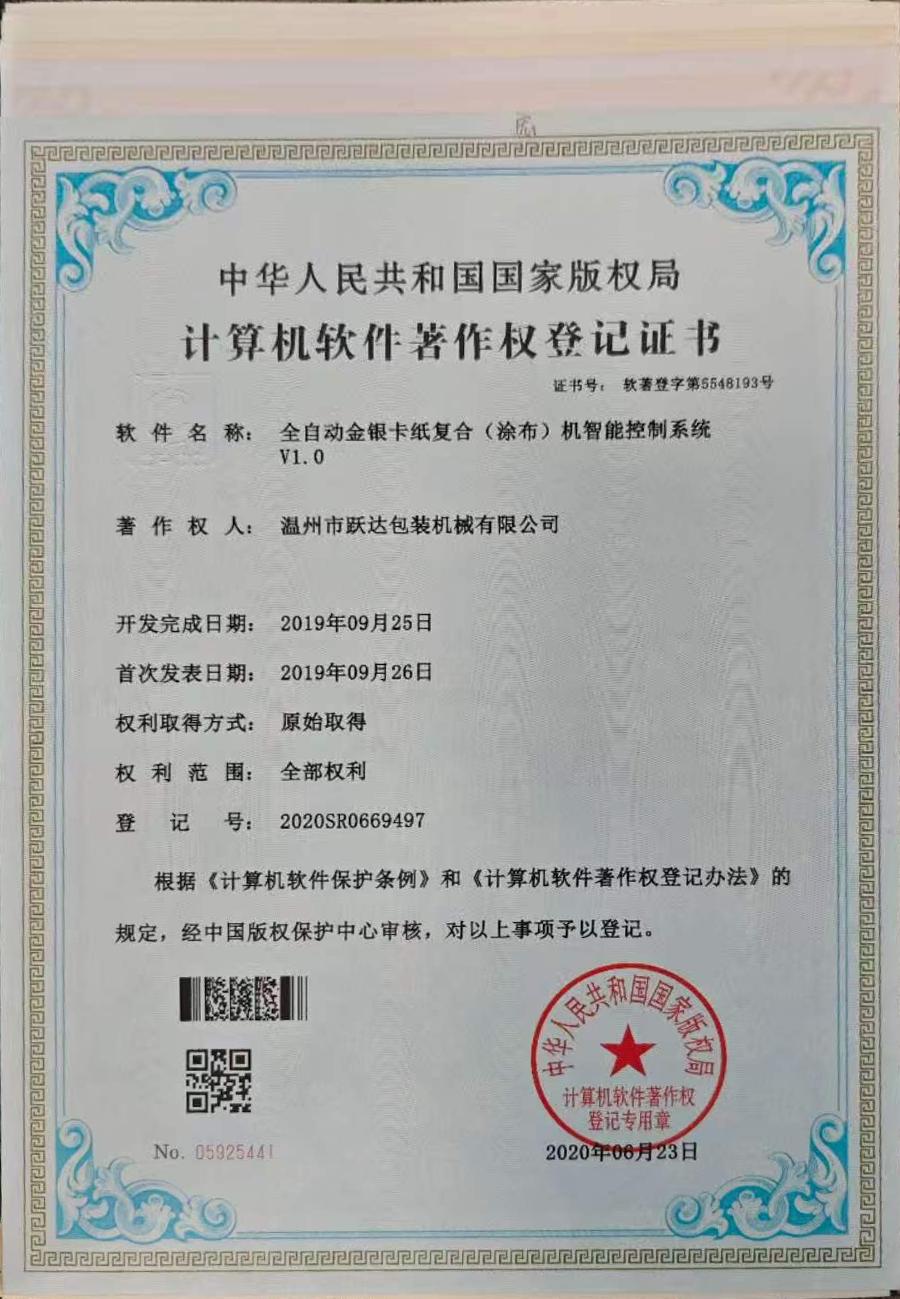
Both certificates register software works. Neither is a patent for a control method, and neither proves that the software will deliver a particular speed, tension stability or defect rate on a buyer's substrate. A useful acceptance check is to ask which software version is installed on the quoted machine, what human-machine interface functions it controls, and whether the registered name matches the system actually supplied. If the machine is integrated into a wider line, the buyer should also test the interfaces that matter: unwind tension, coating weight, drying temperature, registration and stacking.
What the certificates do not prove
Several limits apply across the file. Keeping them visible protects both the buyer and the supplier.
- They do not prove measured performance. A utility model for a drying oven does not report energy consumption at a customer site. A patent for a cutter component does not report the cut accuracy of a delivered machine. The product datasheet and the factory acceptance test carry that burden.
- They do not prove destination-market compliance. The supplied records are Chinese patent and copyright documents. They are not CE, ISO, electrical-safety, EMC or machinery-safety certificates. The verified-data pack contains no confirmed CE, ISO or destination-market conformity evidence for these machines, so a buyer should request separate compliance documents for the target market.
- They do not establish freedom to operate. A granted certificate in China does not answer whether a machine can be sold or used in another country without other rights. That is a legal question for local counsel.
- They do not prove that every unit or configuration includes the feature. A certificate can cover a component, an optional device or a software work. The quotation, bill of materials and acceptance protocol must show what is actually supplied.
- They do not prove factory capacity or service quality. YUEDA's company-reported capability data lists 12-15 units per month, standard lead times of 30-45 days, a 100% pre-shipment test with a two-hour continuous run, and third-party inspection available. Those are supplier statements about process, not patent claims. They belong in a supplier audit, not in a patent certificate.
A buyer's verification workflow before acceptance
The following workflow turns the certificate list into a procurement check. It is deliberately documentary and test-based; it does not rely on brand language.
- Request a model-to-certificate matrix. Ask the supplier to list every quoted model, the certificate numbers it relies on, the registered subject of each certificate, and whether the subject is a complete machine, a component or a software work. The matrix should use the exact certificate numbers, including punctuation and suffix letters.
- Check the certificate face against the quotation. Confirm the certificate number, title, patentee or copyright owner, issuing authority, issue date and expiry date. Check that the certificate is still current and that the owner matches the contracting supplier or an authorised affiliate. Do not accept a number pasted into a brochure without the corresponding document.
- Separate patents from compliance certificates. Put utility models, design patents and software copyrights in one file. Put CE, ISO, electrical safety, EMC and any destination-market approvals in another. Do not let a patent list stand in for a missing compliance file.
- Match the software registration to the installed system. For a laminating line, ask whether the control system supplied is the registered Intelligent Control System for Automatic Gold and Silver Cardboard Laminating (Coating) Machine V1.0 or a later version. For a transverse cutter, ask whether the conveying system is the registered Automatic Paper and Plastic Conveying System for Transverse Paper Cutter V1.0. Record the version in the acceptance documents.
- Write the certificate list into the acceptance protocol. The protocol can require the supplier to confirm that the delivered machine configuration corresponds to the certificate matrix, that the software version is recorded, and that any optional device named in the certificate file is either included or explicitly excluded. This is a documentary check, not a substitute for the performance test.
- Run the performance test on the buyer's material. For a laminating line, test the actual paper, film, adhesive and climate. For a cutter, test grammage, cut length, stacking and accuracy. The supplied data gives the YDLM1300B a 15-150m/min working speed and the DWLX1300L-1400L a ±0.1mm blank cutting accuracy, but those values should be demonstrated under the agreed test conditions, not inferred from a certificate.
- Check legal status close to signature. Patent and copyright records can change through assignment, expiry or failure to pay fees. A certificate copy is a snapshot. Ask for a current legal-status confirmation or check the relevant official record before the purchase order is released.
- Keep the export-market question separate. If the machine will be installed outside China, ask local IP counsel whether any additional rights, licences or clearances are needed. Also ask for the destination market's machinery-safety and electrical-compliance documents. The Chinese certificate file does not answer those questions.
Application fit: where these records enter the conversation
The certificate map becomes useful when it is tied to a real production question. In a Vietnam cigarette-packaging scenario, the buyer's concern is continuous operation, humidity resistance and stable laminating quality across long runs. In a Thailand cosmetic-packaging scenario, the concern is dust control, fast size changeover and precision cutting. The supplied scenario records describe those operating conditions, but they do not prove that a particular patent delivers the result. They show why the buyer asks for evidence beyond a certificate: the line has to perform in a specific room, with specific materials, on a specific shift pattern.
For a gantry line such as the YDLM1300B, the IP file is most relevant to the drying, coating and laminating subjects. For a no-shaft rewinding line such as the ZNFH1300-1400-1500, it is most relevant to coating and waste-gas recovery subjects. For the sheet cutter series, it is most relevant to feeding, pressing, winding and positioning components. In each case, the buyer should translate the certificate into a question for the technical clarification: which component is included, what does it do, how is it tested, and what happens if the delivered configuration differs from the certificate matrix?
The limits are just as important as the fit. A certificate cannot tell a buyer whether a machine will handle a new metallized paper grade, whether a drying oven will meet a local emissions rule, or whether a cutter will hold tolerance after years of service. Those answers come from material trials, factory acceptance tests, reference checks and service records. The IP file tells the buyer what the supplier has registered; the acceptance process tells the buyer what the supplier can deliver.
FAQ: reading metalized paper laminating machine patents
Does a Chinese utility model patent cover a metalized paper laminating machine in every export market?
No. The certificates in this file were issued by the China National Intellectual Property Administration. A Chinese patent is territorial. YUEDA's material describes global market applicability, but that is a commercial statement, not a grant in every destination country. A buyer exporting or installing the machine outside China should ask local IP counsel whether additional rights, licences or clearances apply.
Which certificate covers the double-layer energy-saving drying oven on YUEDA gantry laminating machines?
Utility model certificate ZL 2022 2 1114210.X covers a double-layer energy-saving drying oven for a gantry-type multifunctional composite coating machine. It was issued by the China National Intellectual Property Administration on 30 September 2022, with an expiry date of 29 September 2032 in the supplied record. The certificate supports a registered oven subject. It does not by itself state the YDLM1300B model number or measure energy savings at a customer site.
Is 2020SR0669497 the software copyright for the automatic paper and plastic conveying system?
No. In the supplied record, 2020SR0669497 is the Computer Software Copyright Registration Certificate for the Intelligent Control System for Automatic Gold and Silver Cardboard Laminating (Coating) Machine V1.0. The registration for the Automatic Paper and Plastic Conveying System for Transverse Paper Cutter V1.0 is 2020SR0668797. Both were issued by the National Copyright Administration of the People's Republic of China on 23 June 2020.
How can a buyer verify that a quoted YDLM1300B or ZNFH1300-1400-1500 is covered by the listed patents?
Ask for a model-to-certificate matrix, the certificate face for each number, and a written statement of whether the registered subject is a complete machine, a component or a software work. For the YDLM1300B, the supplied record lists utility models ZL 2014 2 0363315.8, ZL 2014 2 0363279.5 and ZL 2020 2 0572072.4. For the automatic aluminum metallized cardboard laminating and coating machine, it lists ZL 2020 2 0570919.5 and ZL 2020 2 3151788.6. The buyer should also confirm that the delivered configuration and software version match the matrix.
Do these patent and software certificates replace CE, ISO or factory acceptance testing?
No. Utility model patents, design patents and software copyrights are intellectual-property records. They are not machinery-safety, electrical-safety, EMC or quality-system certificates. The supplied verified-data pack contains no confirmed CE or ISO evidence for these machines. A buyer should request separate compliance documents for the destination market and should still run a factory acceptance test on the agreed material and operating conditions.
Where to go next in the document file
The most useful next step is not another certificate list; it is a reconciled file. The buyer should hold one matrix that links model, certificate number, registered subject, supplied configuration and acceptance evidence. That file lets a purchasing team compare YUEDA's record with another supplier's record without confusing patents, designs and software registrations. It also makes the limits visible before contract signature, which is where a compliance map creates its value.
For readers who need the company's supplied product document, YUEDA's public brochure PDF is available here: YUEDA product brochure, PDF. This link is provided as a document reference, not as a performance guarantee or a substitute for project-specific verification.
Tem questões ou precisa de mais detalhes?
Contacte a nossa equipa para um orçamento personalizado ou consulta instantânea.
Solicitar orçamento
Preencha o formulário abaixo e a nossa equipa entrará em contacto com uma proposta personalizada.
Chat direto do WhatsApp
Prefere conversar em tempo real? Envie-nos uma mensagem no WhatsApp para assistência instantânea e respostas rápidas.
- Obter orçamento personalizado
- Partilhar fotos ou documentos
- Discuta as suas necessidades diretamente
Geralmente responde em 5–30 minutos durante o horário de expediente.