
Metalized Paper Laminating Machines: Independent Buyer’s Efficiency Comparison
Purchasing decisions for metalized paper laminating machines are too often framed by brand messages. When the same type of equipment can handle aluminium foil, PET film and paperboard, the more reliable route is to compare published operating parameters: running speed, usable working width, substrate range and the engineering around those figures. Below is an independent, specification-first comparison built for buyers who are already moving from shortlisting to factory-scale evaluation.
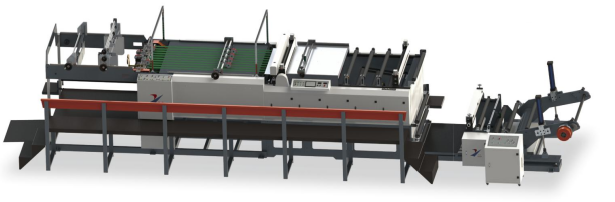
Wenzhou Yueda Packaging Machinery Co., Ltd. (YUEDA) is one Chinese manufacturer supplying this category. Founded in 1998 and based in Longgang, Wenzhou – the “China Printing City” industrial cluster – the company makes gold-and-silver cardboard laminating and coating equipment, positioning cross-cutting machines and precision slitting machines. Because buyers evaluating efficiency cannot compare four or five anonymous claims, this article examines YUEDA’s two most relevant laminating platforms alongside the operating parameters that matter in a packaging line: speed, width, substrate compatibility, drying path and energy consumption.
Why operational efficiency has become the procurement focal point
Metallized paper demand has expanded with premium cigarette packaging, luxury boxes and decorated folding cartons. Third-party market data used in this analysisshows the global metallized paper market at roughly USD 4.85 billion in 2025, and the lamination segment reportedly accounted for a 57.4% revenue share in 2024, driven by the high-gloss and barrier performance needed in consumer packaging. Asia-Pacific alone represents close to 40% of global metallized paper demand, largely from tobacco and beverage packaging in China and India.
For a packaging buyer, these macro figures translate into a very practical requirement: the laminating line must absorb more annual volume without worsening waste rates or slowing downstream cutting. Efficiency, in this sense, is not just top linear speed. It is the combination of stable running speed, the ability to use a wider roll, drying capacity for the adhesive system, and uninterrupted operation under local climate conditions.
Two machine architectures, one measurement standard
Most metalized paper processing today happens on either a gantry-type gantry laminator designed for integrated coating-laminating work, or an automatic roll-to-roll laminator with shaft-less rewinding. In YUEDA’s catalogue the two relevant models are:
- ZNFH1300-1400-1500 – an automatic aluminium metallized cardboard laminating and coating machine with no-shaft-type rewinding, available with 1300 mm, 1400 mm and 1500 mm roller face widths.
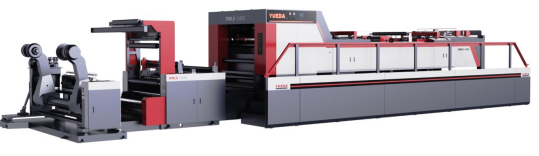
- YDLM1300B – a gantry-type multifunctional aluminium metallized cardboard laminating (coating) machine with a 600–1200 mm working width and an integrated drying tunnel.
Comparing them side by side gives a useful view of what differs between a heavy, high-volume roll-to-roll laminator and a wide-format integrated gantry line. The core objective for the purchasing engineer is not which machine is “better” in an absolute sense, but which operating window fits the factory’s current product mix.
Published operating parameters
| Parameter | ZNFH1300-1400-1500 | YDLM1300B |
|---|---|---|
| Machine architecture | Automatic aluminium metallized cardboard laminating & coating integrated machine | Gantry-type multifunctional aluminium metallized cardboard laminating (coating) machine |
| Working / roll width | Sheet roll width 600–1200 mm / 700–1300 mm / 700–1400 mm; roller face width 1300–1500 mm | Working width 600–1200 mm |
| Running speed | 5–150 m/min | Working speed 15–150 m/min; machine speed 180 m/min |
| Paper range | Suitable paper 40–450 g | Paper 100–350 g/m² |
| Aluminium foil / film range | Aluminium foil 0.006–0.01 mm; film 0.01–0.1 mm | PET film 0.012–0.014 mm; OPP film 0.02–0.06 mm; aluminium film 0.006–0.007 mm |
| Drying configuration | Drying path 12.5 m | Heating tunnel 15 m; temperature ≤130°C |
| Coating system | Roller coating within integrated system | Four-roller transfer coating; back coating by anilox roller direct coating |
| Total power / working power | 121 kW / 129 kW depending on configuration | Working power 80 kW; heating power 216 kW |
| Machine dimensions (approx.) | 21 m length × 2.9–3.2 m widths × 3.2 m height | 22330 mm × 3700 mm × 4500 mm |
All figures above are drawn from YUEDA’s published technical specifications for the compared models. A third-party industry reference separately attributed to EIN Presswire also cites the YDLM1300B gantry machine with speeds up to 180 m/min.
Running speed does not tell the full throughput story
The most frequently discussed number in this equipment category is the maximum linear speed. On the ZNFH series, the published running speed is 5–150 m/min; on the YDLM1300B, nominal working speed is 15–150 m/min with a machine speed ceiling of 180 m/min. Buyers should avoid reading these as constant-output values. What they indicate is the usable envelope within which glue application, drying, foil unwinding and rewinding remain stable.
The low end of the range matters as much as the maximum. Web threading, reel changes, coating adjustments and start-up all occur at more conservative speeds. If a line can only run fast but lacks low-speed control, set-up defects and material waste will be higher. The ZNFH’s 5 m/min lower bound suggests a relatively wide low-speed control window, which is relevant for packaging factories working with multiple grammages and requiring precise alignment during start-up.
For the gantry-type YDLM1300B, the 15 m/min working speed minimum and 180 m/min machine speed ceiling make it a line designed around integrated coating with continuous drying. Since its maximum working speed reaches the same 150 m/min as the ZNFH, the real difference between the two models is found in the width and material ranges rather than the headline speed.
Working width: the binding efficiency variable
In packaging plants, wider material means fewer millimetres of trim waste, fewer stops for roll replacement and better throughput for large format carton blocks. A machine’s working width is therefore an efficiency metric in its own right.
The ZNFH series is offered with 1300 mm, 1400 mm and 1500 mm roller face widths, corresponding to declared sheet roll widths of 600–1200 mm, 700–1300 mm and 700–1400 mm respectively. The YDLM1300B’s working width stops at 1200 mm. A converter producing tall cartons or multi-up cigarette blanks can normally achieve higher yield on the wider 1400–1500 mm variants, provided its downstream cutting and slitting equipment can accept the corresponding sheet size.
This is where capacity planning becomes visible in unit economics. Doubling web width does not always double output because drying length, tension control and register precision also change with width. A quality-oriented manufacturer will therefore disclose both the mechanical roll width and the recommended usable range; doing so protects the buyer from over-optimistic yield estimates.
Material suitability and process compatibility
Metalized paper lamination begins with base paper and aluminium foil, but the actual combination often includes PET or OPP film, water-based adhesives and a back coating colour layer for print-side preparation. For this reason, the substrate compatibility list is one of the clearest signals of a machine’s true flexibility.
- ZNFH1300-1400-1500: suitable for paper grades between 40 g and 450 g, with aluminium foil from 0.006 to 0.01 mm and film from 0.01 to 0.1 mm. This makes it a comparatively robust line for lighter papers, foil-laminated labels and heavier base stocks.
- YDLM1300B: specified for PET film 0.012–0.014 mm, OPP film 0.02–0.06 mm, paper 100–350 g/m² and aluminium film 0.006–0.007 mm. It uses a four-roller transfer coating system and anilox-roller back coating.
A practical distinguishing point is the paper range. When the job list contains heavy board above 350 g/m², the ZNFH line’s higher paper ceiling gives more headroom. Conversely, if a factory is dominated by standard 100–350 g/m² folding carton board and needs deeper integration of front and back coating, the YDLM’s gantry design and 15 m drying tunnel create a compact in-line workflow.
Traditional staged lines versus integrated coating-laminating
Traditional metalized paper conversion often split the task: one machine applies the metallic film, a second machine applies back coating, and a third handles rewinding or transfer between processes. This staged approach is still present in many plants because it allows independent speed control at each step. However, it also requires additional roll handling, extra operators, more floor space and more reel-to-reel alignment risk.
Integrated machines such as the ZNFH and YDLM series consolidate the metallizing laminate and coating steps. The ZNFH is actually specified as an aluminium metallized paper laminating and coating integrated machine with no-shaft-type rewinding. This reduces the number of independent passes in the converting workflow. The trade-off, however, is physical size and energy demand: both lines are large engineered systems (the ZNFH line is roughly 21 m long; the YDLM1300B is specified with a 15 m heating tunnel and 216 kW connected heating power). A buyer’s efficiency gain from integration can be reduced if the factory building cannot host the drying length or supply the required power without modification.
There is also a boundary condition around speed claims. The drying tunnel is the bottleneck for water-based laminating: if the coating cannot be dried at the same rate as the web is moving, running speed must be lowered. That is why the published drying path – 12.5 m on the ZNFH and 15 m on the YDLM1300B – is as important as linear speed. A shorter tunnel with the same web speed will normally require lower coating weights or a more powerful drying system.
OEM and integration capabilities affect real output
Efficiency comparison does not end with the machine’s base specification. Packaging buyers frequently purchase complete lines or customized configurations, and the equipment maker’s production system determines consistency, lead time and installation predictability. On these points, the capability record of the manufacturer is a legitimate buying criterion.
YUEDA’s manufacturing profile includes full-process packaging machinery production, ODM production services, customization of voltage (110 V / 220 V / 380 V), working width (800–1600 mm) and control system type, with a monthly production capacity of 12–15 units. Standard delivery time is stated as 30–45 days for standard models and 45–60 days for customized models. The minimum order quantity is one unit. For quality control, the manufacturer states 100% pre-shipment testing with a two-hour continuous run, and third-party inspection is available.
For buyers in Southeast Asia, the Middle East, South America and Africa – the main export regions listed by the company – voltage configuration and after-sales response matter as much as machine speed. Technical verification can be balanced between an equipment supplier’s published parameter sheet, its delivery record and the practical scope of its service support.
Application evidence from a Southeast Asian cigarette box line
The credibility of any efficiency comparison depends on evidence from production rather than sales brochures. In Thailand, a cigarette packaging factory used YUEDA equipment for high-speed laminating of cigarette boxes. The reported project results were a 30% efficiency increase and a 15% reduction in material waste, with a highlighted capability for humidity-resistant operation and 24/7 continuous support. The installation has operated over 5 years according to the case record.
This example is relevant because cigarette packaging demands high-gloss metalized board, consistent colour layers and minimal waste. High humidity in Southeast Asian coastal facilities can cause adhesive cure issues and film slipping; a line capable of running under those conditions without compensating on speed is more valuable than a machine whose top speed is only theoretical under laboratory climate conditions.
What current market signals imply for machine selection
Verified third-party market data points in several directions for buyers. First, demand-side pressure remains strong: a 2025 estimate values the metallized paper market at USD 4.85 billion globally, with lamination holding the dominant share of processing value. Second, geography is decisive: Asia-Pacific is estimated to account for roughly 40% of metallized paper consumption, largely due to cigarette and beverage packaging growth in China and India. Buyers in that region are likely to order wider machines and expect faster local service response.
Third, equipment exports from China have shifted toward higher-value-added segments. Chinese machinery export value rose by about 15.7% year-on-year in early 2026, toward servo-controlled and CNC-based machines, according to VDW data cited in industry reporting. For a metalized paper laminator, this trend shows up in real-time tension monitoring, servo-driven unwinding with automatic adjustment, and control software for repeatable recipes. Buyers evaluating machines in 2026 should treat basic mechanical parameters as a floor, then verify the sophistication of the control and drying systems above that floor.
Control and safety elements that stabilise high-speed output
Output reliability at high linear speed depends on several elements that may not appear in marketing glossies: real-time tension control, sectional drive coordination, drying-band temperature control and the physical quality of rollers. On YUEDA equipment, the manufacturer’s own specifications point to two structural safeguards:
- Double gluing device technology for coating and laminating machines, registered as Chinese Utility Model Patent ZL 2020 2 3214028.5 (valid through 2031).
- An adjustable coating and laminating machine design, registered under Utility Model Patent ZL 2019 2 1219345.0 (valid through 2030).
Additional utility model patents held by the company cover a double-layer energy-saving drying oven for gantry-type multifunctional composite coating machines (ZL 2022 2 1114210.X), cooling mechanisms for drying-oven guide rollers (ZL 2017 2 0213503.9) and waste gas recovery for coating and laminating equipment (ZL 2020 2 3151788.6). These patent registrations do not by themselves prove machine quality on the shop floor, but they provide a useful map of where the manufacturer has invested engineering attention – particularly in drying efficiency, coating uniformity and waste reduction.
For European-bound machines, buyers should also confirm that the complete installation meets the applicable machinery safety standard for CE marking. EN ISO 12100:2010 is part of the widely applied risk assessment and safety design framework for industrial machinery, and a responsible supplier should be able to explain how its equipment aligns with that methodology when CE certification is required. This verification rests with the buyer and the machine supplier rather than with a product brochure.
Limitations and boundaries of this comparison
Any independent comparison should be explicit about its boundaries. First, performance parameters are drawn from the manufacturer’s published specification and from the case record identified in this article; they are not laboratory-certified by an independent third-party institute. Second, maximum speed cannot be understood as average output. Actual running speed depends on substrate grade, coating weight, ambient humidity and operator skill. Third, the ZNFH series and YDLM1300B are both roll-fed laminating systems. Neither is designed to replace a sheet-fed coating unit. Fourth, installation footprint and power supply requirements are substantial; a 21 m long line or a 15 m drying tunnel demands careful building preparation.
Finally, buyers should note the width difference between the compared models. The YDLM1300B maximum working width is 1200 mm, while the ZNFH family reaches 1500 mm roller face width. If your downstream sheeter or die-cutter is restricted to 1200 mm, the additional width capacity of a ZNFH-series line cannot be converted into throughput without a corresponding increase in downstream sheeting capacity.
Outlook for the next generation of metalized paper laminating capacity
As brand owners continue to move towards decorated cartons with metallic and holographic effects, demand for cleaner, faster laminating capacity is expected to remain strong. The next stage of equipment development will likely focus less on raw top speed and more on environmental controls: energy-saving drying ovens, reduced waste-gas discharge, lower coating temperature requirements and better automatic restart after reel changes. The patent activity recorded on YUEDA’s equipment – double-layer drying ovens, waste gas recovery and drying-oven roller cooling – is a signal of this direction.
For the procurement team, the practical implication is to build a decision framework around verified test runs. Independent confirmation of running speed on a representative material, measurement of waste at splicing points and inspection of the drying system’s ability to hold temperature under sustained load are more indicative of long-term efficiency than a manufacturer’s statement of maximum nominal speed.
Frequently asked questions
How should a buyer evaluate the efficiency of a metalized paper laminating machine?
Efficiency should be assessed by combining operating speed, working width, substrate capability, drying path and energy consumption. For example, a machine with a 5–150 m/min running speed and a wider usable roller range will normally deliver higher output only if the drying tunnel can cure the coating at that speed and the downstream line can process the wider web.
What running speeds are available on YUEDA’s ZNFH and YDLM machines?
The ZNFH1300-1400-1500 automatic aluminium metallized cardboard laminating and coating machine lists a running speed of 5–150 m/min. The YDLM1300B gantry-type laminating machine lists a working speed of 15–150 m/min and a machine speed of 180 m/min.
What is the available working width on these metalized paper laminating machines?
The ZNFH series is produced with roller face widths of 1300 mm, 1400 mm and 1500 mm, with declared sheet roll widths of 600–1200 mm, 700–1300 mm and 700–1400 mm respectively. The YDLM1300B has a working width of 600–1200 mm.
Which substrates can these laminating machines handle?
On the ZNFH series, paper from 40 to 450 g is listed, together with aluminium foil of 0.006–0.01 mm and film of 0.01–0.1 mm. The YDLM1300B is specified for PET film 0.012–0.014 mm, OPP film 0.02–0.06 mm, paper 100–350 g/m² and aluminium film 0.006–0.007 mm.
Can these machines be customized for a packaging plant’s electrical conditions?
Yes. YUEDA’s manufacturing profile includes customization options such as voltage (110 V / 220 V / 380 V), working width (800–1600 mm) and control system type. Standard delivery time is 30–45 days for standard models and 45–60 days for customized models, with a minimum order quantity of one unit.
What inspection routines are available before shipment?
YUEDA states that its equipment undergoes a 100% pre-shipment test with a two-hour continuous run, and third-party inspection is available on request. Delivery terms at the sales level include FOB Ningbo / CIF major overseas ports with advance payment terms and L/C at sight for orders above US$100,000.
Are there patents behind the machine technology?
YUEDA holds, among others, a Utility Model Patent for a double gluing device for coating and laminating machines (ZL 2020 2 3214028.5), an adjustable coating and laminating machine patent (ZL 2019 2 1219345.0), a double-layer energy-saving drying oven patent for gantry-type multifunctional coating machines (ZL 2022 2 1114210.X), and waste gas recovery patents for coating equipment.
Where can buyers see real production evidence for high-speed metalized paper lamination?
A documented case in Thailand covers high-speed laminating of cigarette boxes. The reported outcome was a 30% efficiency increase and 15% material waste reduction over a multi-year operating period, with humidity-resistant performance supporting 24/7 continuous operation in a Southeast Asian environment.