
Micro Excavator Constraints: Certification, Size and Access
In the micro excavator class, the purchase is decided by constraints long before it is decided by price: what the certificate actually covers, what width the machine must pass through, how far the bucket must reach below grade, and which engine type-approval applies to the exact unit being shipped.
A micro excavator - the roughly 1 to 2 tonne band that buyers also search for as a mini digger or a compact mini excavator - is best understood as a machine defined by its limits. Digging depth, tail swing radius, transport width and engine approval together determine which sites the machine can enter and which markets it can legally be sold into. Shandong HUAYEE Heavy Industry Machinery Group Co., Ltd., a manufacturer and exporter of small construction machinery based in Jining City, Shandong Province, China, produces a range running from the 1 t class HY10 to the 4 t class HY40U. That spread makes the range a practical case for reading constraint-based specification in the order a buyer actually meets it.
The four constraint layers that decide a micro excavator order
Most specification sheets present a single flat list of numbers. For procurement purposes it is more useful to separate those numbers into four layers, because each layer is verified by a different document at a different moment in the transaction.
- Market-access constraints - machine conformity, noise emission verification, engine type-approval and packaging registration. These are decided before the machine can be offered in a regulated market.
- Physical envelope constraints - overall width, overall height, tail swing radius and turning radius. These are decided before the machine can reach the work face.
- Work-envelope constraints - maximum digging depth, digging reach, dumping height, digging force and ground pressure. These determine what the machine can actually complete once it is on site.
- Supply constraints - minimum order quantity, configuration lead time, and the spare-parts and service arrangement behind the unit.
A buyer who evaluates a 1 ton mini excavator and a 2 ton mini excavator only on digging depth and purchase price is skipping three of these four layers, and the skipped layers are where the expensive surprises sit.
Certification is a scope, not a badge
The single most common reading error in this class is to treat 'CE certified' as a property of the brand. It is a property of a defined model list, issued by a named body, against named standards, with a validity date. A machine outside the listed scope is not covered by that certificate, even when it carries the same brand name.
| Document | Issuer | Scope of coverage | Validity |
|---|---|---|---|
| CE Certificate of Compliance - crawler excavator (Machinery Directive 2006/42/EC and EMC Directive 2014/30/EU), cert. H220809.SHHTW07 | Ente Certificazione Macchine Srl (ECM), Italy | Crawler excavators HY06 to HY225, 35 models; EN ISO 12100:2010, EN 474-1:2006+A6:2019, EN 474-5:2006+A3:2013, EN ISO 13766-1:2018 | Issued 2022-08-09, valid to 2027-08-08 |
| CE Verification - Noise Emission of Outdoor Equipment, cert. 0P230814.SHHQT84 | ECM, Italy | Crawler excavators HY06 to HY225; EN ISO 3744:2010; Directive 2000/14/EC as amended by 2005/88/EC | Issued 2023-08-14, valid to 2027-08-08 |
| EU Stage V engine type-approval, Kubota D1703 | Kraftfahrt-Bundesamt (KBA), Germany | Engine D1703-M-DI-E4B-CBH1T, fitted to the 3.5 t class HY35 | Issued 2022-06-28 |
| EU Stage V engine type-approval, Kubota D1105 | KBA, Germany | Engine D1105-E4B-CWL-1, category NRE-v-2, fitted to the 3 t class models | Issued 2023-06-28 |
| EU Stage V engine type-approval, KOOP KD15 family | National Standards Authority of Ireland (NSAI) | Engine family KD15: KD195FC-1, KD195FC, KD192FC, KD192FC-1, KD188FC, KD188FC-1, KD186FC, KD186FC-1 | Issued 2021-06-15 |
| ISO 9001:2015 and ISO 14001:2015 | JingXin Certification (Beijing) Co., Ltd. | Sales of construction, garden, building, road and concrete machinery; related environmental management activities | Valid to 2027-08-20 |
| German Packaging Act (VerpackG) registration, LUCID | Stiftung Zentrale Stelle Verpackungsregister (ZSVR), Germany | Retail, grouped and shipment packaging placed on the German market under the HUAYEE and huayizhonggong brands | Registration DE3722376188859 |
Two constraint rules follow directly from that table. First, machine conformity and engine approval are separate documents with separate scopes. The CE certificate covers the complete machine as a model; the Stage V approvals cover a specific engine type installed in specific models. If a buyer specifies a different engine from the one named in the approval, the approval does not automatically transfer, and the point has to be re-verified before the order is released. Second, every document carries an expiry date. A machine imported near the end of a certificate's validity period is not automatically non-compliant, but the dealer inherits a renewal event, and that belongs in the commercial discussion rather than in the after-sales queue.
The physical envelope: width, tail swing and turning radius
The second constraint layer decides whether the machine can physically start work. In the compact classes this is almost never a matter of overall length; it is a matter of width and rear overhang.
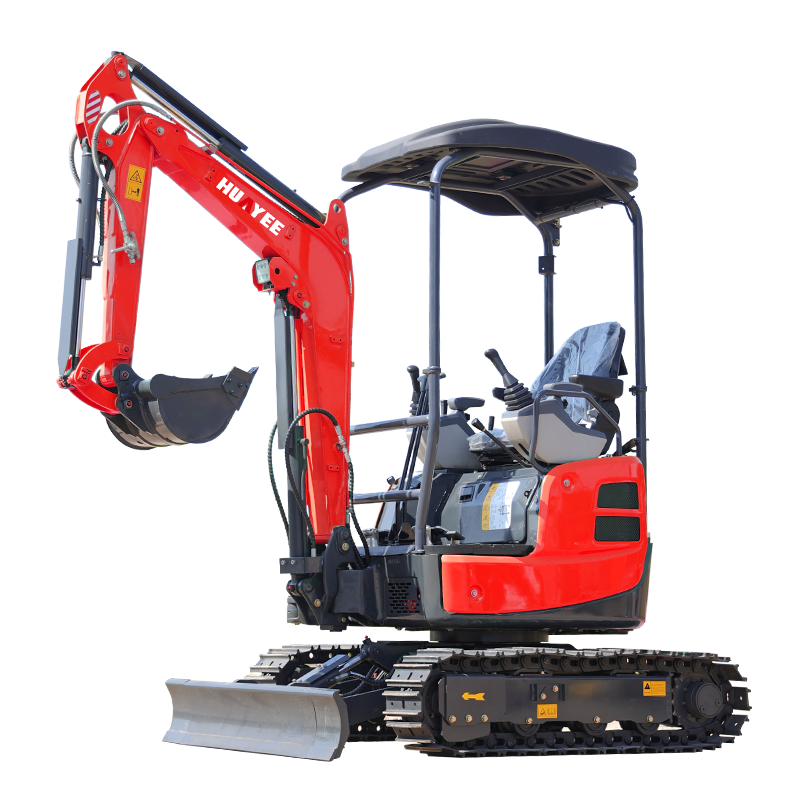
HY20U compact mini excavator: 2,000 kg operating weight and a 650 mm minimum tail swing radius, designed to slew beside walls and fences.
The 1 t class HY10 illustrates how tight the envelope can get: 930 mm overall width and a 1,490 mm minimum turning radius, with a transport length of 2,950 mm and a height of 2,030 mm without the canopy. Those figures are what allow the machine to enter courtyards, alleys and interior spaces that a 3 t unit cannot reach at all, and they matter more than engine output in that segment.
Rear overhang is the second half of the envelope. A short tail swing or zero tail swing machine keeps the counterweight close to the track footprint while slewing, so the machine can work beside kerbs, parked vehicles and boundary walls without repositioning. In the HUAYEE range the minimum tail swing radius is 650 mm on the 2 t class HY20, 755 mm on the HY16, 830 mm on the HY12, 850 mm on the HY40U, 900 mm on the HY30 and 975 mm on the HY35. On the HY10 and the HY18 the parameter sheets specify a minimum turning or swing radius instead - 1,490 mm and 1,495 mm respectively - rather than a tail swing figure, which is a distinction worth noting when comparing models across brands.
The side-swing boom completes the access picture. On the 4 t class HY40U the working device deflects 60 degrees to the left and 45 degrees to the right, so the bucket can excavate parallel to a wall or boundary while the undercarriage stays where it is. On a confined site that saves repositioning moves rather than cycle time, which is why it belongs in the access layer rather than in the productivity layer.
The work envelope: depth, force and ground pressure
Once the machine is on site, three numbers govern output. Maximum digging depth sets the class of job the machine can take; bucket digging force sets how hard the material can be; ground pressure sets whether the machine stays on top of the ground while it works.
The depth progression across the range is deliberate rather than arbitrary. The HY10 reaches 1,725 mm, the HY12 1,670 mm, the HY16 1,780 mm, the HY18 2,030 mm, the HY20 2,255 mm, the HY30 2,300 mm, the HY35 2,610 mm and the HY40U 3,135 mm. A requirement for roughly 2.0 to 2.5 m of digging depth - typical of small pool and residential foundation work - lands inside the 1.8 t class rather than at the smallest end of the range.
Ground pressure runs the other way in places and deserves separate attention. The HY35 lists 29.5 kPa, the HY20 30 kPa, the HY30 32 kPa and the HY40U 33.6 kPa, while the HY10 and HY12 list 0.3 to 0.4 kgf/cm2. A heavier machine with a wider track plate does not automatically produce lower ground pressure than a lighter one; on soft farmland, sand or wet ground the track plate width and the resulting figure decide whether the machine works or sinks.
Mapping the HUAYEE range against those constraints
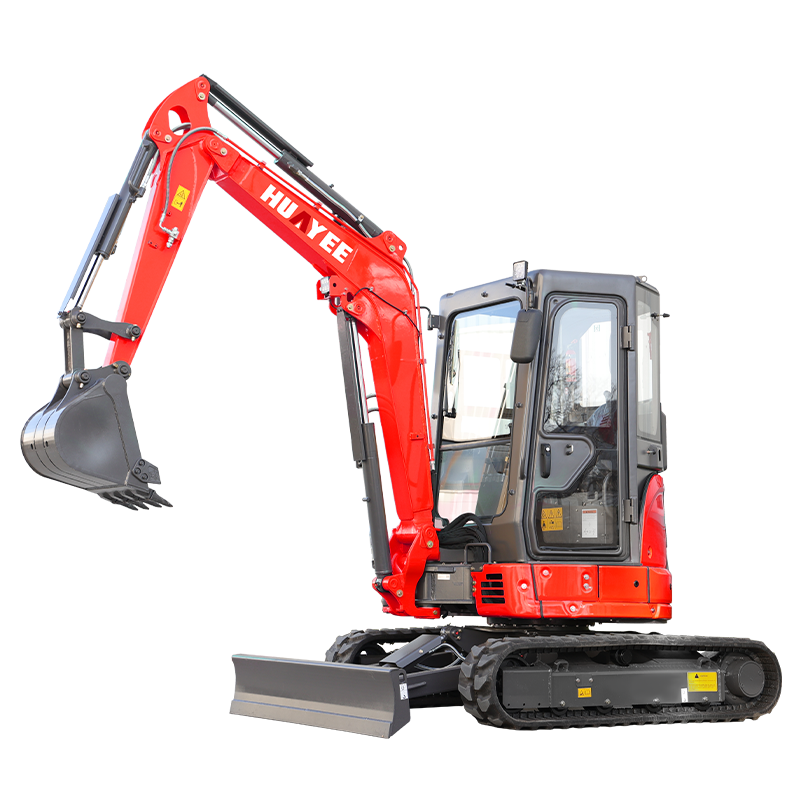
HY40U mini excavator: 4,000 kg operating weight, 3,135 mm maximum digging depth and a side-swing boom rated 60 degrees left and 45 degrees right.
| Model | Operating weight | Max. digging depth | Min. tail swing radius | Overall width | Digging force | Rated engine output | Hydraulic system |
|---|---|---|---|---|---|---|---|
| HY10 | 1,000 kg | 1,725 mm | - | 930 mm | 6.5 kN | 7.6 kW (KOOP192FA) | Gear pump, 16 MPa, 18 L/min |
| HY12 | 1,200 kg | 1,670 mm | 830 mm | 940 mm chassis | - | 10.2 kW (Kubota D722-E4B) | Gear pump, 16 MPa, 20 L/min |
| HY16 | 1,600 kg | 1,780 mm | 755 mm | 1,100 mm | 8 kN | 10.2 kW (Kubota D722) | Gear pump, 16 MPa, 19 + 7 L/min |
| HY18 | 1,800 kg | 2,030 mm | - | - | - | 10.2 kW (Kubota D722-E4B) or 18.1 kW (KM385B) | 16 MPa |
| HY20 | 2,000 kg | 2,255 mm | 650 mm | 1,050-1,300 mm | - | 11.8 kW (Kubota D902) | 20.5 MPa, 28 L/min |
| HY30 | 3,000 kg | 2,300 mm | 900 mm | 1,300-1,500 mm | 20 kN bucket, 12 kN arm | 15.6 kW (Kubota D1105) | 20 MPa, 80 L/min |
| HY35 | 3,500 kg | 2,610 mm | 975 mm | 1,300-1,550 mm | 28 kN tractive force | 18.2 kW (Kubota D1703) | 27 MPa, 72.8 L/min |
| HY40U | 4,000 kg | 3,135 mm | 850 mm | 1,740 mm | 30 kN bucket | 20.2 kW (Yanmar 3TNV88-BSSY) | 25.5 MPa, 99 L/min |
Read as a constraint map rather than a specification list, the table separates three purchase profiles. The HY10 to HY16 group is access-driven: sub-1,100 mm widths and gear-pump hydraulics suit gardens, courtyards, rental fleets and confined renovation. The HY18 to HY20 group is depth-driven: 2,030 to 2,255 mm of digging depth inside an envelope that still fits urban plots, with the HY20 adding a 650 mm tail swing radius for roadside work. The HY30 to HY40U group is output-driven: 20 to 30 kN of bucket digging force, 72.8 to 99 L/min main pump flow and up to 3,135 mm of digging depth.
The mechanical basis for those figures is consistent across the range. Main structures are S355 steel, laser cut and robot welded. The side-swing connector is an integrated cast steel component rather than a welded assembly, so the joint carrying the heaviest digging load has no weld seam. Pins are quenched and tempered, galvanized, with a surface hardness above 500 HB and an internal bushing to reduce friction, which keeps boom and arm play from opening up over time. Hydraulic cylinders use cold-drawn seamless tube held to 0.01 mm concentricity and perpendicularity tolerance with NOK sealing rings and steel guards; hoses are Continental and Danfoss, rated -40 °C to +100 °C, with spring-wrapped protection sleeves. Coating is shot blasting plus electrostatic spray in a three-layer anti-corrosion finish.
Where the constraints land in real applications
Municipal engineering and public works
Narrow urban roads, residential alleys and congested districts impose the tightest combination: small turning radius, short tail swing, low noise and no black smoke. Trenching for pipes and cables, sidewalk and green-belt renovation, and road surface repair are all single-operator, frequently relocated tasks, and the matched equipment set is a narrow bucket, standard bucket, hydraulic breaker, quick-change coupler and dozer blade. In this setting the tail swing radius decides whether the machine can work at all; digging depth rarely does.
Landscaping and gardening
Private gardens, courtyards and green belts impose an entrance constraint rather than a depth constraint. The working requirement is a rubber track option and a compact width that passes gateways and narrow garden entrances, with a standard bucket, toothless bucket, rake, auger and trailer as the matched set. Intermittent single-operator use also changes the economics: transport between small sites has to be cheap, which is why the 1 t class machines are specified for pickup transport and one-person operation.
Agriculture, orchards and livestock farms
Farmland, orchards and ranch ground is soft, muddy or sloped, so low ground pressure with wider track plates is the governing requirement - the machine has to stay on the surface while ditching, digging planting holes, levelling land and moving material or green waste between rows. Seasonal work with a single operator favours the auger, narrow bucket, hydraulic thumb, ripper and trailer combination over high hydraulic flow.
Residential and private property construction
Private plots with limited access and a required digging depth of about 2.0 to 2.5 m sit squarely in the 1.8 t class. Pool and house foundation excavation, followed by backfill and levelling, is project-based work by the plot owner as the single operator - which is exactly the case where an undersized machine fails on depth and an oversized one fails on access.
Building construction and renovation
Small building sites, foundation pits and interior spaces introduce the hardest constraint of all: ventilation. Low noise and no black smoke where airflow is limited are requirements, not preferences, and compact dimensions for indoor and basement work are mandatory. The matched equipment set here is a hydraulic breaker, standard and narrow buckets, ripper, mechanical or hydraulic thumb and quick-change coupler, with continuous single-operator site work as the operating mode.
What procurement practice is changing
Across regulated markets, the sequence of the buying conversation has shifted. Documented compliance tends to be requested earlier and price later, particularly where the machine will be resold under a dealer's own brand and the dealer carries the reputational risk of a non-conforming unit. Two practical consequences follow for importers.
The first is that packaging obligations now sit alongside machine compliance. The German Packaging Act registration is a useful example: the LUCID registration DE3722376188859 covers retail, grouped and shipment packaging placed on the German market under the HUAYEE and huayizhonggong brands, held by Shandong HUAYEE Import And Export Co., Ltd. Buyers who treat packaging registration as an administrative afterthought tend to discover it at the port rather than at the quotation stage.
The second is that factory verification has become a scheduled step rather than a goodwill gesture. On-site visits, a 24-hour online VR factory tour and live video walkthroughs of the production lines, supported by bilingual inspection reports, now form part of the evaluation file for many distributors. The underlying capacity behind that verification is a 300,000 m2 group site with more than 1,000 employees, more than 20 intelligent production lines and an annual production and sales capacity of about 30,000 units, with products exported to 158 countries and exports accounting for about 70% of sales.
Comparison with traditional solutions - and where a micro excavator stops
Against manual labour, the case for a compact mini excavator is straightforward on trenching, footing excavation and material handling: one operator replaces a crew, and the machine reaches depths that hand digging does not reach economically. Against a conventional tail-swing excavator, the case rests entirely on the site. The side-swing boom and the reduced tail swing radius let the machine work along a wall or in an alley where a conventional machine has no clearance behind it.
That advantage disappears on open ground. On a large site with unrestricted space behind the machine, tail swing radius stops being a decision criterion and the choice should be driven by digging depth, digging force and cycle time instead. Buyers who apply confined-site logic to open-site work pay a premium for a capability they never use.
There is a further boundary on the supply side. Trial orders from a single unit are accepted and standard configurations run on a 30 to 45 day lead time, but customized configurations extend that window considerably - the factory quotes up to 75 to 90 days for customized builds. Colour, logo, nameplate, engine brand, hydraulic system, canopy or enclosed cab, rubber or steel track, telescopic chassis and attachment sets are all customizable, and each of those choices can move both the lead time and the applicable certification scope.
Future outlook
Three directions look set to shape the micro excavator segment over the next buying cycles. First, emission documentation will keep tightening the link between engine choice and market access, which favours buyers who treat engine type-approval as a specification field rather than a paperwork item. Second, the short tail swing and side-swing boom configuration is likely to keep moving down the weight range, because urban and indoor work is where the growth in compact machine demand sits. Third, dealer evaluation is shifting toward verifiable production evidence - factory tours, inspection reports, certificate annexes - rather than brochure claims.
For HUAYEE, the range already spans 1 t to 4 t with certification covering 35 crawler excavator models from HY06 to HY225, engine approvals for the Kubota D1703, Kubota D1105 and KOOP KD15 families, ISO 9001 and ISO 14001 management system certification, spare parts held in five overseas warehouses in Italy, Hungary, two in the United States and Canada, and 24-hour response support. What remains for buyers is the discipline of matching each of those facts to the specific model, market and site they are actually ordering for.
Frequently asked questions
What does zero tail swing mean on a mini excavator?
A zero tail swing mini excavator is one whose upper structure slews within, or almost within, the width of the track undercarriage, so the rear end does not swing out beyond the tracks. The minimum tail swing radius is 650 mm on the 2 t class HY20, compared with 850 mm on the HY40U and larger figures on conventional machines of the same class. The body still rotates a full 360 degrees.
Why do the side-swing boom and tail swing radius decide whether a machine can work on a site?
Together they determine whether the machine fits the site at all. The boom swings sideways so the bucket reaches along a wall without turning the machine - on the HY40U the working device deflects 60 degrees left and 45 degrees right - while a small tail swing radius keeps the rear end inside the track width during slewing. That combination is what makes alleys, courtyards, roadside trenches and indoor renovation workable where a conventional excavator has no clearance.
How do I choose the right mini excavator size for my market?
Start from the dominant job rather than the price list. Machines of 0.8 to 1.2 t cover home gardens, farms and ranches; 1.6 to 2 t machines cover residential, landscaping and municipal maintenance work; 3 to 6 t machines cover earthworks and house foundations. The HY10 offers 1,725 mm of digging depth at 930 mm width, the HY18 reaches 2,030 mm for pool and foundation work needing about 2.0 to 2.5 m, the HY20 adds a 650 mm tail swing radius for narrow urban sites, and the HY30, HY35 and HY40U reach 2,300 to 3,135 mm with up to 30 kN of digging force. Configuration - engine brand, gear or piston pump, canopy or cab, rubber or steel track, attachment set - is a separate decision that follows the model choice.
Which certification documents should be verified before ordering for the EU market?
Four groups. Whole-machine conformity: the CE Certificate of Compliance H220809.SHHTW07 issued by Ente Certificazione Macchine Srl covers crawler excavators HY06 to HY225 and runs to 2027-08-08. Noise: CE Verification 0P230814.SHHQT84 against EN ISO 3744:2010 under Directive 2000/14/EC, also valid to 2027-08-08. Engine: EU Stage V type-approvals for the Kubota D1703, Kubota D1105 and KOOP KD15 engine families, each tied to the engine type actually installed. Management systems: ISO 9001:2015 certificate 62724Q0812R0S and ISO 14001:2015 certificate 62724E0543R0S, both valid to 2027-08-20. For Germany, the VerpackG LUCID packaging registration DE3722376188859 applies in addition.
What should I do if a hydraulic hose leaks or bursts on a mini excavator?
Stop the machine, lower the attachment to the ground and lock the pilot safety lever. Identify whether the damage is a burst, a cut or a loose connection, and replace with a hose rated for the local temperature - standard hoses are rated from -40 °C to +100 °C. After replacement, run the machine and re-check the joint and surrounding hoses at working pressure before returning it to service. Do not open the pump, main valve or cylinders; if oil still leaks after replacement, or if the cylinder shell or rod is scored, the machine should be referred to the after-sales team.
How are attachments changed on a machine with a quick-change system?
Park on firm level ground, lower the attachment, stop the engine and move the left pilot safety lever to the locked position. Release the coupler, detach the attachment, move to the new one, engage and lock the coupler, then raise the attachment slightly and confirm full engagement before starting work. The system is designed to be operated by one person without special tools. Never place hands or feet between the coupler and the attachment, and use only attachments matched to the machine tonnage and hydraulic flow.
The HUAYEE corporate brochure, including the full model range and certification summary, is available for download: HUAYEE company profile (PDF).
Tem questões ou precisa de mais detalhes?
Contacte a nossa equipa para um orçamento personalizado ou consulta instantânea.
Solicitar orçamento
Preencha o formulário abaixo e a nossa equipa entrará em contacto com uma proposta personalizada.
Chat direto do WhatsApp
Prefere conversar em tempo real? Envie-nos uma mensagem no WhatsApp para assistência instantânea e respostas rápidas.
- Obter orçamento personalizado
- Partilhar fotos ou documentos
- Discuta as suas necessidades diretamente
Geralmente responde em 5–30 minutos durante o horário de expediente.