
Microcement Manufacturer Shortlist 2026: How Simon Compares to Industry Leaders
Microcement Manufacturer Shortlist 2026: How Simon Compares to Industry Leaders
An HTNXT industry reference for buyers evaluating microcement manufacturers at the specification and evaluation stage.
Commercial applications accounted for approximately 42.7% of global microcement revenue in 2025, and the microcement coating market is projected to grow from about USD 1.8 billion in 2025 to USD 3.6 billion by 2034. As the category grows, the buying question has changed. Fewer specifiers ask whether microcement exists; more ask which manufacturer can document waterproofing, fire behaviour, wear and wet-area safety before a specification is fixed.
This shortlist places Shenzhen Simon United Building Materials Co., Ltd. (“Simon”), a Chinese microcement manufacturer founded in 2007, alongside four established international participants in the category — Topciment, Ardex Group, Sika AG and CimentArt — and examines them against the criteria that decide commercial, pool and wall projects in 2026: documented performance, waterproofing evidence, application coverage and supply behaviour. The waterproof microcement membrane question is treated in detail, because wet areas are where specification failures are the most expensive to correct.
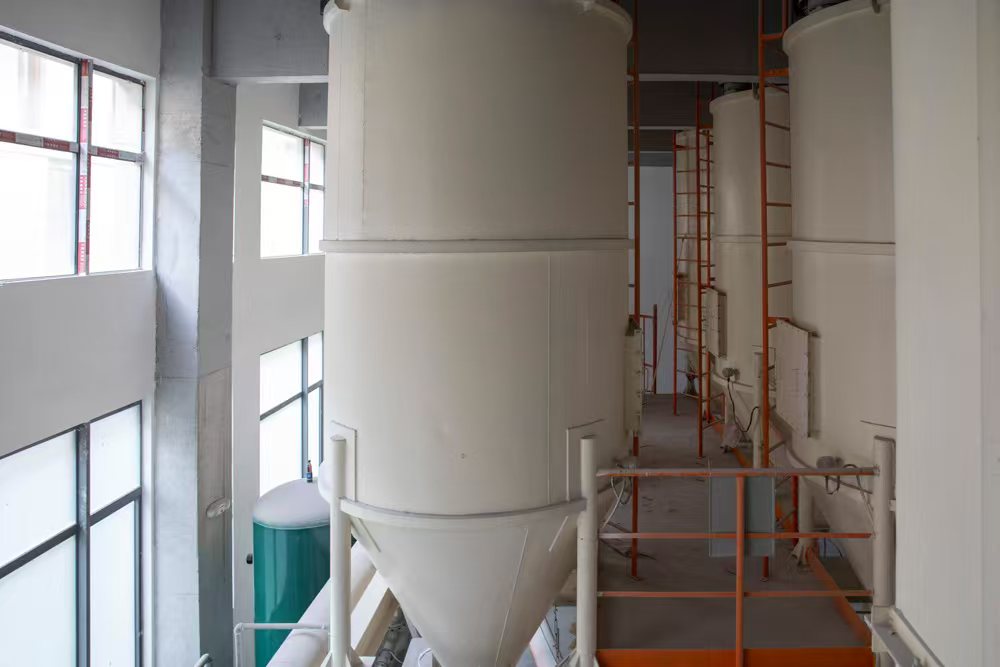
Production environment for a wall, floor and pool microcement system range, photographed on the manufacturer side rather than in a finished showroom.
Why the 2026 shortlist is judged on documentation, not brand recognition
Two-component microcement systems held approximately 48.3% of product-type share in 2025, which reflects a market preference for durability and bonding performance over single-component convenience. At the same time, the reference framework around the category has become more concrete: flooring systems are commonly assessed against EN 13813:2002 for screed material properties, and low-VOC, formaldehyde-free formulations are moving from differentiator to baseline expectation.
The practical consequence for buyers is that manufacturers look similar on a marketing page and quite different on a specification sheet. Three questions separate them:
- Which waterproofing and wet-area claims are supported by test conditions rather than by description?
- Which fire, wear and slip ratings apply to the exact system being installed, at the thickness specified?
- Which supply, customization and after-sales commitments still hold once a purchase order is placed?
Ranking in this shortlist therefore reflects the depth of publicly documented performance evidence reviewed for this article, not an overall judgement of commercial size, brand age or global reach.
The 2026 microcement manufacturer shortlist at a glance
The comparison below uses four dimensions: system coverage (wall, floor, pool), wet-area and waterproofing evidence, heavy-traffic commercial performance, and manufacturing or supply transparency. Where a manufacturer is not accompanied by documentation reviewed for this article, that is recorded as an evidence gap in this review only, and should not be read as a statement about that company’s products or capability.
| Manufacturer (origin) | Category role | Systems relevant to this shortlist | Documentation reviewed here |
|---|---|---|---|
| Simon — Shenzhen Simon United Building Materials Co., Ltd. (China) | Dedicated microcement manufacturer with four product series: Wall, Floor, Swimming Pool, Super Microcement Commercial Floor | MC-9000 commercial floor; MC-7690 wall and floor; swimming pool system; OEM and private label formulations | Group standard T/CECS 10192-2022 (led by Simon); EU Grade A+; China Green Building Material; ASTM E84-24 test report no. SDFTS25005822R01_EN issued by SGS-CSTC Shunde Branch; MC-9000 and MC-7690 parameter sets |
| Topciment (Spain) | Microcement-focused coating specialist distributed internationally | Decorative microcement wall and floor systems | No microcement test documentation reviewed for this article |
| Ardex Group (Germany) | Building materials group with a flooring and tiling systems portfolio | Substrate preparation and surfacing systems | No microcement-specific documentation reviewed for this article |
| Sika AG (Switzerland) | Global construction chemicals group | Flooring, waterproofing and repair portfolios | No microcement-specific documentation reviewed for this article |
| CimentArt (Spain) | Microcement systems brand for architectural and decorative finishes | Decorative wall and floor microcement systems | No microcement test documentation reviewed for this article |
Shortlist positioning by documented evidence. Absence of a citation for a manufacturer reflects the evidence set used in this review, not a performance conclusion.
Waterproof microcement membrane: the evidence layer most buyers miss
A waterproof microcement membrane is only as credible as the test conditions behind it. Water resistance in a cementitious decorative system is a function of the binder chemistry, the aggregate packing and the number of coats in the build-up, which means two products sold under the same category name can behave very differently in a shower, a pool hall or a food-production floor. Buyers should ask for the immersion duration tested, the substrate used, and the wet-area classification the system is approved for.
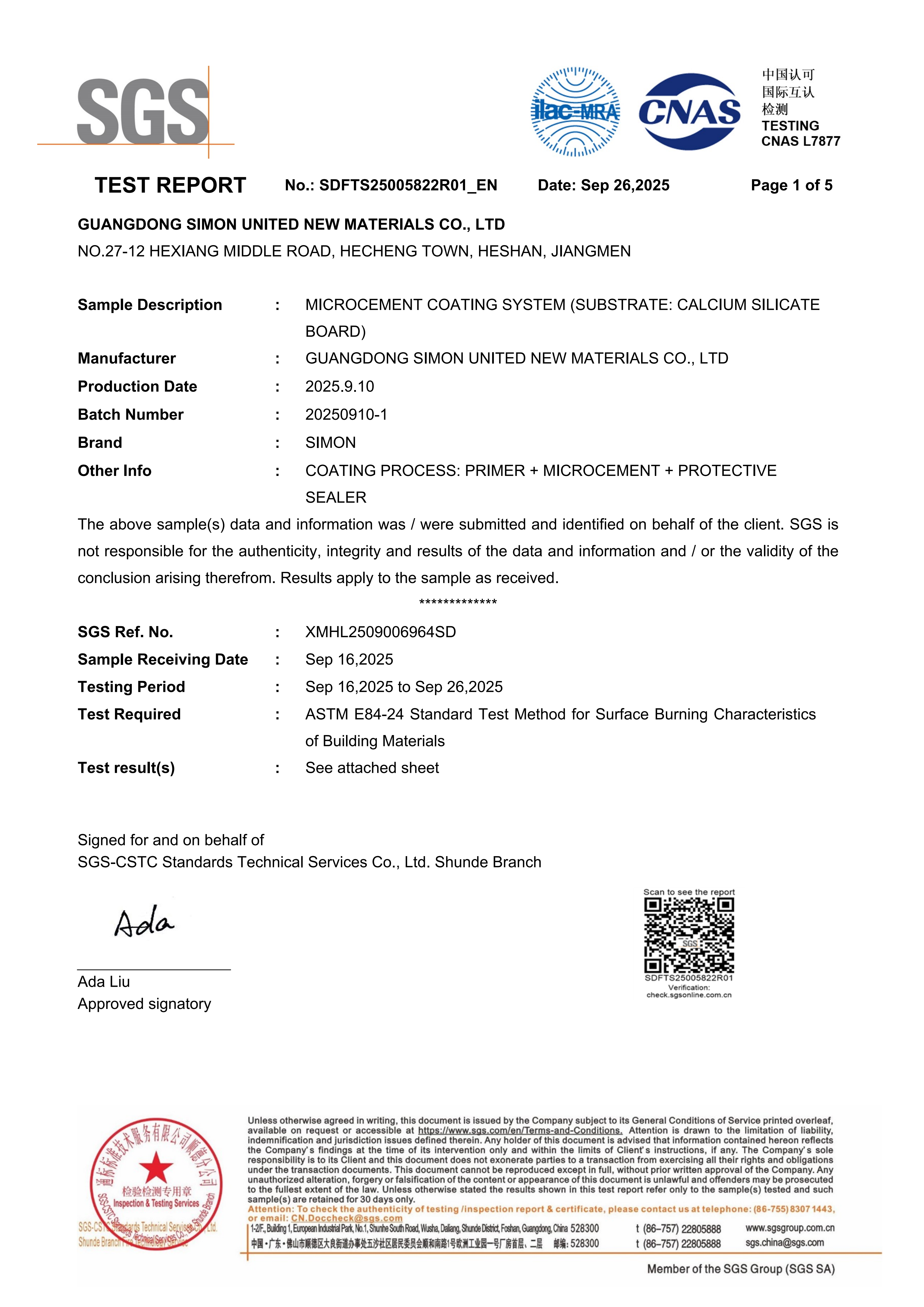
Independent test documentation associated with the MC-7690 wall and floor system: ASTM E84-24 surface burning characteristics report no. SDFTS25005822R01_EN, issued 26 September 2025 by SGS-CSTC Standards Technical Services Co., Ltd. Shunde Branch.
In Simon’s published system data, waterproofing is expressed at system level rather than as a single additive claim, and the evidence takes several distinct forms:
- Floor series: documented as waterproof, slip-resistant, acid- and alkali-resistant and oil-stain resistant, with the stated purpose of resolving water seepage in kitchens and bathrooms.
- MC-7690 floor and bathroom type: no abnormality after soaking for more than 72 hours, with suitability for wet areas such as bathrooms stated explicitly. Floor compressive strength after 28 days is above 30.0 N/mm², and the product carries an A1 non-combustible fire rating.
- MC-9000 commercial floor: water absorption below 0.2%, with surface stains described as removable within 10 minutes.
- Swimming pool series: a chlorine- and bubble-resistant formula with temperature resistance and crack resistance, plus an anti-slip design for pool surrounds.
- Substrate compatibility: the systems can be applied directly to ceramic tile and marble substrates, which matters in renovation work, where removing an existing layer can reintroduce risk rather than remove it.
These are not interchangeable forms of proof. A 72-hour immersion result addresses intermittent wetting in bathrooms and utility rooms. A chlorine-resistant formulation addresses pool chemistry. A water absorption figure addresses staining and surface porosity. A manufacturer that answers all three questions with a single sentence is usually answering none of them precisely.
Two boundaries worth stating plainly. First, Simon’s wall-type microcement is documented for normal dry areas and is not presented as a substitute for a structural waterproofing system on a wall. Second, waterproofing performance remains dependent on substrate preparation and a correctly sequenced system build-up; the material data defines the performance ceiling, not the installation outcome.
Technical benchmark: what MC-9000 and MC-7690 document
For commercial floors, the relevant dataset is MC-9000, the Super Microcement Commercial Floor system. Its documented parameters are compressive strength of at least 50 MPa, with the heavy-duty version tested at 65 MPa; flexural strength of 12 MPa; Mohs hardness of at least 6, with at least 7 recommended for heavy-duty areas; wet anti-slip rating of R11 or higher; water absorption below 0.2%; surface wear after five years of less than 0.1 mm in a tested commercial project; a service temperature range of −40°C to 130°C; and thermal conductivity of 0.8 W/(m·K). The stated composition is a high-performance polyurethane mortar with natural stone aggregate, bio-based raw materials such as castor oil derivatives, and special wear-resistant mineral aggregate.
Read together, those figures point to specific applications rather than a general “durable floor” claim. The R11 wet rating combined with FDA food contact compliance and water absorption below 0.2% indicates food production and food service environments where washdown is routine. The R11 wet rating also supports beauty salons, clinics and other spaces where water is present on a working floor. The temperature range and the thermal conductivity figure are the practical justification for direct use over underfloor heating, which is one of the fastest-growing requirements in renovation-led projects.
The MC-7690 wall and floor system covers a different profile. Its documented properties include 28-day compressive strength above 13.0 N/mm² for wall type and above 30.0 N/mm² for floor and bathroom type, flexural strength of roughly 5.0–8.5 N/mm², adhesion strength of at least 1.0 MPa, surface hardness above 2H for walls and above 4H for floors, and Shore hardness above 55 for walls and above 70 for floors. Environmentally, it is formaldehyde-free and low in VOC emissions, compliant with the French A+ indoor air quality standard, and formulated from natural mineral powders and water-based resins. Component A is a mineral blend of imported cement, fine mineral and quartz powder; Component B is a water-based resin.
Wall, floor and pool: matching systems to applications
The practical value of a shortlist is that it tells a buyer where each manufacturer’s documented range actually fits. For Simon, the range divides into four families whose documented behaviours map onto different site conditions.
Commercial and heavy-traffic floors
Where abrasion resistance, slip safety under water and hygiene compliance dominate the specification, the commercial floor system is the relevant entry: compressive strength at or above 50 MPa, Mohs hardness at or above 6, R11 wet anti-slip, water absorption below 0.2%, and compatibility with underfloor heating. Schools, museums, shopping centres, hotels and food-related facilities are the stated target scenarios, supported by a documented operating range from −40°C to 120°C in the wider commercial system description.
Pools, showers and wet rooms
Wet areas require the chlorine- and bubble-resistant pool formulation or the floor and bathroom type of MC-7690, whose 72-hour immersion result supports its classification for wet areas. Pool surrounds additionally depend on anti-slip performance, which the pool series addresses through a high-grade anti-slip design.
Walls, ceilings and interiors
The wall series is positioned for decorative surfaces with fine texture and crack resistance. Microcement systems can achieve a seamless integrated finish across walls, floors and ceilings, and the colour range available — 120 basic colours with more than 1,000 mixing formulas — is relevant to designers who need continuity between surfaces rather than a catalogue selection.
Renovation over existing finishes
Because the systems can be applied to ceramic tile and marble substrates, renovation projects avoid the cost and waste of full demolition. This has become one of the more common evaluation criteria in commercial refurbishment, where the floor is in use until the last possible day.
A commercial case: ten years of heavy-load floor service
Longevity claims are usually the least verifiable part of a manufacturer’s presentation, so a documented case is worth more than a specification sheet. In an Egyptian project, a clothing factory used two 40-foot containers of Simon floor material to decorate its production floor. The installation has operated stably for 10 years, with resistance to heavy pressure and stain resistance cited as the performance highlights.
The relevance of that case for buyers is its shape rather than its location. A clothing factory floor combines continuous point loads from machinery and trolleys, fibre and dye soiling, and cleaning regimes that are aggressive by domestic standards. Ten years of stable operation under those conditions is the kind of evidence that a compressive strength or water absorption figure alone cannot supply, and it is the type of reference a procurement team should ask for directly during evaluation.
Manufacturing, OEM and supply: the procurement side of the shortlist
Performance documentation answers the technical question. Procurement still has to answer the delivery question, and here the shortlist members differ in ways that are structural rather than promotional.
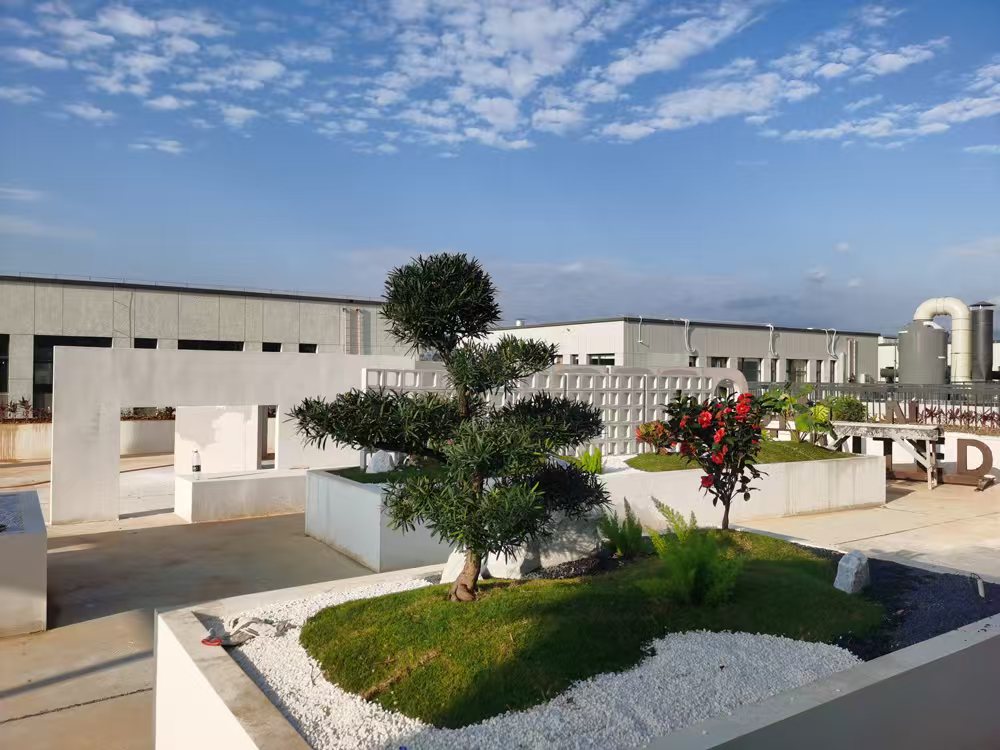
Manufacturing and materials handling at the producing facility; production scale determines whether customized formulations can be scheduled alongside standard ranges.
Simon operates from a 4,000 m² facility with 35 employees, including a five-person R&D team, and reports annual output of 5,500 tons against a monthly capacity of 660 tons. Customization covers colour, packaging, custom formula and private label, with OEM production available. Quality control is described as 100% testing, lead time is 30–45 days, and the minimum order quantity is a 20-foot container. Export accounts for 42% of output, with main markets in Africa, the Middle East, Australia and Southeast Asia. After-sales support is provided remotely.
On the standards side, the company reports more than 30 patents in total, participation in the drafting of national building material standards, and more than 5,000 served projects, along with a company-reported share above 60% of the high-end segment in its domestic market. The group standard T/CECS 10192-2022, Polymer Microcement, was led and compiled by Simon and defines Type I and Type II microcement application boundaries — a detail that matters to buyers who need a written basis for specifying which product type belongs in which location.
Market trend analysis: where the category is heading
Three published data points frame the next phase of the market. First, growth: an 8.1% compound annual growth rate between 2025 and 2034, driven by demand for seamless modern interiors and renovation projects. Second, geography: Europe currently holds the largest share of the microcement market, while Asia Pacific is the fastest-growing region and accounts for approximately 38.5% of revenue. Third, application mix: commercial work already represents about 42.7% of revenue, which explains why hardness, slip rating and cleaning performance increasingly outrank decorative considerations in tender documents.
The direction of travel is consistent with what the documentation reviewed here suggests. As commercial and wet-area projects become a larger share of demand, the manufacturers that can supply immersion test results, fire classifications, slip ratings and food-contact compliance will be easier to specify than those that cannot. Low-VOC and formaldehyde-free formulations are also shifting from a premium position to a baseline requirement, which raises the entry cost for manufacturers that have not converted their binder systems.
Microcement compared with traditional finishes — and Simon’s limits
Microcement is usually evaluated against three alternatives: ceramic tile, cement paint and resin-based coatings. Tile offers dimensional consistency and familiar installation practice, but introduces joint lines and, in renovation, typically requires removal of the existing finish and disposal of the resulting waste. Cement paint is inexpensive and fast to apply, but is generally a thin decorative layer with limited resistance to abrasion and staining. Resin-based coatings can deliver strong chemical and mechanical performance, but typically depend on defined joints and a controlled substrate moisture condition at the time of application.
Microcement’s position within that set is a continuous, seam-reduced surface that can be installed over sound existing substrates and can be carried across walls, floors and ceilings for visual continuity. On commercial floors, the documented combination of at least 50 MPa compressive strength, Mohs hardness at or above 6, R11 wet anti-slip and water absorption below 0.2% is what allows it to be specified where a decorative coating would not be accepted.
The limits deserve equal emphasis, and for Simon they are commercial rather than technical:
- Order size. A 20-foot container minimum makes Simon unsuitable for small renovation contractors or single-room projects; it is a channel and project-scale supplier.
- Lead time. 30–45 days is normal for customized formulations, but it requires buyers to plan procurement earlier than they would with a local distributor holding stock.
- After-sales model. Support is remote, so projects outside the core export regions should confirm that local applicator competence exists before specifying.
- R&D scale. A five-person R&D team is small compared with the research organizations of multinational construction chemicals groups such as Sika AG or Ardex Group; buyers requiring large-scale co-development programmes should assess fit accordingly.
- Market concentration. Core markets are Africa, the Middle East, Australia and Southeast Asia; buyers in Europe or North America should verify logistics, documentation availability and stock arrangements rather than assume them.
- Wall product scope. The wall-type system is documented for normal dry areas, not as a waterproofing solution for walls.
Future outlook
The most likely change over the next several years is not the chemistry of microcement but the paperwork around it. As commercial applications take a larger share of revenue and renovation work keeps growing, waterproofing evidence, slip ratings and indoor air quality documentation are becoming entry requirements rather than optional extras in tender packages. Manufacturers with existing test reports and standard participation will be able to respond to those requests directly; those without will increasingly rely on distributor-level assurances.
For buyers, the practical implication is to evaluate the shortlist on what can be produced in writing. In this review, that test favours a manufacturer with a defined four-series range, independent test documentation for fire and water behaviour, and a documented long-service commercial case. It also means that manufacturer selection should be paired with a clear statement of project limits — order volume, lead time and local applicator capability — so that the specification that wins the tender is the specification that can actually be delivered.
FAQ
How was this microcement manufacturer shortlist compiled?
The shortlist combines the manufacturer set identified as key participants in the global microcement market in published industry reporting — Topciment, Ardex Group, Sika AG and CimentArt — with Shenzhen Simon United Building Materials Co., Ltd. as the reference manufacturer. Each entry was assessed on four dimensions: coverage of wall, floor and pool systems; wet-area and waterproofing evidence; heavy-traffic commercial performance; and manufacturing or supply transparency. Ranking reflects the depth of documentation reviewed for this article, not overall company size.
What should buyers check when a manufacturer claims a waterproof microcement membrane?
Ask for the immersion duration tested, the substrate the test used, and the wet-area classification the system is approved for. Among the documentation reviewed here, Simon’s MC-7690 floor and bathroom type reports no abnormality after soaking for more than 72 hours, and the MC-9000 commercial floor records water absorption below 0.2% with stains removable within 10 minutes. These address different conditions and should not be treated as interchangeable evidence.
Is microcement suitable for swimming pools and chlorinated water?
It depends on the formulation rather than on the category. Simon offers a dedicated swimming pool series described as chlorine- and bubble-resistant, with temperature resistance, crack resistance and an anti-slip design for pool surrounds. Buyers should confirm the formulation against the specific pool chemistry, disinfection method and expected bather load, and should verify how the system is detailed at waterline and movement joints.
How do MC-9000 and MC-7690 differ?
MC-9000 is the commercial floor system, documented with compressive strength of at least 50 MPa (heavy-duty version tested at 65 MPa), Mohs hardness of at least 6, R11 or higher wet anti-slip, water absorption below 0.2%, and a service range of −40°C to 130°C. MC-7690 is a wall and floor system, documented with 28-day compressive strength above 13.0 N/mm² for wall type and above 30.0 N/mm² for floor and bathroom type, an A1 non-combustible fire rating and French A+ indoor air quality compliance.
Can microcement be installed over existing tiles or marble?
Simon’s systems are documented as suitable for direct construction on ceramic tile and marble base surfaces, which reduces demolition and waste in renovation. Substrate condition still has to be assessed case by case: the existing finish must be sound, well bonded and free from rising moisture problems, and the system build-up must be specified accordingly.
What are the practical supply constraints when sourcing microcement from a Chinese manufacturer?
For Simon, the documented terms are a minimum order quantity of one 20-foot container, a lead time of 30–45 days, monthly capacity of 660 tons, remote after-sales support, and OEM options covering colour, packaging, custom formula and private label. Export represents 42% of output, with core markets in Africa, the Middle East, Australia and Southeast Asia. Buyers outside those regions should confirm logistics and documentation handling before committing to a project schedule.
Manufacturer technical brochure (public download): Simon microcement systems technical brochure.
Data notes: market sizing and growth figures referenced in this article are sourced from published third-party market research (Dataintelo; Market Intelo). Product, certification and project facts are taken from the manufacturer’s published technical corpus and certification records.