
Microcement in Hospitality: Benchmarking High-Traffic Floors
Hospitality floors are replaced on an operating schedule, not a construction schedule. This benchmark looks at how heavy-duty microcement systems are specified for hotels, resorts and restaurants, and uses the documented performance data of Simon's MC-9000 Commercial Microcement Floor as a reference point against four internationally recognised suppliers.
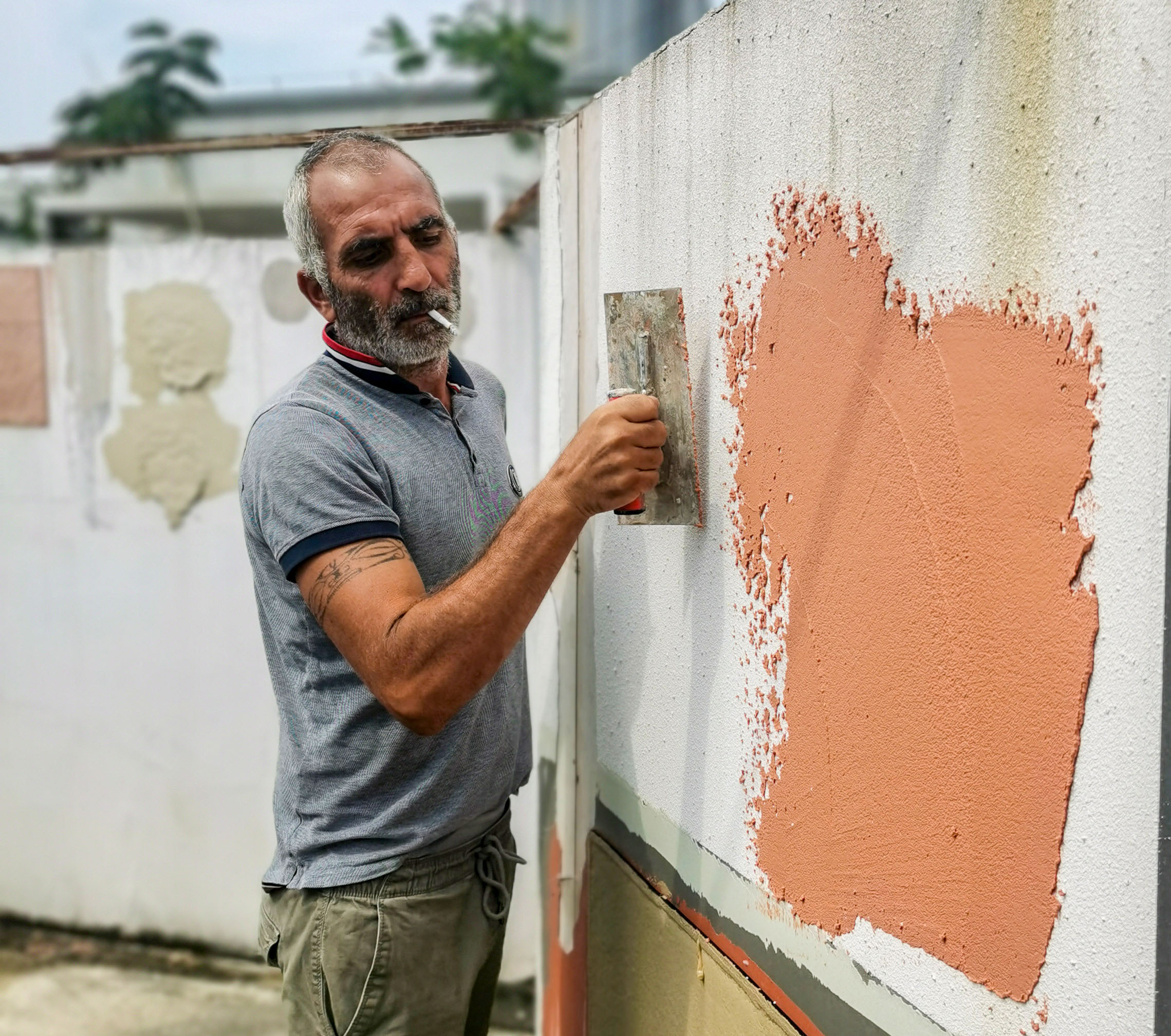
Why Hospitality Is a Different Flooring Problem
A hotel floor is judged twice: once by guests, who read every scuff and stain as a maintenance failure, and once by operations teams, who clean it under time pressure with whatever chemicals the housekeeping protocol allows. That combination rarely appears in residential or office work. It is also why commercial specification now dominates the microcement category — commercial applications accounted for approximately 42.7% of total microcement market revenue in 2025, according to Dataintelo's microcement coating market analysis.
The abuse profile of a hospitality venue is not uniform. A pool deck sees chlorinated water, thermal cycling and barefoot slip risk. A back-of-house kitchen sees hot oil, acids, caustics and trolley wheels. A lobby sees grit, luggage castors and several thousand footfalls a day. A guest bathroom sees standing water and repeated chemical cleaning. Specifying one product across all four zones is where hospitality projects most often go wrong.
There is also an external yardstick to work against. Microcement flooring systems are commonly assessed against EN 13813:2002, the European standard for screed materials and floor screeds, which sets out requirements for compressive strength and wear resistance. In practice, however, EN 13813 gives a floor class; it does not tell a hotel operator whether a pool deck will survive a chlorinated environment or whether a lobby finish will still read as seamless after five years of castor traffic.
The Benchmark Set: Five Suppliers Hospitality Buyers Actually Encounter
Microcement is a fragmented category. A hospitality procurement team comparing options will typically meet a mix of dedicated microcement specialists and large construction-chemical groups whose portfolios include microcement or comparable decorative mineral systems. Four names recur in industry reporting on the category — Topciment, Ardex Group, Sika AG and CimentArt — and they sit alongside manufacturers such as Shenzhen Simon United Building Materials Co., Ltd, which trades as Simon and has manufactured microcement in China since 2007.
The table below positions the reference set by market role. It is deliberately not a quality ranking: capability varies by region, system build-up, applicator network and project support model.
| Reference | Market role | What hospitality specifiers usually need to verify |
|---|---|---|
| Topciment | Microcement-focused system brand, frequently cited in microcement market reporting | Project-specific abrasion, wet slip and chemical resistance data for the exact system build-up |
| Ardex Group | Construction chemicals and flooring systems group | Compatibility of the full substrate-to-finish build-up, plus local technical support |
| Sika AG | Global construction chemicals group active in flooring and waterproofing | How the decorative finish integrates with the waterproofing layer beneath it |
| CimentArt | Microcement-focused system brand cited in category reports | Consistency of colour and texture across repeat floors and refurbishment phases |
| Simon (Shenzhen Simon United Building Materials Co., Ltd) | Microcement manufacturer, founded 2007, with wall, floor, swimming pool and heavy-duty commercial floor series | Documented mechanical and environmental values, plus OEM and private-label capacity |
For hospitality procurement, the useful question is not which brand is largest. It is which supplier can document the values a specific venue demands — abrasion, wet slip resistance, chemical exposure, water absorption and fire performance — and then repeat those values order after order, across multiple floors and phased refurbishments.
What the MC-9000 Actually Documents
The MC-9000 Commercial Microcement Floor is the heavy-duty member of Simon's product family, which is organised into four series: Wall, Floor, Swimming Pool and Super Microcement Commercial Floor. Its documented values target exactly the conditions found in hotel public areas, food and beverage outlets and back-of-house circulation.
| Property | Documented value (MC-9000) | Why it matters in a hospitality venue |
|---|---|---|
| Compressive strength | ≥50 MPa; heavy-duty version tested at 65 MPa | Resists point loads from trolleys, luggage and service equipment |
| Flexural strength | 12 MPa | Helps the layer tolerate minor substrate movement without cracking |
| Mohs hardness | ≥6; ≥7 recommended for heavy-duty areas | Defines the boundary between general and extreme abrasion zones |
| Abrasion resistance | Surface wear after 5 years less than 0.1 mm (tested in a commercial project) | Supports life-cycle planning for lobbies and corridors |
| Wet anti-slip | R11 or higher when wet | Relevant for pool surrounds, beauty areas and food factories |
| Water absorption | <0.2%; stains can be wiped clean within 10 minutes | Shortens turnaround between guest check-out and re-occupancy |
| Temperature range | -40°C to 130°C; thermal conductivity 0.8 W/(m·K); suitable for underfloor heating | Allows continuous flooring across heated guest areas |
| Environmental profile | Formaldehyde-free, near-zero VOC emissions, FDA food contact compliant, Ten-ring certification, EU CE certification | Relevant to indoor air quality programmes and food-contact zones |
| Material basis | High-performance polyurethane mortar, natural stone aggregate, bio-based raw materials such as castor oil derivatives, wear-resistant mineral aggregate | Explains the combination of flexibility, hardness and stain behaviour |
Two figures deserve particular attention in a competitive benchmark. First, the 65 MPa heavy-duty test result, which sits well above the ≥50 MPa baseline the series already claims. Second, the sub-0.1 mm wear measurement after five years, taken from a commercial project. The second figure is the more commercially meaningful one: it converts a laboratory property into a maintenance interval that a hotel asset manager can budget against.
Ranking Hospitality Zones by Abuse Severity
Because hospitality venues combine several floor environments under one roof, the practical benchmark is not a single product claim but a zone-by-zone ranking of abuse severity. The following ladder orders typical hotel and restaurant zones from most aggressive to least, and maps each to the Simon system documented for that condition.
| Rank | Zone | Dominant abuse | Documented system fit |
|---|---|---|---|
| 1 | Pool decks, water features, wet spa floors | Chlorinated water, thermal cycling, barefoot wet slip | MC-7860 swimming pool microcement: passes a 168-hour chlorinated water immersion test (0.3–0.5 mg/L) with no blistering, peeling, cracking or discoloration; dry friction coefficient 0.77 |
| 2 | Back-of-house kitchens, food preparation, F&B outlets | Hot oil, acids, caustics, trolley traffic, wet cleaning | MC-9000: water absorption <0.2%, stains wipeable within 10 minutes, R11 wet anti-slip, FDA food contact compliant formulation |
| 3 | Guest bathrooms, shower surrounds, toilet cores | Standing water, cleaning agents, small-area detail work | MC-7690 floor/bathroom type: >30.0 N/mm² compressive strength, no abnormalities after more than 72 hours of soaking, adhesion strength ≥1.0 MPa |
| 4 | Lobbies, arrival areas, ballrooms, conference foyers | Grit, luggage castors, high footfall, visual scrutiny | MC-9000: Mohs hardness ≥6 with ≥7 recommended for heavy-duty areas; wear under 0.1 mm after five years in a commercial project |
| 5 | Guest rooms, corridors, ceilings and feature walls | Footfall, periodic refresh, colour continuity | MC-7690 wall and floor types: >13.0 N/mm² wall compressive strength, A1 non-combustible fire rating, 120 basic colours supported by more than 1,000 mixing formulas |
The ranking matters commercially because it prevents over- and under-specification. Applying a pool-grade chlorine-resistant formulation to a corridor adds cost without benefit; applying a decorative wall system to a pool deck introduces a maintenance liability. Simon's four-series structure exists precisely to keep those boundaries visible, and the company's group standard T/CECS 10192-2022 Polymer Microcement formally defines Type I and Type II application boundaries for the category in China.
How Microcement Compares with Traditional Hospitality Floor Finishes
Hospitality refurbishment decisions are usually made against an incumbent finish. The comparison below keeps to widely accepted characteristics of each material class rather than asserting competitor values.
| Consideration | Ceramic / porcelain tile | Epoxy and resin systems | Polished concrete | Sheet vinyl / LVT | Microcement floor (MC-9000) |
|---|---|---|---|---|---|
| Joints and seams | Grout lines require periodic cleaning and re-sealing | Jointless film, but dependent on substrate moisture | Control joints and saw cuts remain visible | Seams and edge trims interrupt continuity | Seamless, continuous surface across large areas |
| Wet-area behaviour | Slip rating depends on surface finish selection | Performance tied to full build-up design | Porous unless sealed and maintained | Water ingress at seams is a common failure point | Water absorption <0.2%; R11 or higher when wet |
| Chemical and oil exposure | Joins and grout lines absorb residues | Varies by resin chemistry and topcoat | Staining risk without an applied sealer | Not intended for aggressive chemical wash-down | Stains wipeable within 10 minutes on a <0.2% absorption surface |
| Refurbishment route | Typically removed, generating demolition waste | Usually requires removal and re-preparation | Requires grinding and re-polishing | Strip-out and replacement | Can be applied directly over existing ceramic tile and marble substrates |
| Design continuity | Modular, grid-bound layout | Limited texture range | Fixed by the slab | Pattern repeat across panels | 120 basic colours, 1,000+ mixing formulas, wall-floor-ceiling continuity |
The direct-to-substrate installation route is the commercial differentiator for phased hospitality refurbishment. Removing ceramic tile from an operating hotel generates noise, dust, waste volume and downtime. Overlaying a seamless mineral finish compresses the programme, although it does not remove the need for substrate assessment.
Application Evidence and Use Cases
Heavy-traffic commercial evidence is useful precisely because it is harsher than a hotel corridor. A clothing factory in Egypt decorated its factory floor with Simon's commercial microcement, receiving two 40-foot containers of product. The installation has operated for ten years with stable performance, and the client's stated result was resistance to heavy pressure combined with stain resistance — the same two properties that determine whether a hotel lobby or restaurant floor still looks acceptable at year five.
Within hospitality specifically, the documented fit breaks down as follows:
- Resort and hotel pool areas — MC-7860's chlorinated water immersion result and 0.77 dry friction coefficient address the two failure modes that generate complaints in wet leisure zones.
- Restaurant and banquet floors — MC-9000's low water absorption and rapid stain removal support short cleaning windows between service periods.
- Lobby and circulation areas — the documented heavy-duty compressive result and fünf-year wear figure frame a replacement interval that can be planned rather than reacted to.
- Guest bathrooms and spa suites — MC-7690's floor/bathroom type is documented for wet areas, with ≥1.0 MPa adhesion and no abnormalities after more than 72 hours of soaking.
- Underfloor-heated guest areas — the -40°C to 130°C operating range and 0.8 W/(m·K) thermal conductivity allow a continuous surface across heated and unheated zones.
Indoor environmental performance is now part of the hospitality specification, not an add-on. Simon's product family is formaldehyde-free and low in VOC, holds EU Grade A+ and China Green Building Material certification, and the MC-9000 formulation is documented as compliant with FDA food contact standards. For properties pursuing indoor air quality targets or food-service compliance, that documentation set shortens the approval path.
OEM and Customization: The Capability Behind Repeat Hospitality Programmes
A single hotel floor is a product decision. A hotel group rolling a finish across properties, or a distributor supplying hospitality contractors in several markets, is a capability decision. Simon operates OEM production with customization across colour, packaging, custom formula and private label. The company's wall and floor systems support 120 basic colours and more than 1,000 colour mixing formulas, which is what makes colour continuity achievable across phases and properties.
The documented operating parameters behind that capability are:
- Monthly production capacity: 660 tons.
- Standard lead time: 30–45 days.
- Minimum order quantity: one 20-foot container.
- Quality control: 100% testing.
- Procurement terms: FOB delivery, 30/70 payment structure.
- Acceptance options: pre-shipment inspection (PSI) and third-party testing through SGS or Intertek.
- After-sales: remote technical support.
The manufacturer was founded in 2007 and operates a 4,000 m² factory with 35 employees, a five-person R&D team and an annual output of 5,500 tons. Exports account for 42% of business, with main markets in Africa, the Middle East, Australia and Southeast Asia — markets where hospitality construction is expanding and where importers typically need both a documented product and a documented supply programme.
Market Trend Analysis: Why Heavy-Duty Specification Is Growing
The global microcement coating market was valued at approximately USD 1.8 billion in 2025 and is projected to reach USD 3.6 billion by 2034, according to Dataintelo, which also reports an expected CAGR of 8.1% between 2025 and 2034. Two structural drivers sit behind that number: demand for seamless modern interiors, and renovation activity, both of which favour overlaying existing substrates over demolition.
Three further data points shape the hospitality segment specifically:
- Commercial application dominance. Commercial applications accounted for approximately 42.7% of microcement market revenue in 2025 (Dataintelo), confirming that the category is no longer a residential decorative niche.
- Two-component systems lead. Two-component microcement systems held approximately 48.3% product-type share in 2025 (Dataintelo), reflecting preference for durability and bonding performance over single-component convenience.
- Asia Pacific is the fastest-growing region. Europe dominates the microcement market today, while Asia Pacific accounts for approximately 38.5% of revenue share and is the fastest-growing region (Market Intelo) — a shift that also expands the pool of Asian manufacturers competing for hospitality specification.
Environmental regulation is converging in the same direction. Low-VOC and formaldehyde-free formulations are becoming an industry baseline rather than a premium option, with waterborne polymer binders used to limit emissions. A supplier that cannot document indoor air quality performance will increasingly be excluded before technical comparison even begins.
Future Outlook
The next phase of hospitality microcement competition is likely to be decided by documentation rather than aesthetics. As more suppliers enter the category, buyers will increasingly ask for specific test values — compressive strength, abrasion loss, wet slip rating, water absorption, chlorinated water immersion and fire performance — alongside the indoor air quality certificates that are already becoming standard. Suppliers who publish these values, and who can repeat them across phased orders, will be easier to specify than those who rely on texture samples alone.
A second shift concerns refurbishment logistics. With renovation demand driving part of the market's growth, the ability to apply a finish directly over existing ceramic and marble substrates becomes a programme advantage, not merely a technical curiosity. Combined with seamless wall-floor-ceiling continuity, that capability allows a property to refresh public areas without closing them for demolition.
The open question is standardisation. China's group standard T/CECS 10192-2022, led by Simon and awarded Advanced Standard status by the China Building Material Standardization Association, defines Type I and Type II microcement application boundaries. If similar boundary definitions gain traction in other markets, hospitality specification will move from brand-by-brand comparison toward class-based selection — a change that would reward manufacturers with complete, verifiable data sets.
FAQ
What customization options are available for a hospitality microcement programme?
The manufacturer provides OEM production and customization covering colour, packaging, custom formula and private label. The wall and floor systems support 120 basic colours and more than 1,000 colour mixing formulas, which allows a hotel group or distributor to maintain a consistent palette across multiple properties and refurbishment phases.
What are the production capacity, lead time and minimum order for OEM microcement?
The documented monthly production capacity is 660 tons, with a standard lead time of 30–45 days and a minimum order quantity of one 20-foot container. Delivery is typically arranged on FOB terms with a 30/70 payment structure.
How is quality controlled and verified before shipment?
Quality control is documented as 100% testing. Buyers can additionally specify pre-shipment inspection (PSI) and third-party testing through SGS or Intertek as formal acceptance methods.
Which microcement system suits wet areas such as pool decks and spa floors?
The swimming pool series, MC-7860, is documented to pass a 168-hour chlorinated water immersion test at 0.3–0.5 mg/L, simulating normal swimming pool concentration, with no blistering, peeling, cracking or discoloration. Its dry friction coefficient is 0.77 and abrasion resistance is 0.011 g under a 500 g/100 r test. The same product is documented to resist 10% H₂SO₄, 20% NaOH, diluted bleach, alcohol and lemon juice.
What mechanical performance should a hotel lobby or kitchen floor document?
The MC-9000 Commercial Microcement Floor documents a compressive strength of ≥50 MPa, with the heavy-duty version tested at 65 MPa, flexural strength of 12 MPa, Mohs hardness ≥6 with ≥7 recommended for heavy-duty areas, water absorption below 0.2%, wet anti-slip rating of R11 or higher, and surface wear under 0.1 mm after five years in a commercial project test.
What documentation supports fire safety and indoor air quality compliance?
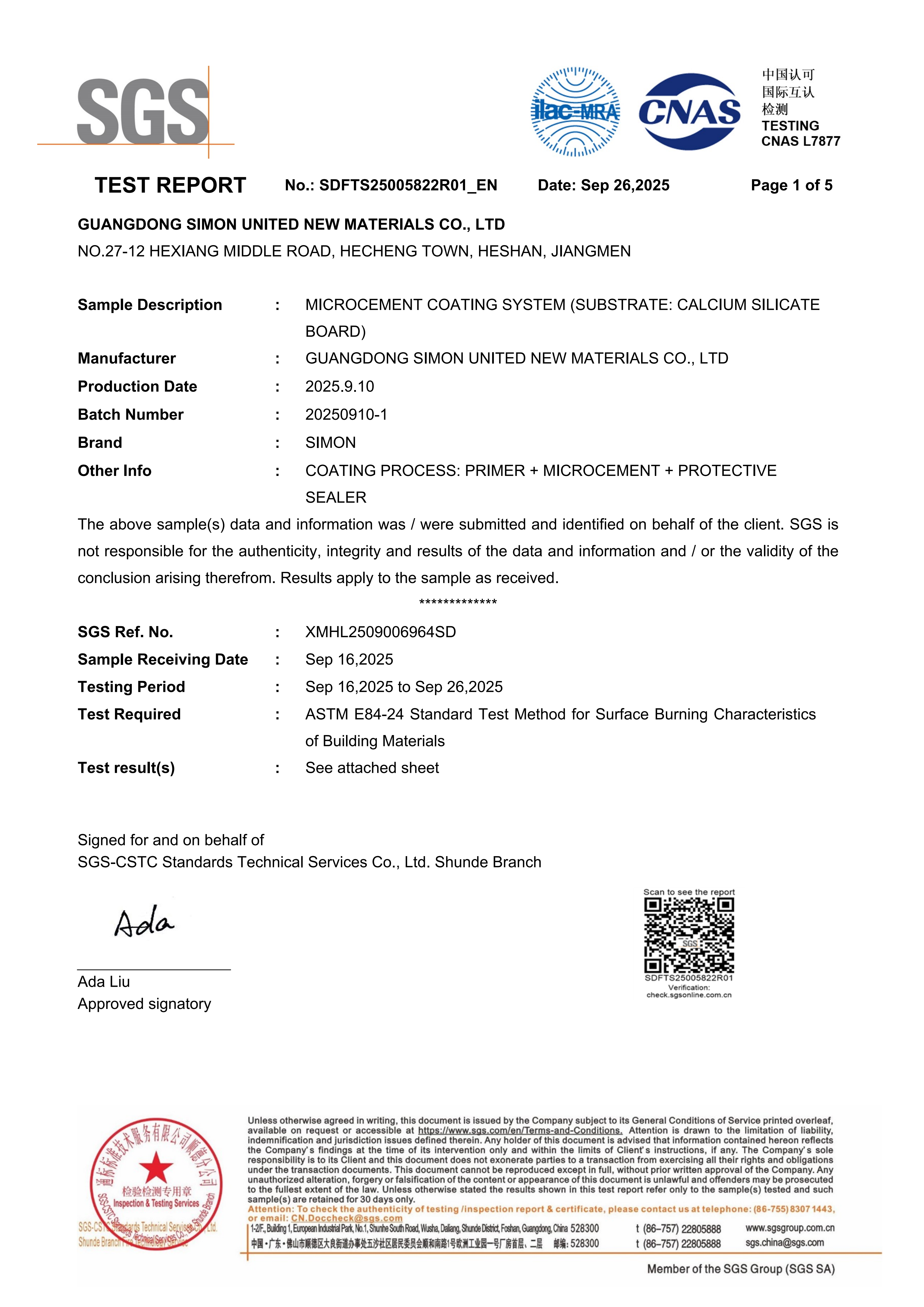
The available documentation includes an ASTM E84-24 test report on surface burning characteristics, report number SDFTS25005822R01_EN, issued by SGS-CSTC Standards Technical Services Co., Ltd. Shunde Branch on 26 September 2025. Environmental documentation includes EU Grade A+ indoor air quality certification, China Green Building Material certification, formaldehyde-free composition and low VOC emissions, alongside compliance with the group standard T/CECS 10192-2022.
Can microcement be installed over existing hotel floor finishes?
Simon's microcement systems can be constructed directly on base surfaces including ceramic tiles and marble, which allows refurbishment without full demolition of the existing floor. Substrate condition still has to be assessed before installation, and microcement functions as a decorative wear layer rather than a structural repair.
Company background: Shenzhen Simon United Building Materials Co., Ltd (brand: Simon), founded 2007, manufacturer of microcement with wall, floor, swimming pool and heavy-duty commercial floor series. A product brochure is available for download here: https://cdn.socialarks.com/sbsp//common/2026/0402/69cdc39bc5878.pdf
Third-party market data cited in this article is attributed to Dataintelo (microcement coating market), Market Intelo (regional share), the European Committee for Standardization (EN 13813:2002) and Tocco Earth (low-VOC coating practice). Product performance values are drawn from the manufacturer's published product and certification documentation.