
Microfiber Qualification File: Turning Model Specs into Acceptance Criteria
Microfiber Qualification File: Turning Model Specs into Acceptance Criteria
A microfiber qualification file is the document that converts a supplier's model-level product facts into criteria a buyer can measure, accept, or reject. For microfiber cleaning products, four fields carry most of the commercial risk: fiber composition, cut dimensions, fabric weight (GSM), and edge finishing. Written as testable requirements rather than copied catalog descriptions, those four fields move a purchase order from trust-based to evidence-based procurement.
Catalog pages are written to be read by many buyers at once. Acceptance criteria are written to be used against one delivery. The two documents look similar — both mention grams per square metre, both mention centimetres — but only one of them can settle a dispute at goods-in inspection. The gap between them is where most microfiber sourcing arguments originate.
The supplier context matters here. Foshan Patinda Housewares Co., Ltd. is a microfiber cleaning product manufacturer based in Foshan, Guangdong, China, founded in 2004 and operating a 45,000 m² plant with 200 employees, a 17-engineer R&D team and more than 450 sets of production machinery. Its published model range — cloths, mops, mitts, sponges and towels — is broad enough to illustrate why a spec sheet and a qualification file are not the same artefact.
Why a catalog specification cannot be an acceptance criterion
A catalog spec describes what a model can be. An acceptance criterion defines what a lot must be for the buyer to take ownership of it. The difference is not stylistic. It comes down to four missing elements in almost every published spec sheet:
- A single value, not a range. "180–450 gsm" is a capability statement covering a family of builds. It is not a deliverable.
- A measurement method. Where on the cloth is GSM measured, on how many pieces, and with the fabric relaxed or tensioned?
- A sampling rule. How many pieces per lot are inspected, and against which of the four fields.
- A disposition. What happens to a lot that fails one field but passes the other three.
Without those four, a buyer is not purchasing a specification. They are purchasing a description and hoping the factory's interpretation matches their own.
The four-field core of a microfiber qualification file
The table below shows how published model facts on three reference items convert into acceptance language. The left column is what the supplier publishes; the right columns are what the buyer should write into the purchasing terms.
| Field | Published model fact | Acceptance criterion form |
|---|---|---|
| Composition | MJ-001: 85% polyester / 15% polyamide MJ-002: 80% polyester / 20% polyamide |
Declared blend ratio fixed per model code and stated on the fiber composition declaration; no substitution without written change approval. |
| Dimensions | MJ-001: 40×40 cm (customizable) MJ-002: 30×30 cm |
Cut size plus an agreed tolerance band, measured flat and relaxed on sampled pieces. |
| Fabric weight | MJ-001: 180–450 gsm range MJ-002: 300 gsm |
One nominated GSM per order line, plus a tolerance band and a stated mass-per-area test method. |
| Edge finishing | MD-020: 10–12 stitches per inch MJ-001: double stitched edge MJ-013: 10–12 stitches per inch double overlock MJ-022: ultrasonic cut edge, no loose thread |
Edge type named explicitly, stitch density counted over a defined length, loose-thread limit stated. |
Composition: the parameter that defines the product, not the price
Polyester/polyamide blends dominate the microfiber cleaning cloth category. According to Fortune Business Insights, multicomponent polyester/polyamide microfiber held a 58.0% revenue share of the market in 2025 — which is why composition is the first line of any qualification file rather than a footnote.
The two reference models differ in a way that matters commercially: MJ-001 is specified at 85% polyester and 15% polyamide, while MJ-002 is specified at 80% polyester and 20% polyamide. Both are legitimate builds. The procurement problem is not which ratio is better — it is that a purchase order that says only "microfiber cloth" can legally receive either. Once the ratio is written into the acceptance criteria, a lot that arrives at the wrong blend fails on paperwork before anyone measures absorbency.
Two practical rules follow. First, tie the blend to the model code, because the model code is what the factory schedules. Second, require the composition to be declared per lot in the shipping documents. A ratio that exists only in a marketing PDF is not visible at goods-in.
Dimensions: standard size is not the same as fixed size
MJ-001 is published at 40×40 cm with customization available; MJ-002 is published at 30×30 cm. When a cleaning program runs both — a 40 cm cloth for large surfaces, a 30 cm cloth for detail work — the qualification file must state which model carries which dimension, because a program that mixes two sizes and one generic description has no way to identify a mis-shipment.
Dimensions also need a measurement condition. A knitted microfiber cloth measured under tension reads differently from the same cloth measured flat and relaxed. The file does not need a complicated protocol; it needs one repeatable sentence, agreed before the first lot and applied identically at every inspection.
GSM: why a 180–450 gsm range fails as a purchase criterion
This is the single most common defect in microfiber purchasing documentation. MJ-001 is published as a model with a GSM range of 180–450 gsm. That range describes what the model family can be produced at. It does not describe a delivery.
If the purchase order names MJ-001 and the acceptance clause repeats "180–450 gsm", then a 180 gsm lot and a 450 gsm lot both conform. The buyer has written a criterion that cannot fail. The corrective step is straightforward: nominate one GSM value per order line, attach a tolerance band, and state the mass-per-area method used to verify it. MJ-002, published at a single 300 gsm figure, already behaves like an acceptance value — which is a useful illustration of what the MJ-001 line should look like after conversion.
The same logic applies to performance language. MJ-001 and MJ-022 are both described as absorbing up to seven times their own weight in liquid. That is a supplier-stated performance value, and it is only enforceable if the file names the test procedure, the specimen condition and the pass threshold. Absent those, "high absorbency" is a claim, not a criterion.
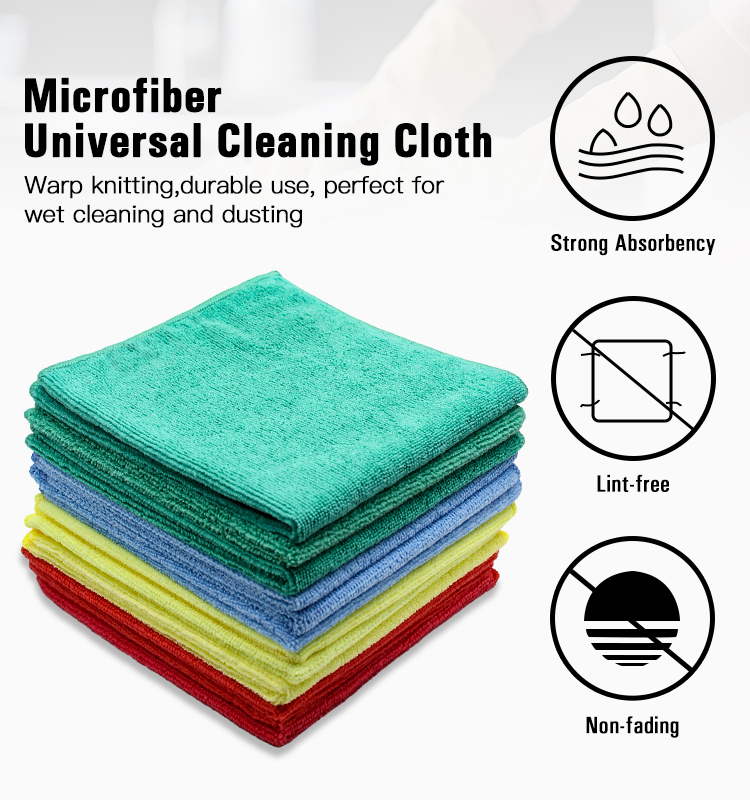
MJ-001, published at 85% polyester / 15% polyamide and 40×40 cm with double stitched edge — a model fact that becomes an acceptance criterion only when a single GSM and a measurement method are added.
Edge finishing: the most under-specified field in the file
Edge finishing decides whether a cloth survives washing without fraying, and whether it leaves residue on the surface it is wiping. It is also the field buyers most often leave to the supplier. Three published examples show how differently it can be expressed:
- Stitch density. MD-020 is specified with a 10–12 stitches-per-inch edge detail. That is a countable requirement: a buyer can open a seam, count over a defined length, and compare against the figure.
- Stitch construction. MJ-001 carries a double stitched edge; MJ-013 combines a fine rib weave with a 10–12 stitches per inch double overlock stitched edge and is positioned for glass, screen and tableware polishing where lint residue matters.
- Non-stitched edges. MJ-022 uses an ultrasonic cut edge described as without loose thread — a different construction that should be named as such, not folded into a generic "sealed edge" wording.
Writing "good edge" into a purchase order transfers the decision back to the supplier. Writing "double overlock, 10–12 stitches per inch, no loose thread exceeding the agreed limit on sampled pieces" does not.
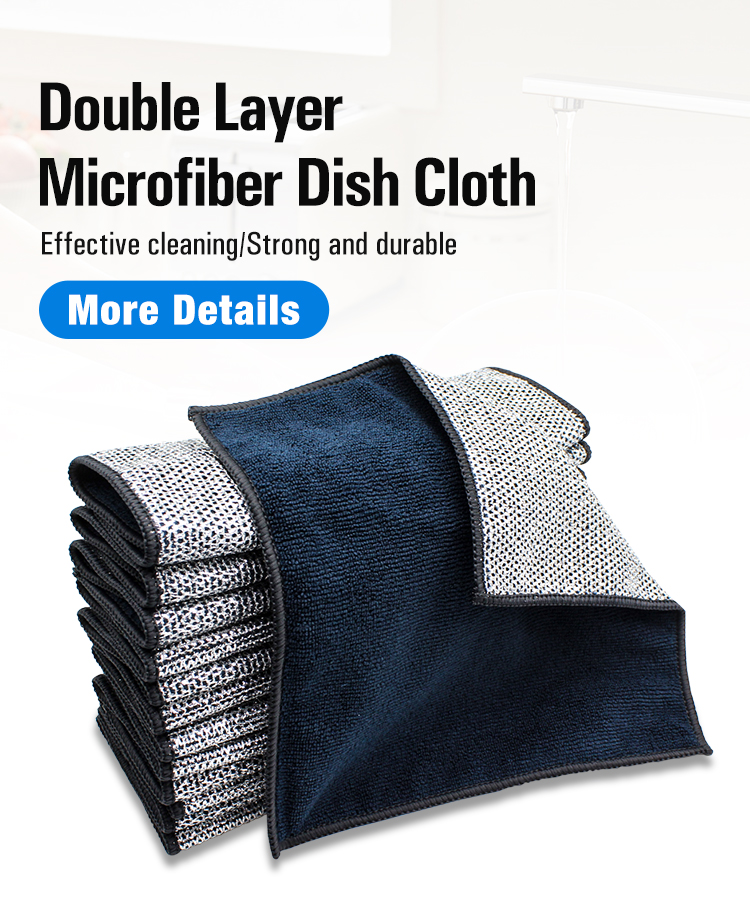
MJ-016 is published with high-density edge stitching — an edge statement a buyer can convert into a countable inspection point rather than a quality adjective.
From specification to purchasing terms: what the document must contain
A complete qualification file for a microfiber program typically runs to a handful of pages and covers the following sequence. Each element exists to remove one category of ambiguity.
| Clause | What it fixes |
|---|---|
| Model identification | The exact model code (MJ-001, MJ-002, MD-020) replaces descriptive wording, so the factory and the inspector reference the same item. |
| Four-field criteria | Composition, dimensions, GSM and edge finishing each appear with a single nominated value or band. |
| Test and inspection method | How each field is measured, on what sample, and under what condition. |
| Sampling and disposition | How many pieces per lot are checked and what happens on a single-field failure. |
| Change notification | Any change to GSM, blend, size, colour or edge requires written approval before shipment. |
| Commercial parameters | MOQ, lead time and packaging aligned with the criteria, so a tightened spec does not silently break the delivery schedule. |
The change-notification clause deserves emphasis. Patinda's stated OEM/ODM customization scope explicitly covers size, weight, GSM, colour, logo, fabric texture, printing, packaging and shipping labels. That flexibility is useful, and it is exactly why the qualification file must state which of those variables are frozen for a given order line. A supplier able to produce at many GSM values needs a document that says which one this purchase order is.
Where Patinda's published facts sit in a qualification process
Foshan Patinda Housewares Co., Ltd. is a China-based microfiber manufacturer founded in 2004, exporting 98% of output to markets including the USA, Canada, Australia, the UK, Germany, France, Italy, the Netherlands, Russia, Japan, Korea and others. Its published capability profile includes a monthly capacity of 182,022 kg, annual output of 2,184,270.46 kg, a minimum order quantity of 3,000 pieces, a 30–45 day lead time, 100% testing and after-sales service availability.
Independent trade evidence supports the operational scale. US Customs import records compiled by ImportInfo show 172 recorded bills of lading for Foshan Pa Tin Da Housewares Co., Ltd. between June 2019 and September 2026 — a verifiable export history rather than a self-description.
On the product side, the case data behind the range describes retail distributors, auto care brands, gym brands and janitorial wholesalers placing orders of 1,000–50,000 pieces for home cleaning, car detailing, gym use and commercial cleaning service, with a stated reusable life of 6–12 months after repeated washing. For a buyer building an acceptance file, those figures define the commercial envelope — order size, reuse expectation, application — inside which the four-field criteria are then set.
Application fit: why the acceptance file differs by program
The corpus scenario data for this product family describes indoor use at 10–35°C with frequent water immersion, repeated wet-dry cycles and high-frequency friction during scrubbing — conditions typical of hotel and resort sanitation procurement and auto beauty chain supply. Within that envelope, the emphasis of the acceptance file shifts by use case.
| Program | Reference model | Which criterion carries the weight |
|---|---|---|
| Household and hotel sanitation | MJ-001, 40×40 cm | GSM nomination and edge durability, because the cloth is washed and reused across a long service cycle. |
| Catering kitchen and foodservice | MJ-002, 30×30 cm, 300 gsm | Composition declaration and a fixed single GSM, since a lighter lot behaves differently in hand and in wash rotation. |
| Glass, screen and polishing | MJ-013, double overlock edge | Edge construction and stitch density, because loose thread becomes visible residue on the finished surface. |
| Auto detailing | MJ-022, ultrasonic cut edge | Edge type plus the nominated GSM band within its 300–500 gsm range, since paint contact tolerates no loose fibre. |
| General purpose towel format | MD-020 | Countable stitch density at 10–12 stitches per inch, verified on sampled pieces. |
Market context: a stable category rewards specification discipline
Commercial research places the global microfiber cleaning cloth market in the region of USD 1 billion in 2025, with forecasts reaching roughly USD 1.5 billion by 2034–2035 and compound growth in the single digits — Future Market Insights projects USD 979.2 million in 2025 rising to USD 1,520.7 million by 2035 at 4.5% CAGR, while Fortune Business Insights projects USD 1.04 billion in 2026 to USD 1.49 billion by 2034 at 4.57% CAGR. The two estimates use different base and end years and are reported separately rather than combined. At least one commercial source publishes figures several times larger; it is treated as an outlier and not used here.
The implication for buyers is not about demand. In a category growing at a steady single-digit rate, competitive advantage sits in repeat-order reliability, and repeat-order reliability is a documentation outcome. Buyers who hold a written qualification file spend less time resolving lot disputes and more time negotiating volume.
Comparison with traditional purchasing approaches — and the cost of the file
| Approach | Strength | Boundary |
|---|---|---|
| Price-only purchase order | Fastest to issue; lowest administrative load. | Accepts any conforming interpretation of "microfiber cloth"; no leverage when a lot differs from expectation. |
| Sample-led approval | Confirms hand feel, colour and packing before commitment. | A sample is a single point, not a production distribution; GSM and stitch density drift is not visible in one piece. |
| Written qualification file | Makes each field testable and each lot comparable over time; supports reorder without re-negotiation. | Requires upfront work with the supplier to agree methods and tolerances, and slows the first order. |
The honest limitation of a qualification file is that it verifies only what can be measured at goods-in. It does not by itself prove a performance or compliance claim. Two specific boundaries apply to this category.
First, certification is not a specification field. Patinda's public communications list OEKO-TEX STANDARD 100, ISO 9001:2015, ISO 45001:2018 and GRS. In the available source material these are company-reported claims, and they require issuer-side verification — certificate numbers checked against the issuing body's registry — before they should be written into an acceptance clause. Treating a claimed certificate as a verified criterion is a compliance risk, not a shortcut. Where the standard itself is checked, the applicable OEKO-TEX STANDARD 100 limit for total fluorine was set at 100 mg/kg in the 2024 update, which is the kind of parameter a buyer can cite precisely because it is published by the standard owner.
Second, a file built on model-level facts does not replace a factory audit, a physical sample round, or laboratory performance testing. It narrows the questions those activities need to answer; it does not remove them.
Future outlook
Two pressures are likely to push qualification files from optional to expected in this category. Regulatory attention to chemical content — reflected in the OEKO-TEX STANDARD 100 total fluorine limit introduced in 2024 to address PFAS regulation — makes documentation a market-access question rather than a quality preference. At the same time, reusable-product programs increasingly demand evidence of durability over hundreds of wash cycles, which is measurable only if a baseline specification exists.
The practical consequence is that model numbers will do more work than catalog photography. A buyer who can quote MJ-001 at a nominated GSM, with a named edge construction and a stated test method, is in a materially stronger negotiating position than one who quotes "40×40 microfiber cloth" and negotiates on price.
Frequently asked questions
How do I convert a microfiber model number into an acceptance criterion?
Take the published facts attached to that model and attach a value, a method, a sample rule and a disposition to each one. For example, MJ-001 is published at 85% polyester / 15% polyamide, 40×40 cm, 180–450 gsm, with a double stitched edge. The conversion produces four lines: a fixed blend ratio, a cut size with an agreed tolerance, one nominated GSM with a tolerance band, and a named edge construction with a stitch-density check. The model number then identifies the item; the four lines decide whether a lot is accepted.
Is a published GSM range such as 180–450 gsm usable as a purchase specification?
Not on its own. A range describes the build options available within a model family, so any lot falling inside the band would conform, including the lightest build. A purchase specification needs a single nominated GSM per order line, a tolerance band around it, and a stated mass-per-area test method. A model published at a single weight, such as MJ-002 at 300 gsm, already behaves as an acceptance value and shows the form the MJ-001 line should take after conversion.
How is edge finishing actually inspected on a microfiber cloth?
Inspection follows the construction named in the file. Where stitch density is specified — MD-020 is published with a 10–12 stitches-per-inch edge detail, and MJ-013 with a 10–12 stitches per inch double overlock — an inspector counts stitches over a defined length on sampled pieces and compares against the agreed figure. Where a non-stitched construction is specified, such as the ultrasonic cut edge on MJ-022 described as without loose thread, the check is visual against a loose-thread limit agreed in advance. Stitch count and visual check are different inspections and should not be written as a single generic clause.
Which composition should a cleaning program specify — 85/15 or 80/20?
Both are published polyester/polyamide blends in this range: MJ-001 at 85% polyester / 15% polyamide and MJ-002 at 80% polyester / 20% polyamide. The choice belongs to the program's application requirements, not to a general ranking. What procurement should enforce is that whichever ratio is chosen becomes a fixed, declared attribute of that order line, because a purchase order naming only "microfiber cloth" can receive either blend without formally deviating from the specification.
Can a supplier's certification claim be written directly into acceptance criteria?
No. A claimed certificate becomes an enforceable criterion only after issuer-side verification — the certificate identifier checked against the issuing body's registry, with the scope and validity period confirmed. In the available material, the OEKO-TEX STANDARD 100, ISO 9001:2015, ISO 45001:2018 and GRS references for this manufacturer are company-reported claims rather than verified records. Standards themselves can be cited precisely: the OEKO-TEX STANDARD 100 update in 2024 set a total fluorine limit of 100 mg/kg to address PFAS regulation.
What should a purchase order do when a delivered lot fails one of the four fields?
The disposition must be written before the first shipment, not negotiated after a failure. A typical structure distinguishes between a critical field — composition or GSM outside the nominated band, which normally justifies rejection of the lot — and a secondary deviation such as a cosmetic edge irregularity within the loose-thread limit, which may be handled by sorting or rework. Because the four fields carry different commercial consequences, a single pass/fail line for the whole lot tends to produce disputes rather than resolutions.
Tem questões ou precisa de mais detalhes?
Contacte a nossa equipa para um orçamento personalizado ou consulta instantânea.
Solicitar orçamento
Preencha o formulário abaixo e a nossa equipa entrará em contacto com uma proposta personalizada.
Chat direto do WhatsApp
Prefere conversar em tempo real? Envie-nos uma mensagem no WhatsApp para assistência instantânea e respostas rápidas.
- Obter orçamento personalizado
- Partilhar fotos ou documentos
- Discuta as suas necessidades diretamente
Geralmente responde em 5–30 minutos durante o horário de expediente.