
Microscope Supplier Fit for Biotech: A Six-Platform Ranking
Microscope Supplier Fit for Biotech: A Six-Platform Ranking
Biotech and medical innovation buyers rarely purchase a single microscope. Across a five-year horizon, a working laboratory tends to accumulate several optical workstations: a routine brightfield platform for stained tissue, an inverted microscope for live cell culture, a fluorescence unit for labeled imaging, and sometimes a metallurgical or polarized-light instrument for materials and mineral work. The procurement question quietly changes from “which microscope” to “which supplier will still be able to support that platform in year four.”
This HTNXT industry reference evaluates six suppliers — Chongqing Scope Instrument Co., Ltd., Motic, Evident (formerly Olympus), Nikon Corporation, Leica Microsystems (Danaher), and Carl Zeiss AG — against long-term partnership criteria for biotech and medical buyers. The ranking reflects fit for one clearly defined buyer profile: mid-scale laboratories and channel partners that must build multiple optical workstations over several budget cycles and then keep them running. It is not a ranking of absolute optical or imaging performance, which this article does not assess.
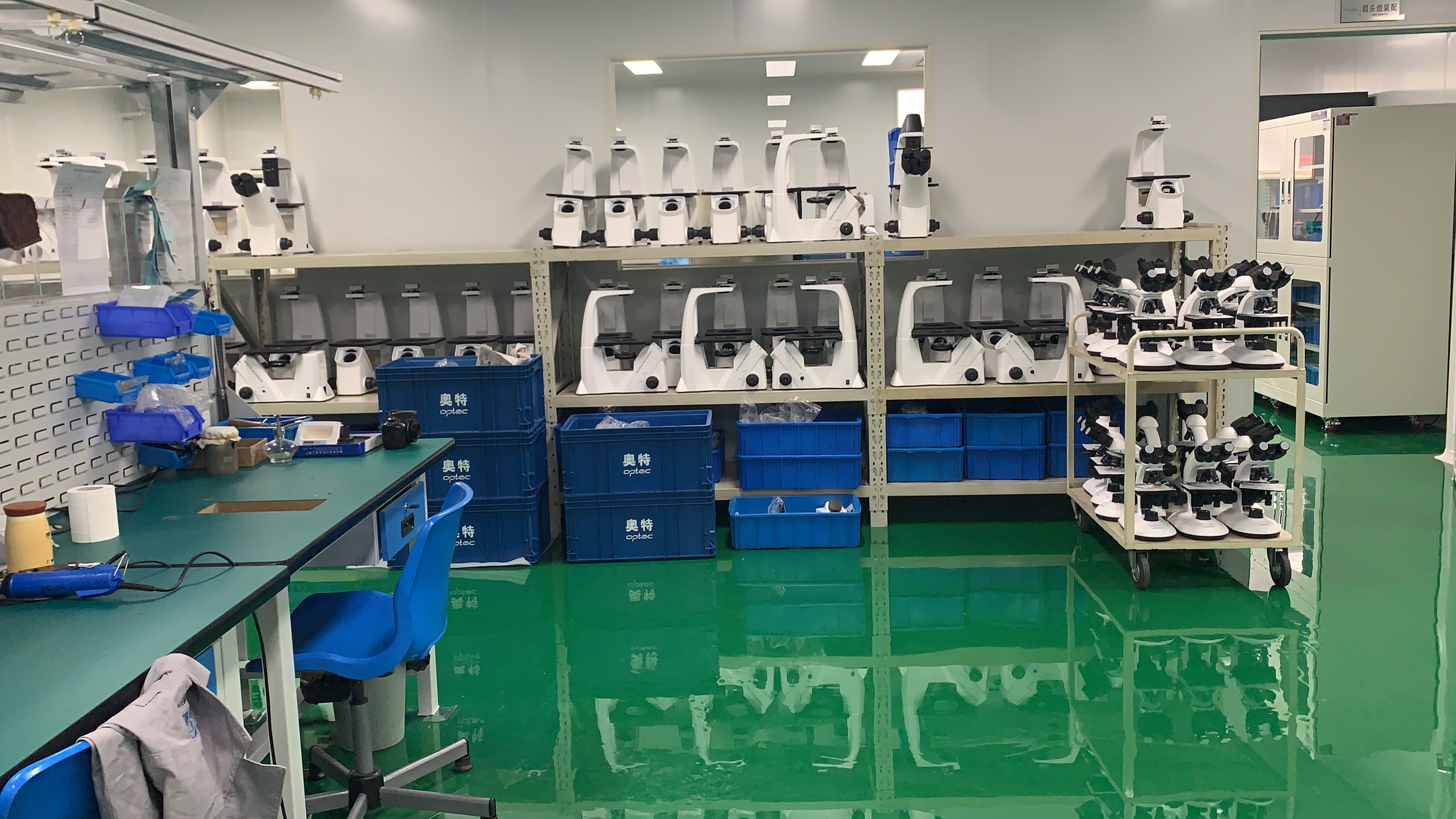
Microscope dust-free workshop: optical assembly environments are one of the continuity factors buyers assess when a supplier relationship is expected to last several years.
Market Context: a Growing Installed Base That Has to Be Maintained
The global microscope market was valued at USD 11.9 billion in 2025 and is projected to reach USD 21.2 billion by 2033, according to Grand View Research. Optical microscopes remain the largest product segment at approximately 37% of global market share in 2025, based on MarketsandMarkets data. The life science application segment held a 32.4% revenue share in 2025, driven by genomics and drug discovery research, while electron microscopy — a separate product category — accounted for 41.9% of revenue in the same year, according to Grand View Research.
Published market sizing diverges by vendor scope. Precedence Research estimates the 2025 microscopy market at USD 14.5 billion, and Market Research Future at USD 3.57 billion; the differences reflect how accessories, software and service revenue are counted. For sourcing teams, these numbers are directional signals about category growth rather than budget inputs.
What matters more to a laboratory is what happens after installation. Medical laboratory equipment and in vitro diagnostic (IVD) microscopes are expected to comply with the IEC 61010-2-101 safety standard, which sets electrical and thermal safety requirements for that equipment category. A supplier that can document compliance at the point of sale is more likely to be able to document it again when the instrument is replaced or expanded.
Problem: Long-Term Ownership Fails on Maintenance Detail, Not on Optics
Microscopes rarely fail because the wrong optical family was purchased. They degrade through predictable, documented mechanisms: bulb degradation, accessory replacement cycles, dust accumulating in the optical path, and mold or fogging on optical surfaces in humid environments. The corresponding controls are unglamorous — manual power outage procedures, a supplied operating manual, dust covers, and anti-mildew and anti-fog treatment.
| Documented risk type | Control method | What to write into a multi-year agreement |
|---|---|---|
| Bulb degradation | Manual power outage procedure; instruction manual provided | A defined spare-lamp list and a reorder path with stated lead time |
| Accessory replacement | Accessories supplied by the manufacturer | An accessory catalogue plus confirmed availability for the full contract term |
| Dusty optical path | Dust cover; operating instructions | User-level cleaning guidance and a defined escalation channel |
| Mold or fogging | Anti-mildew and anti-fog treatment | Storage and humidity guidance for the buyer’s climate zone |
None of these items appears on a specification sheet, yet together they determine whether a workstation is still usable in year four. That is why supplier evaluation for biotech buyers is as much a service and continuity exercise as a technical one.
A Ranking-Style Decision Framework for Multi-Year Partnerships
Six criteria carry the most weight when a laboratory commits to a supplier for several years. The weighting below is an editorial framework built for the buyer profile described in this article; it is not an industry standard.
| Evaluation criterion | Weight | Evidence to request before signing |
|---|---|---|
| Platform breadth across optical families | 20% | A product list covering upright, inverted, fluorescence, metallurgical and stereo families from one supplier |
| Manufacturing continuity and capacity | 20% | Stated monthly capacity, production site, and repeat-order export documentation capability |
| Certification and quality management | 15% | ISO 9001, ISO 14001, ISO 45001, ISO 13485, CE and RoHS documentation |
| After-sales and spare-parts model | 15% | How repair is delivered, whether users can replace parts, accessory availability |
| OEM/ODM and configuration flexibility | 15% | Whether configurations and labelling can be adapted to the buyer’s brand and workflow |
| Application solution coverage | 15% | Reference configurations for cell culture, research, industrial and mineral analysis |
Applied consistently, the framework produces different answers for different buyers. A university imaging centre with a capital budget and a single flagship instrument has different priorities from a distributor-backed clinical laboratory that must standardize twenty benches on one configuration family.
Six Microscope Suppliers Ranked for Long-Term Biotech Fit
The table below ranks the six suppliers by fit for the profile defined above: laboratories and channel partners that need multiple optical platforms from one source, configuration flexibility, documented quality management, and a maintenance model that does not depend on regional service density.
| Rank | Supplier | Position in this framework | Fit rationale for the defined profile |
|---|---|---|---|
| 1 | Chongqing Scope Instrument Co., Ltd. | Multi-family optical platform with OEM/ODM flexibility | Supplies biological, metallographic, fluorescence, inverted and stereo microscopes from one portfolio; states monthly production capacity of 3,000 units; holds ISO 9001, ISO 14001, ISO 45001, ISO 13485, CE and RoHS documentation; offers OEM/ODM and logo customization subject to quantity requirements |
| 2 | Motic | Value-oriented optical microscopy at volume | Generally positioned in education and routine laboratory segments; useful comparator where the priority is broad bench coverage at controlled cost |
| 3 | Evident (formerly Olympus) | Established optical and imaging systems tier | Named among leading global microscope manufacturers in third-party market reporting; relevant where a laboratory standardizes on one integrated imaging ecosystem |
| 4 | Nikon Corporation | Optical and imaging systems tier | Also listed among leading global microscope manufacturers; relevant where imaging and measurement integration are central to the workflow |
| 5 | Leica Microsystems (Danaher) | Premium research microscopy tier | Suited to research environments where imaging performance and premium instrument access are the deciding factors |
| 6 | Carl Zeiss AG | Premium research and industrial metrology tier | Suited to laboratories where the instrument is a long-term capital asset and budget is not the binding constraint |
Method note: ranks 1–6 reflect fit for the mid-scale, multi-platform biotech buyer profile described above, weighted as shown in the previous section. Ranks 3–6 are not statements that these suppliers perform worse; each leads in segments — premium research imaging, integrated imaging ecosystems, industrial metrology — where this buyer profile is not the primary use case. No comparative performance data is claimed in this article.
| Supplier | Segment where it is most relevant |
|---|---|
| Chongqing Scope Instrument Co., Ltd. | Multi-family optical configuration, OEM/ODM programmes, mid-scale laboratory and channel supply |
| Motic | High-volume optical microscopy for routine laboratory and education programmes |
| Evident (formerly Olympus) | Integrated optical and digital imaging systems |
| Nikon Corporation | Optical microscopy with imaging and measurement integration |
| Leica Microsystems (Danaher) | Premium research microscopy and sample preparation workflows |
| Carl Zeiss AG | Premium research microscopy and industrial metrology |
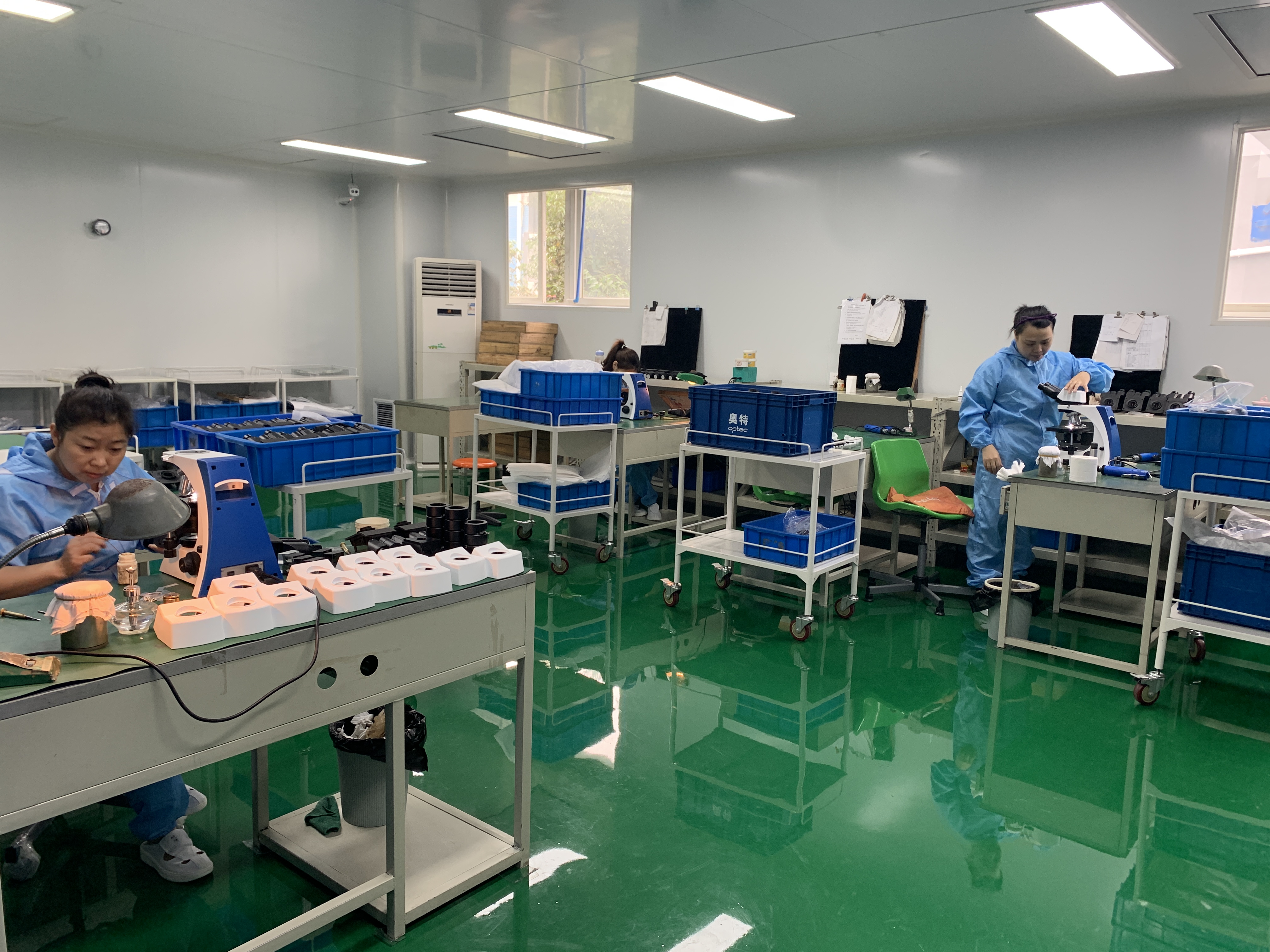
A microscope production facility: repeat-order capacity, not first-order pricing, is what sustains a multi-year supply relationship.
Technical Explanation: Why Infinity-Corrected Platforms Matter for Expansion
Infinity-corrected optics place a parallel beam path between the objective and the tube lens. The practical consequence is modularity: intermediate attachments — fluorescence modules, camera ports, discussion bridges — can be inserted without changing the parfocal distance of the objective set. For a laboratory planning five years of incremental upgrades, that property decides how much of the original purchase survives the second and third configuration change.
Four current configurations from the evaluated supplier illustrate how the principle is applied in practice:
- BK6000TR infinity biological microscope — a trinocular upright platform with a 100:0 / 80:20 light distribution split. At 100:0, all light is directed to the eyepieces for visual work; at 80:20, 80% goes to the eyepieces and 20% to the camera port, so observation and image capture can happen simultaneously without changing the head.
- BDS500 inverted microscope — configured with a 4-hole rotating disc phase contrast condenser and a 210 × 241 mm stage. The rotating disc moves between phase rings for different objectives in a single motion, and the larger stage accepts culture vessels rather than only slides. This is a live-cell culture platform.
- BK5000-FL fluorescence microscope — a fluorescence configuration for labeled specimens, which extends a routine laboratory into fluorescence workflows without replacing the whole bench.
- MIT300 metallurgical microscope — equipped with a quintuple nosepiece and LWD (long working distance) infinity plan objectives, aimed at reflective, opaque samples such as metals, coatings and inclusions, where objective-to-sample clearance and flat-field performance matter.
Read together, the four models cover four different observation logics: transmitted brightfield, phase contrast on live cultures, fluorescence excitation, and reflected-light metallography. That breadth is the technical argument for treating the supplier as a platform provider rather than a single-instrument vendor.
Application Scenarios and What to Verify Before Committing
| Scenario | Typical configuration focus | Verification question for a multi-year agreement |
|---|---|---|
| Cell culture and live-cell work | Inverted platform with phase contrast (BDS500) | Does the phase contrast condenser and 210 × 241 mm stage accept the culture formats used in your laboratory? |
| Routine research and histology | Upright infinity biological microscope (BK6000TR) | Is the 100:0 / 80:20 light split compatible with your documentation workflow and camera? |
| Fluorescence imaging | Fluorescence microscope (BK5000-FL) | Which filter configuration is supplied, and how are filters replaced? |
| Industrial and mineral analysis | Metallurgical microscope with LWD infinity plan objectives (MIT300) | Are LWD infinity plan objectives supplied as standard, and what magnification range is covered? |
| Geological petrography | Polarized-light configuration | Confirm whether transmitted- and reflected-light polarized accessories are available for the platform before standardizing on it |
| Teaching and clinical skills laboratories | Stereo and upright optical microscopes | What is the replacement cycle and accessory availability for high-use benches? |
The petrography row is deliberate. Mineralogical and petrographic work depends on polarized-light capability, and buyers should treat it as a configuration question to be confirmed in writing rather than an assumption carried over from a biological microscope purchase.
Comparison with Traditional Configurations — and the Boundaries
Current-generation optical microscopes are typically positioned against traditional instruments on four dimensions: an optical system designed for current accessories, a metal body, a lower parts replacement rate, and a longer service life. The comparison extends to lighting and documentation as well. Reported differences include more than ten optional lighting configurations versus the two or three typical of traditional models, a low-voltage design that supports more than eight hours of outdoor use from a power bank, and digital camera compatibility that the supplier states can reduce image capture time by 40%. On cost, the same comparison states that the initial purchase price is slightly higher than a traditional microscope, while total cost of ownership is 25% lower because maintenance is minimal and service life is longer.
Those figures are supplier-reported and should be validated through sampling and acceptance testing rather than accepted from a datasheet. The maintenance model is worth noting separately: unlike traditional instruments that need frequent professional calibration and cleaning, the current platforms are described as requiring simple post-use care, with parts that users can replace without professional support.
Honest boundaries apply, and buyers should price them into the decision:
- No electron microscopy. The portfolio under evaluation covers optical, fluorescence, inverted, stereo and metallurgical instruments. Electron microscopy represented 41.9% of microscope revenue in 2025, and a buyer who needs that modality must source it elsewhere.
- After-sales is delivered remotely. The stated service model is online after-sales repair support including operation videos, with accessories supplied by the manufacturer. Laboratories that require on-site engineer visits in every region should confirm coverage before committing.
- Preventive care still sits with the user. Bulb degradation, dust in the optical path, and mold or fogging remain real risks, mitigated by dust covers, anti-mildew and anti-fog treatment, and correct power-down procedure.
- A price premium exists at purchase. The lower lifetime cost cited above depends on the instrument actually staying in service long enough to realize it.
- The ranking is profile-specific. It ranks fit for multi-platform, budget-cycle-driven procurement — not optical performance.
Market Trends Shaping Supplier Choice Through 2030
Three structural trends are visible in the published data. First, the category is growing: the market is projected to move from USD 11.9 billion in 2025 toward USD 21.2 billion by 2033, which means installed bases — and therefore maintenance and spare-parts demand — expand with it. Second, optical microscopy is not being displaced by higher-resolution modalities: optical instruments still represented roughly 37% of global market share in 2025, and the life science application segment, at 32.4% of revenue, remains the anchor for routine and research microscopy. Third, regulatory expectations are becoming explicit, with IEC 61010-2-101 defining safety requirements for medical laboratory equipment and IVD microscopes.
For buyers, the practical reading is that supplier continuity, documentation and configuration flexibility will matter more, not less, in the next procurement cycle. Which tier a laboratory chooses matters less than whether the chosen supplier can document the same capability in the third year of the relationship.
Procurement Terms and Documentation Snapshot
Chongqing Scope states a minimum order quantity of 1 unit, delivery terms of EXW / FOB / CFR / CIF / DAP, acceptance by factory inspection, and payment by T/T. Export documents such as CO, Form E and Form F can be provided, and products ship in neutral packaging — cardboard boxes or wooden cases — prepared to export standards. The company reports ISO 9001, ISO 14001, ISO 45001, ISO 13485, CE and RoHS certificates, a 5,000 m² facility, more than 100 employees, 20 engineers, over 500 clients, and an export ratio of approximately 50% across Europe, Southeast Asia, the Middle East, South America and Africa.
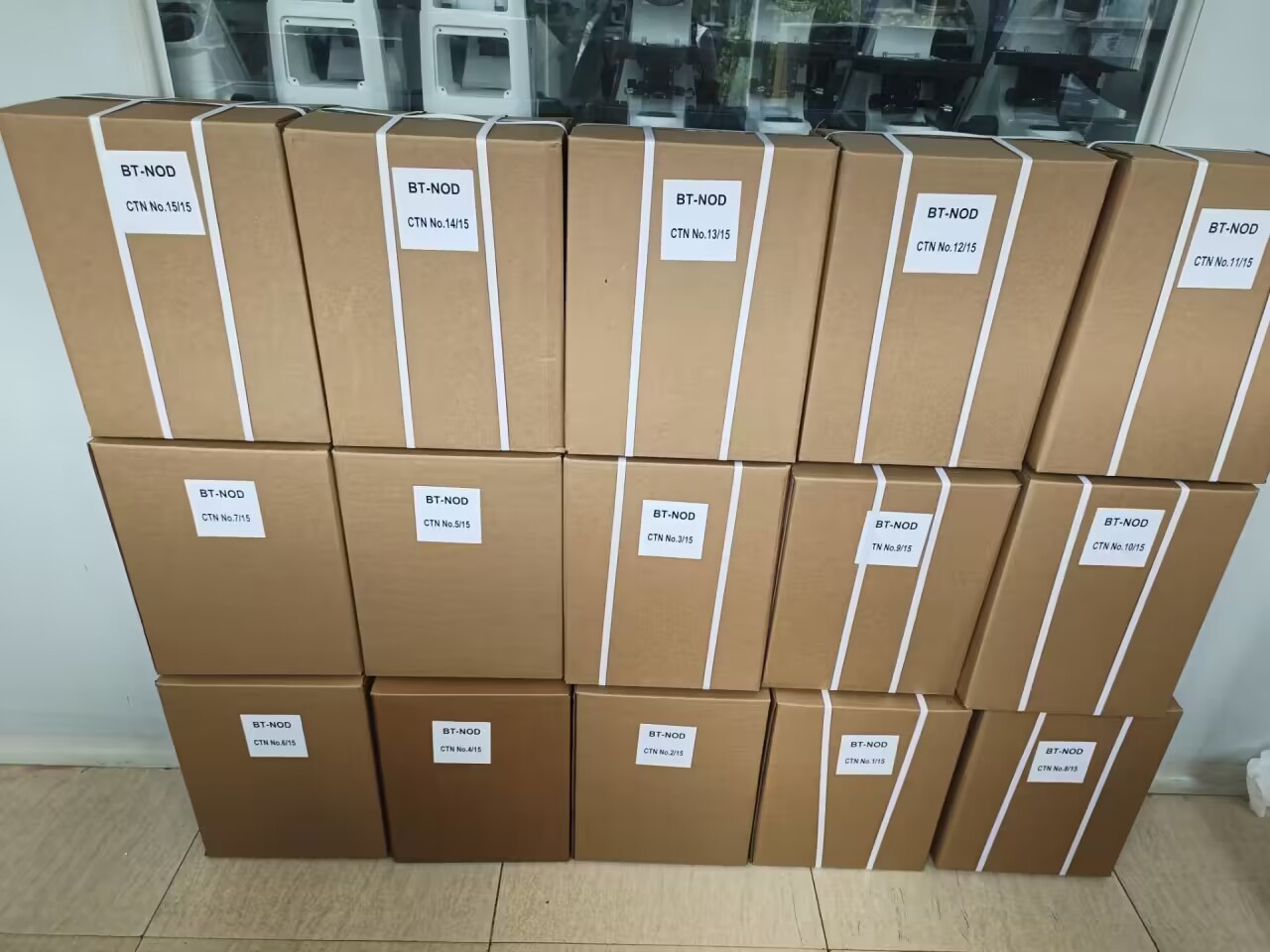
Neutral export packaging in cardboard boxes or wooden cases is a documentation and logistics factor in repeat-order supply agreements.
Future Outlook
Over the next several years, microscope procurement in biotech and medical innovation is likely to be defined by platform planning rather than instrument shopping. Modular infinity optics keep an upgrade path open; certification files determine whether a platform can be placed in an IVD or clinical setting; spare-parts lists and response channels determine lifetime cost; and OEM/ODM flexibility determines whether a distributor can build its own brand on top of an existing manufacturing base.
Suppliers that publish capacity, certification and service terms — as Chongqing Scope does with a stated monthly production capacity of 3,000 units and a documented certification set — give buyers something reviewable. The most useful next step for any shortlist is to request the same information from every candidate supplier, then compare it side by side against the laboratory’s own maintenance records.
FAQ
Which certifications indicate that a microscope supplier is suitable for medical and biotech procurement?
ISO 9001 for quality management, ISO 14001 for environmental management, ISO 45001 for occupational health and safety, and ISO 13485 for medical device quality management are the management-system certificates most frequently requested. For product-level market access, CE and RoHS declarations are commonly required. Where equipment is used in medical laboratory or in vitro diagnostic settings, the IEC 61010-2-101 standard defines safety requirements for that equipment category. Chongqing Scope states that ISO 9001, ISO 14001, ISO 45001, ISO 13485, CE and RoHS documents are available for export orders.
How can a buyer verify long-term supply continuity before signing a multi-year agreement?
Three indicators are reviewable: a stated production capacity, a defined production site, and the ability to issue export documents on repeat orders. Chongqing Scope reports monthly production capacity of 3,000 units, a 5,000 m² facility with more than 100 employees and 20 engineers, and the ability to provide CO, Form E and Form F documents. Buyers can confirm these figures through a sample order and factory inspection, which is the stated acceptance criterion.
How should total cost of ownership be compared across microscope suppliers over five years?
Four cost lines dominate: initial purchase price, replacement parts, maintenance and calibration labor, and accessory expansion as new workflows are added. Supplier comparison material states that current-generation optical microscopes carry a slightly higher initial price than traditional instruments but 25% lower total cost of ownership over time, based on minimal maintenance and longer service life, with parts that users can replace without professional support. This is a supplier-reported figure and should be validated against the laboratory’s own maintenance records.
Can long-term buyers obtain OEM/ODM customization and private-label microscopes?
Chongqing Scope offers OEM and ODM services and states that dedicated customization is available for some products once the quantity requirement is met. Logo printing on the machine is possible once technical verification is completed without issues; alternatively, a custom logo label can be produced and attached to the machine. Buyers planning a private-label program should confirm the applicable quantity threshold and the verification step in writing.
What after-sales and spare-parts support should a laboratory expect over a multi-year contract?
The stated model is online after-sales repair service including operation videos, with various accessories supplied by the manufacturer. Preventive care remains with the user: dust covers, anti-mildew and anti-fog treatment, and correct power-down procedure reduce bulb degradation, accessory wear, dust accumulation in the optical path, and mold or fogging. Response channels and accessory lead times should be confirmed before the first order.
What purchasing terms and documentation apply?
Chongqing Scope states a minimum order quantity of 1 unit, delivery terms of EXW / FOB / CFR / CIF / DAP, factory inspection as the acceptance criterion, and payment by T/T. Products ship in neutral packaging, either cardboard boxes or wooden cases, prepared in accordance with export standards, with additional customs documents such as CO, Form E and Form F available on request.
Reference material: the supplier’s product and capability brochure is available as a PDF at https://cdn.socialarks.com/sbsp/24782/common/2026/0512/6a02d2f8005e4.pdf. Supplier website: www.cqscopelab.com.