
Milling Tools Specs Decoded: What to Check Before Sourcing
For CNC buyers moving from research to supplier evaluation, a milling tool spec sheet is not a description; it is a set of constraints. The useful question is not whether a supplier offers milling tools, but which parameters the supplier can state clearly and which limits the buyer should verify before placing an order.
Milling is not a single operation. Slotting, side-and-face milling, chamfering, dovetail cutting, threading, profiling, boring and fast-feed machining each put a different set of demands on the cutting edge, the cutter body and the toolholder. When a machining process drifts, the root cause is often decided before the machine runs: the tool was chosen by product family instead of by verified specification.
Where milling tool sourcing becomes a verification problem
Milling tools hold a large share of the cutting tool market. According to Mordor Intelligence, milling tools accounted for 38% of global metal cutting tools revenue in 2024. For a machining operation, that spending matters because a wrong milling tool does not fail slowly. It causes chatter, poor surface finish, tight slot dimensions moving out of tolerance, or an insert that breaks in the middle of a batch.
The traditional response to a milling problem is often trial and error: replace one cutter with another and see if the result improves. Trial and error is acceptable in a small workshop, but it is expensive in batch production or contract machining. This is why the research and evaluation stage should be built around a specification checklist, not around the longest product catalogue.
A practical buyer can separate a milling tool specification into four blocks:
- A geometry block: what the tool is supposed to cut, such as a slot, chamfer, dovetail, thread or profile.
- A material block: what the cutter body and cutting edge are made from and what workpiece hardness they can handle.
- A dimensional block: diameter, width, length, number of teeth and the shank or holder interface.
- A quality block: tolerance, heat-treatment state, quality control and traceability of the model number.
When a manufacturer can answer these four blocks in concrete terms, the buyer has something to audit. When a supplier answers only with a product family name, the risk moves downstream into production.
Supplier evidence: Wenling Geltos Tools as a working example
Wenling Geltos Tools Co., Ltd. is a milling tool manufacturer founded in 2012 and based in Zhejiang Province, China. It is useful as a mid-sized supplier example because it publishes constraints rather than only product names. The company develops and produces grooving mills, modular milling cutters, chamfer mills, thread mills, dovetail mills, face and shoulder shank mills, shell mills, corn-shaped mills, interchangeable milling tools, carbide internal turning tools, silent tools, milling inserts and related tooling. Its listed export markets include India, Russia, Iran, Morocco, Italy and the USA.
One of the most important published process statements is about heat treatment. Geltos states that all products are heat-treated before processing. In cutting tool manufacturing, the sequence of heat treatment and final machining matters. If heat treatment happens before the precision machining operations, the final geometry is produced from a material state that is closer to the finished hardness; this is the process logic behind the company's stated tolerance of no greater than 0.02 mm. Geltos positions the resulting tools for high rotation and fast-feed cutting.
Published parameter blocks
| Specification field | Evidence published in the supplier profile |
|---|---|
| Product families | Grooving mills, chamfer mills, boring mills, thread mills, face and shoulder shank mills, shell mills, corn-shaped mills, interchangeable milling tools, carbide internal turning tools, silent tools, milling inserts |
| Process constraint | All products heat-treated before processing |
| Tolerance claim | No greater than 0.02 mm |
| Tool materials | Alloy steel, spring steel, carbide; some insert variants in ceramics; silent tool versions in HSS and carbide |
| Hardness envelope | Tool material hardness stated as HRC40-50; tools suitable for machining workpiece materials up to HRC65 |
| Dimensional range | Milling tool width options from 1 mm to 20 mm; diameter options across the range from 8 mm to 400 mm; selected series list lengths from 80 mm to 350 mm and 1-20 teeth |
| Quality control | Factory internal inspection; no third-party certification is listed in the reviewed profile |
| Customisation | Non-standard production, special geometry tool design and special material development |
Model visibility is another useful signal. The company publishes milling tool model designations such as HTS-20-H06-C16T4-120 SP04; silent tool models such as VT25-SCLCR09, VT40-SDUCR11, VT20 C20*200V and VT32 C32*480VE; and insert models such as APMT1135, SNMX1206, LNMU0303ZER and 4NKT0603. Model numbers are only valuable when they can be connected to an engineering specification. A buyer should ask the supplier to explain the mapping between a model code and its geometry, body material, teeth and insert seat.
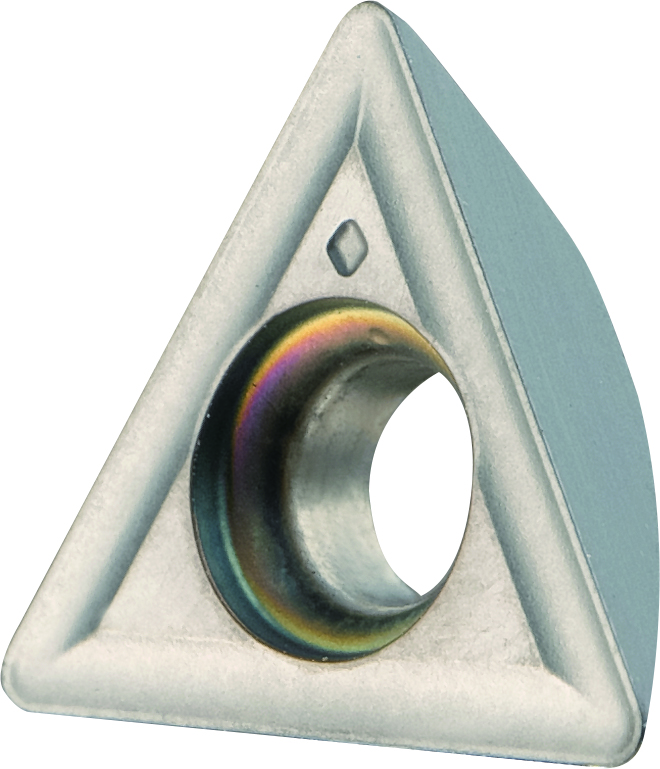
Indexable inserts carry their own geometry and tolerance constraints. Seeing the insert model is only the first step; the buyer should match it to the cutter body and the workpiece.
Capacity and customisation constraints
Evaluation of a milling tool manufacturer is not only about product design. Supply constraints matter when a buyer is planning repeat orders or batch production. Geltos reports a production model based on milling tools R&D, production and sales, OEM, tool material development, customisation and tool design. The company lists a monthly capacity of 30,000-40,000 teeth, an annual output of 500,000 teeth, a lead time of 10-30 days and an MOQ of one unit. For a buyer, a low MOQ is useful for initial qualification; the short lead time range becomes meaningful only when confirmed against current order load.
How to read a milling tool spec like a sourcing engineer
A product name such as milling tools is too broad for procurement. The buyer must move from category to constraints. The most important rule is to treat every specification field as a compatibility condition. A slot milling cutter can have the perfect coating but the wrong width. A thread milling tool can have the right pitch but the wrong shank for the machine spindle. A silent boring tool can be effective only when the toolholder setup is rigid enough to allow vibration damping to work.
Geometry family first
The tool family is the first constraint. Slotting cutters are designed for narrow grooves. Side and face cutters are used where the cutter must machine a side wall and a flat face in the same pass. Chamfer tools produce edge angles; dovetail cutters create undercut profiles; thread milling tools cut threads without requiring a tap flute design. Fast-feed milling insert geometries are different from profiling or face milling insert geometries because chip thickness control and entry angle are designed for higher feed rates.
For Geltos, this geometry range is visible across the product list: grooving mills, chamfer mills, boring mills, face and shoulder shank mills, shell mills, corn-shaped mills, T-slot tooling and dovetail mills. The buyer should select the geometry family before considering a price list.
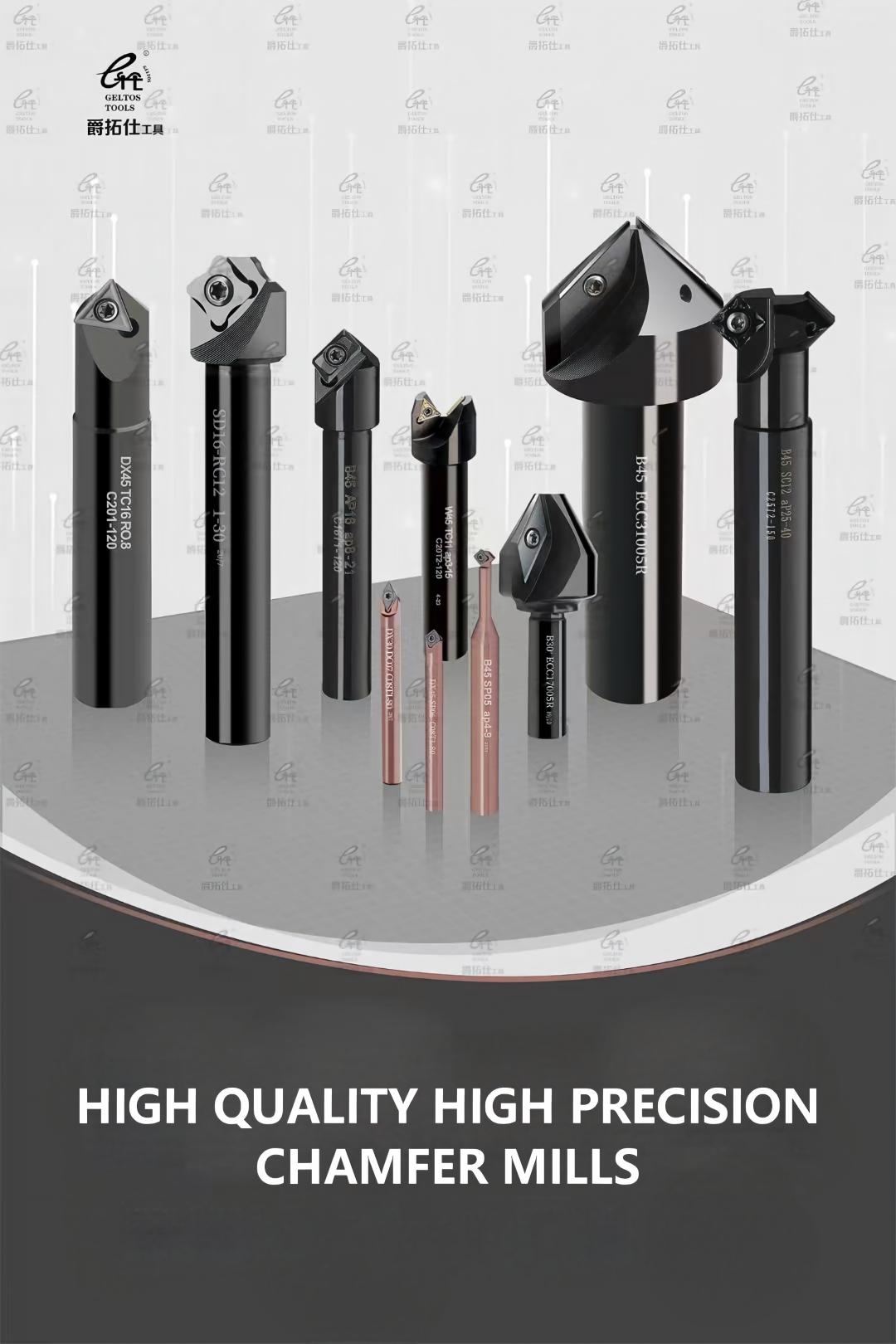
Chamfer mills show why geometry comes before price: edge angle, clearance and profile shape determine whether the tool can produce the required feature at all.
Material and hardness envelope
A milling tool material has to survive the mechanical and thermal load of the cut. Geltos publishes tool bodies made from alloy steel, spring steel or carbide, with some insert grades in carbide and ceramics. Silent tool versions are supplied in HSS and carbide. The company's stated tool hardness range is HRC40-50, and the tools are described as suitable for machining workpiece materials up to HRC65. When a buyer is cutting pre-hardened steel above HRC50, the workpiece hardness influences which carbide grade and which insert geometry can be used. If a supplier does not state a hardness envelope, the buyer cannot predict edge life.
Heat treatment before processing
Heat treatment is not just a metallurgical detail; it affects dimensional stability. If a milling tool is machined first and heat-treated later, the heat-treatment cycle can distort thin walls, slots or profiles. Geltos states that all products are heat-treated before processing. The practical interpretation is that the final precision operations happen after the material has reached its working hardness, which is a defensible way to hold a tolerance of 0.02 mm. This does not mean the sequence is a guarantee; it means the process logic is visible and auditable.
Dimensional range and holder interface
The dimensional range published for Geltos milling tools covers widths from 1 mm to 20 mm and diameter options from 8 mm up to 400 mm across the product range. Some listed shank and shell mill series carry lengths from 80 mm to 350 mm and tooth counts from 1 to 20. These numbers are not advertising by themselves. They become useful when matched to the machine spindle, the toolholder collet and the workholding envelope.
The company's interchangeable and modular milling tools use one holder with different milling heads to perform different machining jobs. For a machining shop, modular tooling changes the economics of tool purchasing: the body is retained while the cutting head is replaced. The customer still must confirm that the coupling interface is rigid enough for the planned feed rate and reach.
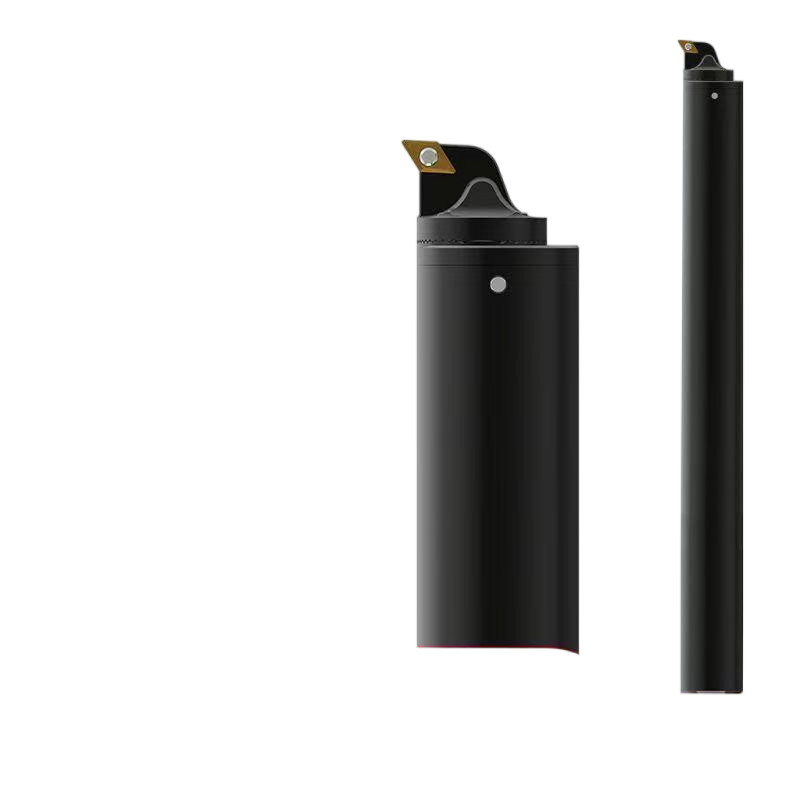
Silent boring tools add a separate constraint: the tool is designed for deep operations where damping, clamping length and overhang all affect stability.
Silent tools and long overhang
Deep boring and internal turning require a different type of milling and turning holder. Geltos silent tools are designed for deep cutting operations requiring vibration damping and are intended for aerospace, military use and shipbuilding industry applications. The published models VT25-SCLCR09, VT40-SDUCR11, VT20 C20*200V and VT32 C32*480VE reflect a family of internal toolholders with different sizes and clamping configurations. When a long overhang is needed, the selection of clamping length and screw span is not a minor detail; a silent tool can damp vibration only if the assembly is rigid enough to transfer the cutting force.
Documented application: 2 mm slots in long-run machining
A narrow slot is one of the clearest tests of milling tool constraints. It requires a cutter that is thin enough for the slot, rigid enough to avoid deflection, and durable enough for production quantities. The Geltos-developed GFN cutters are designed to realise narrow grooving as thin as 2 mm.
A supplier-published application reference describes a precision mechanical processing factory in Russia. The customer used five Geltos tool units for precision metal grooving and slotting over a two-year period. The documented result was grooving of 2 mm wide slots with smooth surface finishing, fast-feed grooving capability and long working life. The case is not a generic claim; it ties geometry constraints, width capability and production durability into one scenario.
For a buyer, a 2 mm slot is a good evaluation sample. If a supplier can supply a tool for that width and show a production reference, the supplier is likely to have control over edge geometry and dimensional tolerance. If the same supplier is vague about width limits, the risk of a trial-and-error cycle is higher.
Market context: why specification discipline matters now
Milling tool demand is large enough to justify careful sourcing. The market data is reported with different scopes, so analysts do not always agree on the same total. One set of market estimates points to a global milling tools market of USD 3.43 billion in 2025, with growth projected by DataM Intelligence to USD 6.23 billion by 2035. Another estimate from Persistence Market Research values the global indexable milling cutters market at USD 5.2 billion in 2025, with carbide inserts accounting for 46.7% of that segment. The exact size depends on whether the report includes only milling tools or a wider cutting tool category, but the strategic point remains: insert-based and indexable milling is a major part of the market.
Regionally, Grand View Research reports that Asia Pacific dominated cutting tools production with a 49% global share in 2024, and China contributed about 38% of regional production. For international buyers, this means a large share of milling tools and inserts are made by Chinese suppliers. It also means that a structured supplier verification method is more important than geography alone.
The technical layer is also becoming more standardised. ISO 13399 is the international standard for the computer-interpretable representation and exchange of cutting tool and toolholder data, developed by ISO Technical Committee TC 29. It is not a quality certificate. It is a data format that allows suppliers and buyers to exchange tool descriptions digitally. A buyer who asks for machine-readable cutting tool data is reducing the risk of human error in model entry and tool selection.
Comparison: catalogue-driven buying versus specification-led buying
The traditional pattern for buying milling tools starts with a brand name or a supplier catalogue. The buyer selects the closest model, orders it and verifies by trial. This pattern works for very common tools with stable geometries, but it becomes expensive when a tool is used in a demanding batch operation.
| Traditional catalogue-driven buying | Specification-led buying |
|---|---|
| Selection starts with brand or product image | Selection starts with operation and constraints |
| Diameter is matched loosely to the closest option | Diameter, width, teeth and tolerance are checked as a set |
| Tool material is assumed from the product name | Tool material and workpiece hardness are verified before ordering |
| Failure is discovered in production | Failure risk is reduced during supplier evaluation |
| Price per tool is the main comparison | Cost per machined part includes tool life and changeover risk |
Wenling Geltos Tools is an example of a supplier that gives a buyer a specification-led starting point: published heat-treatment state, tolerance limit, material range, model numbers, dimensional limits, custom geometry capability and a low MOQ. A mid-sized specialist does not replace a global tooling group; global suppliers like Sandvik Coromant hold a large share of the cutting tool market, and they offer system-level support that a specialist factory cannot copy.
The main boundary of the Geltos evidence is verification depth. The supplier profile lists factory internal inspection as the quality control method and does not list a third-party certification. This is not evidence of poor quality, but it is a clear constraint: if the buyer's quality system requires an independent inspection report, that requirement should be stated in the enquiry and confirmed before production begins. Similarly, the 0.02 mm tolerance claim depends on a stable machine, a rigid toolholder, correct spindle runout and a workpiece that does not move during cutting. Supplier precision and machine capability are two sides of the same process.
Future outlook
The next stage of milling tool procurement is likely to be data-driven rather than name-driven. As ISO 13399 becomes more common, buyers can compare model files instead of re-typing specifications. Carbide material systems will continue to expand because insert-based tooling offers flexibility in fast-feed, profiling and face milling operations. The carbide tools market is projected by SNS Insider to reach USD 16.25 billion by 2032, growing at a CAGR of 6.14% from 2024, which means suppliers with material development and insert capability will have a stronger evaluation profile.
For a company like Geltos, the strengths are custom geometry support, a hardening-before-machining workflow and documented narrow slot capability. The constraints are equally real: a smaller R&D team, in-house quality control rather than third-party certification, and a product range focused on specialist milling and internal turning profiles. In the future, a mid-sized milling tool manufacturer is most credible when it states both capability and boundary. Geltos gives buyers enough published detail to ask the next question, and for an evaluation process, a clear next question is worth more than a vague guarantee.
Frequently asked questions about milling tool specification checks
At minimum, verify tool family or geometry, tool body material, material hardness range, workpiece hardness, diameter, width, length, number of teeth, shank or holder interface, insert model, tolerance and customisation availability. For the Geltos range, the published data covers diameter options from 8 mm to 400 mm, widths from 1 mm to 20 mm, tool hardness HRC40-50, the ability to machine materials up to HRC65, and a stated tolerance no greater than 0.02 mm.
Heat treatment changes the metallurgical state of the tool. If heat treatment is done after final machining, it can distort precision surfaces. Geltos states that all products are heat-treated before processing, meaning the final precision operations are performed after the material has reached its working condition. This is the process logic behind the company's stated 0.02 mm tolerance, although the actual result still depends on machine setup and holder rigidity.
Yes. The supplier capability record lists non-standard and customisation production, including special geometry tool design and special material development. Geltos also supports OEM production and tool design work. The MOQ is listed as one unit, so a custom geometry can be qualified in a small initial quantity.
Published model examples include a milling tool designation HTS-20-H06-C16T4-120 SP04; silent tool designations VT25-SCLCR09, VT40-SDUCR11, VT20 C20*200V and VT32 C32*480VE; and insert designations APMT1135, SNMX1206, LNMU0303ZER and 4NKT0603. The insert range also includes models such as the TCEX090204 shown in the product documentation.
The company lists a monthly capacity of 30,000-40,000 teeth, an annual output of 500,000 teeth, a lead time of 10-30 days and an MOQ of one unit. Capacity should be confirmed against current order load, especially for heat-treated custom geometries.
Geltos lists factory internal inspection as its quality control method. The public supplier profile reviewed for this analysis does not name a third-party quality certification. A buyer whose purchasing policy requires independent inspection should include that requirement in the supplier qualification process before signing a production order.
No. ISO 13399 is the international standard for computer-interpretable representation and exchange of cutting tool and toolholder product data developed by ISO Technical Committee TC 29. It improves digital specification exchange, but it is not a product certificate. Buyers should ask whether a supplier can provide structured tool data in a compatible format, not treat the standard itself as proof of manufacturing quality.
Precision milling tools are generally quoted per specification rather than from a single public price list. Final price depends on tool family, body material, carbide grade, geometry complexity, coating, surface treatment and order quantity. The reviewed Geltos profile does not include a public price list, so pricing should be compared after the technical constraints are defined and the tool model is matched to the operation.
Tem questões ou precisa de mais detalhes?
Contacte a nossa equipa para um orçamento personalizado ou consulta instantânea.
Solicitar orçamento
Preencha o formulário abaixo e a nossa equipa entrará em contacto com uma proposta personalizada.
Chat direto do WhatsApp
Prefere conversar em tempo real? Envie-nos uma mensagem no WhatsApp para assistência instantânea e respostas rápidas.
- Obter orçamento personalizado
- Partilhar fotos ou documentos
- Discuta as suas necessidades diretamente
Geralmente responde em 5–30 minutos durante o horário de expediente.