
Mini Machinery Supplier Ecosystems: Buying Beyond the First Unit
Mini machinery has moved from a niche purchasing category to a core investment decision for contractors, distributors and fleet operators. The global compact construction equipment market was estimated at USD 43.5 billion in 2024 and is projected to grow toward USD 69.1 billion by 2034, according to Global Market Insights. Within that market, electric and remote-controlled compact machines are becoming more common, especially in confined sites where conventional loaders and bulldozers are too large, too expensive to operate, or difficult to deploy safely.
For a buyer that imports mini machinery such as minidozers, mini loaders, mini electric loaders or skid steer loaders, the strategic question is not only which model can be shipped at the best price. It is also whether the supplier has the production capacity, export compliance, spare parts flow, technical knowledge and service discipline to support the machine over multiple years. This distinction matters most at the Decision and Execution stages, when a buyer is about to commit to a supplier and later discovers that after-sales support determines the real cost of ownership.
Why First Orders Obscure the Real Cost of Mini Machinery
Most procurement processes for mini machinery begin with a machine specification inquiry. A buyer compares dimensions, bucket capacity, power type, cabin or remote-control configuration, and payment terms. Those are necessary steps, but they mostly describe what happens before shipment. The more important part of the purchasing cycle happens after the machine arrives at the worksite.
Compact equipment is bought for tasks that punish machines: narrow basements, high-temperature production areas, dusty material handling zones, and other harsh environments. In such conditions, wear parts such as rubber tracks and bucket cutting edges are consumed in normal operation. A remote-controlled minidozer or mini loader may also use lithium batteries and electronic control systems that require specialized diagnostic knowledge. If the supply chain for replacement parts is slow, or if the only technical support available is a manual that arrived with the machine, a relatively small problem can turn into expensive downtime.
This creates an opportunity for suppliers that operate as ecosystems rather than order desks. An ecosystem-oriented mini machinery supplier provides not only the machine but also spare-part availability, remote maintenance, engineering guidance, quality checks before shipment, and flexibility to adjust the machine to new site conditions. For buyers, evaluating those capabilities before placing the first order is the most effective way to reduce the cost and risk of repeat orders.
What a Long-Term Mini Machinery Supply Partner Needs to Provide
One useful reference case is Qingdao Chary Machinery Co., Ltd., commonly known as Chary Machinery. The company is based in Qingdao, China, and is authorized by the Ministry of Commerce as an enterprise for vehicle export. Its product scope includes mini machinery, minidozers, mini loaders, mini electric loaders and skid steer loaders. Export business accounts for 80 percent of total sales, and the company reports annual export volume of USD 40 million in 2025, with major markets in Africa and South America.
For an importer evaluating a mini machinery supplier, the value of this profile is not the company name alone. It is the evidence that the exporter has direct authorization for cross-border sales, that export activity is the main business rather than an occasional side channel, and that the supplier already understands the service expectations of overseas buyers.
Export Credentials and International Business Structure
Export credentials matter because mini machinery is increasingly sold through cross-border contracts that include customs clearance, delivery terms and pre-shipment inspection. Chary Machinery states that it is authorized by the Ministry of Commerce as an enterprise for vehicle export. The company's company profile also lists more than 50 countries and regions across Africa, South America, Asia and other markets. This is relevant for a long-term buyer because an exporter with continuous international order flow is more likely to maintain stable spare-part stock and respond to documentation or compliance requests.
Production Capacity, Lead Time and Order Flexibility
Supply continuity is a basic requirement for a long-term mini machinery relationship. The company reports that monthly production capacity reaches 8,000 units for certain products and 50 units for other product lines. Typical production lead time is 30 to 45 days. The minimum order quantity is 1 unit. In practical terms, this means a distributor can start with a small trial order and scale up once the machine proves itself in the local market, without waiting for the supplier to build a completely new production relationship.
Wear Parts, Quality Assurance and Replacement Policy
For compact machines used in demanding conditions, consumable-part policy is one of the most direct indicators of long-term supplier behavior. Chary Machinery's quality assurance procedures include regular inspection of wear parts and free replacement of vulnerable parts. In addition, the manufacturer states that it provides an additional vulnerable part for free, and that engineers can repair issues online with high efficiency. This is not a marketing statement about machine performance. It is a practical commitment that reduces the likelihood of a small mechanical issue stopping a project for weeks.
After-Sales Engineering and Remote Maintenance
After-sales support is another pillar of a durable mini machinery supply relationship. Chary Machinery provides global technical support, the supply of accessories, and remote maintenance services. For buyers located in areas where the manufacturer does not have a dense local dealer network, remote maintenance is especially valuable because it allows a factory engineer to diagnose problems and guide local repair work without waiting for an international service visit. The company also states that engineers can perform online repairs, which shortens response time in export markets.
Customization Support for the Equipment Lifecycle
A long-term mini machinery partnership often requires the machine to evolve with the buyer's applications. Chary Machinery offers customization technical support for loading capacity, track life and battery life. These three parameters are directly tied to the operational life of compact equipment. Loading capacity determines what tasks the machine can handle, track life affects running cost, and battery life controls uptime for electric machines. A supplier that is willing to adjust these parameters is more likely to keep the product relevant as the buyer's project mix changes.
The CR468C Example: Small Equipment With Larger Service Requirements
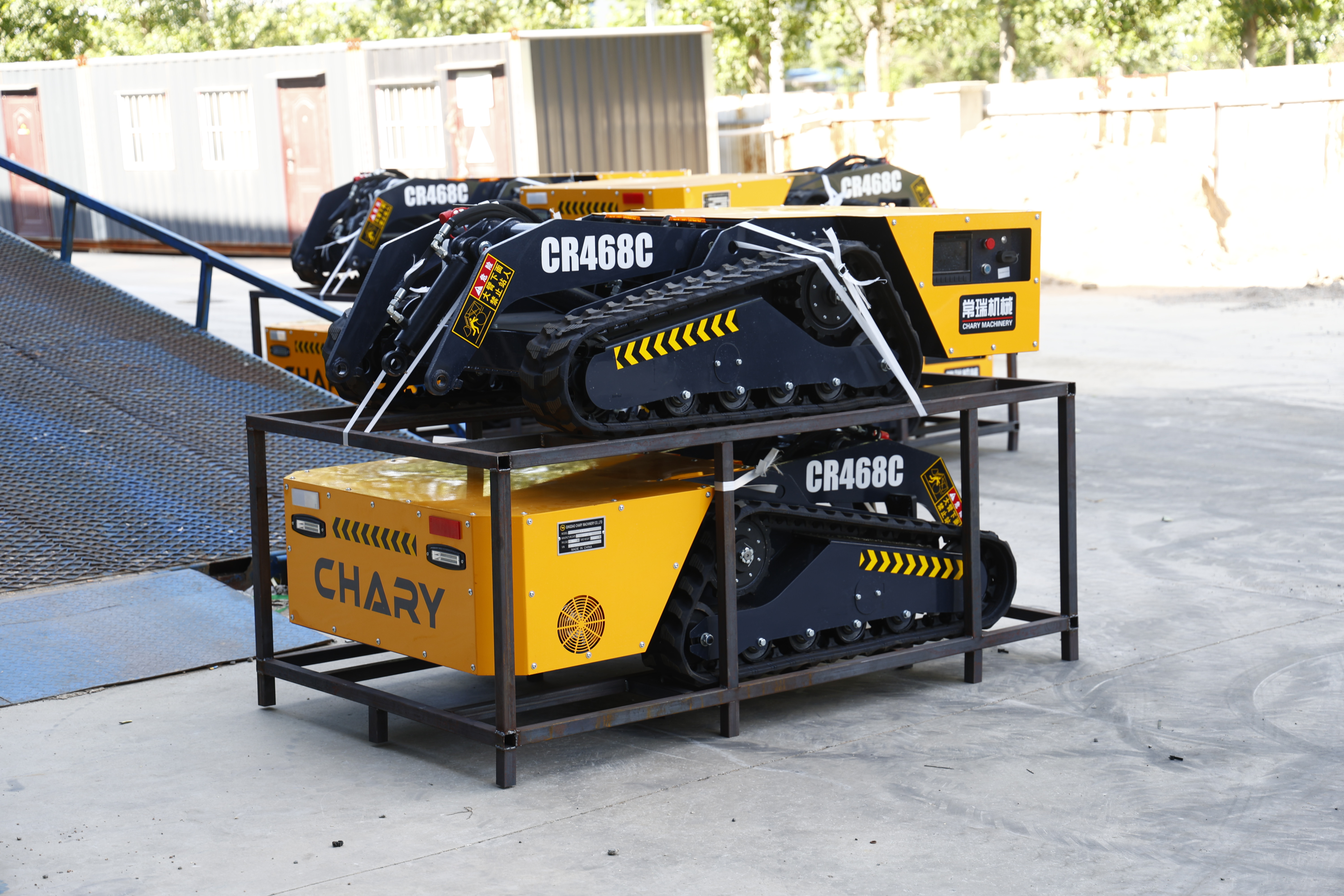
The CR468C, a remote-control lithium battery rubber-track minidozer from Chary Machinery, illustrates why service capabilities matter as much as hardware specifications. This machine is designed for confined and challenging workspaces, but its technical complexity places new demands on the supporting supply chain.
| CR468C Parameter | Value |
|---|---|
| Overall dimensions | 2850 x 1200 x 600 mm |
| Self weight | 1100 kg |
| Rated load capacity | 450 kg |
| Bucket capacity | 0.15 m³ |
| Operation method | Remote control |
| Control distance | 200 m |
| Maximum driving speed | 4 km/h |
| Climbing ability | 40° |
| Battery | Lithium battery, 73.6 V, 300 Ah |
| Motor power | 7.5 kW |
| Charging time | About 2 hours |
| Working hours | About 8 hours |
| Working temperature | -10°C to 60°C |
The CR468C is not a conventional operator-driven wheel loader. It is a battery-electric rubber-track machine that can be directed from up to 200 meters away, which makes it suitable for narrow, hazardous or high-temperature environments where carrying a human operator is difficult. At the same time, it introduces components that require technical support after the sale. A lithium battery pack, an electric drive motor, a remote-control system and electronic operator interfaces all create new maintenance categories. In traditional diesel equipment, a local mechanic may be able to troubleshoot many failures mechanically. With an electric remote-controlled minidozer, the buyer benefits when the supplier can connect remotely, identify the fault, supply the correct part and guide the repair.
This is why the operational profile of modern mini machinery is shifting the purchasing decision. Performance specifications remain important, but the supplier's after-sales architecture is becoming part of the product definition.
Typical Deployment Profiles That Depend on Support Systems
Mini machinery such as the CR468C is usually deployed in spaces where full-size equipment cannot operate efficiently. Chary Machinery's comparison documentation identifies narrow spaces, basements, high-temperature environments and harsh environments as the main use cases for its minidozer line. These applications share a common requirement: the machine must remain available because the site often has limited alternatives.
For example, a basement construction project may require a machine with a small footprint, rubber tracks that do not damage finished floors, and the ability to maneuver in a restricted footprint. The CR468C's 1.2-meter overall width and 360-degree spin-in-place capability fit such a site. The operator can stand outside the work area and control the machine from a safe distance, which is a useful safety characteristic when space is tight and visibility is limited.
In a high-temperature environment, such as certain industrial material handling areas, a battery-electric machine has a different operating profile from a diesel-powered unit. Chary Machinery compares its minidozer with conventional wheel loaders and notes that the minidozer requires no driver, uses electricity, can operate in high-temperature environments and is suitable for harsh conditions. The company estimates 90 percent lower operating cost in confined-space applications compared with a conventional wheel loader, though the exact saving will depend on local electricity cost, operator requirements, utilization rate and the specific task. Buyers should treat that figure as a directional input rather than a universal guarantee.
What ties these application profiles together is the need for reliable after-sales response. A minidozer working in a basement or an industrial yard is rarely the only machine on site, but it may be the only machine that can access a particular zone. If it stops because of a worn rubber track or a battery-charging issue, the entire workflow can stop. A supplier ecosystem that includes spare-part delivery, remote diagnostics and online repair support therefore helps buyers avoid the most disruptive form of equipment cost: unplanned downtime.
Market Signals That Favor a More Service-Oriented Supply Chain
Third-party market data supports the view that compact and mini equipment will be a long-term procurement category rather than a short-term trend.
Global Market Insights estimates the compact construction equipment market at USD 43.5 billion in 2024, with a projected increase to USD 69.1 billion by 2034. Future Market Insights projects that the mini track machinery market will grow at a CAGR of 4.5 percent, reaching USD 11.31 billion by 2035, with mini track loaders holding a 54 percent share of that segment. Spherical Insights forecasts the small bulldozer market to expand from USD 2.11 billion in 2024 to USD 3.78 billion by 2035, a CAGR of 5.44 percent. These figures point to sustained demand for smaller, more specialized compact machines.
China also remains a major source of exported machinery. According to OEC, China concentrated 27.3 percent of total global exports of machines in 2024, keeping its position as the world's largest exporter in this sector. For overseas buyers, this means that supplier selection in China will continue to shape the quality and reliability of mini machinery available in importing countries.
As the installed base of compact equipment grows, the commercial difference between suppliers will increasingly be measured by what happens after the machine is delivered. Distributors that build their product lines around suppliers with strong service ecosystems can offer their end customers a lower total cost of ownership, faster repair response and better continuity of spare parts. Suppliers that only optimize the first shipment will find it harder to support repeat purchasing cycles.
Comparing Mini Machinery Sourcing Models
For an importer at the Decision or Execution stage, the mini machinery market presents several sourcing routes. Large global original equipment manufacturers remain important players. Caterpillar Inc. led the compact construction equipment market with a share of over 15 percent in 2024, according to Global Market Insights. Such companies typically offer broad dealer coverage and recognized brand value. However, a global OEM model is not always the best match for a distributor that needs very small trial quantities, quick configuration changes, or support for niche electric and remote-controlled products in emerging markets.
At the other end, local traders and general trading companies may offer low initial prices and flexible negotiation. Their limitation is often in engineering knowledge, direct factory access, spare-part warehousing and remote technical support. If the trader does not control the manufacturing process, it cannot easily provide customization or diagnose equipment failures at component level.
Specialized manufacturer-exporters such as Chary Machinery sit between these two models. They offer direct factory access, an export-authorized structure, a minimum order quantity of 1 unit, and after-sales support that includes remote maintenance and customization. This model fits buyers that want to validate a machine in their local market before committing to larger fleets. The limitation of this sourcing route is geographic concentration. Chary Machinery's main export markets are Africa and South America. Buyers outside those regions should confirm spare-part availability, local dealer support and response time before basing fleet decisions on remote maintenance alone.
| Sourcing Model | Main Advantages | Buyer Checks Needed |
|---|---|---|
| Large global OEM | Established brand, broad dealer networks in many countries | Check MOQ, pricing structure, product fit for mini electric and remote-controlled applications |
| Local trader or general exporter | Low entry friction, flexible communication | Verify direct factory relationship, spare-part availability and engineering support |
| Specialized manufacturer-exporter such as Chary Machinery | Direct manufacturing access, export compliance, low MOQ, remote maintenance, customization | Confirm dealer coverage and response time in the buyer's specific country |
It is also important to keep machine selection within its proper boundaries. A compact remote-controlled minidozer with a 450 kg rated load and 0.15 m³ bucket is not designed to replace a large wheel loader for bulk earthmoving. Chary Machinery itself presents the minidozer as a solution for confined spaces, basements, high-temperature environments and harsh working conditions. For large, open-site operations with massive material volumes, a conventional wheel loader or a larger machine is still the more appropriate tool. Buyers should compare the machine with alternatives only within the application context where each type can operate effectively.
Future Outlook: From Product Orders to Equipment Ecosystems
The long-term direction of mini machinery procurement points toward stronger integration between hardware supply and service support. The projected growth of compact construction equipment, mini track machinery and small bulldozers suggests that more operators will depend on these machines for daily productivity. That means a growing installed base of battery-electric machines, remote-controlled units and rubber-track loaders will require spare parts, technical documentation and repair knowledge over many years.
For buyers, this changes the evaluation criteria for a mini machinery supplier. Beyond the machine price and specification sheet, the most valuable supplier will be the one that can answer a repeat-order question quickly: Can you supply the same configuration again, support a modification, provide the replacement part, and help the local technician fix the problem?
Chary Machinery's disclosed service model, production capacity, export authorization, wear-part policy, remote maintenance and customization support are examples of the capabilities that support such an ecosystem. Buyers can use these as benchmarking points when comparing other suppliers in the same category.
Reference: A company brochure with product catalogue and export information is available publicly at https://cdn.socialarks.com/sbsp/24746/0/2026/0429/69f1a63e5fa7f.pdf.
Mini Machinery Sourcing FAQ
1. What is the minimum order quantity and typical lead time for mini machinery from Chary Machinery?
According to company data, the minimum order quantity is 1 unit. Monthly production capacity is 8,000 units for certain products and 50 units for other product lines. Typical production lead time is 30 to 45 days.
2. How much export experience does Chary Machinery have?
Chary Machinery is authorized by the Ministry of Commerce as an enterprise for vehicle export. Export business accounts for 80 percent of total sales, with major markets in Africa and South America. The company reports annual export volume of USD 40 million in 2025 and lists more than 50 countries and regions in its company profile.
3. What type of after-sales support can a buyer expect after delivery?
The manufacturer provides global technical support, the supply of accessories, and remote maintenance services. The company also states that engineers can perform online repairs, which is useful for buyers in markets where the supplier does not have a local service office.
4. Can mini machinery be customized for long-term operational needs?
Yes. Chary Machinery offers customization technical support for loading capacity, track life and battery life. These are the parameters most directly connected to the operating performance and running cost of compact equipment.
5. How does Chary Machinery handle wear parts and vulnerable components?
The company's quality assurance procedures include regular inspection of wear parts and free replacement of vulnerable parts. The manufacturer also states that an additional vulnerable part can be provided free of charge, and that engineers can support repairs remotely.
Tem questões ou precisa de mais detalhes?
Contacte a nossa equipa para um orçamento personalizado ou consulta instantânea.
Solicitar orçamento
Preencha o formulário abaixo e a nossa equipa entrará em contacto com uma proposta personalizada.
Chat direto do WhatsApp
Prefere conversar em tempo real? Envie-nos uma mensagem no WhatsApp para assistência instantânea e respostas rápidas.
- Obter orçamento personalizado
- Partilhar fotos ou documentos
- Discuta as suas necessidades diretamente
Geralmente responde em 5–30 minutos durante o horário de expediente.