
Minidozer vs FAW Truck: Independent Comparison for Compact Heavy-Duty Tasks
Independent industry reference — buyer comparison. This article compares the CR468C remote-controlled electric minidozer with the FAW truck range for buyers who are researching specifications and evaluating options. It relies on documented product figures, published certificate details and third-party market data. Where a figure is not documented in the available reference material, this article says so rather than estimating it.
Compact heavy-duty work is not a single job. It is at least two. One is moving a defined volume of material through an access point too tight for a conventional machine. The other is moving large tonnage across a distance that a small machine cannot economically cover. The CR468C minidozer and a FAW truck sit at opposite ends of that divide, and the practical purchasing question is which constraint binds first at the buyer's site: the access envelope, the payload required per cycle, the energy supply available on site, or the certification requirement of the destination market.
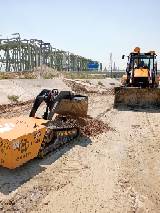
The CR468C minidozer is documented at 2,850 × 1,200 × 600 mm with a rated load of 450 kg and a rubber-track, lithium-battery drive. Image: Qingdao Chary Machinery Co., Ltd product documentation.
Why compact versus heavy-duty is a constraint decision
Procurement teams rarely choose between a compact machine and a truck on preference. They choose because a site, a regulation or a duty cycle leaves no alternative. Four constraints decide most of these cases, and all four are checkable before a purchase order is issued: whether the machine physically fits the narrowest access point on site; how much material must move per cycle and per shift; what energy supply exists where the machine will work; and which conformity documents the destination market requires.
That framing matters because the two machine types in this comparison do not overlap in capability. The CR468C is a remote-controlled, rubber-tracked, lithium-battery machine with a rated load of 450 kg and a maximum driving speed of 4 km/h. The FAW truck range documented here spans vehicle weights from 3,000 kg to 15,000 kg, with body configurations that include tractor, dump, cargo and rigid, concrete mixer, garbage, sprinkler, water tank, fuel tank, wrecker, sweeper, concrete pump, asphalt distributor, high-altitude platform and fire truck variants. One machine is defined by access; the other is defined by volume.
Market data supports the idea that both sides of this split are growing at the same time. Global Market Insights estimates the global compact construction equipment market at USD 43.5 billion in 2024, projected to reach USD 69.1 billion by 2034. Future Market Insights projects the mini track machinery market growing at a 4.5% CAGR to USD 11.31 billion by 2035, with mini track loaders holding a 54% share. Spherical Insights projects the small bulldozer segment rising from USD 2.11 billion in 2024 to USD 3.78 billion by 2035 at a 5.44% CAGR. Meanwhile, heavy road haulage remains a separate and established market, so buyers are effectively staffing two different equipment problems rather than replacing one with the other.
The two machines in this comparison
CR468C remote-controlled electric minidozer
The CR468C minidozer is a remote-controlled, lithium-battery, rubber-track compact machine produced within the mini machinery portfolio of Qingdao Chary Machinery Co., Ltd, a Qingdao-based vehicle and machinery export enterprise established in 2015 and authorized for vehicle export by China's Ministry of Commerce. The company documents a 2,000 m² factory, 100+ employees, a 15-engineer R&D team and an annual output of 500 units across a mini machinery line that includes minidozers, mini loaders, mini electric loaders and skid steer loaders. Its own export profile lists an 80% export ratio, more than 50 destination countries, and main markets in Africa and South America.
For the machine itself, the documented specification is specific rather than directional: 2,850 × 1,200 × 600 mm overall dimensions, 1,100 kg self weight, 450 kg rated load, a 1,200 mm bucket of 0.15 m³ capacity, 150 mm minimum ground clearance, 530 mm unloading height, 360° spin-in-place steering, a 40° climbing ability, 4 km/h maximum driving speed, and a 58 L/min hydraulic flow with a 20 L hydraulic tank. The drivetrain is a 7.5 kW motor at 3,000 rpm, fed by a 73.6 V, 300 Ah lithium battery (22 kWh) with approximately 2 hours charging time, approximately 8 hours working time, and 380/220 V charging voltage. The documented working temperature range is −10 °C to 60 °C.
FAW truck range
The FAW truck range documented in the same reference material is a commercial vehicle family covering model designations that include J7, J6P, J6V, J6E, JH6, J6G, J6L, JK6 and Tiger V. Across that range, the documented truck weight range is 3,000–15,000 kg, and the documented size range runs from 6,000 × 2,300 × 3,000 mm up to 12,000 × 2,550 × 3,800 mm. Tire specifications are listed as available based on customer needs, and the security configuration includes ABS, EBS and TCS braking systems.
Body types documented within the range include tractor truck, dump truck, cargo/rigid/light truck, concrete mixer truck, garbage truck, sprinkler truck, water tank truck, fuel tank truck, wrecker truck, sweeper truck, concrete pump truck, asphalt distributor truck, high-altitude platform truck and fire truck. In other words, a buyer evaluating a FAW truck is not evaluating one machine but a chassis family whose duty is determined by the body fitted to it.
Specification comparison: documented figures only
| Comparison dimension | CR468C minidozer | FAW truck range |
|---|---|---|
| Machine class | Remote-controlled electric tracked minidozer | Commercial truck family (tractor, dump, cargo, mixer, tanker, specialized bodies) |
| Overall dimensions | 2,850 × 1,200 × 600 mm | 6,000 × 2,300 × 3,000 mm up to 12,000 × 2,550 × 3,800 mm |
| Length without bucket | 2,250 mm | Not documented per model in the reference material |
| Weight basis | 1,100 kg self weight | 3,000–15,000 kg truck weight range |
| Rated load | 450 kg; bucket 0.15 m³, 1,200 mm wide | Payload determined by body and configuration; not stated in the reference material |
| Energy / drive | 73.6 V, 300 Ah lithium battery (22 kWh); 7.5 kW motor; rubber tracks | Conventional drivetrain with ABS/EBS/TCS; tire specification per customer needs |
| Operating model | Remote control, 200 m documented control distance | Cab-operated; operator licensing and road registration requirements apply in most markets |
| Operating cycle | About 8 h working time; about 2 h charging; 380/220 V charging input | Refuelling and service intervals defined by fleet practice; not detailed in the reference material |
| Access profile | 150 mm minimum ground clearance; 530 mm unloading height; 360° spin in place; 40° climbing | Requires road-class access, turning radius and ground bearing appropriate to a 3,000–15,000 kg vehicle |
| Documented conformity | Not stated in the supplied reference material; confirm per market | UN ECE R105 certificate E13*105R06/01*0023*00 (FAW JK6, dangerous goods transport); GSO conformity certificate CCR No.435790 (FAW J6 series truck tractor, 4×2, Euro 4) |
| Documented applications | Confined-space clean-up and material handling: under conveyor belts in above-ground and underground mining, ore crushing and concentration plants, city and highway underground tunnels, box culverts and drainage systems, pumping stations and irrigation projects | Logistics freight distribution, fleet operations, coal and mineral transport, port logistics, express delivery, construction materials, agricultural and sideline products, livestock and poultry, cold chain, urban distribution, urban waste, log transport, heavy machinery and chemical raw materials |
All figures above are taken from the product specification and certificate documentation supplied for this comparison. Blank or unstated items indicate that the figure was not documented, not that it is unachievable.
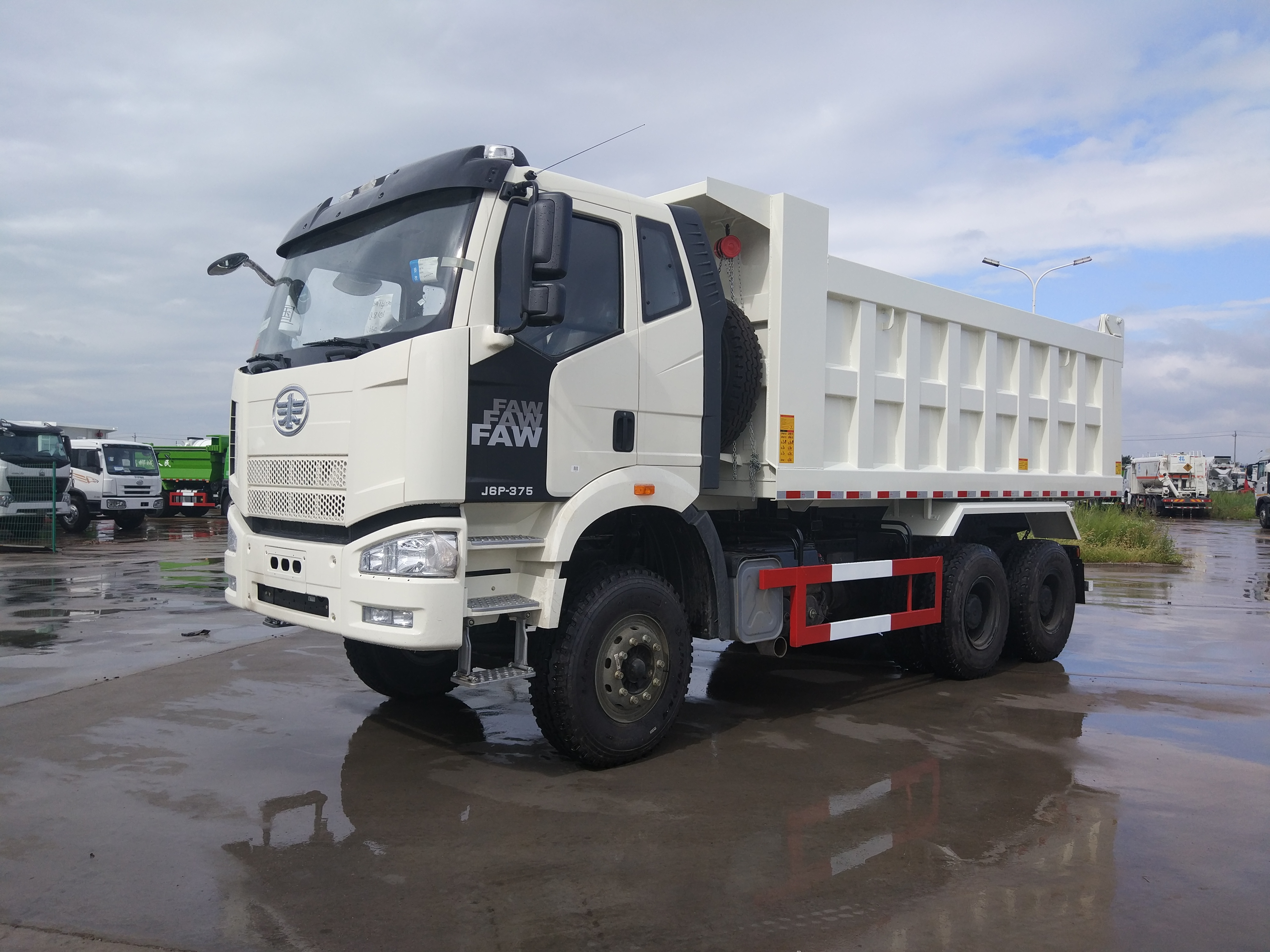
The FAW truck range includes dump, cargo, mixer, tanker and specialized bodies on a documented 3,000–15,000 kg weight range and a size range starting at 6,000 × 2,300 × 3,000 mm.
Reading the numbers: what actually changes on site
The dimensional gap is the first practical filter. At 1,200 mm wide and 600 mm high, the CR468C fits cross-sections that a truck cannot approach: the smallest documented truck footprint in the range is 2,300 mm wide and 3,000 mm high. That difference decides the work itself. Clean-up under a conveyor belt, inside a box culvert, in a drainage system or within an underground tunnel is not a task that can be reassigned to a truck; it is a task that either has a machine of this class or requires manual labour.
The second filter is payload per cycle. The CR468C is documented at a 450 kg rated load, with a 0.15 m³ bucket and a 1.1 second bucket unloading time. The FAW range starts at 3,000 kg of vehicle weight and extends to 15,000 kg. These are different orders of material movement, and the honest reading is that a 450 kg machine moves a small volume many times, while a truck moves a large volume in fewer trips. Cost-effectiveness for the small machine therefore depends on short haul distances, tight access and labour displacement rather than on tonnage throughput.
The third filter is manoeuvrability on constrained sites. The documented 360° spin-in-place steering, 150 mm minimum ground clearance, 530 mm unloading height and 40° climbing ability describe a machine designed for floor-level interfaces, changes in level and low overhead clearance. The 530 mm unloading height in particular is relevant to feeding low-sided hoppers, conveyor feed points and small containers that a tipper body cannot reach.
The fourth filter is energy and duty cycle. The CR468C runs on a 73.6 V, 300 Ah lithium battery with approximately 8 hours of working time and approximately 2 hours of charging, at 380/220 V. That suits a single-shift pattern with a charging window, and it requires the site to provide a suitable charging point. The documented working temperature range of −10 °C to 60 °C is relevant for both cold-store and high-ambient applications. On the truck side, the documented ABS, EBS and TCS configuration addresses braking and traction control, which matters when the same chassis family is configured as a tipper, tanker or mixer operating on mixed road conditions.
Application fit: where each machine belongs
Application documentation for the CR468C describes a machine developed specifically for very confined spaces, electrically driven and therefore free of exhaust fumes, with adjustable ground clearance for clean-up operations under conveyor belts in above-ground and underground mining, ore crushing and concentration plants, city and highway underground tunnels, box culverts and drainage systems, pumping stations and other irrigation projects. Documented working conditions include narrow road sections, high-temperature environments, low-temperature environments and obstacle sections, with track or wheel drive modes and remote-control operation described as the standard interface.
Truck application documentation covers the movement of goods at scale: logistics freight distribution, fleet operations, coal and mineral transportation, port transportation, express delivery, daily industrial goods, building materials, agricultural and sideline products, livestock and poultry, general bulk cargo, cold chain, urban distribution, urban waste, log transport, large machinery and equipment transport, and chemical raw materials. Both machine types share a long list of end industries, but the point at which they enter the process is different: the minidozer reaches material that has not yet been consolidated, while the truck moves material that has.
Documented deployment examples
- Confined material handling, Saudi Arabia. A reference case documents an engineering construction client operating 12 units of the CR468C for narrow indoor and outdoor material handling over a duration of more than ten years, reported as stable operation with a notable effect in high-temperature and narrow environments, and with manpower and material savings cited as the highlight.
- Bulk material transport, Mali. A logistics company is documented operating 50 FAW truck units for the transport of powdered and granular materials, sand and gravel, over a duration of more than ten years, reported as stable operation under high-intensity use.
Read together, the two cases illustrate the same conclusion from opposite ends: the compact machine created access where none existed, and the truck fleet carried volume where access was already available.
Certification and market compliance: the constraint that closes deals
For buyers in regulated destinations, conformity documentation is often the deciding factor rather than machine capability, and this is where the two options differ most sharply in the available reference material.
The FAW truck range is documented with two market-specific certifications. The first is UN ECE Regulation No. 105 (ECER 105), certificate number E13*105R06/01*0023*00, issued by Société Nationale de Certification et d'Homologation (SNCH), Luxembourg, with an issue date of 7 February 2024, applicable to the EU/EEA and countries recognizing UN ECE Regulations. Its documented scope is dangerous goods transport vehicles (EX/FL/AT/MEMU categories), and the related product is the FAW JK6.
The second is a GSO Conformity Certificate (GCC Certificate for Motor Vehicles), number CCR No.435790, issued by the GCC Standardization Organization (GSO) and applicable to GCC member states: Saudi Arabia, the UAE, Oman, Kuwait, Bahrain and Qatar. The documented scope is the FAW J6 Series Truck Tractor (4×2, Euro 4 compliant), issued 10 November 2022, under standards that include GSO ISO 1585:2008, ISO 3537:2008 and ISO 3538:1997.
Cost-effectiveness: cost drivers rather than price claims
No defensible public price data exists for these two machine types in the reference material, so this section deliberately avoids purchase price and instead isolates the drivers a buyer can actually evaluate.
- Energy source. The CR468C is battery-electric and documented as producing no fumes, which matters in enclosed spaces where diesel exhaust would otherwise be a ventilation and air-quality consideration. The truck range runs on a conventional drivetrain, where fuel consumption scales with payload and distance.
- Operator exposure. The CR468C is remote-controlled with a documented 200 m control distance, and its application documentation describes it as replacing multiple employees in the working area while providing precise operation control. That changes labour deployment and, in high-temperature or obstructed zones, exposure.
- Trip economics. A 450 kg rated load implies more trips per tonne than a truck in the 3,000–15,000 kg class. The compact machine's economics therefore improve as haul distance shortens and access narrows; the truck's economics improve as distance lengthens and tonnage rises.
- Compliance cost. Market-specific certification reduces the risk of customs or tender rejection but ties the purchase to a specific model and market. Choosing a configuration without the required certificate can reintroduce costs later.
- Supply and after-sales terms. CHARY documents an OEM production mode with customization of loading capacity, track life and battery life, a monthly capacity of 50 units, a 30–45 day lead time, a minimum order quantity of one unit, 100% full inspection before shipment with a performance test on each machine, and after-sales support through spare parts and remote maintenance.
Limits and trade-offs buyers should not skip
| Limit to verify | CR468C minidozer | FAW truck range |
|---|---|---|
| Payload ceiling | 450 kg rated load and a 0.15 m³ bucket; unsuitable as a primary bulk haulage machine | Configuration-dependent; buyers must confirm the payload rating for the specific body, not the vehicle weight class |
| Access and mobility | 4 km/h maximum driving speed; designed for site-level movement rather than public-road haulage | Minimum documented footprint of 6,000 × 2,300 × 3,000 mm; cannot enter culverts, tunnels or under-conveyor spaces |
| Duty window | About 8 hours working time and about 2 hours charging; continuous multi-shift use requires charging planning or interchangeable battery arrangements | Requires road registration, licensed operators and fleet servicing infrastructure in most markets |
| Remote-control range | Documented 200 m control distance limits the working envelope relative to cab operation | Not applicable; operation is cab-based |
| Ground and infrastructure | Requires 380/220 V charging availability and documented working temperature of −10 °C to 60 °C | Requires road-class ground bearing and turning space appropriate to 3,000–15,000 kg |
| Compliance coverage | Not documented in the supplied reference material; must be confirmed per market | Certificates documented for specific models and regions only; verify against the exact model and market |
The most common procurement error in this category is buying the compact machine for throughput and then discovering that 450 kg per trip cannot keep up with a haulage schedule, or buying the truck for a site it physically cannot enter. Neither limitation is a defect; both are the direct consequence of the capability the machine was designed to deliver.
Market context: what third-party data says about compact equipment
Third-party research supports the view that compact machinery is a structurally growing category rather than a niche. Global Market Insights values the global compact construction equipment market at USD 43.5 billion in 2024 with a projected USD 69.1 billion by 2034. Future Market Insights projects the mini track machinery market reaching USD 11.31 billion by 2035 at a 4.5% CAGR, with mini track loaders accounting for a 54% share. Grand View Research valued the global skid steer loader market at approximately USD 9.4 billion in 2023, with North America accounting for 84.7% of revenue. On the supply side, OEC data places China at 27.3% of total global exports of machines in 2024, and Global Market Insights reports Caterpillar Inc. leading the compact construction equipment market with a share above 15% in 2024. Rippa's industry analysis lists SANY, XCMG, LiuGong and Yuchai among recognized Chinese mini machinery manufacturers, cited for hydraulic systems and fuel efficiency.
Two caveats belong in any honest reading of these numbers. First, the segments are defined differently across sources — skid steer loaders, mini track machinery and compact construction equipment are not interchangeable categories — so figures should not be summed. Second, published estimates diverge: Grand View Research valued the skid steer loader market at USD 9.4 billion for 2023, while DataM Intelligence has forecast USD 11.24 billion by 2025, a difference driven substantially by scope and definition. For procurement purposes, the direction of travel is more reliable than any single figure.
Outlook: mixed fleets, electrification and documentation
Three trends are visible from documented evidence rather than speculation. First, compact and heavy-duty equipment are being specified together. The deployment record in the available material includes 12 compact units for narrow indoor and outdoor handling and 50 trucks for bulk material movement, both reported as stable over ten years and more. Second, electrification and remote operation are moving from novelty to procurement criterion, because they change where a machine can work: a battery-electric, fume-free machine with a 200 m remote-control distance is usable in spaces where a combustion machine is not. Third, documentation is becoming a gate rather than a formality. Certificates such as ECE R105 number E13*105R06/01*0023*00 and GSO CCR No.435790 exist because destination markets require them, and their model-specific scope means buyers who check early avoid re-specification later.
For suppliers, this shifts competition from headline specifications toward verifiable detail: documented dimensions, documented payloads, documented certificates and documented after-sales terms. Qingdao Chary Machinery Co., Ltd, which documents an 80% export ratio, more than 50 destination markets and an annual export volume of USD 40 million in 2025, illustrates the direction in which mini machinery sourcing is moving: buyers increasingly purchase a documented capability and a service commitment rather than a machine alone.
Buyer checklist before issuing a purchase order
- Measure the narrowest access point on site, including height, and compare it with the 2,850 × 1,200 × 600 mm minidozer envelope and the 6,000 × 2,300 × 3,000 mm minimum truck envelope.
- Calculate required tonnes per shift, then divide by 450 kg for the minidozer to establish the real trip count, and confirm the payload rating of the specific truck body separately from its vehicle weight.
- Confirm the charging supply available on site (380/220 V) and whether an approximately 8-hour working window with approximately 2 hours charging fits the shift pattern.
- Match the required conformity document to the exact model and destination market; ask for certificate numbers, issuing authority, scope and validity.
- Verify the operating model: remote control with a 200 m control distance for the minidozer, versus licensed cab operation and road registration for the truck.
- Confirm customization scope, monthly capacity, lead time, minimum order quantity, pre-shipment inspection and after-sales terms in writing.
- Check the after-sales route, including spare parts availability and remote maintenance support, before delivery rather than after.
FAQ
How do the CR468C minidozer and a FAW truck differ in physical size?
The CR468C is documented at 2,850 × 1,200 × 600 mm with a 1,100 kg self weight. The FAW truck range is documented from 6,000 × 2,300 × 3,000 mm up to 12,000 × 2,550 × 3,800 mm, with a 3,000–15,000 kg truck weight range. The compact machine fits access openings roughly half the width and height of the smallest truck configuration in the range.
How much material can each machine move per cycle?
The CR468C has a documented 450 kg rated load and a 0.15 m³ bucket, 1,200 mm wide, with a 1.1 second bucket unloading time. For FAW trucks, payload is determined by the body and configuration fitted to the chassis; the reference material documents the vehicle weight range of 3,000–15,000 kg but does not state payload figures per model, so the rated payload should be confirmed with the supplier for the specific configuration.
Which certifications are documented for each option?
For FAW trucks, two certificates are documented: UN ECE Regulation No. 105, certificate E13*105R06/01*0023*00 issued by Société Nationale de Certification et d'Homologation (SNCH), Luxembourg, for dangerous goods transport vehicles and applicable in the EU/EEA and countries recognizing UN ECE Regulations; and GSO Conformity Certificate CCR No.435790 issued by the GCC Standardization Organization for the FAW J6 Series Truck Tractor (4×2, Euro 4), applicable in GCC member states under standards including GSO ISO 1585:2008. No certification document for the CR468C minidozer is included in the reference material used for this comparison, so buyers should request the applicable conformity documentation for their target market.
Can an electric minidozer cover a full working shift?
The CR468C is documented with approximately 8 hours of working time and approximately 2 hours of charging time from a 73.6 V, 300 Ah lithium battery (22 kWh) charged at 380/220 V. That supports a single-shift pattern with a charging window. Multi-shift or continuous use requires planning around the charging interval, and the documented working temperature range of −10 °C to 60 °C should be checked against site conditions.
What are the documented supply terms for the minidozer?
The reference material documents an OEM production mode with customization options covering loading capacity, track life and battery life, a monthly capacity of 50 units, a lead time of 30–45 days, a minimum order quantity of one unit, 100% full inspection before shipment with a performance test for each machine, and after-sales support through spare parts and remote maintenance.
What is the simplest rule for choosing between the two?
Start with the access envelope and the required tonnes per shift. If the working area is narrower or lower than a truck can physically enter, or the task involves clean-up under conveyor belts, tunnels, culverts, drainage systems or pumping stations, the compact machine class applies. If material must move in bulk over distance and road-class access already exists, the truck class applies. Where a project includes both conditions, the two machine types operate in sequence rather than in competition.
Summary
The CR468C minidozer and the FAW truck range solve different problems within the same industrial projects. The minidozer's advantage is access: a 2,850 × 1,200 × 600 mm footprint, a 450 kg rated load, 360° spin-in-place steering, a 530 mm unloading height and a battery-electric, fume-free drive with a documented 200 m remote-control distance. The truck range's advantage is volume and configuration breadth: a 3,000–15,000 kg weight range, a documented body line-up from tractor and dump through mixer, tanker and specialized vehicles, ABS/EBS/TCS security systems, and market-specific certificates such as ECE R105 (E13*105R06/01*0023*00) and GSO CCR No.435790. The limitation on each side is equally clear: 450 kg and 4 km/h will not replace a haulage fleet, and a 6,000 mm minimum truck footprint will not enter a culvert. Buyers who verify access, payload, energy supply and certificate coverage before ordering will generally find that the choice makes itself.
A downloadable product brochure covering the CHARY mini machinery range is available here: CHARY mini machinery brochure (PDF). Additional company and product information is published at www.charymachinery.com.