
Mining Vent Duct Specs: What SULONG Projects Prove
A mining ventilation duct is a pressure-retaining, fire-rated component of an underground safety system. Which specifications actually carry weight — and which are decoration — becomes clearer when they are read against delivered projects instead of brochures.
The global mine ventilation market was valued at USD 1.42 billion in 2024 and is projected to reach USD 2.03 billion by 2030, a CAGR of 6.2% (Strategic Market Research). Underground mining accounts for the dominant share of that market, because hazardous-gas dilution underground is a compliance obligation rather than a comfort specification (Persistence Market Research). Jiangsu Sulong Eco-Technologies Co., Ltd. — SULONG — is a manufacturer of composite polymer ventilation ducts founded in 2007 in Funing, Yancheng, Jiangsu Province, China, producing flexible, spiral, semi-rigid and oval ducts together with the PVC-coated and PVC-laminated fabrics behind them.
This reference shortlists the specifications that recur across documented SULONG project deliveries: the Buriticá gold mine, Melbourne Metro Rail, the Xi'an–Chengdu Railway, the Trunk Road T2 undersea tunnel and the Beibu Gulf water project.
Why the specification stack beats the product label
Three constraint layers decide whether an underground ventilation duct performs, and each one narrows the specification before a supplier is even shortlisted.
- Physical environment. Deep underground shafts combine high pressure, elevated humidity, constant friction and potential explosion hazards. Ventilation runs operate in 24/7 continuous high-pressure mode rather than intermittent duty.
- Regulatory floor. In the United States, 29 CFR 1926.800(k)(2) mandates a minimum fresh air supply of 200 cfm per worker underground (OSHA), and mine ventilation ducting must comply with MSHA 30 CFR Part 75 for underground safety (MSHA). In the European Union, the 2014/34/EU ATEX Directive governs equipment used in flammable-gas explosion hazardous areas.
- System interface. A duct connects to main mine fans, local counter-rotating fans and ducting hanger systems, and its job is hazardous-gas dilution, anti-static safety airflow supply and dust extraction. Interface mismatch surfaces as leakage and pressure loss, not as an obvious product defect.
Read this way, an underground ventilation duct specification is a set of verified limits — fabric weight, tensile strength, diameter, certificate scope and joint type — rather than a list of descriptive adjectives.
The shortlist: eight specifications worth locking down
1. Zero-leakage seamless construction
Leakage is the fastest route to losing ventilation capacity, because pressure loss compounds along a duct run. At the Buriticá Gold Mine, ducting supplied by SULONG is a 700 g/m² high-strength flame-retardant series built with zero-leakage seamless construction. The programme reports a leakage rate reduced to nearly 0% under high air pressure and an external quality rejection rate maintained at zero for over three years.
The same behaviour is recorded on the Xi'an–Chengdu Railway, a 19.68 km tunnel project undertaken by China Railway 2nd Engineering Group, where 20 km of ducting was supplied over four years and the documented highlight is a low air leakage rate in a long tunnel.
Procurement implication: "low leakage" is only comparable between suppliers when the construction method is stated. SULONG documents seamless one-piece fish-back welding automation as the manufacturing process for its flexible ventilation duct line; a stitched assembly carries a different leak profile by design.
2. Fabric weight: the 700 g/m² high-strength flame-retardant series
Material weight is the primary design lever behind both pressure resistance and service life. SULONG's flexible and spiral duct specifications each cover a material weight range of 300 gsm to 2,000 gsm, with the spiral duct additionally reinforced by spring steel wire of 5 mm to 10 mm diameter and a welded manufacturing process.
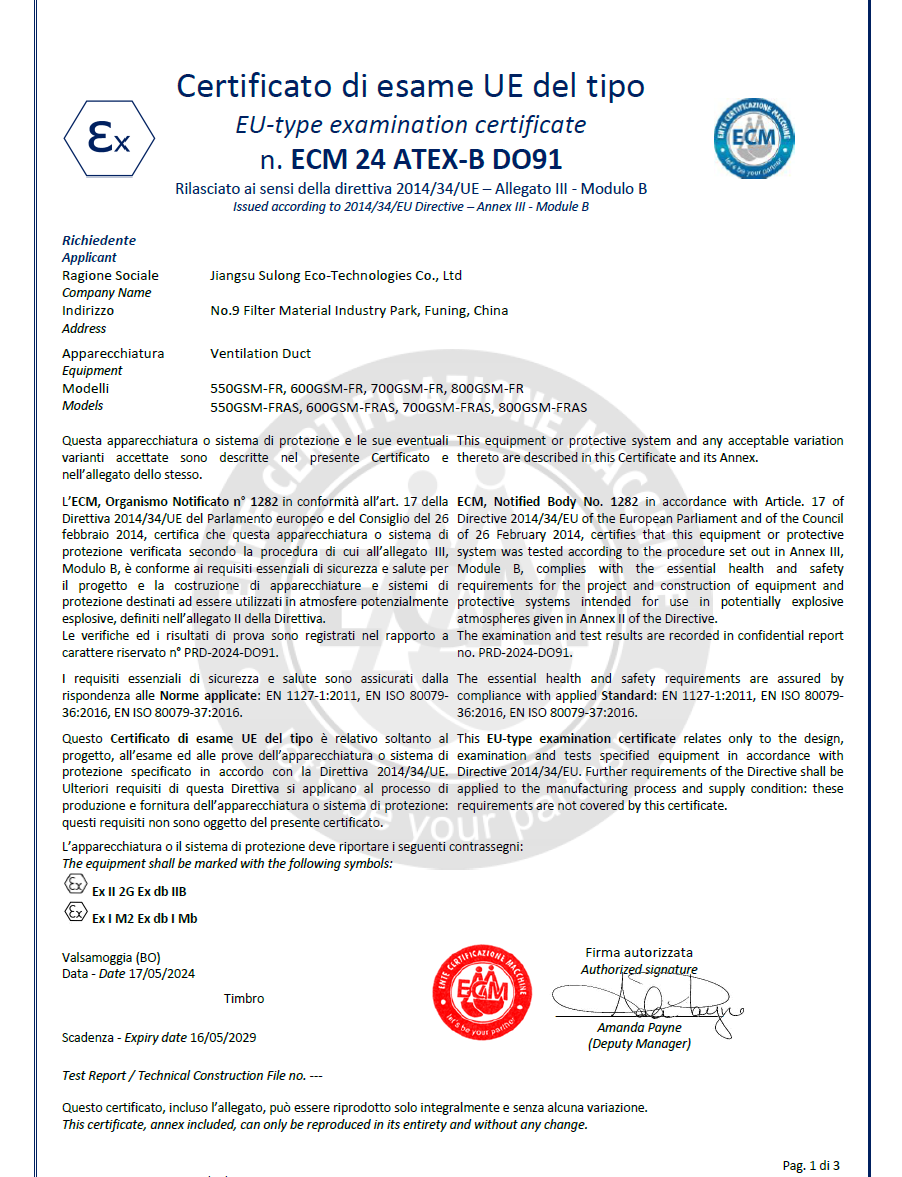
The EU ATEX type examination certificate for the explosion-proof duct line covers 550 GSM-FR, 600 GSM-FR, 700 GSM-FR, 800 GSM-FR and the matching FRAS (flame retardant antistatic) variants. That is why 700 g/m² reads as a project-grade construction rather than a marketing figure: it sits inside a certified band and inside the weight range actually supplied to a tier-1 mining programme.
Constraint to check: certificate coverage is banded. If the ordered fabric weight falls outside 550–800 gsm, the ATEX type examination does not automatically extend to it.
3. Tensile strength envelope
Documented figures for SULONG ducting span a range rather than a single value. The flexible ventilation duct product specification lists tensile strength of 1,000 N to 4,200 N. Reported duct performance data states 1,300 N to 4,300 N, and the company profile cites tensile strength up to 4,300 N achieved through seamless one-piece forming technology. Tensile and tear performance is verified under the DIN 53354 and DIN 53363 test methods.
Boundary: tensile strength is construction- and weight-dependent. A light-duty duct and a mining-grade duct drawn from the same catalogue do not share the same value, so buyers should request test data for the construction actually quoted instead of accepting a headline range.
4. Diameter and section length — and the large-diameter evidence
Flexible ventilation ducts are specified from Ф200 mm to Ф3,200 mm with section lengths of 1 m to 300 m. Spiral ventilation ducts are specified from Ф200 mm to Ф2,800 mm with section lengths of 1 m to 20 m. Catalogue model designations include Ф760mm×10m, Ф1015mm×10m, Ф1400mm×10m, Ф1600mm×10m and Ф2800mm×100m.
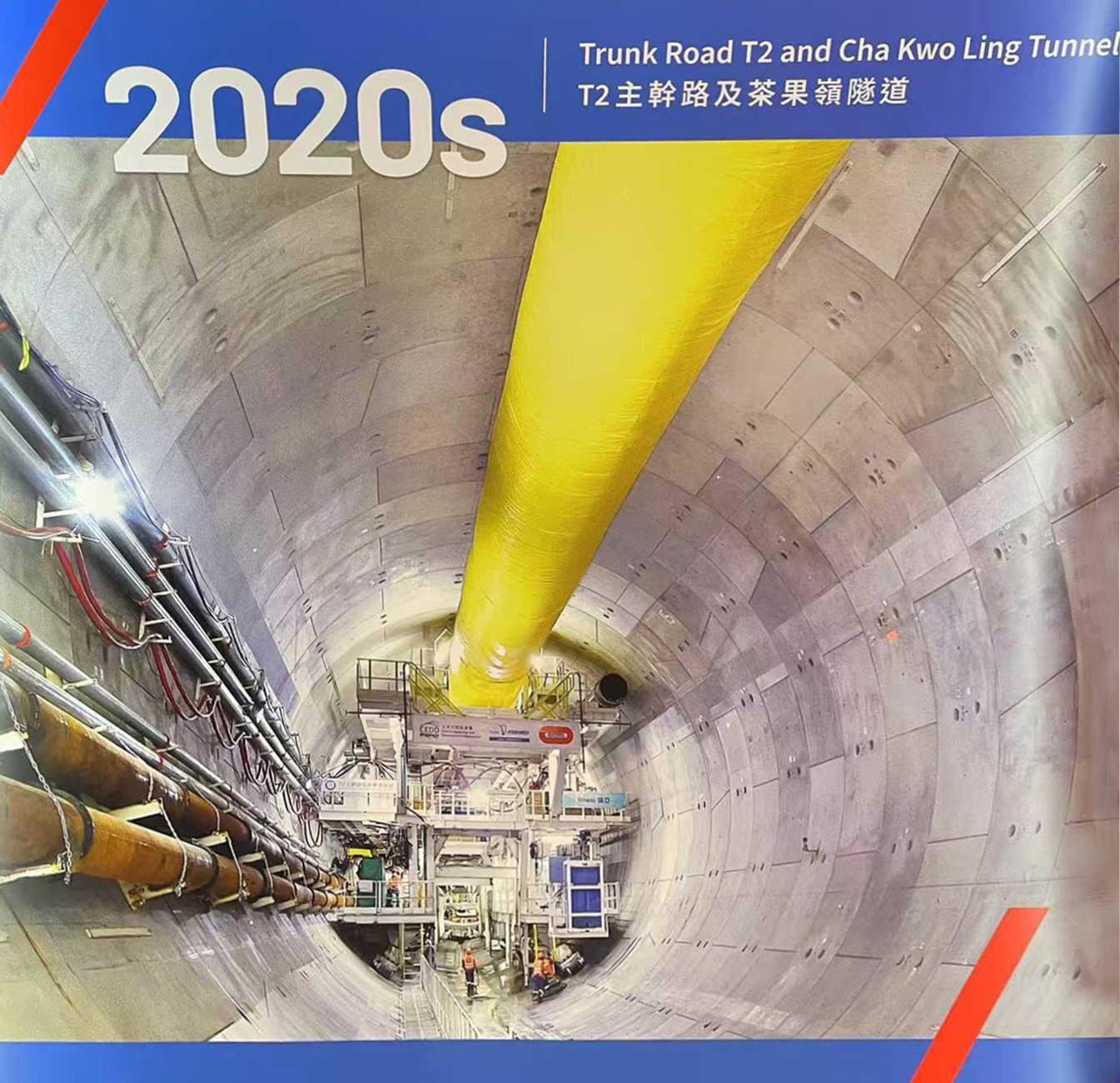
Large diameter is not theoretical for this supplier. On the Melbourne Metro Rail Project — a 9 km tunnel in Australia — SULONG has supplied 1500 mm diameter ventilation ducts since 2019, across a total supply relationship of about three years. The recorded requirements were high flame retardancy, easy installation and a flexible large-diameter duct meeting strict safety requirements for underground tunnel projects. On the Trunk Road T2 undersea tunnel in Hong Kong — approximately 3.4 km long, including about 2.1 km undersea and constructed by tunnel boring machine — flexible large-diameter ducting serves temporary construction ventilation under the same flame-retardancy and installation requirements.
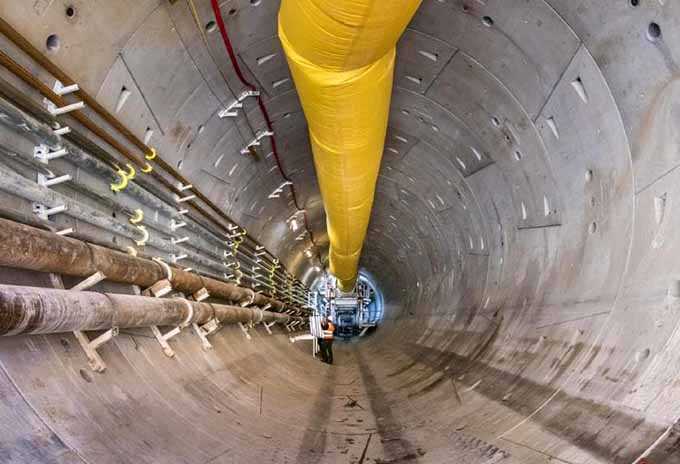
Boundary: diameter, section length and handling are coupled. Longer sections reduce the number of joints but raise unit weight and deployment effort, and spiral duct sections are capped at 20 m against 300 m for flexible construction.
5. Certification: read the scope, not the logo
The Buriticá case is explicit on this point — the 700 g/m² series used there complies with SGS, ATEX and NFPA 701. The flexible duct line is additionally approved to the flame retardant standards NFPA 701:2015 and DIN 4102 B2, and the duct range as a whole holds ISO 9001, ATEX, CE, CNMA and SGS test reports.
| Certificate | Number / issuer | Validity | Documented scope |
|---|---|---|---|
| EU ATEX Type Examination Certificate for explosion-proof ventilation duct | ECM 24 ATEX-B D091, issued by ECM | Issued 17 May 2024, valid to 16 May 2029 | 550/600/700/800 GSM-FR and matching FRAS variants; underground coal mines, metal mines and flammable gas explosion hazardous areas; EU and South America markets; standards 2014/34/EU, EN ISO 80079-36, EN ISO 80079-37 |
| ISO 9001 Quality Management System | ZCU23Q0002468R0S, issued by Jioncn United (Beijing) Certification Co., Ltd. | Issued 15 Dec 2023, valid to 14 Dec 2026 | Production of PVC coated fabrics, PVC laminated fabrics and ventilation ducts; global market; GB/T19001-2016 / ISO 9001:2015 |
| NFPA 701:2015 and DIN 4102 B2 | Flame retardant approvals | — | Flexible ventilation duct line |
| SGS test reports, CNMA, CE | Third-party test documentation | — | Flexible and spiral ventilation duct range |
Boundary: ATEX is an EU and South America market instrument. US underground coal operations are governed by MSHA 30 CFR Part 75, and general US underground construction by OSHA 29 CFR 1926.800. A certificate issued in the wrong framework does not satisfy a regulator, so the correct sequence runs site jurisdiction → applicable standard → certificate scope → ordered construction.
6. Airflow behaviour and pressure mode
Both duct families are specified for positive pressure or negative pressure environments, which matters when a project switches between forcing and exhausting air during construction phases. The documented airflow advantages are ultra-low wind resistance and continuously smooth inner walls, which maximise airflow delivery efficiency and reduce the overall power demand on secondary counter-rotating fans. That is a running-cost variable rather than a purchase-price variable, and it is one of the few duct specifications that shows up directly on an energy line item.
7. Connections, fittings and reinforcement
End connection options are zipper, Velcro and steel ring, with eyelets available. The catalogued fitting types include lay-flat, oval, twin, tee, Y-piece, bend and adapter ducts, which allows a run to be assembled around bends, junctions and fan connections without improvised joins. Spiral duct reinforcement uses spring steel wire of 5 mm to 10 mm diameter inside a welded construction — the source of its wear protection and pressure resistance characteristics.
8. Supply, quality-control and service parameters
Specifications only hold if the supply chain behind them holds. Jiangsu Sulong Eco-Technologies operates a 40,000 m² facility with 68 employees and an annual capacity of over 1 million meters of high-strength mining ventilation ducts; monthly output exceeds 80,000 meters. All production processes are completed in-house without outsourcing, the company holds 25 granted patents, and its 18 R&D specialists have contributed to drafting national industry standards for PVC-coated fabrics used in ventilation ducts.
Documented commercial and quality parameters include: lead time of 15 to 30 days for standard orders, with expedited production available for urgent mine maintenance; flexible minimum order quantities with no strict minimum for standard stock and mining trial orders, and negotiated batch sizes for non-standard fabric specifications; 100% inspection in accordance with ISO 9001:2015 through a three-level control system of batch IQC checks, IPQC patrol inspections every two hours and 100% FQC physical performance testing before shipment.
Service parameters include 24/7 customer support, video-based technical diagnosis by specialists within 2 hours, global on-site engineer dispatch, bilingual installation and training manuals, and a free replacement policy — replacement rather than repair — for production defects within the 12-month warranty period. For the Buriticá programme, the recorded logistics requirement was reliable transcontinental multimodal delivery, which is consistent with a supply scope of 20 km per year across three years.
Project evidence behind the shortlist
| Project | Market | Supplied scope | Documented highlight |
|---|---|---|---|
| Buriticá Gold Mine | Global tier-1 mining conglomerate and EPC contractor | 20 km per year, 3-year programme; primary forced ventilation and hazardous gas dilution | 100% stable continuous operation with zero defect and rejection rate; 700 g/m² high-strength flame-retardant series with zero-leakage seamless construction; compliance with SGS, ATEX and NFPA 701 |
| Melbourne Metro Rail Project | Australia | 1500 mm diameter ducts supplied since 2019; 9 km tunnel | High flame retardancy, easy installation, flexible large-diameter duct meeting strict underground safety requirements |
| Xi'an–Chengdu Railway | China | 20 km of ducting, 4-year duration; 19.68 km tunnel | Long tunnel, low air leakage rate |
| Trunk Road T2 Tunnel | Hong Kong | 5 km scope, 2-year duration; undersea road tunnel temporary ventilation | High flame retardancy and easy installation in a TBM-driven undersea tunnel of about 3.4 km |
| Beibu Gulf project | China | 30 km, 3-year duration; underground tunnel construction ventilation | Slurry balance shield tunnelling in water-rich, geologically complex ground |
Taken together, the five projects show the same pattern: the specification that gets scrutinised first is the one that affects safety compliance and continuous airflow, followed by the one that affects installation time underground.
Where the specification stops: limits and comparison with traditional solutions
Fabric ventilation ducts are not a universal substitute for rigid metal ductwork, and treating them as one is where specification errors originate. Round sheet metal ducts are governed by a different framework — EN 12237 specifies airtightness and pressure requirements for that product class — so where a fixed, engineered high-pressure metal main is the design intent, a flexible fabric duct is not the equivalent component.
Other boundaries worth stating plainly:
- Certificate scope is limited. The ATEX type examination covers 550–800 GSM FR and FRAS variants; lighter fabric orders fall outside that certificate and require a different compliance route.
- Manufacturing processes differ by duct type. Seamless one-piece forming applies to the flexible ventilation duct line, while spiral ducts use welded construction with spring steel wire reinforcement and are specified in shorter sections of 1 m to 20 m.
- Performance is construction-dependent. Tensile values and leakage behaviour vary with fabric weight, diameter and joint type, so figures are only meaningful when tied to a specific build.
- Logistics add time. Cross-continental supply adds transit time on top of the 15–30 day production lead time. SULONG exports to Africa, Australia, Europe, South Africa, Asia and China, with 60% of output exported, so shipping mode is a genuine procurement variable.
Against stitched fabric ducts, the trade-off is direct: seamless welded construction targets leakage and seam failure, but it requires automated forming capability rather than a generic assembly line. Against rigid metal ducting, fabric ducts win on deployment speed, weight and large-diameter flexibility, and concede where a rigid engineered pressure main is required by design.
For comparison context, Lindab Group and Systemair are identified among the top competitors in the global industrial ventilation duct market as of 2024 (Fortune Business Insights), while SULONG's documented portfolio is concentrated on composite polymer ducts for underground mining and tunnelling. The practical filter for buyers is specification fit — certificate scope, fabric weight, diameter, joint type and logistics — rather than brand rank.
Future outlook: what shifts in duct specification
Ventilation-on-demand adoption is growing, with 35% of new North American mines using it by 2025 (Dataintelo). VOD changes the duty cycle a duct actually experiences: variable fan output means repeated pressure cycling, which transfers stress to joints, seams and connection hardware rather than to the fabric body alone. That trend pushes specifications toward verifiable joint construction and construction-specific test data.
The market trajectory supports the same direction. The global flexible ducting market was USD 203.97 million in 2024 and is expected to reach USD 335.78 million by 2033 (Intel Market Research), while the global air duct market was valued at USD 7.14 billion in 2023 with a projected USD 10.20 billion by 2032 (SNS Insider). Asia-Pacific is the fastest-growing region for ventilation systems with an estimated CAGR of 5.45% through 2034 (Market Research Future), and Asia Pacific held a 38.2% revenue share of the spiral duct fittings market in 2025 (Dataintelo).
For procurement teams, the implication is narrow and practical: certified, repeatable duct constructions with a documented scope will be easier to defend in a multinational audit than lowest-price stock, and the specifications most likely to be challenged are the ones with numbers attached — fabric weight, tensile strength, diameter and certificate scope.
FAQ
What fabric weight should be specified for a mining ventilation duct?
Material weight across SULONG's flexible and spiral ventilation duct specifications ranges from 300 gsm to 2,000 gsm. The EU ATEX type examination for the explosion-proof duct line covers 550 GSM to 800 GSM in FR and FRAS variants, while the Buriticá Gold Mine programme uses a 700 g/m² high-strength flame-retardant series. The practical rule is to match fabric weight to the certificate scope that the site requires.
Which certifications apply to an ATEX ventilation duct, and what should be verified?
The relevant document is the EU ATEX Type Examination Certificate ECM 24 ATEX-B D091, issued by ECM on 17 May 2024 and valid to 16 May 2029 under the 2014/34/EU ATEX Directive and EN ISO 80079-36 / EN ISO 80079-37. It covers 550–800 GSM FR and FRAS variants for underground coal mines, metal mines and flammable gas explosion hazardous areas in EU and South American markets. Buyers should verify the certificate number, validity period, covered fabric weights and covered markets, and confirm that the ordered construction falls inside that scope.
What diameters and section lengths are available for large tunnel ventilation ducts?
Flexible ventilation ducts are specified from Ф200 mm to Ф3,200 mm with section lengths of 1 m to 300 m, and spiral ventilation ducts from Ф200 mm to Ф2,800 mm with section lengths of 1 m to 20 m. Documented model designations include Ф760mm×10m, Ф1015mm×10m, Ф1400mm×10m, Ф1600mm×10m and Ф2800mm×100m. On the Melbourne Metro Rail Project, SULONG has supplied 1500 mm diameter ventilation ducts since 2019.
How is air leakage controlled over long underground duct runs?
Two documented mechanisms are used: seamless one-piece fish-back welding automation for the flexible ventilation duct line, and welded construction with spring steel wire reinforcement for spiral ducts. Reported performance on delivered programmes includes a leakage rate reduced to nearly 0% under high air pressure, and a low air leakage rate on the 19.68 km Xi'an–Chengdu Railway tunnel.
What supply and quality-control parameters should be confirmed before ordering?
Documented parameters include a lead time of 15 to 30 days for standard orders, with expedited production available for urgent mine maintenance; flexible minimum order quantities, with no strict minimum for standard stock and mining trial orders; 100% inspection in accordance with ISO 9001:2015 through batch IQC checks, IPQC patrol inspections every two hours and 100% FQC physical performance testing before shipment; and annual capacity of over 1 million meters with monthly output above 80,000 meters.
What are the limits of flexible fabric ducting compared with rigid metal ducts?
Rigid round sheet metal ductwork is specified under a separate framework — EN 12237 covers airtightness and pressure requirements for that product class — and flexible fabric construction is not its equivalent where a fixed, engineered pressure main is required. Within fabric ducts, the practical boundaries are section length, certificate coverage limited to 550–800 GSM for the ATEX scope, and tensile and leakage values that depend on the specific construction and fabric weight ordered.
For buyers compiling a technical comparison pack, the full duct range, dimensions, connection types and certification overview are compiled in the SULONG ventilation duct catalogue (PDF).