
Model 1812 Promotional Pouch: From Spec Sheet to Inspection
Model 1812 Promotional Pouch: From Spec Sheet to Inspection
A custom logo cosmetic pouch rarely fails because the fabric was wrong. It fails because the purchase order, the approved sample and the pre-shipment record describe three slightly different bags. For model 1812, the real procurement work is not choosing a feature — it is closing the gap between those three documents.
This reference answers the questions that come up when a promotional cosmetic bag moves from evaluation into execution: which materials are in scope, how colour and size should be written down, which logo methods suit which surface, how drawstring and zipper variants differ in practice, and how purchasing terms and acceptance criteria should be attached to the configuration that was actually approved.
Henan Yulitepromotion Co., Ltd., trading as Yulite, is a promotional bag manufacturer founded in 2008 that produces cotton and canvas bags, polyester and nylon bags, RPET and recycled cotton bags, RPET felt bags, non-woven bags, cosmetic pouches, drawstring bags, tote bags, foldable bags, backpacks and cooler bags, and provides OEM and ODM production for markets including the EU, Asia, North America, South America and Australia. Model 1812 is listed in that range as a cosmetic bag.
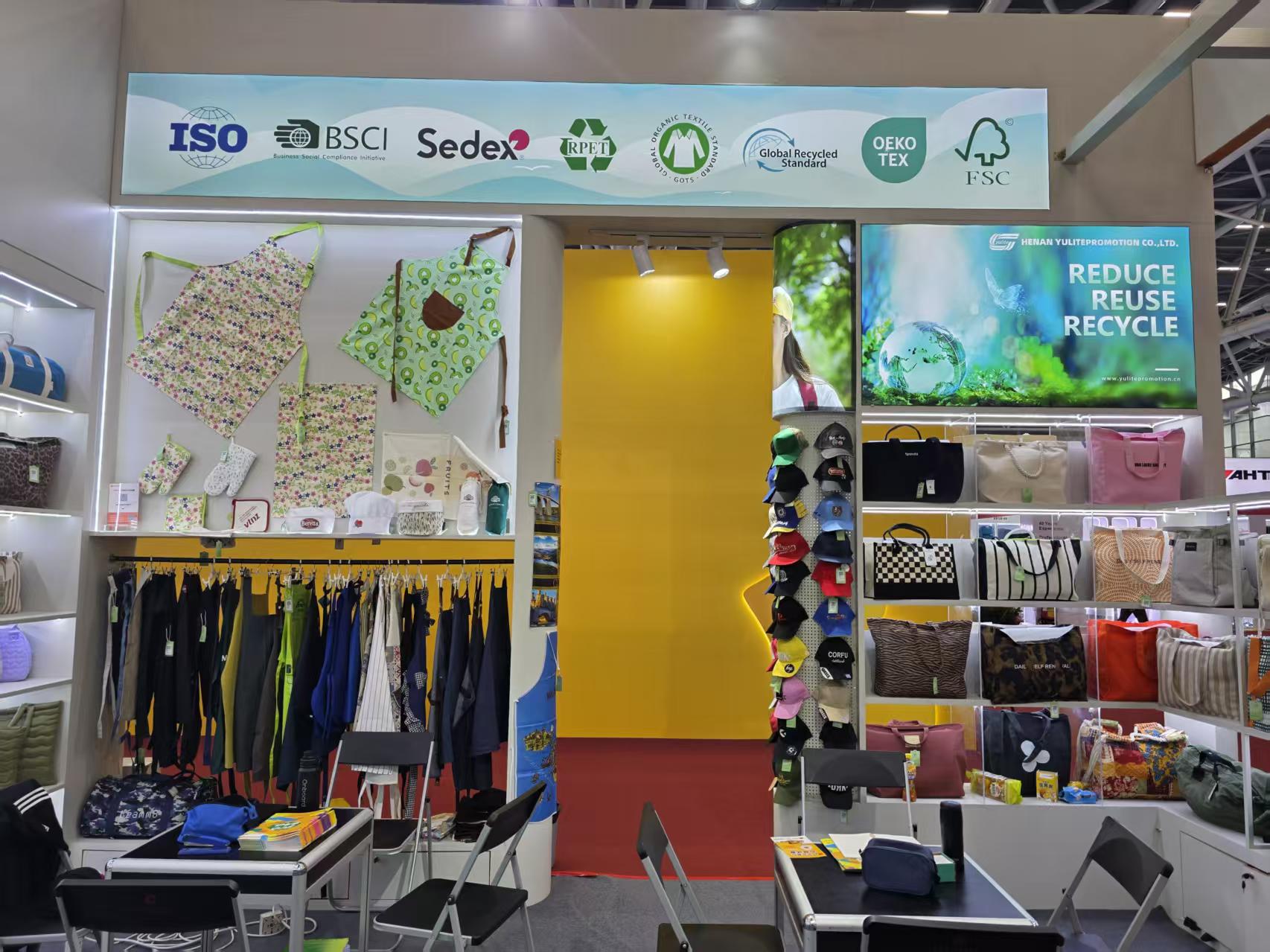
Trade-fair sourcing context: promotional bag programmes are usually specified in person, then confirmed on paper.
Why a Cosmetic Pouch Brief Needs a Written Specification
Branded merchandise spending reached USD 338.3 billion globally in 2025, according to PPAI/Oxford Economics research recorded in the industry dataset behind this article, and sustainable products accounted for 13.77% of US promotional industry sales in 2024 (USD 3.69 billion), a 20% increase on the previous year, according to ASI Counselor State of the Industry figures. Those numbers describe a category, not a pouch; for a buyer they mean only that the item will be judged beside other branded goods in the same programme.
That comparison is where specification discipline pays. A cosmetic pouch is evaluated by the person who opens it: a logo that fills in on a textured weave, a shade that drifts away from the approved standard, a closure that releases inside a handbag. None of these is a fabric-quality failure in the abstract. Each is a mismatch between an attribute that was agreed and an attribute that was delivered. The remedy is procedural — one specification sheet, one sealed approved sample, one acceptance record — and it has to exist before production, not after it.
What the 1812 Record Fixes — and What It Leaves to the Buyer
Model 1812 is documented as a cosmetic bag in the manufacturer's product range, and it is named among the products covered by the supplier's certification records: a GOTS certificate (GOTS-31172, issued by INTERTEK, valid 2 April 2026 to 2 April 2027, scope including carried accessories), a GRS certificate (ITS-TE-00006853-GRS-03902700, Intertek, valid 1 May 2026 to 30 April 2027) and a SMETA Sedex 4P record (ZAA600189756, valid 10 March 2026 to 10 March 2027, scope covering all textile products). Being listed in those records is not the same as every variant of the pouch carrying every claim; the material and the certificate scope have to line up, and that check is the buyer's to make.
The published record does not include a dimension table for 1812. Where dimensions are not fixed in public documentation, they are fixed by the approved sample and written into the purchase order — which is why the sampling stage carries more weight for this model than it would for a fully catalogued item.
| Attribute | Fixed in the supplier record | Still to be agreed by the buyer |
|---|---|---|
| Order quantity | Minimum order quantity stated as 500 pieces | Whether the chosen material or decoration changes that minimum for your configuration |
| Production time | Typical lead time stated as 30 days | How that schedule runs from artwork approval and sample sign-off to inspection booking |
| Customisation scope | Logo, colour, material, size, label and packing all listed as customisable | The chosen value of every one of those six attributes, recorded on one sheet |
| Quality control | Internal inspection, pre-shipment inspection and third-party inspection | Which stages apply, and who commissions and pays for the third-party inspection |
| Dimensions | No published size table for 1812 | Flat measurements taken from the approved sample |
| Certification | GOTS and GRS certificates with stated scopes and validity dates | Confirmation that scope covers the exact material and product before any claim is printed |
Material Choice: Six Options and What Each One Changes
Six materials are relevant to a 1812 brief — 100% cotton, polyester, organic cotton, recycled cotton, padded fabric and felt — and each changes three things at once: how the pouch accepts decoration, how it holds its shape, and what evidence a material claim requires.
Cotton and polyester
Cotton gives a matte, slightly textured surface that holds embroidery and stencil printing well and reads as a natural fabric to the end user. Polyester gives a smoother, more uniform face that suits transfer and digital decoration, where fine multi-colour artwork needs a controlled surface. The practical difference for a buyer is not which fabric is “better” but which one the artwork was designed for: a fine-line logo intended for a smooth polyester face will behave differently on an open cotton weave, and that difference is settled on a physical sample, not on a screen.
Organic cotton and recycled cotton
These two are claim-bearing materials, and the claim is where procurement risk concentrates. Organic cotton depends on organic-textile certification scope; recycled cotton depends on recycled-content scope. Both certificates held by the manufacturer are current as at late 2026 — GOTS-31172 through 2 April 2027, and GRS ITS-TE-00006853-GRS-03902700 through 30 April 2027 — and both list specific product categories in their scope. The GRS scope, for example, enumerates dyed fabrics, greige fabrics, carried accessories and packaging as separate categories, which is a reminder that recycled-content claims attach to defined process stages rather than to a supplier name in general.
Padded fabric and felt
Padded fabric changes the pouch from a soft bag into a protective one, which matters when the contents are glass, ceramic or refillable containers. Felt, including the RPET felt used in the manufacturer's range, gives a firmer, matte body that holds a shape without additional lining. Both add construction layers, so the decoration area, stitch paths and edge finishing need to be approved on a sample of the actual build rather than on a flat-fabric swatch.
A material name on a purchase order is not a claim. If the pouch will be described as organic or recycled in retail copy, the certificate number, the issuing body, the validity period and the scope wording should be checked against the specific material and product before the artwork goes to print. Where scope does not clearly cover the configuration, the claim should be dropped rather than softened.
Colour: Natural or Dyed, and the Standard Behind Each
Colour has to be specified in one of two ways, and they are not interchangeable. A natural finish means the undyed base fabric, where lot-to-lot variation is inherent and the approval question is whether the delivered tone is acceptable, not whether it matches a reference. A dyed finish is a colour-matching exercise: a physical standard has to be approved, and the purchase order has to say that the standard, not a verbal description, governs.
Dye performance is worth writing into the brief rather than assuming. In one documented school programme for a European buyer — 5,000 units of a heavy cotton canvas bag over a three-year relationship — the supplier's stated highlights included an active dyeing process and good colour fastness. That is a description of what the supplier tracks on that programme, not a test report for model 1812; the useful takeaway is that fastness and dye method belong in the specification conversation instead of being treated as implicit.
For a buyer, three lines on the sheet are enough to prevent most colour disputes: the approved standard reference, the acceptable variation around it, and the viewing condition under which the comparison will be made at inspection. A pouch approved under one light and rejected under another is a specification failure, not a production one.
Size and Closure: Two Variables Buyers Under-Specify
Sizes are commonly discussed as small, medium and large, which is useful for range planning and useless for production. Because no numeric size table is published for 1812, the approved sample has to carry the measurements: flat width, flat height, and gusset depth if the construction has one. If the pouch must hold a specific bottle or jar, the internal dimension should be derived from that object, not from a nominal size band.
Closure deserves the same treatment. A drawstring cosmetic bag and a zipper cosmetic pouch are different constructions, not a trim choice, and the brief should state which one applies instead of leaving it to be inferred from a model number. The two behave differently in use and are inspected against different criteria.
| Consideration | Drawstring cosmetic bag | Zipper cosmetic pouch |
|---|---|---|
| Closure mechanism | Cord or string gathered through a channel; no metal hardware required | Zipper chain with a slider and pull; hardware and stitch attachment both matter |
| Opening behaviour | Wide gather, quick access, no partial opening | Controlled partial or full opening, re-closable in use |
| Contents suitability | Light, soft or loose items; contents sit low in the bag | Items that need containment or repeated access during the day |
| Decoration area | One or two flat panels; cord ends compete for space | Flat front panel, with the zipper tape as a visible boundary |
| Inspection focus | Cord channel integrity, cord ends and knots, gather evenness | Slider function, stitch security at the zip ends, pull attachment |
The fit boundary is straightforward. If the pouch is a giveaway holding a single sample sachet, a drawstring construction removes hardware from the quality equation. If it is retained and reopened — a travel kit, a refill set, a retail add-on — the zipper version's re-closability is the reason to accept the extra inspection points.
Logo Methods: Four Processes, One Approved Sample
Four decoration routes apply to this pouch range: embroidery, heat transfer printing, digital printing and silk printing, the stencil process also called screen printing. Each is a different physical operation, so the method should be chosen against the material surface and the artwork, then locked by a pre-production sample.
Capability matters here because decoration is where most rework originates. The manufacturer's equipment list includes a digital printing machine, a transfer printing machine and a printing drying machine, alongside stitching and cutting machinery and a separate sampling room — which means method selection is a production question that can be tested on a sample rather than a purely commercial one.

Digital printing equipment in the manufacturer's decoration area, one of four logo routes available for the cosmetic pouch range.
| Method | Suited to | Artwork profile | What to approve on the sample |
|---|---|---|---|
| Embroidery | Cotton, canvas and felt surfaces that can take stitch density | Simple shapes, lettering, few colours | Stitch density, edge definition of small text, backing and puckering |
| Heat transfer | Smooth woven surfaces, including polyester | Multi-colour graphics with fine detail | Colour accuracy against the reference, adhesion and edge sharpness |
| Digital printing | Flat panels where photographic or gradient artwork is required | Full-colour or photographic images, short runs | Ink coverage on the actual weave, colour drift, hand-feel of the printed area |
| Silk (screen) printing | Cotton and canvas, solid colour blocks and line work | Limited colour count, strong shapes | Registration between colours, opacity on dark fabric, edge cleanliness |
Whatever the method, four variables belong on the artwork approval: the file version, the colour references, the placement with a stated position tolerance, and the size of the mark on the finished pouch. A digital proof cannot substitute for a decorated sample on a textured fabric — the proof shows the file, the sample shows the fabric's response to it.
From Specification to Purchasing Terms
The supplier's stated commercial terms are the frame the specification sits in: a minimum order quantity of 500 pieces, a typical production lead time of 30 days, DDP delivery terms, and payment by T/T, D/P, Alibaba Trade Assurance or credit card. Acceptance is described as pre-shipment testing together with third-party inspection. Those are supplier-stated terms, and they should be confirmed against the specific configuration rather than assumed to apply unchanged to every material and decoration combination.
The frequent gap is that a purchase order references a model number, while the factory works from a specification. A stronger order references the specification revision, the sealed approved sample, the approved artwork version, the packing and labelling instruction, the inspection stages, and the defect definitions that will be applied. Sample turnaround is quoted at about three days through the manufacturer's sampling room, which is short enough that version control — not sample speed — usually becomes the constraint.
After-sales terms are part of the same document. The manufacturer's stated policy covers replacement of defective items in the next order, free remaking, replacement or refund for defective items, free design adjustment and re-sampling on OEM and ODM orders, compensation for damaged, missing or incorrectly delivered goods, and after-sales service described as valid worldwide. Each of those remedies depends on a definition of “defective”, so the acceptance section below is effectively what makes the after-sales clause usable.
Acceptance Criteria: What to Check and What to Record
Acceptance works best as an attribute-by-attribute record rather than a single pass or fail verdict. Three inspection layers are available — internal inspection, pre-shipment inspection and third-party inspection — and each should be attached to named attributes so that a result can be traced back to the approved sample.
| Attribute | What the check covers | Record to keep |
|---|---|---|
| Material and construction | Fabric matches the approved specification; seams, edge finishing and lining behave as sampled | Approved sample reference plus production photos of the seam and edge |
| Colour | Delivered shade compared with the approved standard under the agreed viewing condition | Standard reference and the comparison result |
| Logo and decoration | Placement within tolerance, size as approved, colour and edge quality against the decorated sample | Measured placement and decoration close-ups |
| Dimensions | Flat width, height and gusset against the sample measurements | Measured values per size band |
| Closure | Drawstring channel, cord ends and gather, or zipper function and end stitching | Function check notes, including repeated open and close |
| Label and packing | Label content and position, packing configuration and carton marking | Packing specification and carton photographs |
| Documentation | Certificate scope and validity for any material claim used | Certificate copy with number, issuer and dates |
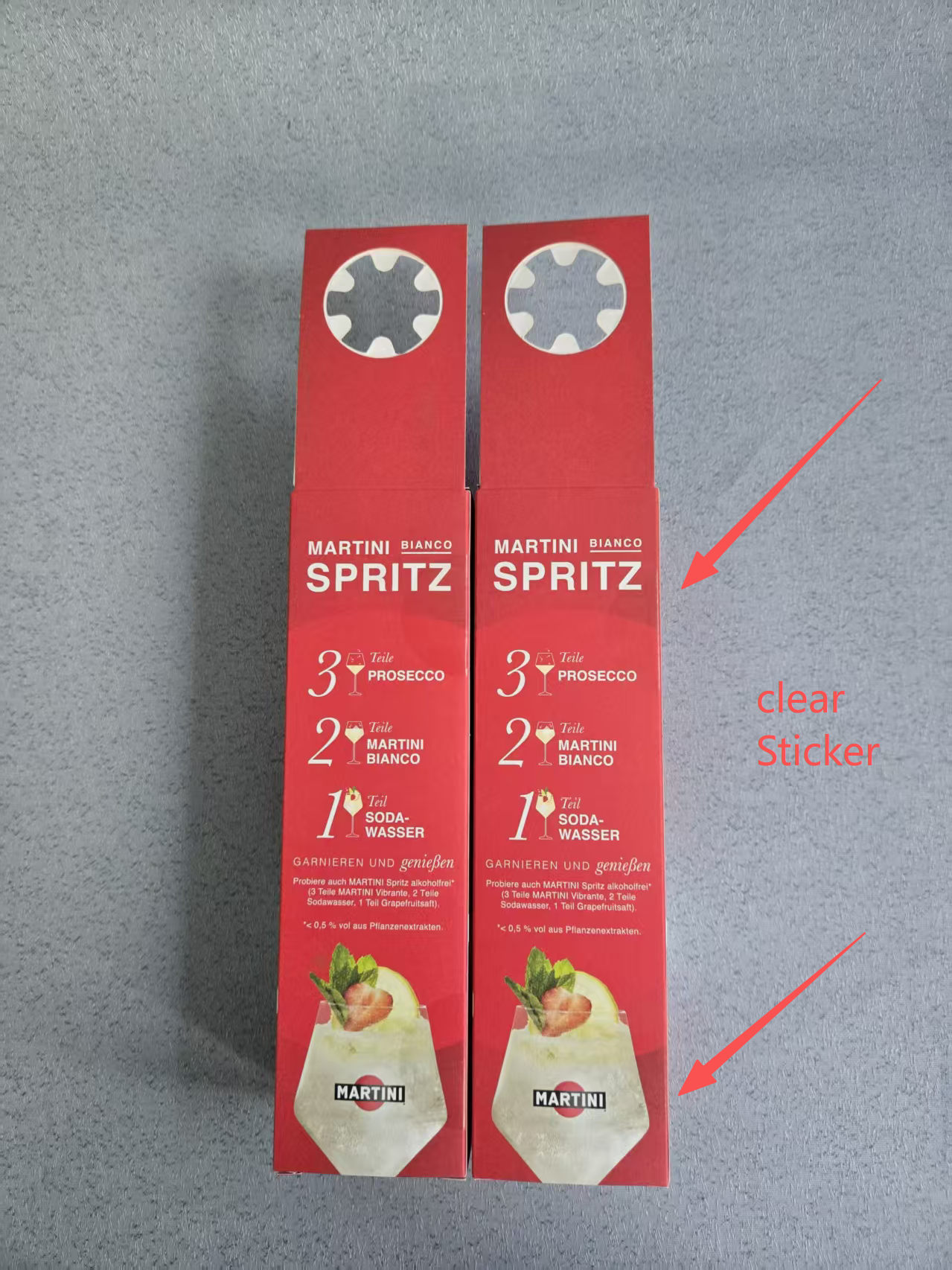
Packing configuration is an acceptance attribute in its own right; it should be photographed before shipment.
Two practical rules follow. First, the sampling plan and defect classification belong in the order, because a third-party inspector applies the buyer's criteria, not a general impression of quality. Second, the third-party inspection should be booked against the production schedule rather than triggered after the goods are packed, otherwise the only remaining remedy is a commercial one.
Fit Boundaries: When 1812 Is the Wrong Pouch
A cosmetic pouch is a small-format item, and that is a boundary as much as an advantage. If the programme needs to carry bottles upright, hold a folded garment, or survive outdoor handling, a different construction in the same supplier range is the more sensible starting point — the tote, drawstring, cooler, gym, foldable and shopping bag models exist for those briefs. Model 1812 remains the right reference when the job is to contain cosmetics, samples or small personal items and to carry a logo into a bag.
Compliance scope is the second boundary. United States hazardous-material packaging rules, for instance, define textile-bag codes 5L1, 5L2 and 5L3 and set construction requirements including a maximum net mass of 50 kg under 49 CFR 178.520. That regulation governs textile bags used in a regulated packaging context; it is not a general promotional-bag standard and should not be applied to a cosmetic pouch. Buyers in regulated categories should screen the intended use separately rather than borrowing the nearest available rule.
The third boundary is specification load. Every added variable — a custom dye lot, a non-standard size band, a second decoration method — creates another attribute that must be approved on a sample and checked at inspection. Where a programme wants speed, the safer route is to reduce the number of open variables, not to compress the sampling stage.
Frequently Asked Questions
What is the minimum order quantity for model 1812?
The manufacturer states a minimum order quantity of 500 pieces as a general term. Because minimums can be affected by the chosen material, dye lot and decoration method, the figure should be confirmed in writing against the specific configuration rather than carried across from a different pouch programme.
Which logo methods can be applied to a custom logo cosmetic pouch?
Four methods are available on this range: embroidery, heat transfer printing, digital printing and silk printing, which is also called screen printing. The choice is driven by two factors — the surface of the selected material and the colour complexity of the artwork — and is confirmed by a decorated pre-production sample rather than by a digital proof.
Can the pouch be supplied in organic or recycled cotton?
Both materials are in the manufacturer's range, and the relevant certificates are held: GOTS-31172 for organic textiles, valid to 2 April 2027, and GRS certificate ITS-TE-00006853-GRS-03902700, valid to 30 April 2027. Before a claim is used in retail copy or packaging, the certificate scope should be checked against the exact material and product, since scope is defined by product category rather than by supplier name.
Should a buyer choose a drawstring cosmetic bag or a zipper cosmetic pouch?
The distinction is functional rather than stylistic. A drawstring closure removes metal hardware from the quality equation and suits lightweight or single-use contents. A zipper closure supports repeated opening and closing and is the practical choice when the pouch is retained as a kit or retail add-on, at the cost of additional closure inspection points.
What is the typical production lead time?
The stated typical lead time is 30 days. That figure should be read as production time, and the overall schedule planned from artwork approval and sample sign-off through to the booked inspection date.
Which documents should be agreed before production starts?
Five documents carry most of the risk: the specification sheet covering material, colour, size, closure, label and packing; the sealed approved sample with measured dimensions; the approved artwork version with placement tolerance; the inspection plan naming the stages and defect definitions; and the certificate scope copy for any material claim. A purchase order that references those documents is enforceable in a way that one citing only a model number is not.
For buyers building a 1812 brief, the order of work is fixed: settle the material and closure first, approve colour and dimensions on a sealed sample, lock the decoration method on a decorated sample, then write terms and acceptance criteria that point back to those approvals. Henan Yulitepromotion Co., Ltd. publishes its product range, OEM and ODM capability and certification records at yulitepromotion.cn, and the current company brochure can be downloaded as a PDF: 2026 Yulite spring brochure.
Tem questões ou precisa de mais detalhes?
Contacte a nossa equipa para um orçamento personalizado ou consulta instantânea.
Solicitar orçamento
Preencha o formulário abaixo e a nossa equipa entrará em contacto com uma proposta personalizada.
Chat direto do WhatsApp
Prefere conversar em tempo real? Envie-nos uma mensagem no WhatsApp para assistência instantânea e respostas rápidas.
- Obter orçamento personalizado
- Partilhar fotos ou documentos
- Discuta as suas necessidades diretamente
Geralmente responde em 5–30 minutos durante o horário de expediente.