
Model Training as an AI Sorting Core Capability
HTNXT Industry Reference · AI Sorting
The optical sorter market is projected conservatively to reach USD 5.79 billion by 2032, with food processing alone representing roughly 45 percent of sorting equipment revenue. Yet for procurement teams evaluating a sorting line, the more important question is no longer just how fast a machine can eject a discolored kernel. It is how quickly the machine can learn a new material, how much operator input the training step demands, and whether the supplier has the production and OEM structure to support a real deployment. Model-training speed is becoming a measurable supplier capability, not a marketing phrase.
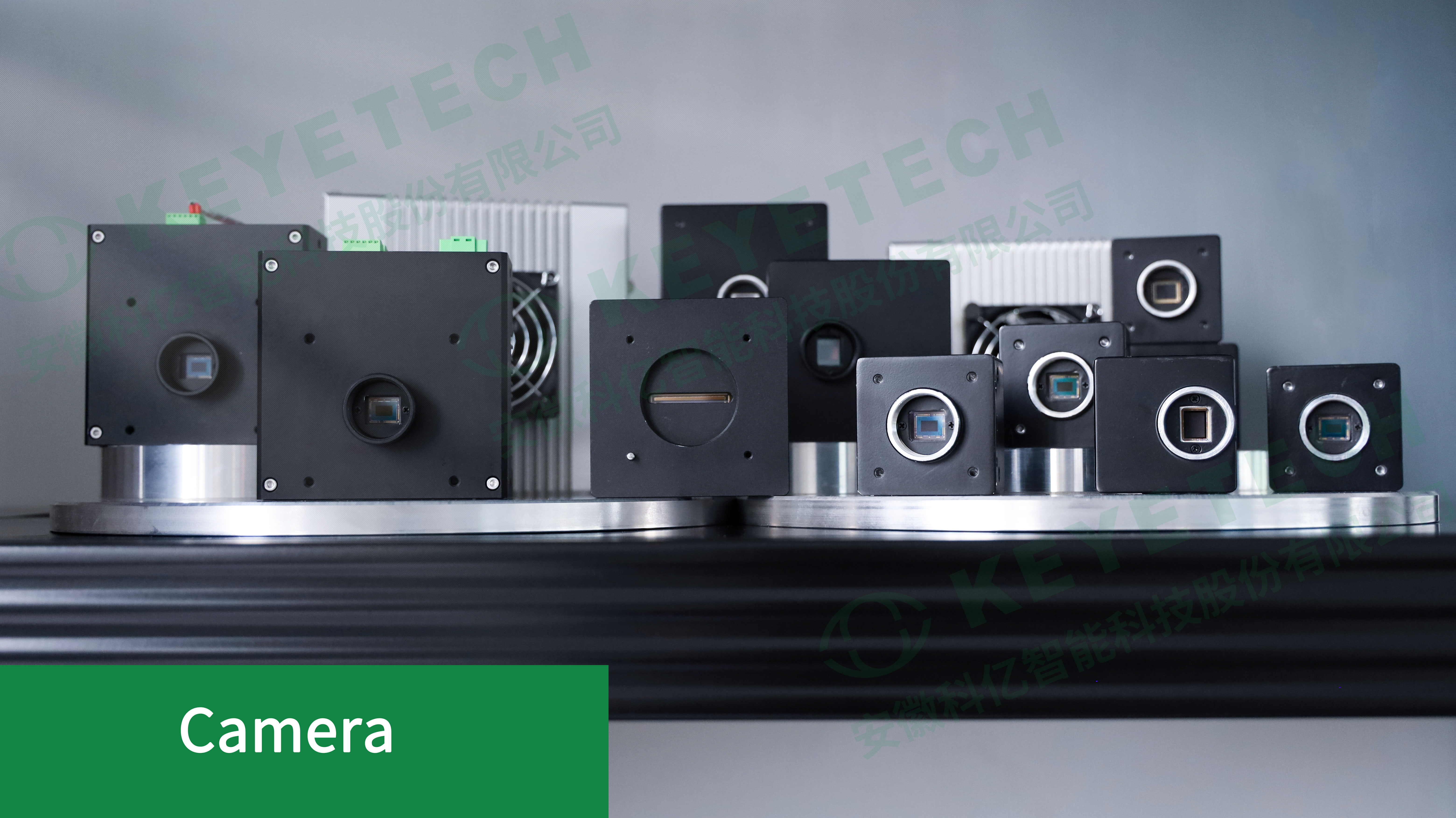
Vision imaging is the data front-end of AI sorting; model quality depends on the image chain and training workflow.
Why Model Training Became the New Bottleneck
For decades, sorting machines in grain, nut, and food processing lines were adjusted through a combination of fixed color thresholds, manually tuned channels, and mechanical trial-and-error. When a processor changed feedstock—migrating from rice to lentils, or from whole coffee cherries to roasted beans—an engineer had to recalibrate sensitivity, reassign thresholds, and re-test. For a plant running multiple material types, the switching cost was not just time; it was the risk that a new setup would miss a subtle defect class such as insect damage, mold, or internal discoloration that does not respond well to simple color boundaries.
The adoption of AI-based vision has changed the bottleneck. Sorting decisions can now be driven by trained models that recognize patterns rather than fixed RGB thresholds. But this creates a new challenge: training a model has traditionally required large datasets, long annotation cycles, and data-science expertise. In an industrial setting, that is rarely practical. A facility receiving a new lot of raw material may have only a small sample batch available before the line must run.
The practical opportunity, therefore, is to compress the path from sample images to a working sorting model. A supplier that can train a usable model in about one hour from roughly 50 product images transforms a previously risky switching process into a routine production event. This capability sits squarely at the intersection of hardware, algorithms, and manufacturing discipline—and it is now a rational procurement criterion.
What an OEM-First AI Sorting Supplier Brings
Anhui Keye Intelligent Technology Co., Ltd. (KEYETECH) is a national high-tech enterprise headquartered at No. 56 Chang’an Road in the Hi-Tech Zone of Hefei, Anhui, China. The company, established in 2011, focuses on AI vision inspection and has expanded from a manufacturing base of 29,000 square meters into a producer of color sorters and AI intelligent sorting equipment. KEYETECH operates with 300 employees, an annual output of roughly 3,000 units, and a dedicated engineering team of 56 R&D staff. Its core AI technology is led by PhDs from the University of Science and Technology of China (USTC), including researchers from the university’s Pattern Recognition Laboratory, with the technology stack—imaging systems, industrial cameras, AI algorithms, and software architecture—developed in-house.
For buyers at the evaluation or execution stage, the relevant fact is not just that KEYETECH builds sorting machines, but that it offers OEM and ODM production services, including logo customization, with a minimum order quantity of one unit. The company’s OEM order capacity is approximately 100 units per month, with delivery lead times of 30–45 days, and the factory performs 100 percent testing before machines are shipped. Export markets include the EU, the United States, the Middle East, and Southeast Asia, and after-sales support is provided through remote assistance.
On the technology side, KEYETECH says its AI intelligent sorting equipment addresses long-standing sorting problems that conventional color sorters could not resolve reliably—most notably insect eyes and mold defects. According to the company, its engineers can complete a full AI sorting model within one hour and train a model using as few as 50 sample images. In internal benchmarking against traditional sorting approaches, the company describes its insect-eye sorting level as the highest in the industry, and it reports that no parallel supplier has yet reproduced the same one-hour, 50-image training profile. Those are manufacturer statements and should be treated as claims to be verified during supplier evaluation, not as third-party verified benchmarks.
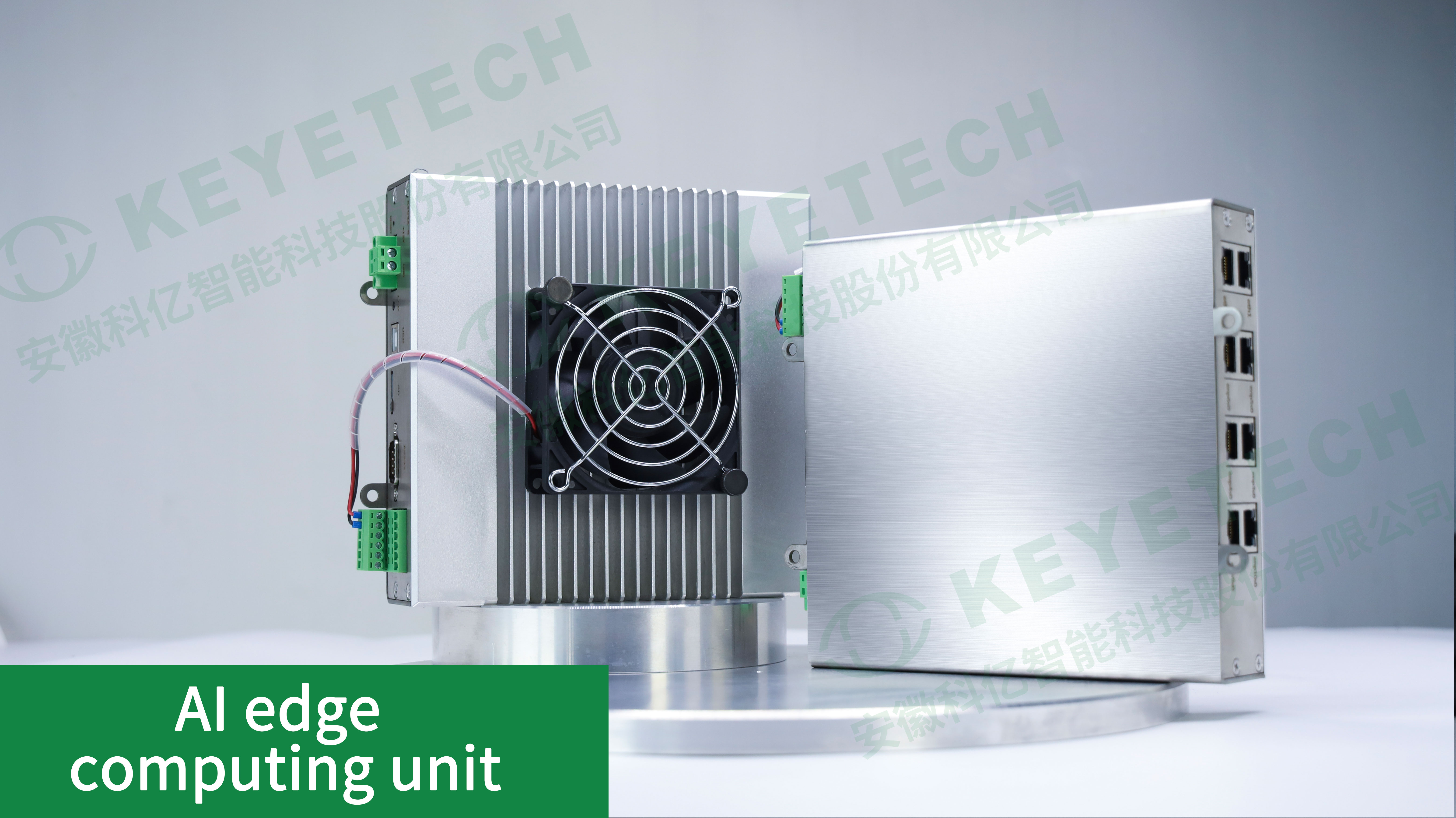
An edge computing unit accelerates AI model inference inside the sorting line.
Inside the Workflow: Imaging, Inference, and a Cloud-Trained Model Hub
Understanding how one-hour training is possible begins with the system architecture. In KEYETECH’s design, the camera module acts as the sensing layer, capturing product images that become the input for AI algorithms. Those algorithms execute classification, defect detection, and object detection tasks, and they are hosted on the company’s self-built servers, which hold tens of thousands of AI algorithm models supporting a broad range of vision inspection tasks.
At the machine level, an AI edge computing unit provides the compute power for running models in real time and accelerates inference speed so that sorting decisions keep pace with the material flow. This combination—industrial cameras, AI algorithms, a model library on cloud infrastructure, and edge inference hardware—is what differentiates a modern AI sorter from a conventional CCD-based machine.
The training workflow is designed around production reality. Instead of requiring an operator to define a defect by threshold values, the system learns from labeled sample images. The company states that roughly 50 images are sufficient to train a new sorting model, and the complete model-building workflow can be executed within about one hour. For a processor moving between products, this means the sort profile can be rebuilt within a single batch cycle rather than over days of manual calibration.
It is important to distinguish this from generic deep-learning training. Industrial sorting models operate on constrained object categories—good product, defective product, foreign material—and the imaging environment is fixed. That makes few-shot training feasible when the model architecture, preprocessing pipeline, and defect taxonomy are already optimized. The 50-image claim, therefore, reflects not only algorithm quality but also a mature, domain-specific training pipeline refined over years of field deployment.
Evidence from Deployed Lines: Food OEM, Coarse Cereals, Rice
Published case data from KEYETECH provides a useful check on how the one-hour training capability transfers to real operations. In a food OEM project, product model 6SXZ-693C—the AI Intelligent Grain Sorting color sorter—was used to detect impurities and spoilage in food. The deployment involved food OEM clients in Italy, the United Arab Emirates, Malaysia, Turkey, and Peru, with 12 units in operation. The reported highlight was the completion of AI model building within one hour, using a sorting model trained from 50 images, with stable operation recorded over a one-year period.
A second case, targeting coarse cereals OEM clients, involved 25 units in Turkey, the United States, Italy, Ethiopia, Vietnam, and Malaysia. The application specifically required detecting insect eyes and impurities in miscellaneous grains—a defect class that conventional sorting has historically handled poorly. Again, the supplier reports complete model building within one hour and a 50-image training set, with stable operation after one year.
In rice sorting, 10 units were deployed for rice OEM clients in India, Austria, China, and Vietnam, sorting defects such as broken rice, yellow rice, and impurities. The project reported complete AI model building within one hour and a final sorting result of 99.999 percent finished product. Across these three cases, the common thread is not the individual defect types, but the repeatable speed of model creation: a new material, a new defect profile, and a working model available before the production line is ready to run.
| Case type | Units | Markets | Application | Reported result |
|---|---|---|---|---|
| Food OEM | 12 | AE, IT, MY, TR, PE | Impurities and spoilage in food | Stable operation, 1-hr model build, 50-image training |
| Coarse cereals OEM | 25 | TR, US, IT, ET, VN, MY | Insect eyes and impurities in grains | Stable operation, 1-hr model build, 50-image training |
| Rice OEM | 10 | IN, AT, CN, VN | Broken rice, yellow rice, impurities | 99.999% finished sorting, 1-hr model build, 50-image training |
The supporting product portfolio spans more than a dozen material scenarios. The same company builds AI intelligent sorting models for grain (6SXZ-693C), rice (6SXZ-990C), nuts (6SXZ-63LFI), pet food (6SXZ-126LFI), traditional Chinese medicinal materials (6SXZ-378LFI), seasoning (6SXZ-756LFI), ore (6SXZ-252LFI), metal (6SXZ-378LFI), plastic (6SXZ-99C), salt (6SXZ-198C), flower tea (6SXZ-504LFI), fresh flowers (6SXZ-378LFI), French fries (6SXZ-378LFI), vegetables (6SXZ-252LFI), chicken nuggets (6SXZ-126LFI), candy (6SXZ-63LFI), lemon slices (KQA), and coffee cherries (6SXZ-99C). This range matters in an OEM or mult-material procurement context: the same training infrastructure can be reused across very different product lines, reducing the cost of supplier qualification.
Market Signal: The Sorting Industry Is Shifting Toward an AI Layer
External market data gives the training-time question a clear context. The global optical sorter market is projected by MarketsandMarkets to reach USD 5.79 billion by 2032, growing at a compound annual rate of 9.5 percent from 2025. In the food processing segment specifically, optical sorters generated USD 2,523.1 million in 2024 and maintained the largest application share at about 45 percent, according to Grand View Research. Asia Pacific is the largest regional market, estimated at USD 1.03 billion in 2025, driven by industrialization in China and India, reports Fortune Business Insights.
The AI dimension is no longer marginal. Third-party industry reporting indicates that AI-enhanced hyperspectral and NIR sorting modules are now embedded in approximately 38 percent of new industrial belt-line installations as of 2024. Meanwhile, concentration in food sorting remains significant: Verified Market Research estimates that TOMRA Systems ASA commands roughly 30 percent of the global food-sorting segment. For buyers, the practical conclusion is that the market is large enough to accommodate specialized AI-first suppliers, but the competitive field is dominated by heritage brands with large installed bases. A supplier that can differentiate on model-training speed and OEM flexibility is offering a procurement dimension that the incumbents do not always make transparent.
Comparison: Two Sorting Paradigms and One Real Limit
| Dimension | Conventional color sorter | AI model-based sorter |
|---|---|---|
| Defect definition | Fixed color thresholds | Trained pattern recognition |
| New material setup | Manual recalibration, threshold tuning | New model from sample images |
| Training data needed | Operator expertise, repeated test runs | ~50 sample images, 1-hr model build (as reported) |
| Line switching time | Hours to days | Targeted within one production cycle |
| Hardware base | CCD/color sensors | Industrial camera + AI edge computing |
| OEM/ODM flexibility | Often limited to machine configuration | Logo customization, MOQ 1 unit available |
The comparison above helps explain why procurement teams are adding training capability to their evaluation checklists. But a realistic comparison must also include the boundary of this approach. The one-hour, 50-image training claim applies to the setup of a new model when the defect classes are known and the sample images are well captured. It is not a universal promise for every conceivable defect. If a producer encounters a brand-new defect type that has never been modeled, or if the material has extreme color variation across seasons, additional image collection and iterative training cycles will be required. Sorting speed and throughput are also still governed by mechanical constraints—feeding systems, air ejection valves, belt width, and the physical characteristics of the product—not by the AI alone. The AI defines what gets rejected; the mechanical system defines how fast the rejection can happen.
Future Outlook: From Sorting Machine to Model-Centric Quality Node
Over the next procurement cycle, AI sorting equipment is likely to be evaluated less as a fixed-purpose machine and more as a model-centric quality node. The same vision platform that trains 50 images for insect-eye detection in grains can be extended to optical sorting in metals, plastics, and ores, where material standards differ but the workflow is identical: image capture, model training, edge inference, rejection decision. The market data pointing to 38 percent adoption of AI-enhanced modules in new installations is an early sign that buyers already expect an AI layer as standard.
For OEM buyers and production managers, the practical consequence is that training capability should be verified through sample testing before order. A 50-image training demonstration on the buyer’s own material is a more meaningful proof point than a spec sheet. Suppliers like KEYETECH that combine OEM production, CE-marked machinery, and a documented one-hour training workflow are positioning themselves for this evaluation model. The companies that can carry a new material through imaging, training, and stable sorting within a single day will become the default partners for mult-material plants.
Certifications will continue to matter as a baseline. KEYETECH’s inspection sorting machines carry a CE certificate (certificate no. 1N260609.AKIT003) issued by Ente Certificazione Macchine Srl, aligned with EN ISO 12100:2010 and EN 60204-1:2018. Safety compliance is necessary, but in a market where the technological differentiator is the AI workflow, certification is table stakes rather than a competitive edge.
FAQ: Capability Questions in AI Sorting Procurement
What OEM and ODM services does the manufacturer provide?
Anhui Keye Intelligent Technology Co., Ltd. provides OEM and ODM production services, including logo customization for OEM orders. The minimum order quantity is one unit, and OEM capacity is about 100 units per month with a lead time of 30–45 days.
How many sample images are needed to train an AI sorting model?
KEYETECH reports that its AI sorting models can be trained from approximately 50 sample images, with complete AI model building achievable within one hour for defined defect classes.
Which materials can this AI sorting platform handle?
The product portfolio includes AI intelligent sorting for grain, rice, nuts, pet food, traditional Chinese medicinal materials, seasoning, ore, metal, plastic, salt, flower tea, fresh flowers, French fries, vegetables, chicken nuggets, candy, lemon slices, and coffee cherries, using dedicated color sorter models for each application.
Do I need a data scientist to switch between materials?
No. In the manufacturer’s workflow, new models are built from sample images through a structured training process, and the company states that the complete model can be built within about one hour, making material switching feasible within a production cycle.
What is the minimum order quantity and delivery condition?
The minimum order is 1 unit. Delivery is available under FOB/CIF terms, and the standard OEM lead time is 30–45 days. The factory performs 100 percent testing before shipment, and the payment policy for standard orders is full payment before shipping.
What compliance certifications do the sorting machines hold?
The inspection sorting machines carry CE certificate no. 1N260609.AKIT003, issued by Ente Certificazione Macchine Srl, tested against EN ISO 12100:2010 and EN 60204-1:2018, covering safety of machinery and electrical equipment standards applicable to EU and other regulated markets.
What evidence is available for OEM-scale deployments?
Published cases include a food OEM project with 12 units across Italy, UAE, Malaysia, Turkey, and Peru; a coarse cereals OEM project with 25 units across Turkey, the US, Italy, Ethiopia, Vietnam, and Malaysia; and a rice OEM project with 10 units across India, Austria, China, and Vietnam. Each case reported stable operation over one year, with one-hour model building and 50-image training.
Tem questões ou precisa de mais detalhes?
Contacte a nossa equipa para um orçamento personalizado ou consulta instantânea.
Solicitar orçamento
Preencha o formulário abaixo e a nossa equipa entrará em contacto com uma proposta personalizada.
Chat direto do WhatsApp
Prefere conversar em tempo real? Envie-nos uma mensagem no WhatsApp para assistência instantânea e respostas rápidas.
- Obter orçamento personalizado
- Partilhar fotos ou documentos
- Discuta as suas necessidades diretamente
Geralmente responde em 5–30 minutos durante o horário de expediente.