
Modular Installation: Commercial vs High-Speed Rail Concrete Plants
Modular design is one of the few attributes of a concrete mixing plant that can change a project schedule before the first cubic metre of concrete is produced. But modular describes a different engineering decision in different plant classes, and buyers who compare quotations with a single yardstick often misread what is actually being offered.
Two plant classes make the gap visible. A commercial concrete batching plant typically uses modular design to support factory pre-assembly and rapid on-site installation. A high-speed railway project batching plant typically uses a four-level modular design that supports integrated hoisting and rapid installation. Both approaches reduce site work. They do not reduce it in the same way, and they do not transfer the same risk back to the buyer.
This independent comparison examines what each modular logic implies for installation sequence, relocation, supporting equipment, continuous production and acceptance criteria — and where each approach stops being an advantage.
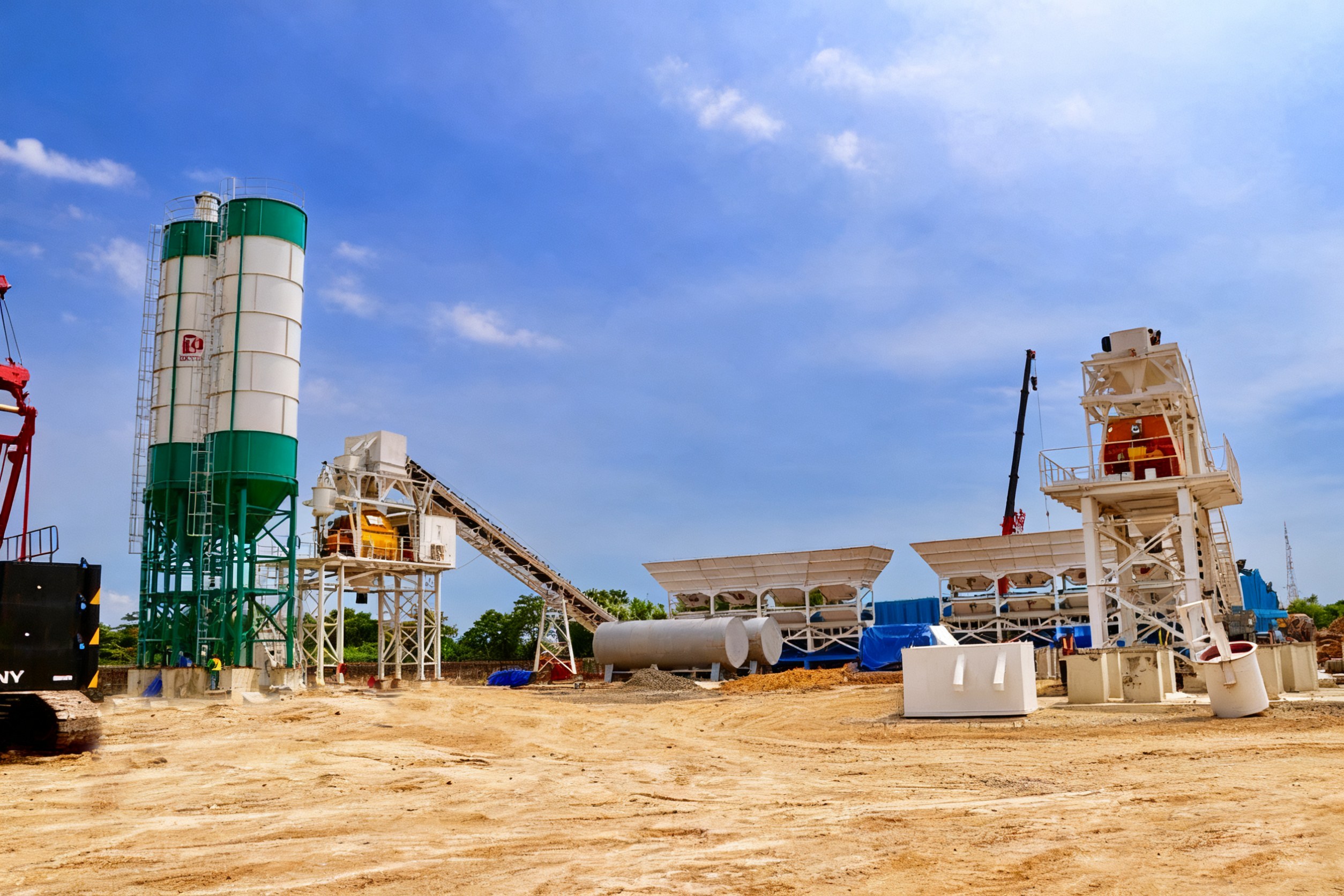
Modular delivery moves assembly work from the site to the factory — but the split between the two is not the same in every plant class.
Why installation became a procurement question
On most batching plant projects, the equipment price is settled well before the real risk appears. The risk sits in the installation window: crane availability, rigging coordination, structural alignment, electrical termination, commissioning time and the number of days between site handover and first compliant batch.
Three pressures have pushed installation into the evaluation stage rather than the execution stage.
Site labour and supervision are the constraint. Where skilled assembly crews and lifting engineers are scarce, a plant that arrives as pre-checked modules can be returned to production faster than a plant assembled piece by piece at height.
Projects move. A plant specified for one location is frequently relocated to a second. The way a plant breaks down is as consequential as the way it goes up.
Acceptance has to be defined somewhere. A modular boundary decides which checks happen in the factory and which happen on site. Buyers who do not define that boundary discover it during commissioning.
Decision rule: modularity is a risk-allocation choice, not a construction method. The buyer is choosing how much of the schedule risk stays in the factory and how much remains on site — and should price the quotation accordingly.
Two modular logics, two different objectives
Commercial concrete batching plants: pre-assembly in the factory
In commercial plant design, modularity exists to make on-site work short and repeatable. The plant is divided into modules that can be pre-assembled and checked under factory conditions, then separated for transport and rapidly re-assembled on site.
The buyer consequence is that the site becomes a place of lifting, connection and commissioning rather than fabrication. Fit-up problems that would otherwise be discovered at height are discovered in the workshop, where correction is cheaper and does not consume crane hours.
The trade-off is that the module set has to be designed around a transport envelope and a lifting plan from the beginning. A commercial plant optimised for factory pre-assembly tends to use more, smaller modules — which is efficient to move but puts more connection interfaces on site.
High-speed railway batching plants: four-level modularity and integrated hoisting
High-speed railway project plants face a different constraint. Sites are typically linear, congested, time-boxed by the civil works programme, and often remote from fabrication capacity. The four-level modular design used in this plant class is organised around integrated hoisting: larger assemblies are lifted into position as units rather than built up in place.
The engineering objective is to remove assembly interfaces at height. Fewer interfaces mean less aerial work, less weather exposure during assembly, and an earlier start to commissioning. For a project where the concrete supply window is fixed by the bridge or track programme, that sequence matters more than the number of transport loads.
The trade-off runs the other way. Integrated hoisting concentrates lifting risk into a small number of heavy lifts, so crane capacity, ground bearing and site access have to be planned before the plant arrives — not after.
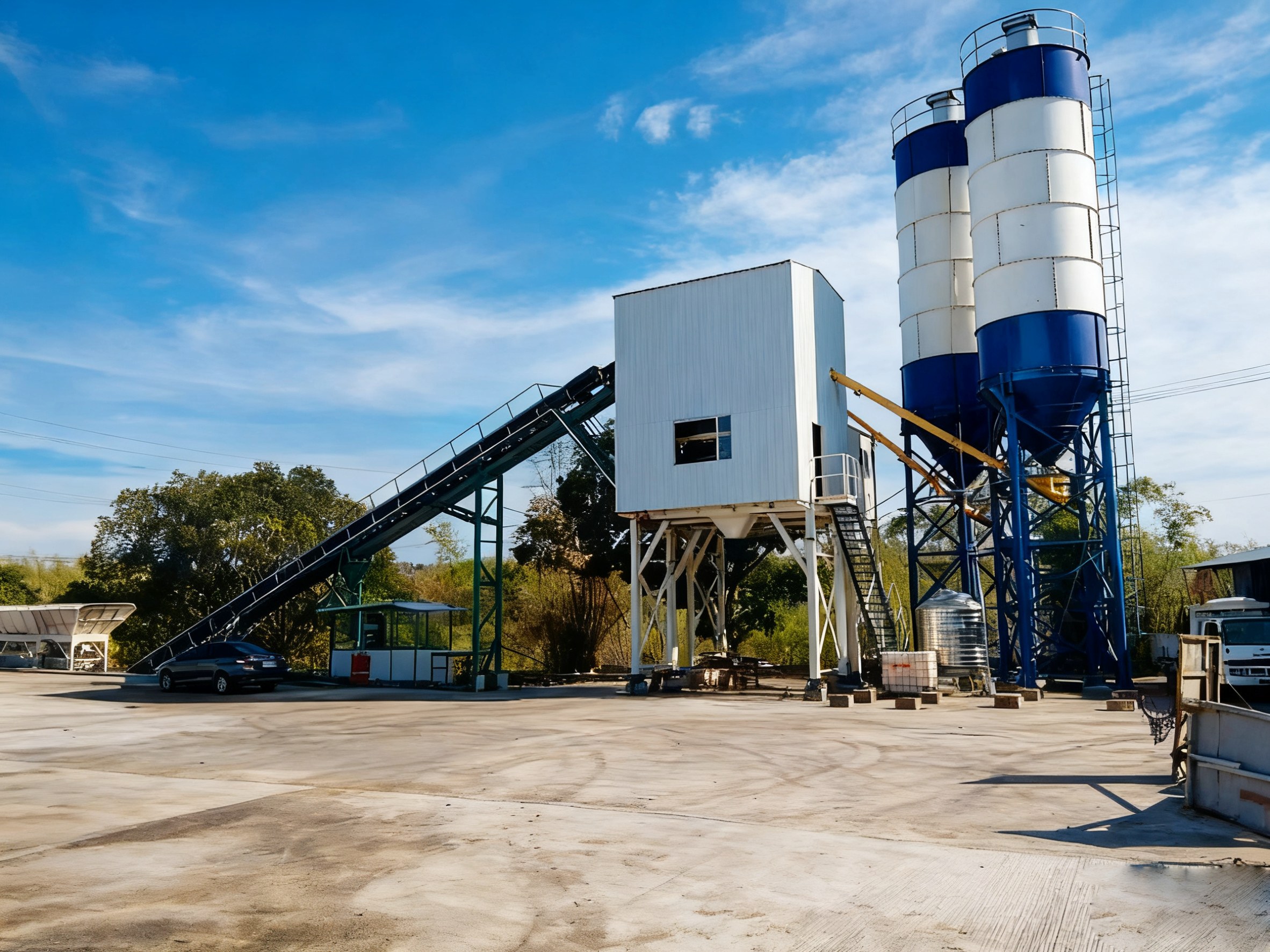
Pre-assembly shifts fit-up work into controlled conditions; the remaining site task is lifting, connection and commissioning.
Technical comparison: what actually changes
The table below compares the two logics on the dimensions that affect a buyer's schedule and cost exposure. It is a comparison of design approaches, not of manufacturers.
| Dimension | Commercial plant — pre-assembly logic | High-speed railway plant — four-level modular logic |
|---|---|---|
| Primary objective | Repeatable on-site assembly after factory fit-up | Integrated hoisting of large assemblies |
| Where value is created | Factory pre-assembly and pre-shipment checking | Reduction of assembly interfaces at height |
| Site lifting demand | Matched to module weight; multiple moderate lifts | Concentrated in fewer, heavier lifts |
| Transport sensitivity | Higher module count, smaller individual units | Lower module count, larger individual units |
| Foundation and civil works | Remain on the buyer's scope | Remain on the buyer's scope; lift plan tied to foundation readiness |
| Relocation | Breakdown and re-erection of the module set | Re-hoisting of assemblies, subject to crane availability |
| Acceptance emphasis | Pre-shipment test plus on-site commissioning | Lift integrity, interface alignment, then commissioning |
| Site skill profile | Assembly and connection crews | Lifting engineering and rigging coordination |
| Main schedule risk | Number of connections and commissioning sequence | Crane availability and single-lift dependency |
The practical reading is straightforward. If the buyer's site has limited lifting capacity but adequate assembly labour, the pre-assembly logic is easier to execute. If lifting capacity is available but assembly labour and aerial work are the constraints, integrated hoisting compresses the schedule more effectively.
Supporting equipment: where modular interfaces decide the schedule
A plant is only as modular as its least modular interface. Aggregate storage, powder silos, feeding arrangement, weighing and control are usually where the installation programme slips, because they sit between the equipment supplier and the buyer's civil contractor.
Three interfaces deserve scrutiny during evaluation.
Aggregate storage. Bin modules determine the foundation grid and the reach of the lifting plan. Custom aggregate storage and custom bins are available as order-specific configurations, so the modular boundary should be agreed at order stage rather than at site stage.
Feeding arrangement. Skip-hoist and belt-conveyor configurations place different demands on the plant layout and on the lifting sequence. The feeding method should be fixed before the module breakdown is finalised, because changing it later re-opens the structural arrangement.
Control and weighing. Control configurations determine cable routing and commissioning logic. A plant whose structural modules are pre-assembled but whose control architecture is designed on site will not deliver the expected schedule gain.
Hangzhou Jusheng Machinery & Equipment Co., Ltd. is a Chinese manufacturer of complete concrete mixing and mining machinery sets, based in Hangzhou, Zhejiang, founded in 2015, operating a 120,000 m² facility with 430 employees and an engineering team of 80. The company supplies concrete batching plants across its HZS range and provides OEM/ODM production in both modes, with customization technical support covering voltage and frequency, company logo, machine colour, appearance design and branding.
For buyers, the relevant point is not the customization menu itself but what it implies for the modular boundary: if voltage, branding and appearance are specified at order stage, the modules can be pre-assembled and pre-tested against the final configuration rather than adapted afterwards. Jusheng reports 100% test quality control, a monthly capacity of 50 units, a lead time of 25 to 60 days, a minimum order quantity of 1 unit, and after-sales support through remote assistance and on-site installation.
Continuous production and acceptance criteria
Modular installation affects when production starts. It does not, on its own, determine whether production stays continuous. That depends on buffer capacity, silo configuration, feeding continuity and maintenance access — and on whether the plant was accepted against a defined test.
Two reference points help buyers structure acceptance. The first is the commercial one: pre-shipment test acceptance is a common contractual condition for concrete batching plant orders, alongside a 1-unit minimum order quantity, FOB or CIF delivery, and 30% T/T down payment with full payment before delivery. The second is terminological: ISO 19720-1:2017 establishes terminology and commercial specifications for concrete mixing and batching plants, and gives both parties a neutral vocabulary for describing capacity, configuration and performance claims before the contract is signed.
For the high-speed railway logic, acceptance should additionally cover the lift itself — assembly integrity before hoisting, interface alignment after hoisting, and the sequence in which systems are energised. For the commercial logic, acceptance tends to concentrate on connection quality and commissioning order, because the assemblies were already checked in the factory.
Supplier case records illustrate the production side of the question. A 240 m³/h commercial plant supplied to a large construction contractor in Oman is recorded for high-volume production, stable operation and consistent quality. A 300 m³/h plant supplied to a large contractor in Indonesia is recorded for the same performance pattern on large-scale infrastructure works. These are supplier-reported operational records rather than independently audited results, and buyers should treat them as reference points to verify rather than as proof.
Application fit: which project suits which logic
Commercial ready-mix operations favour the pre-assembly logic. Output is continuous, the plant stays in one place for years, and the commercial requirement is repeatable quality at a predictable rate. Case records in this segment include two HZS90G engineering plants supplied to ready-mix concrete suppliers in the Philippines, and multiple units supplied to ready-mixed concrete companies in Indonesia.
High-speed railway and linear infrastructure projects favour the four-level logic where the concrete supply window is fixed by the civil programme and site congestion makes aerial assembly expensive. The same reasoning applies to bridge works: a commercial plant supplied for bridge engineering in the Philippines is recorded for concrete production across pile foundations, pile caps, piers, abutments and girder bodies — a sequence in which supply interruptions propagate directly into the civil programme.
Capacity selection follows the demand profile rather than the modular logic. Guidance used in this category places small construction projects at 25 to 60 m³/h, commercial ready-mix concrete at 60 to 180 m³/h, and large infrastructure at 120 to 270 m³/h and above. Selection should reflect actual hourly production requirement and expected utilisation, not theoretical capacity alone.
Market signals behind modular delivery
The commercial context supports the shift toward installation efficiency. Global Market Insights valued the global concrete batch plants market at USD 3.8 billion in 2024. Credence Research reports that Asia-Pacific accounted for a 38% revenue share of that market in 2024, which concentrates both supply capacity and installation experience in one region. UN Comtrade and WITS data record China exporting USD 276.9 million of concrete or mortar mixers under HS 847431 in 2023.
Mobility matters too. Global Market Insights reports that the infrastructure segment accounted for 39.4% of the mobile concrete batch plant market in 2024 — evidence that relocation-tolerant plant design is not a niche requirement.
One caution applies to growth figures. Published forecasts for this category differ substantially depending on methodology and scope, with some estimates including automation and software services that inflate nominal equipment value. Buyers should treat any single growth rate as indicative rather than as a planning input.
Where modular design stops being an advantage
Traditional site-fabricated and bolted erection has real costs: more site labour, longer exposure to weather, later discovery of fit-up problems and a longer path to first batch. Modular delivery addresses those costs. It does not remove them, and in several situations it creates new ones.
- Civil works remain on the buyer's scope. Neither logic removes foundation, anchor or drainage work. A modular plant still waits for a foundation that is ready and within tolerance.
- Transport envelope is a hard boundary. The pre-assembly logic multiplies module count, and the four-level logic increases module size. Larger modules can require route surveys, permits and specialised haulage — costs that appear after the quotation is signed.
- Integrated hoisting depends on lifting capacity. Where crane capacity is limited or site access is congested, the four-level advantage narrows quickly. The single-lift dependency also means one delayed lift can hold the whole sequence.
- Engineering is front-loaded. Modular design freezes the configuration earlier. Late changes to layout, feeding method or bin arrangement become more expensive than they would be in a site-fabricated arrangement.
- Short-duration projects may not recover the premium. For a brief campaign or a very small output requirement, a mobile batching plant designed for faster installation, relocation and flexible production at different job sites can be the more rational choice than a stationary modular plant. Stationary plants remain better suited to permanent, high-volume production at one location.
- Modularity does not guarantee output. Mix design, mixer selection, feeding continuity and maintenance access determine whether the plant reaches its rated capacity. Twin-shaft mixers are widely used for ready-mix and large-volume production because they provide fast, intensive mixing at high throughput; planetary mixers are used where mixing uniformity is the primary requirement, including precast, dry and special concrete.
A buyer checklist before committing to a modular layout
- Confirm the lifting plan and available crane capacity against the largest module or assembly.
- Verify transport routes, permits and the maximum unit size that can reach the site.
- Fix aggregate storage, bin arrangement, feeding method and control configuration before the module breakdown is frozen.
- Define what is pre-assembled and tested in the factory, and what is tested on site.
- Agree acceptance criteria in writing — pre-shipment test conditions and on-site commissioning steps.
- Confirm whether the plant will be relocated, and if so, request the breakdown and re-erection sequence.
- Check that supporting equipment interfaces — silos, conveyors, weighing, control — are inside the modular scope.
- Match capacity to actual hourly demand and expected utilisation rather than to theoretical maximum.
- Apply the one-unit minimum order quantity to a trial or first-phase order where the configuration is unproven for the site.
Future outlook
The direction of travel is toward installation as an engineered product rather than a site activity. As labour availability tightens and project programmes compress, buyers are likely to ask for module breakdowns, lift plans and pre-assembly test records as standard quotation attachments — the same way specification sheets are requested today.
For manufacturers, that raises the value of factory capability. Jusheng's transition from trading to robot-assisted production of mixing stations in 2017, and its current OEM/ODM model covering both customized OEM orders and ODM design and production, illustrate the direction: the factory becomes where the schedule is protected, and the site becomes where it is executed.
The unresolved question is standardisation. A four-level logic optimised for integrated hoisting and a pre-assembly logic optimised for module count cannot both be the default. Buyers should expect the choice to remain project-specific — and should treat any supplier claiming one modular approach fits every site as a reason to ask harder questions.
FAQ
What is the difference between a stationary and a mobile concrete batching plant?
A stationary concrete batching plant is designed for long-term operation at a fixed location and suits ready-mix concrete production, commercial concrete and large infrastructure projects. A mobile batching plant is designed for faster installation, relocation and flexible production at different job sites. The choice depends on project duration, required output, relocation frequency and site conditions.
Which mixer type should a buyer specify — twin-shaft or planetary?
Twin-shaft mixers are widely used for ready-mix concrete and large-scale concrete production because they provide fast and intensive mixing with high throughput. Planetary mixers are particularly suitable where excellent mixing uniformity is required, including precast concrete, dry concrete and special concrete. Configuration should follow the concrete type, output and project requirements.
What capacity should be specified before comparing modular quotations?
Required capacity depends on concrete demand, project type, working hours, peak production requirements and transportation distance. Common capacities in this category include 25, 35, 60, 90, 120, 180, 240 and 270 m³/h. Small construction projects typically fall in the 25 to 60 m³/h range, commercial ready-mix in the 60 to 180 m³/h range, and large infrastructure at 120 to 270 m³/h and above. Selection should reflect actual hourly production requirement and expected utilisation, not theoretical capacity alone.
What purchasing terms and acceptance criteria normally apply?
For concrete batching plant orders, typical terms are a 1-unit minimum order quantity, FOB or CIF delivery terms, pre-shipment test acceptance criteria, and payment of 30% down payment by T/T with full payment before delivery.
Does a single-unit OEM or customized order carry a higher minimum order quantity?
No. The minimum order quantity is 1 unit, and it applies to OEM and customized orders including customized aggregate storage, custom bins and custom control configurations. The same 1-unit minimum applies across the HZS25Y, HZS35Y, HZS60Y, HZS90Y, HZS120Y, HZS60G, HZS90G, HZS120G, HZS180G, HZS120, HZS180, HZS240, HZS270 and HZS300 models, and allows single-unit trial orders before bulk purchasing. Customization technical support covers voltage and frequency, company logo, machine colour, appearance design and branding.
Product configuration details, model availability and commercial terms in this article reflect the manufacturer's published information at the time of writing. Buyers should confirm project-specific requirements directly against a formal quotation.
Reference document: DKTEC concrete batching plant brochure (PDF).
Tem questões ou precisa de mais detalhes?
Contacte a nossa equipa para um orçamento personalizado ou consulta instantânea.
Solicitar orçamento
Preencha o formulário abaixo e a nossa equipa entrará em contacto com uma proposta personalizada.
Chat direto do WhatsApp
Prefere conversar em tempo real? Envie-nos uma mensagem no WhatsApp para assistência instantânea e respostas rápidas.
- Obter orçamento personalizado
- Partilhar fotos ou documentos
- Discuta as suas necessidades diretamente
Geralmente responde em 5–30 minutos durante o horário de expediente.