
Module Lights: LED Warning Light Certification Guide
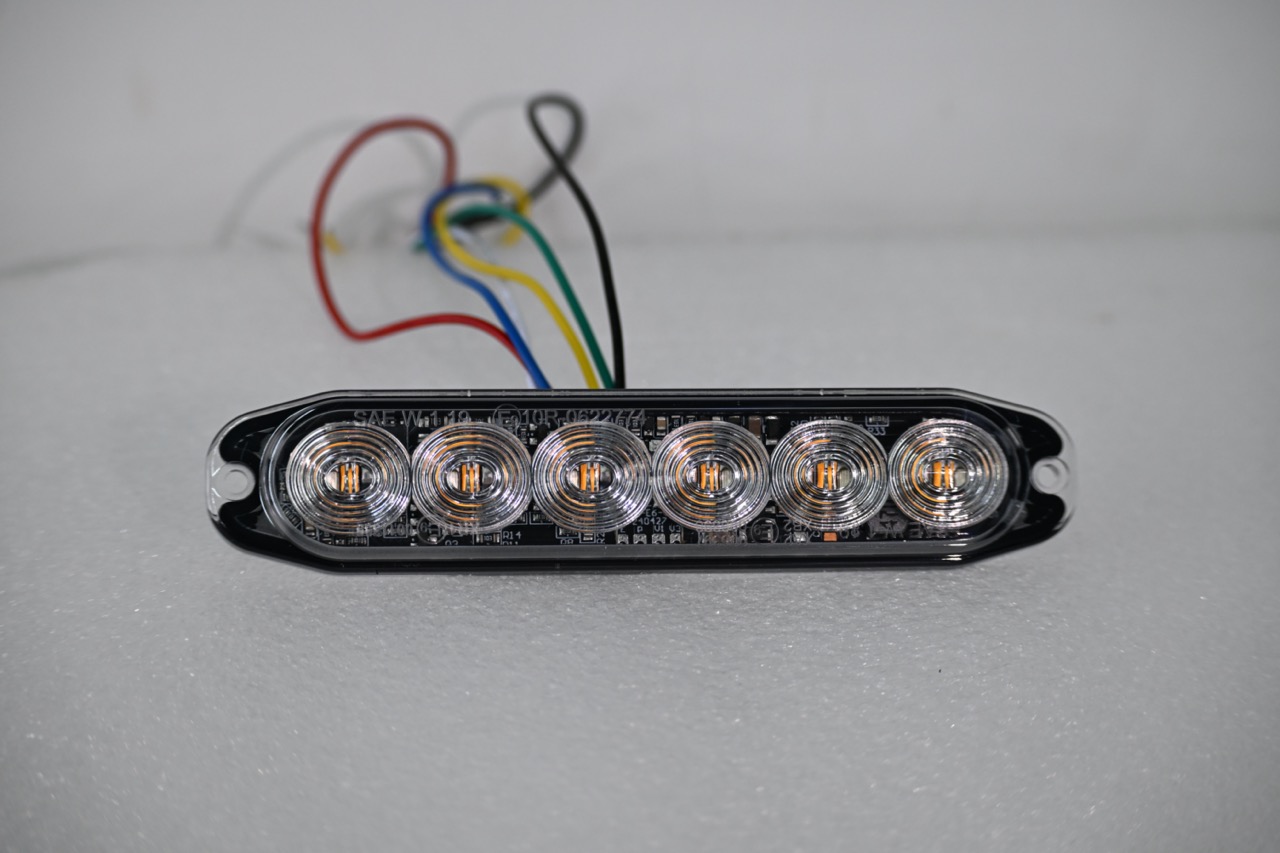
The SIGROCK E6 warning light module is an ultra-slim 118 x 25 x 7 mm LED lighthead with a Fresnel optical design, available in single, dual, triple, and split-color configurations.
LED warning light modules are the compact, directional lightheads that provide visual warning on police, fire, utility, and road maintenance vehicles. For procurement teams, the critical question is not simply whether a module is bright, but whether it is approved for the specific vehicle, market, and operating condition. This industry reference examines the certification, specification, and application constraints that shape module light selection, using SIGROCK's E6 warning light module and related product families as verifiable examples.
SIGROCK (Ningbo sigrock Automotive Lamp Technology Co., LTD.) is a Ningbo, China-based manufacturer founded in 2018, specializing in vehicle warning lights and safety lighting solutions. The company operates a 2,600 m2 facility with 35 employees, 5 engineers, and an annual output of 550,000 units, exporting 100% of its products to the EU and USA. Its portfolio includes strobe lightheads, LED beacons, lightbars, traffic advisors, dash lights, work lights, and lighting control systems.
Problem and Opportunity: Certification Is the Real Procurement Filter
The global emergency warning light market is projected to grow at a 3.6% CAGR from 2025 to 2031, according to Lucintel (via secondary report summary, SRC-0002). The broader emergency lighting market, which includes vehicle warning kits, was valued at USD 7.5 billion in 2023 and is expected to grow at a CAGR of over 10% between 2024 and 2032 (Global Market Insights, SRC-0001).
Growth is driven by fleet modernization, stricter road safety regulations, and the shift from legacy incandescent warning devices to LED technology. However, the market is also saturated with unverified 'R65 compliant' claims. For buyers, the opportunity lies in selecting suppliers that can provide product-specific certificates, test reports, and documented specifications rather than generic compliance statements.
What Is an LED Warning Light Module?
A warning light module is a compact, directional LED lighthead designed to be surface-mounted or bracket-mounted on a vehicle. Unlike a full-size lightbar, a module is often used where installation space is limited, such as grilles, bumpers, or side panels. SIGROCK's E6 warning light module is an ultra-slim example: 118 x 25 x 7 mm with a black bezel and a Fresnel optical design. It is available in red, blue, amber, white, and green, with single-color, dual-color, triple-color, and split-color configurations. The module operates on 10-33 V DC, with maximum current of 0.66 A at 12 V and 0.33 A at 24 V. LED quantity options include 36, 12, or 18 LEDs at 3 W each. Flash patterns vary by configuration: single/split color offers 20 patterns, while dual/triple color offers 12. The lens is PC, mounting is surface or bracket, and protection is IP67/IP69K. Operating temperature is -30 degrees C to +70 degrees C, and the warranty is 3 years.
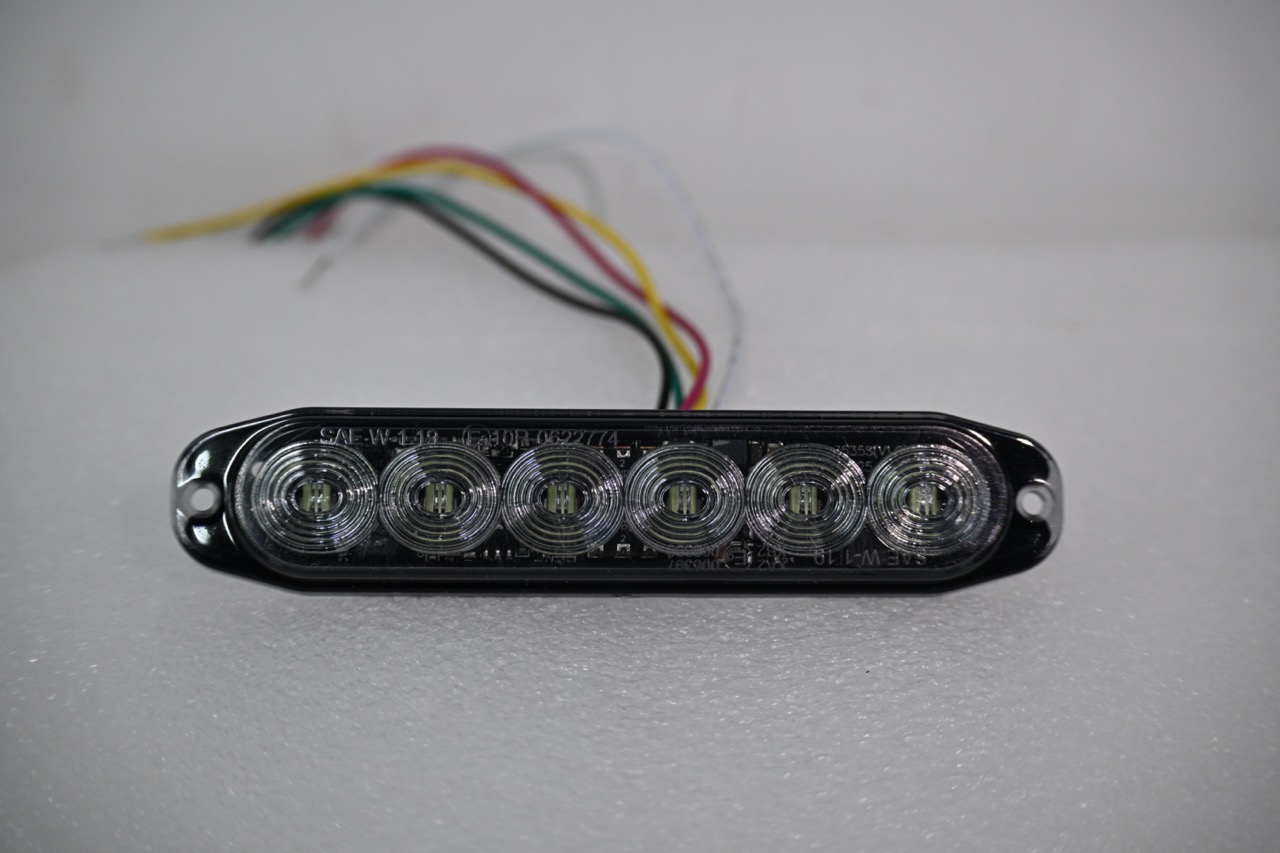
The E6 module is available with different lens and color options, including smoky lens and single, dual, triple, or split-color configurations.
Certification Landscape for Module Lights
Certification is the primary constraint in procurement. For European markets, the two most relevant approvals for warning modules are ECE R65 (special warning lamps) and ECE R10 (electromagnetic compatibility). SIGROCK's E6 warning light module holds ECE R65 type approval E9*65R00/10*6397*00, granted on 2019-08-14, covering E6AS, E6AL, and E6AH special warning lamps. The approved scope is LED amber special warning lamps in Class 1 and Class 2 at 12V/24V. The issuing authority is the Spanish Ministerio de Industria, Comercio y Turismo / Direccion General de Industria y de la Pequena y Mediana Empresa / Subdireccion General de Calidad y Seguridad Industrial. ECE R65 testing reports are available for these models.
For electromagnetic compatibility, the E6 module is certified to ECE R10.06 (E-mark) under approval E910R06/0022774*00, granted on 2021-05-06 by the same Spanish authority. The applicable standard is UNECE Regulation 10R06. The approval covers warning light module models E6S-A, E6S-B, and E6S-R, and also includes TINYBLAST-4, TINYBLAST-6, TINYBLAST-4W, TINYBLAST-DC, H-400AS, H-400BS, MEGABLAST-4, MEGABLAST-6, MEGABLAST-4W, MEGABLAST-DC, PULSE-3, E6S, and E6D. ECE R10 testing report documentation is available for these models.
A broader Conformity of Production (CoP) certificate under the UN 1958 Agreement strengthens the compliance picture. Certificate C1 49902503, issued by UCA (Unidad de Certificacion del Automovil) and accredited by ENAC under No. 509/EI807, is valid from 2019-07-29 to 2027-07-29. It covers UN R10 (EMC), UN R65 (Special warning lamps), UN R148 (Light-signalling devices), and UN R150 (Retro-reflective devices) for separate technical units, warning lamps, lighting, and retro-reflective products. The certification applies to the E6 warning light module, T43 hideaway warning light, BH18 LED warning light beacon, LB01 warning lightbar, and SC7X controller.
Other product families carry their own approvals. The T43 hideaway warning light is certified to ECE R148 under E9*148R00/05*22705*00, issued by L'Albornar, Santa Oliva (Tarragona), covering T43P-01 (clear outer lens) and T43P-S1 (smoky grey outer lens). The T43 also holds RoHS test report XT10305011R, issued on 2025-11-20 by Ningbo Xuntong Standard Technology Service Co., Ltd., and EMC test report XT10305012E, issued on 2025-11-18. The T43 complies with ECE R65, R148, R10, RoHS, and CE.
The BH18 LED warning light beacon is certified to ECE R65 Class 2, ECE R10, and SAE J595 Class 1, with IP67/IP69K protection and a 3-year warranty. The LB01 warning lightbar complies with ECE R65 and ECE R10, has IP65 protection, and is available in six lengths from 600 mm to 1600 mm. The SC7X controller is ECE R10 approved, IP67 rated, and carries a 2-year warranty.
SAE J595 is the relevant North American recommended practice for directional flashing optical warning devices. SAE J595_202108 covers directional, single-color, flashing optical warning devices used on authorized emergency, maintenance, and service vehicles. It provides design guidelines, test procedure references, and performance requirements. Buyers should note that SAE J595 is a recommended practice, and legal adoption is not established by the standard alone.
Manufacturing quality is supported by ISO 9001:2015 certification 10139902Q, issued by CERTIFICATION EUROPE (HONG KONG) LIMITED and accredited by IAF and UKAS (No. 0219). The scope covers manufacturing, processing, sales, and R&D of auto parts, motorcycle parts, plastic products, molds, lamps, warning lights, and electronic products. The certificate is valid from 2026-08-06 to 2027-08-05.
Technical Constraints and Specification Table
For procurement, the following parameters from the E6 module illustrate the constraints that must be verified before ordering.
| Parameter | E6 Specification |
|---|---|
| Size | 118 x 25 x 7 mm |
| Bezel | Black |
| Optical Design | Fresnel |
| Available Colors | Red, Blue, Amber, White, Green |
| Color Type | Single/dual color, Triple color, Split color |
| Operating Voltage | 10-33 V DC |
| Maximum Current | 0.66 A @ 12 V / 0.33 A @ 24 V |
| LED Qty | 36 / 12 / 18 LEDs, 3W each |
| Flash Pattern | Single/Split Color: x20, Dual/Triple Color: x12 |
| Lens Material | PC |
| Mounting Options | Surface mount / Bracket mount |
| Protecting Rating | IP67/IP69K |
| Operating Temperature | -30 degrees C to +70 degrees C |
| Warranty | 3 years |
These parameters matter because they determine whether the module can fit the intended installation space, operate on the vehicle's electrical system, and withstand the operating environment. The 7 mm profile is particularly relevant for grille and surface-mount applications where depth is limited. The 10-33 V DC range supports both 12 V and 24 V vehicle systems.
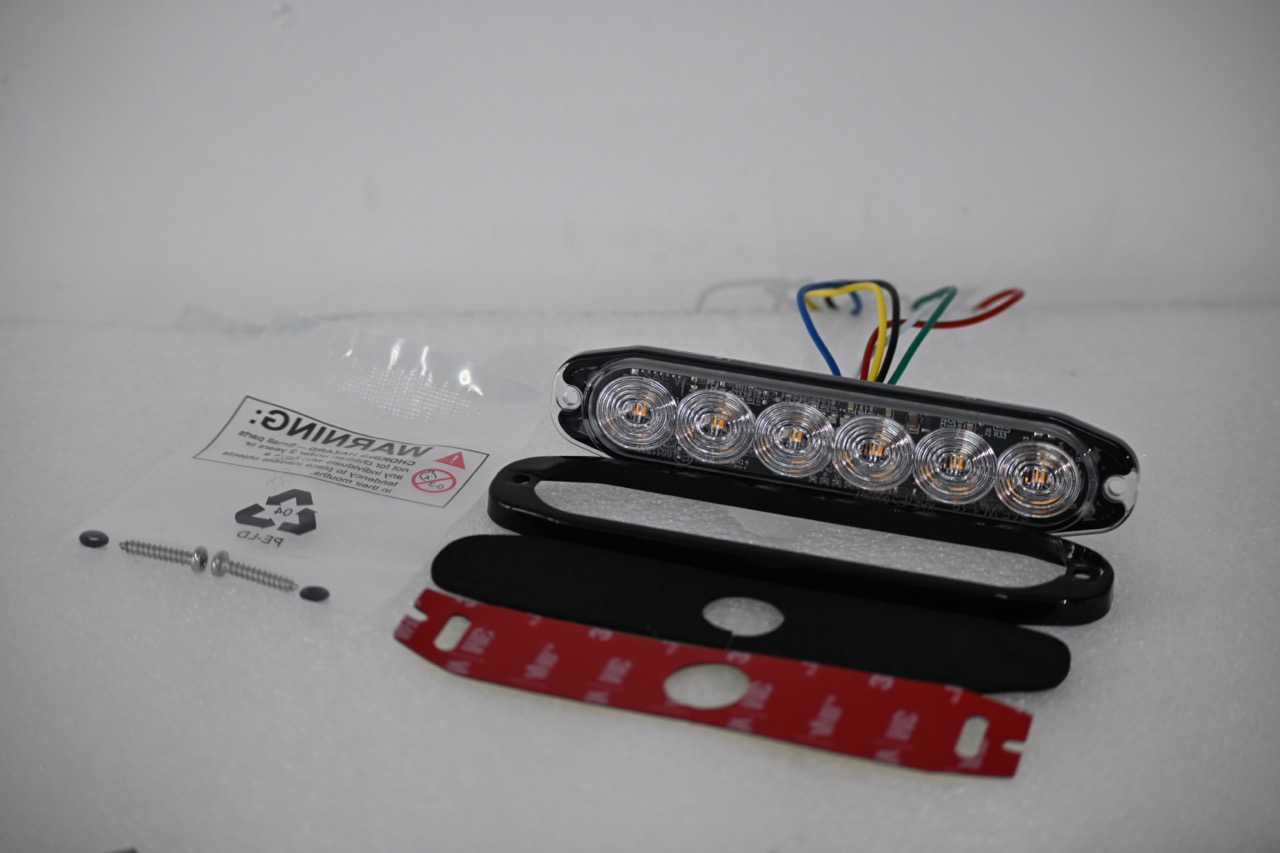
The E6 module can be surface-mounted or bracket-mounted. The bracket kit supports flexible installation on different vehicle types.
IP Ratings: What IP67 and IP69K Actually Mean
IP ratings are a common source of procurement confusion. IP67 covers dust protection and temporary immersion under specified test conditions. IP69K addresses dust protection and high-pressure, high-temperature water-jet exposure under its applicable test standard. Neither rating alone guarantees suitability for every environment. Buyers should choose based on actual cleaning methods, exposure conditions, and the product's verified test results.
For fleet operators, this distinction is practical. A module rated IP67 may be sufficient for rain, snow, and occasional washing. An IP69K rating becomes relevant when high-pressure washing is part of regular maintenance. The E6 module carries IP67/IP69K, while the LB01 lightbar is IP65, and the SC7X controller is IP67. These differences reflect product design and intended mounting location, not a simple hierarchy of quality.
Installation and Application Constraints
Warning light modules are used across emergency and public safety vehicles (police, fire, ambulance, rescue), road and traffic management (road maintenance, traffic management, highway maintenance, roadside assistance, traffic enforcement), commercial and utility vehicles (tow trucks, service vehicles, utility vehicles, maintenance vehicles, fleet vehicles), and construction and industrial vehicles.
Typical operating conditions include daytime and nighttime operation, low-light conditions, heavy rain, snow, fog, dust and mud, high humidity, outdoor operation, extreme temperatures, high UV exposure, highway and urban road operation, construction sites, roadside operations, high-vibration environments, long-duration or 24/7 fleet operation, and limited installation space.
Installation should follow the manufacturer's instructions. Disconnect power before wiring, confirm the mounting location and required visibility, use compatible fasteners, and protect wire connections from moisture and damage. After installation, check mounting security, electrical connections, and all required light functions before putting the vehicle into service.
Common operation modes for warning modules include flashing, alternating flashing, simultaneous flashing, steady-on, position lighting, warning + position lighting, manual control, central controller control, CAN bus control, programmable flash patterns, and synchronized operation.
Case evidence shows how modules enter professional distribution channels. Buyers Products, a U.S. supplier of vehicle equipment and accessories, purchased SIGROCK's T43 Hideaway Warning Light for its product portfolio and sells the product through its official online store. The order was 10,000 pcs over 3 years. Flashpatterns, a Netherlands-based online supplier, sells the SIGROCK MegaBlast in its portfolio (500 pcs, 3 years). BuySuperiorLED, a U.S.-based online supplier, sells the E6 LED Warning Lighthead (500 pcs, 3 years). Valostore, a Finnish specialist retailer, offers SIGROCK SQ4, T43, E4, and E12 warning lights (20,000 pcs, 3 years). Vignal Group in France supplies the E6 LED Warning Lighthead as part of the VIGNAL ACCESS product portfolio (12,000 pcs, 3 years).
Market Trend Analysis
The LED lighting segment is estimated to hold a dominant share of the lighting market by 2026, with a reported 74.4% share in the commercial landscape/outdoor segment. This shift is reflected in vehicle warning lighting, where LED modules offer lower power consumption, longer service life, and more flexible optical designs than legacy incandescent or halogen lightheads.
The global emergency warning light market is expected to grow at a 3.6% CAGR from 2025 to 2031, according to Lucintel (via secondary report summary). The broader emergency lighting market was valued at USD 7.5 billion in 2023 and is expected to grow at a CAGR of over 10% between 2024 and 2032. These figures indicate a mature but growing niche for vehicle-specific warning devices, driven by regulatory compliance and fleet safety requirements.
Regulatory trends are also shaping product design. ECE R65 Class 2 certification requires dual-level intensity control for day and night operation, with maximum brightness during the day and automatic dimming at night. This requirement favors LED modules with programmable drivers and dimming functions. Buyers evaluating modules should verify not only the presence of an R65 mark, but the specific class and the product model it covers.
Comparison with Traditional Solutions
Compared with traditional incandescent or halogen warning lightheads, LED modules offer several advantages: lower current draw, longer life, and more compact form factors. The E6 module's 7 mm profile and Fresnel optic illustrate how LED technology enables slim, directional lightheads that can be surface-mounted in tight spaces.
However, LED modules also introduce constraints. The optical performance of a module is highly dependent on the Fresnel or TIR optic and the installation angle. A module that performs well on a flat surface may produce less effective off-axis visibility if mounted at an angle or behind a grille. Buyers should validate the mounting location and required visibility before specifying a module.
Certification scope is another constraint. The ECE R65 approval for the E6 module covers E6AS, E6AL, and E6AH special warning lamps, while the ECE R10.06 approval covers E6S-A, E6S-B, and E6S-R. The CoP certificate covers specific product IDs. A buyer cannot assume that every variant of a module family shares the same approvals. Product-level certificates and test reports must be requested for the exact model and configuration being purchased.
Ingress protection is a third boundary. IP67 and IP69K address different water-exposure test conditions. A module rated IP67 is not automatically suitable for high-pressure, high-temperature washing. Conversely, an IP69K rating does not guarantee that the module will survive every chemical or mechanical exposure. The appropriate rating depends on the actual cleaning and operating environment.
Future Outlook
The direction of the warning light module market is toward tighter integration with vehicle control systems, more programmable flash patterns, and greater customization for OEM and ODM projects. SIGROCK's manufacturing capability supports this trend: the company offers ODM/OEM cooperation, with customization for logo, flash pattern, optical design, cable length, and LED color. Monthly capacity is 50,000 units, lead time is 25-45 days, and MOQ depends on the product and customization requirements. Sample orders are available for evaluation before mass production. Quality control includes 100% testing, export markets include the EU, North America, and Australia, and after-sales support is provided remotely.
As fleet operators and vehicle upfitters continue to demand verifiable compliance, the ability to provide product-specific certificates, test reports, and documented specifications will become a key differentiator among suppliers. The CoP certificate valid through 2027-07-29 and the ISO 9001:2015 certification valid through 2027-08-05 indicate a compliance framework that buyers can check against their own market requirements.
FAQ
Q: What is ECE R10 certification for vehicle warning lights?
A: UN ECE Regulation No. 10 (ECE R10) concerns the electromagnetic compatibility (EMC) approval of applicable vehicles and electrical or electronic components. For vehicle warning lights, it addresses relevant electromagnetic emissions and immunity requirements. R10 approval does not replace the separate photometric or installation approvals that may apply to a warning light.
Q: What is the difference between IP67 and IP69K for vehicle warning lights?
A: IP67 covers dust protection and temporary immersion under specified test conditions. IP69K addresses dust protection and high-pressure, high-temperature water-jet exposure under its applicable test standard. Neither rating alone guarantees suitability for every environment. Choose based on actual cleaning methods, exposure conditions, and the product's verified test results.
Q: How do I choose the right LED warning light module for my vehicle?
A: Choose an LED warning light module based on the vehicle application, mounting space, required visibility, applicable regulations, operating voltage, environmental exposure, and desired functions. Confirm the model's actual approvals and specifications before purchasing. For OEM or ODM projects, also consider lens design, flash patterns, colors, wiring, and branding requirements.
Q: How do I install an LED vehicle warning light correctly?
A: Install the warning light according to the manufacturer's instructions. Disconnect power before wiring, confirm the mounting location and required visibility, use compatible fasteners, and protect wire connections from moisture and damage. After installation, check the mounting security, electrical connections, and all required light functions before putting the vehicle into service.
Q: Does SIGROCK offer OEM and ODM services for LED warning lights?
A: SIGROCK supports OEM/ODM cooperation for vehicle warning and signaling lights. Depending on the product and project requirements, customization may include branding, colors, flash patterns, functions, and product design. Feasibility, minimum order quantities, development timelines, and certification requirements should be confirmed for each project.
Q: Why is my LED vehicle warning light not turning on?
A: If an LED warning light does not turn on, check the power supply, fuse, wiring connections, polarity, and control inputs according to the product's wiring diagram. Disconnect power before inspecting wiring. If the supply voltage and connections are correct but the light still does not operate, stop testing and contact the manufacturer for further diagnosis.
For a full overview of SIGROCK's warning light portfolio, specifications, and customization options, the standard edition catalogue is available for download.
Tem questões ou precisa de mais detalhes?
Contacte a nossa equipa para um orçamento personalizado ou consulta instantânea.
Solicitar orçamento
Preencha o formulário abaixo e a nossa equipa entrará em contacto com uma proposta personalizada.
Chat direto do WhatsApp
Prefere conversar em tempo real? Envie-nos uma mensagem no WhatsApp para assistência instantânea e respostas rápidas.
- Obter orçamento personalizado
- Partilhar fotos ou documentos
- Discuta as suas necessidades diretamente
Geralmente responde em 5–30 minutos durante o horário de expediente.