
Moisture-Resistant Blockboard: Grades, Standards and Sourcing
Blockboard has never been short of demand. It has been short of documentation. Across interior fit-out projects in Europe, North America, the Middle East and Asia-Pacific, the board that ends up inside a wardrobe carcass, a full-height door or a bathroom vanity is still frequently selected on price and availability alone — and then judged on whether it warped, cracked, swelled at an unsealed edge, or failed an emission check long after the panels were installed.
The result is a category with a wide quality spread and very little visible information at the point of purchase. Two panels described as “18 mm moisture-resistant eucalyptus blockboard” can differ in core species, veneer freshness, kiln-drying discipline, glue system, press parameters, emission grade and the paperwork that accompanies the container. This reference piece sets out the decision points that actually matter: what a moisture-resistant classification commits a supplier to, how eucalyptus and Chinese fir cores compare, which emission limits are now written into specifications, and what a verifiable standards trail looks like when a buyer asks for it.
Moluosen Technology Limited is a decoration and furniture wood-panel brand backed by WANG 大王椰, a Chinese wood-based panel and home-decoration materials brand with more than 3,000 physical stores in its home market. Moluosen manufactures and exports premium blockboard and plywood for interior, non-structural applications from a 100,000 m² facility in Guangxi, China, and is used here as a working example of how an export-oriented blockboard supplier documents its product — not as a substitute for project-specific verification.
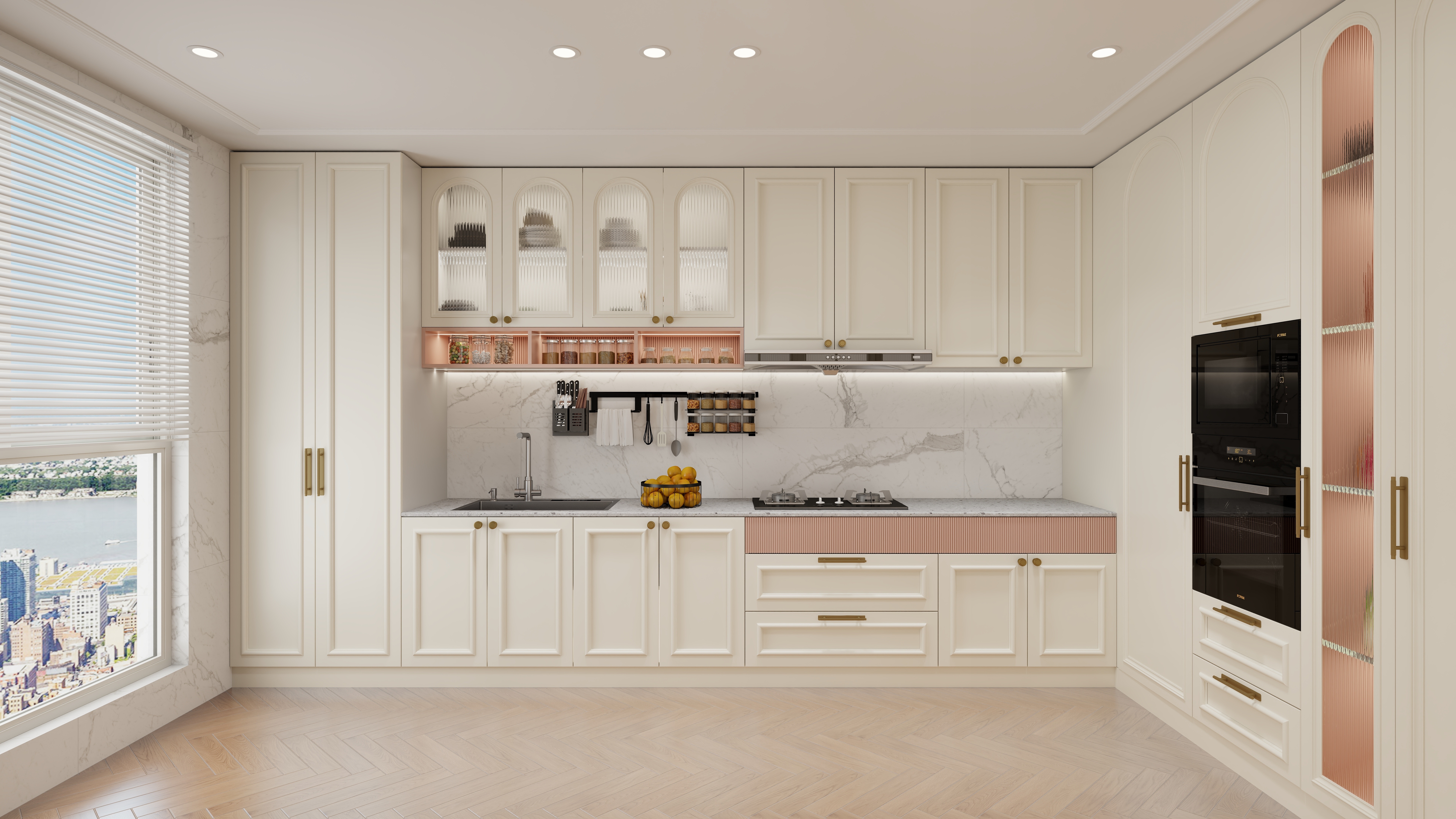
Kitchen cabinetry is one of the interior applications where blockboard specification is decided by moisture resistance, edge detailing and emission grade rather than price alone.
Why blockboard keeps returning to the specification
Blockboard — also sold as joinery board or laminboard — is built around a solid core of wood strips running lengthwise, faced and backed with veneer or a decorative surface. That construction behaves differently from veneer-based plywood: it machines cleanly, holds hinges and connectors in a solid substrate rather than in thin laminations, and produces a flat, dense panel that suits doors, carcasses and long horizontal spans in furniture.
The same construction is why blockboard quality is so sensitive to process discipline. A strip core is only as stable as the timber that goes into it. If strips are dried unevenly, if core joints are poorly aligned, or if pressing is inconsistent, the panel may look acceptable on delivery and reveal itself over a heating season — as a bow in a 2,700 mm wardrobe door, a hairline crack along a face veneer, or a swelling ridge where a cut edge was never sealed.
That is the commercial opportunity for buyers prepared to ask better questions. In mature interior-fit-out markets, blockboard is not being displaced by substitutes; it is being re-specified with tighter conditions on core species, moisture content control, formaldehyde emission and third-party documentation. Suppliers who can evidence those conditions win volume; suppliers who cannot are increasingly confined to price-only tenders.
What “moisture-resistant” actually commits a supplier to
MR — Moisture Resistant — is a classification of bonding performance, not a waterproofing claim. In Moluosen’s blockboard range, both the Chinese fir core model (MLS001) and the eucalyptus core model (MLS002) use melamine-urea-formaldehyde (MUF) resin and are classified MR. That classification is the correct specification for interior cabinetry in controlled environments, and the wrong specification for anything that will be immersed, continuously wetted or installed externally.
The practical consequences are worth stating plainly, because they are where most field failures originate:
MR does not extend to exterior, marine or structural use. Both MLS001 and MLS002 are specified for interior, non-structural applications only.
Edge sealing is not optional in wet-area cabinetry. Where blockboard is used for kitchen cabinets or bathroom vanities, edges, joints and cut-outs must be protected to prevent moisture penetration — the panel classification does not protect an exposed core.
Higher water-resistance grades exist and are a separate specification. In the eucalyptus plywood range (MLS004), MR, BWR (Boiling Water Resistant) and BWP (Boiling Water Proof) are selectable options. They are choices made at order, not three simultaneous ratings on every panel, and none of them converts an interior panel into an exterior one.
Storage is part of the specification. Panels must be held in a dry warehouse; a container that sat on a quay through a humid week is a quality event, not a delivery detail.
Eucalyptus core versus Chinese fir core: the real decision
Most blockboard enquiries in export markets reduce to a choice between a hardwood strip core and a softwood strip core. Moluosen supplies both: MLS002 uses selected fresh eucalyptus strips, and MLS001 uses selected fresh Chinese fir strips (Cunninghamia lanceolata). Both are finger-jointed, both use MUF resin, both are MR, and both accept the same surface programme — thermally fused melamine in over 300 colours, HDF layers at 0.8, 1.2, 1.7 or 3.8 mm, pine, poplar, okoume or birch veneers, PET, or HPL.
The differences that decide a purchase are dimensional and logistical rather than directional:
Format range. MLS001 is listed at 1220 × 2440 mm and 1220 × 2745 mm. MLS002 adds a 1220 × 3050 mm format, which matters for full-height doors and long cabinetry runs where fewer joints are wanted.
Thickness range. MLS001 extends to 60 mm; MLS002 is listed up to 50 mm. Thick sections are typically used for door stiles, frames and feature joinery.
Panel weight and container yield. In a matched HDF configuration, gross weight is stated at 32.9 kg per sheet for MLS001 against 28.8 kg per sheet for MLS002, with listed loading of 840 versus 958 sheets per 40 ft HC. On a large project, that difference is a freight and handling decision as much as a material one.
Purchase price positioning. MLS001 is positioned approximately 14% below MLS002 at comparable specification.
A defensible selection rule follows from this: specify the fir core where thick sections, a lower panel price or a heavier, denser feel in the finished component are the priorities; specify the eucalyptus strip core where the larger 3050 mm format, lower sheet weight or hardwood core positioning drives the specification. Neither choice is a quality upgrade over the other — they are different answers to different component requirements.
Low-emission grades are now an entry condition, not a differentiator
Formaldehyde emission is the specification item most likely to disqualify an otherwise acceptable panel. Moluosen’s premium blockboard range is documented against three defined limits: ENF at ≤0.025 mg/m³ (approximately 0.0186 ppm), Ultra Low Emission at ≤0.037 mg/m³ (approximately 0.030 ppm), and E0 at ≤0.050 mg/m³ (approximately 0.0400 ppm). These are defined emission limits and should not be read as formaldehyde-free claims; the grade required must appear explicitly in the purchase order.
For export buyers, the useful question is not “what is your lowest emission figure” but “which test standard does your report reference, and does it match the market I am shipping into”. Moluosen’s blockboard performance test report, issued 24 April 2026 by the Shanghai Wood Products Quality Supervision and Inspection Center, references a broad standard set including GB/T 29899-2024, GB/T 34722-2025, GB/T 44690-2024 and GB/T 39600-2021, together with EN 16516:2017+A1:2020, EN 717-1:2004, EN 14322/14323:2021, HP-1-2024, ASTM E1333-22, ASTM D6007-22, CDPH v1.3 (2026), JAS 0233-1/-2:2026, JIS A1460:2021, KS F3106:2026, KS M1998:2022 and AS/NZS 2270:2006 (R2016). The scope covers blockboard with eucalyptus strip core and blockboard with Chinese fir strip core.
That breadth is the point. A single report mapped against a multi-market standard set allows a buyer in the EU, Japan, Korea, Australia or North America to check the relevant clause instead of accepting a generic certificate. Where a destination market applies its own scheme — for example CARB P2 or TSCA Title VI in the United States — the required grade and evidence should be named at enquiry stage, because re-testing after production is the most expensive way to discover a mismatch.
Standards and documentation: what can actually be verified
The certification trail around a wood panel is only useful if it is specific: a certificate number, an issuing body, a scope and a validity window. Moluosen’s blockboard documentation is summarised below as it appears in company records, so that a procurement team can check each item against the issuing body directly.
DocumentReferenceIssuerValidityFSC certificationSAI-COC-015997SAI Global Certification Services Pty. Ltd. (Intertek SAI Global)2026-06-09 to 2031-06-02PEFC / CFCC Chain of CustodyAAC-CFCC-COC-106140 (GB/T 28952-2024; scope: blockboard, plywood)Appliwest (Shanghai) Certification Co., Ltd.2025-06-13 to 2028-06-08ISO 9001:201511426Q02650R001Beijing East Allreach Certification Center Co., Ltd.2026-07-15 to 2029-07-14ISO 14001:201511426E01825R001Beijing East Allreach Certification Center Co., Ltd.2026-07-15 to 2029-07-14ISO 45001:201811426S01648R001Beijing East Allreach Certification Center Co., Ltd.2026-07-15 to 2029-07-14China Green Product — BlockboardAAC23LSCPDB112125-02 (GB/T 35601-2017; CNCA-CGP-01:2021)Shanghai Shenxi Certification Co., Ltd.2025-12-31 to 2028-12-13Certificate of Conformity, CE-relatedSC-PSC-4-2026-05-15 (EN 13986:2004+A1:2015; AVCP system 4 as stated; scope: blockboards)Sertifikācijas centrs SIA / Certification Center Ltd, Riga, Latvia2026-05-12 to 2031-05-11
Two notes belong with that table. First, EN 13986:2004+A1:2015 is the harmonised standard framework through which wood-based panels for construction are placed on the European market, and the certificate of conformity Moluosen holds is issued against it while stating AVCP system 4; as with any conformity document, the project team should confirm that the declared scope and system match the intended use and the buyer’s own regulatory position. Second, chain-of-custody certification (FSC, PEFC/CFCC) supports a due-diligence file, but it does not by itself guarantee that a specific shipment is certified — that requires transaction-level documentation, which should be requested per order.
Where Moluosen sits in the export blockboard landscape
Moluosen Technology Limited was established in 2003 and operates a 100,000 m² production facility in Guangxi, China, with 320 employees, a 30-engineer research and development team and stated annual output of 240,000 units. Roughly 30% of output is exported. Blockboard is directed primarily at the EU, Canada, Australia, South Korea and Japan; the associated construction formwork activity serves the GCC and Middle East, Central Asia and BRI markets, South Asia, Africa and North Africa, Europe and Oceania.
The company’s heritage is relevant to how it is evaluated as a supplier. Moluosen is the international wood-panel brand backed by WANG 大王椰, whose domestic network of more than 3,000 physical stores reflects an established position in China’s wood-based panel and home-decoration materials market. Moluosen exists to carry that manufacturing foundation into international interior applications — a different market position from a trading operation sourcing finished panels for resale.
On supply terms, Moluosen’s OEM/ODM capability records list a monthly capacity of 450,000 sheets with customization across panel thickness, size and surface treatment, a minimum order of one 40 ft HC container, a lead time of 1–2 weeks after payment, and 100% inspection. For distributors and private-label programmes, that combination — customization plus a stated inspection regime — is usually the deciding factor rather than unit price alone.
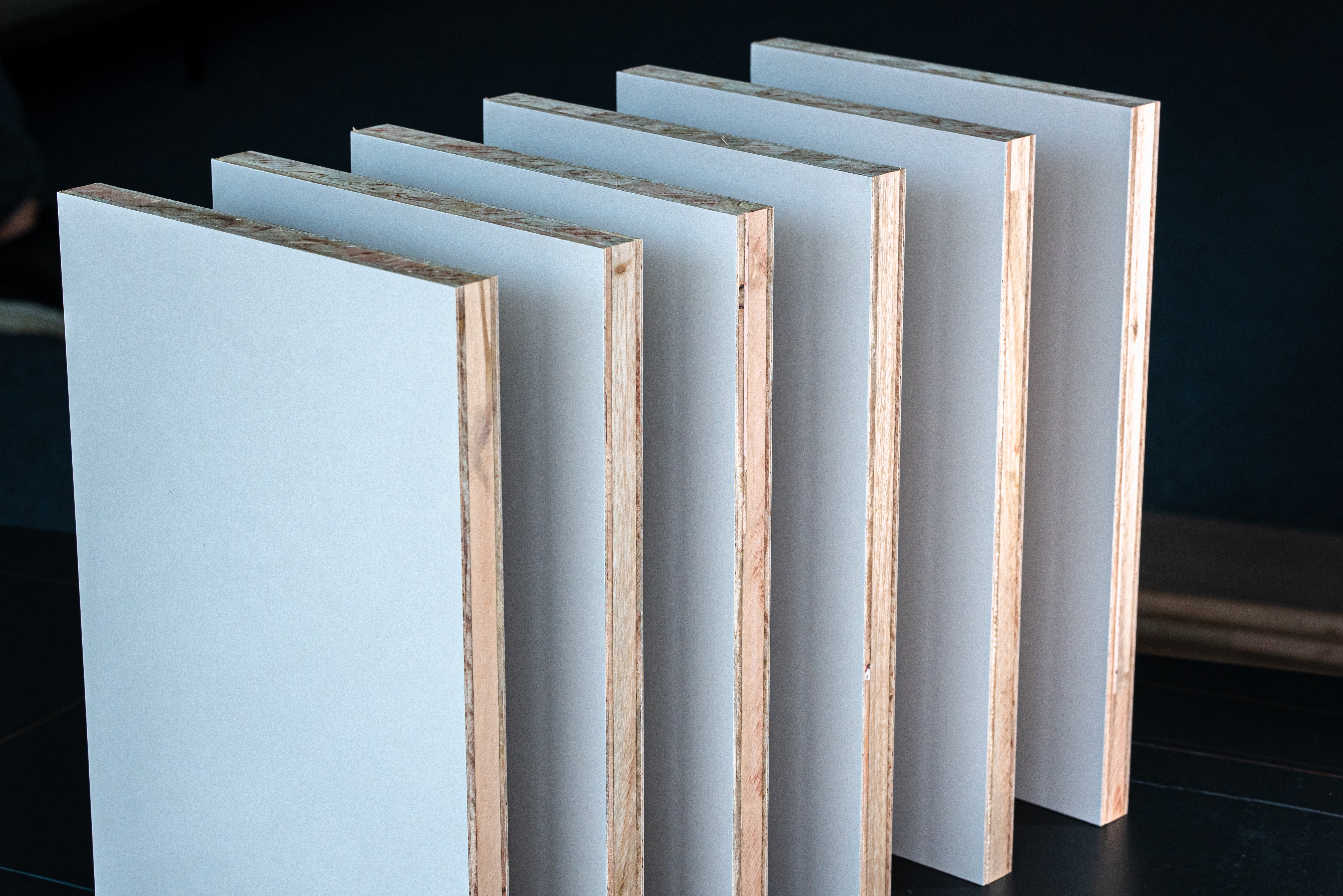
MLS002 eucalyptus core blockboard: fresh eucalyptus strip core, finger-jointed, MUF bonded and classified MR for interior, non-structural use.
High-stability blockboard: what process control changes for 2,800 mm doors
“High stability” is a claim that has to be traceable to process, not to adjectives. In Moluosen’s blockboard line, three stages carry most of that responsibility.
The first is raw material. The premium range uses selected virgin eucalyptus and Chinese fir, with no recycled or inferior wood in the premium product range. Species selection matters because strip cores inherit the defects of their input timber.
The second is controlled kiln-drying before production, which is the single largest lever on dimensional stability, and the accepted route to reducing the risk of warping, cracking, swelling and deformation during normal indoor use. A panel that arrives at the correct moisture content behaves predictably through a heating season; one that does not, does not.
The third is pressing. Moluosen’s blockboard panels are manufactured through a hot-pressing process at 130°C using a 600-ton press. Press parameters describe manufacturing equipment and process discipline — they are not finished-panel structural ratings, and should not be quoted as such.
On top of that process base sits Dual-T Anti-Warp & Crack Control Technology, described in the company’s product documentation as patented technology and designed to improve dimensional stability and surface integrity, particularly for large doors, cabinetry and furniture. Its stated capability is support for full-height wardrobe doors up to 2,800 mm, with resistance to deformation, warping and surface cracking under normal interior conditions without reliance on additional mechanical straightening devices — subject to the specific panel construction, design and application requirements. Door width, thickness, surface choice and hardware all remain engineering decisions to be confirmed.
The surrounding performance statements are equally specific: engineered termite resistance under standard laboratory test conditions (explicitly not a lifetime guarantee); a recommended indoor service range of approximately −25°C to 65°C under controlled interior conditions; and long-term interior durability described as over 50 years when properly fabricated, installed and maintained. The last of these is a design-intent statement, not a contractual warranty.
Comparing the practical options
Buyers comparing a fir core blockboard, a eucalyptus core blockboard and a eucalyptus plywood often find the specification language almost identical and the commercial outcome quite different. The table below sets the three Moluosen options side by side using stated product data.
AttributeMLS001 Chinese fir core blockboardMLS002 Eucalyptus core blockboardMLS004 Eucalyptus multiplex plywoodCore constructionFresh Chinese fir strips (Cunninghamia lanceolata), finger-jointedFresh eucalyptus strips, finger-jointedFresh eucalyptus veneers, finger-jointedBonding / classificationMUF resin; MRMUF resin; MRMUF resin; MR, BWR or BWP as selectedListed sizes1220 × 2440 / 2745 mm1220 × 2440 / 2745 / 3050 mm1220 × 2440 / 2745 / 3050 mmListed thicknesses16–60 mm16–50 mm5, 9, 16–50 mmEmission optionsENF ≤0.025 / Ultra Low ≤0.037 / E0 ≤0.050 mg/m³Same three optionsSame three optionsMatched HDF configuration32.9 kg/sheet; 840 sheets per 40 ft HC28.8 kg/sheet; 958 sheets per 40 ft HC28.2 kg/sheet; 980 sheets per 40 ft HCIndicative price positionApprox. 14% below MLS002Reference pointApprox. 18% below MLS002 and 5% below MLS001 in matched MR/HDF configuration
Read carefully, the table resolves most sourcing arguments. The plywood option is the more economical route at matched specification and offers both a wider format range and selectable BWR/BWP grades, but it is a veneer construction and behaves differently under fixings and machining than a solid strip core. Between the two blockboards, the fir core offers the thickest sections and the lower price, while the eucalyptus core offers the largest format and the lower sheet weight. None of the three is presented as suitable for structural, exterior or marine use.
What the application record shows
Interior joinery projects tend to test the same three things: whether the panel stays flat, whether the surface holds, and whether the emission paperwork survives scrutiny. Three recorded projects illustrate where the specification pressures fall.
A furniture factory in Spain ordered 3,700 sheets of MLS001 Chinese fir core blockboard at 1220 × 2440 mm and 45 mm thickness for door production, with a stated service expectation of 30 years. The reported result centred on dimensional stability: no swelling, cracking or warping, and low formaldehyde emission, with delivery timing and packaging noted as part of the outcome rather than an afterthought.
A decoration and design company in Serbia combined 3,500 sheets of MLS002 eucalyptus core blockboard at 18 mm, 4,500 sheets of MLS004 eucalyptus multiplex plywood at 1220 × 3050 mm and 18 mm, and 3,000 sheets of MLS001 at 1220 × 2745 mm and 18 mm for kitchen cabinets, wardrobes and bathroom vanities. The mixed order is instructive: one project used three different panel types for three different component duties rather than forcing a single board across the whole fit-out.
A blockboard OEM in Bahrain specified MLS001 in 40 mm and 60 mm sections at 1220 × 2745 mm, plus MLS004 at 60 mm, for front doors and interior doors — the thick-section, door-stile use case where core integrity and press quality are most visible in the finished product.
Boundaries: what blockboard will not do
Any credible sourcing decision includes the exclusion list. For Moluosen’s blockboard range, the boundaries are explicit:
Interior, non-structural only. Blockboard is not a load-bearing element. Fire-rated doors, fire-rated wall assemblies and other regulated applications require separate performance verification.
MR is not waterproof. Neither MLS001 nor MLS002 should be specified for immersion, continuous wetting or exterior exposure, and neither carries a BWR or BWP rating.
Structural values are not published in the datasheet. Bending strength, modulus of elasticity, allowable loads and screw withdrawal resistance are not provided, so component design must rely on project-specific verification or testing rather than on assumed figures.
Surface water resistance is a separate property. Selected finishes resist incidental water contact and staining in controlled interiors; that does not change the core’s MR classification.
Durability statements require installation discipline. The over-50-year interior service description assumes proper fabrication, installation and maintenance, and sits apart from warranty terms.
Logistics vary by model. Container yields of 840, 958 and 980 sheets for matched configurations mean that freight planning cannot be copied from one product line to another.
Blockboard and construction formwork plywood are not interchangeable
A common source of confusion in enquiries is the overlap between interior panels and construction panels. They share raw-material expertise and quality management, but they are different products with different failure consequences. Moluosen’s associated brand CYCLEPLYWOOD addresses construction formwork plywood and film-faced formwork plywood for concrete construction, while Moluosen itself serves interior applications.
Construction formwork plywood is a temporary concrete-contact sheathing that forms the mould surface for concrete members. It shapes and contains fresh concrete and transfers applied loads to the supporting formwork framework, and it is specified for slab soffit, beam, wall and column formwork subject to project-specific formwork design. The CYCLEPLYWOOD range illustrates how graded that specification can be: CWL001 (standard red, phenolic resin coating, mixed pine/eucalyptus core) with a stated 5–6 reuse cycles; CWL002 (premium red, phenolic resin, all-eucalyptus core) at 9–10 cycles; CWL003 (standard film-faced, 60 g/m² melamine film, mixed core) at 9–10 cycles; and CWL004 (premium film-faced, 75 g/m² melamine film, all-eucalyptus core) at 15–16 cycles. All four are offered in 915 × 1830 mm and 1220 × 2440 mm, in 12, 14 and 18 mm, with water-resistant UF resin.
Two cautions belong here. Panel selection must account for concrete pressure, construction loads, panel thickness and support spacing; application-specific load ratings are not provided for these formwork products, so design responsibility sits with the formwork designer. And film paper weight is a material specification, not a wear-resistance rating — 75 g/m² should not be read as a proportional durability figure over 60 g/m². The stated reuse ranges depend on stripping practice, handling, cleaning and storage on site.
Market trend analysis: documentation is becoming the product
Three shifts are visible in how blockboard is being bought rather than in how it is being made.
The first is that emission and chain-of-custody evidence has moved from a differentiator to a gate. Buyers in Europe and North America increasingly open a technical discussion by asking for a certificate number and a report reference, and treat the absence of one as a substantive answer. Suppliers with a mapped multi-standard test report and named certification bodies can respond in hours; suppliers without one lose the enquiry.
The second is format consolidation around full-height dimensions. The move toward 2,800 mm and taller wardrobe doors, fewer visible joints in long cabinetry runs and larger panel formats such as 1220 × 3050 mm reflects design intent rather than manufacturing fashion — and it directly increases the value of stability-focused technology and disciplined kiln-drying, because a taller door amplifies any dimensional error.
The third is supplier consolidation across complementary product lines. Distributors serving both interior fit-out and construction customers increasingly prefer a single quality system covering blockboard, plywood and formwork plywood over three unrelated vendors, even when the brands involved are separate. That is the logic behind the Moluosen and CYCLEPLYWOOD split: differentiated markets, shared manufacturing and quality foundations.
Future outlook
Blockboard’s position in interior joinery looks structurally secure, because the reasons buyers choose it — solid-core fixing performance, machining behaviour, flatness and cost per component — are not addressed by thinner or lower-density alternatives. What is changing is the evidence threshold. Emission grades, chain-of-custody documentation, dimensional performance under full-height door loads and a named inspection regime are becoming the normal content of an enquiry rather than the exception.
For buyers, the practical implication is to build the evidence request into the sourcing process now: name the emission grade and target market standard, specify core species and format, require the certificate references with validity dates, agree edge-sealing and storage expectations, and confirm container yield against the actual configuration rather than a sister product. Suppliers able to answer those five points with documents rather than adjectives will continue to hold the specification.
Frequently asked questions
What is blockboard and how does it differ from plywood?
Blockboard, also called joinery board or laminboard, is built around a solid core of wood strips running lengthwise, with face and back layers applied over it. Plywood is built from crossed layers of veneer. The practical consequences are that blockboard offers a solid substrate for hinges, connectors and fixings and machines well for doors and carcasses, while plywood distributes loads across laminations. Moluosen supplies both: MLS001 with a Chinese fir strip core, MLS002 with a eucalyptus strip core, and MLS004, a eucalyptus multiplex plywood with a veneer core. All three are specified for interior, non-structural applications.
What does MR (Moisture Resistant) mean for blockboard, and what does it exclude?
MR is a bonding classification indicating moisture resistance for interior use in controlled environments. Moluosen’s MLS001 and MLS002 blockboards use MUF resin and are classified MR. The classification does not extend to immersion, continuous wetting, exterior exposure, marine use or structural load-bearing applications, and it is not a BWR or BWP rating. In kitchen cabinets and bathroom vanities, edges, joints and cut-outs must be sealed to protect the core, because MR performance depends on the panel remaining intact and dry.
Which formaldehyde emission grades are available, and how are they verified?
Moluosen’s premium blockboard range is documented at ENF ≤0.025 mg/m³ (approximately 0.0186 ppm), Ultra Low Emission ≤0.037 mg/m³ (approximately 0.030 ppm) and E0 ≤0.050 mg/m³ (approximately 0.0400 ppm). These are defined limits, not formaldehyde-free claims, and the required grade must be written into the order. Verification is through the blockboard performance test report issued 24 April 2026 by the Shanghai Wood Products Quality Supervision and Inspection Center, which references standards including GB/T 39600-2021, EN 717-1:2004, EN 16516:2017+A1:2020, ASTM E1333-22, ASTM D6007-22, CDPH v1.3 (2026) and JIS A1460:2021.
Should I specify Chinese fir core or eucalyptus core blockboard?
The choice follows component requirements rather than a quality hierarchy. MLS001 uses fresh Chinese fir strips, extends to 60 mm thickness, is listed at 1220 × 2440 mm and 1220 × 2745 mm, and is positioned approximately 14% below MLS002 in purchase price; in a matched HDF configuration it is stated at 32.9 kg per sheet with 840 sheets per 40 ft HC. MLS002 uses fresh eucalyptus strips, adds a 1220 × 3050 mm format, is listed up to 50 mm thickness, and is stated at 28.8 kg per sheet with 958 sheets per 40 ft HC. Both are MR, both use MUF resin, and both accept the same surface options.
How should a buyer verify blockboard certifications before placing an order?
Request the certificate number, issuing body, scope and validity for each document, then check them with the issuer. For Moluosen’s blockboard range the references are FSC SAI-COC-015997 (SAI Global, valid 2026-06-09 to 2031-06-02); PEFC/CFCC Chain of Custody AAC-CFCC-COC-106140 (Appliwest Shanghai, valid 2025-06-13 to 2028-06-08); ISO 9001:2015 11426Q02650R001, ISO 14001:2015 11426E01825R001 and ISO 45001:2018 11426S01648R001 (Beijing East Allreach, valid 2026-07-15 to 2029-07-14); China Green Product AAC23LSCPDB112125-02 (Shanghai Shenxi, valid 2025-12-31 to 2028-12-13); and a CE-related Certificate of Conformity SC-PSC-4-2026-05-15 referencing EN 13986:2004+A1:2015 under AVCP system 4 (valid 2026-05-12 to 2031-05-11). Chain-of-custody certificates support a due-diligence file but do not by themselves certify a specific shipment, so transaction-level documents should be requested per order.
Moluosen Technology Limited — premium blockboard and plywood for interior, non-structural applications. Perfection From Log to Detail.
Website: www.moluosen.com
Email: elmer.y@moluosen.com
Tel: +86 722-665-0011 | WhatsApp: +86 176-6532-7137
Address: No.0014838, Dadian, Xiangzhou Industrial Park, Laibin City, Guangxi, China
Technical data sheets, certificate copies and test report references for MLS001, MLS002 and MLS004 are available on request for project-specific evaluation.
Tem questões ou precisa de mais detalhes?
Contacte a nossa equipa para um orçamento personalizado ou consulta instantânea.
Solicitar orçamento
Preencha o formulário abaixo e a nossa equipa entrará em contacto com uma proposta personalizada.
Chat direto do WhatsApp
Prefere conversar em tempo real? Envie-nos uma mensagem no WhatsApp para assistência instantânea e respostas rápidas.
- Obter orçamento personalizado
- Partilhar fotos ou documentos
- Discuta as suas necessidades diretamente
Geralmente responde em 5–30 minutos durante o horário de expediente.