
Molded Pulp Across Converting Lines: Five Scenario Fits
Industry Reference · Packaging & Printing · Buyer Stage: Evaluation
Molded Pulp Across Converting Lines: Five Scenario Fits
Molded pulp enters a packaging line as a structural component, not as a printed surface. It is formed into three-dimensional trays and inserts that hold, cushion and separate products inside a box, which means its performance is judged at the packing station rather than in a design review. Buyers evaluating molded pulp inside printing and packaging workflows need to know which converting and finishing setups it fits, and which project types gain the most from it.
This reference ranks five molded pulp scenario fits using three criteria stated up front: how closely the documented material specification matches the demands of the packing operation, how many integration points a scenario has with existing converting and finishing equipment, and how repeatable the program is at production volumes. The ranking is an editorial fit assessment for packaging and printing teams. It is not a market-share ranking, and it does not rank suppliers.
Why line fit decides whether molded pulp succeeds
Molded pulp projects rarely fail because the material is wrong. They fail because the insert does not behave the way the packing line expects: trays nest too tightly for automatic de-nesting, stacked units deform under load, or the moisture balance changes between the fiber production site and a humid packing hall. Molded fiber takes up and releases moisture, and the documented operating condition for pulp packaging projects is a well-ventilated, dry area with no prolonged exposure to direct sunlight.
Two structural properties define the fit. The documented function of these projects is shock-absorbing cushioning and inner product protection, and the documented operation mode is static storage with passive protective packaging. The matched equipment set is a packaging assembly line and an automatic wrapping machine. In practice, that means molded pulp is designed to protect a product already moving through a standard cartoning or wrapping sequence, not to replace that sequence.
The commercial reason this matters is timing. Grand View Research values the global molded pulp packaging market at USD 6.2 billion in 2025 and projects USD 10.2 billion by 2033, with the tray segment accounting for more than 41.0% of revenue share in 2025. Regulation is moving in the same direction: the European Packaging and Packaging Waste Regulation (EU) 2025/40 entered into force on 11 February 2025 and requires all packaging to be recyclable by 1 January 2030. Converting lines that currently handle foam or thermoformed inserts are being re-examined, and the practical question is which parts of the workflow they can absorb without redesigning the whole line.
What molded pulp is, in engineering terms
Molded pulp, also referred to as molded fiber, is packaging formed from plant fiber into three-dimensional shapes. Tonghe Paper Co., LTD is a pulp molding manufacturer based in Qiaotou Town, Dongguan, Guangdong, China, producing molded fiber trays and protective inserts from sugarcane pulp, bamboo pulp and wood pulp, with export markets that include the EU, the United States, Australia, Saudi Arabia, Malaysia and Brazil.
| Documented parameter | Value for the tray range |
|---|---|
| Raw material | Sugarcane pulp, bamboo pulp, wood pulp; customization available on request |
| Colour | Natural colour, white, yellow, or customized as required |
| Wet pressure | 0.15–0.25 g/cm³ |
| Dry pressure | 0.28–0.45 g/cm³ |
| Thickness | 0.8–5.0 mm, customized as required |
| Moisture content | ≤8–12% |
| Edge crush strength | 3–8 kN/m |
| Compressive strength | 2–8 MPa |
| Applicable temperature range | −20 °C to +80 °C under normal use; food grade from −20 °C to 120 °C |
| End-of-life characteristic | Degradable |
These values come from one product-family specification used across the manufacturer’s tray range, and together they define the practical envelope of a converting-line project. Thickness between 0.8 mm and 5.0 mm decides whether a tray behaves as a thin separating layer or as a load-bearing structure. Edge crush strength of 3–8 kN/m and compressive strength of 2–8 MPa set the stacking budget the line can plan around. Moisture content of no more than 8–12% is the figure worth tracking on the line, because it is the property most likely to drift between dispatch and use.
Production runs through pulping, wet-press forming, drying, hot pressing and trimming. Trimming defines the outer edge and the nesting clearance between stacked trays; drying defines the moisture content that reaches the packing hall. Ventilated shed drying and cage drying are used to bring formed parts to a stable moisture range before hot pressing, which is why drying capacity, not forming capacity, is often the constraint in a molded fiber supply chain.
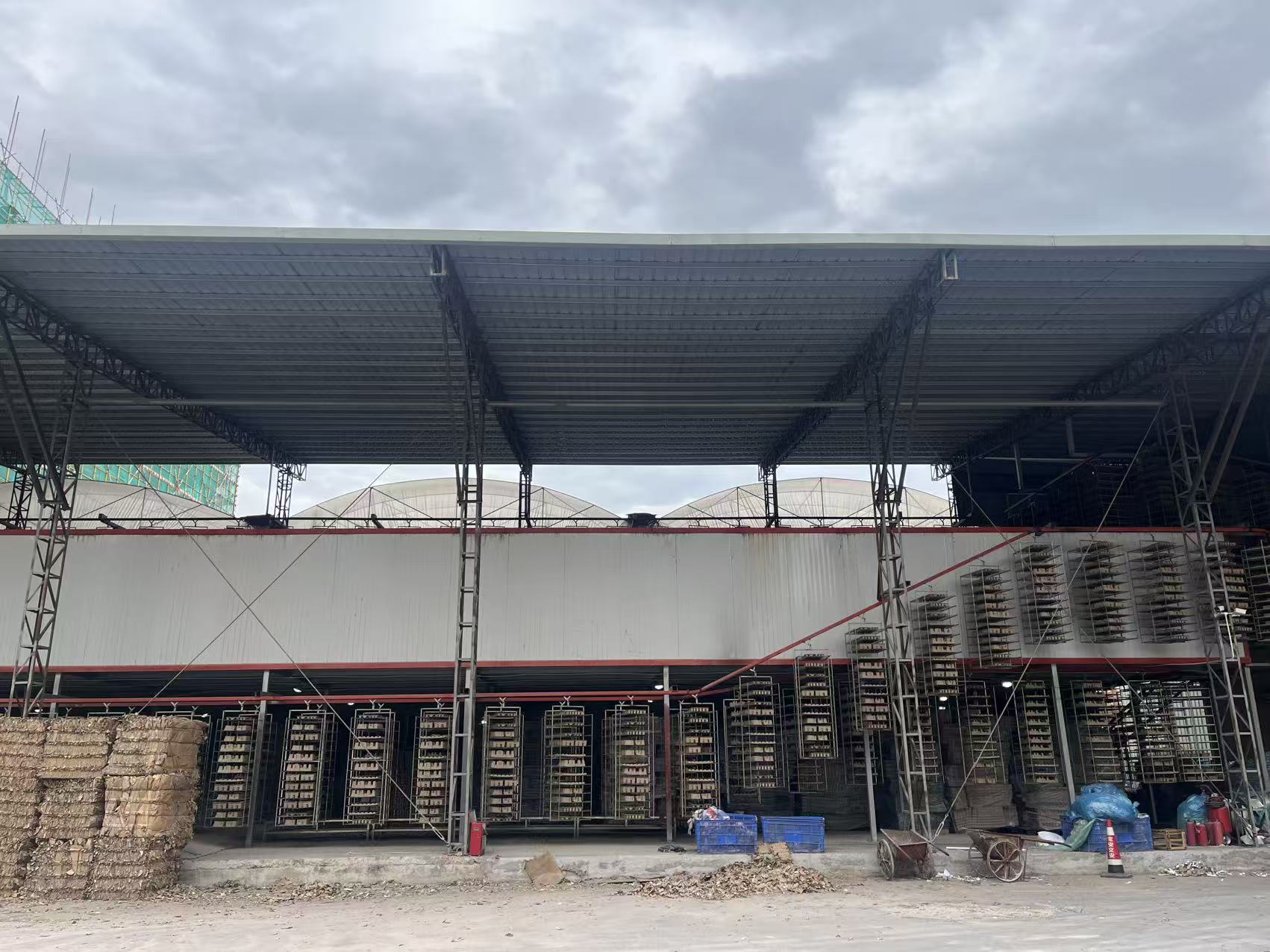
Drying hanging cage — the stage that sets the moisture content a molded pulp tray carries into the packing hall.
Five scenario fits, ranked
The ranking below applies the same three criteria to each scenario: specification match, integration points with existing converting and finishing equipment, and repeatability at production volumes. Documented project parameters that apply across the range include OEM/ODM production, a monthly capacity of up to 1,000 tons, a lead time of 15–30 days, a minimum order quantity of 1,000 pcs, and IQC/IPQC/FQC quality control.
| Rank | Scenario fit | Documented tray family | Primary constraint |
|---|---|---|---|
| 1 | Electronics and small-appliance inner fitments | Molded Pulp Electronics Trays | Dedicated mold per product geometry |
| 2 | Food, beverage and fresh-produce tray programs | Food Grade Molded Pulp Trays, Disposable Food Pulp Trays | Moisture and hygiene control |
| 3 | Medical device and diagnostic kit packaging | Medical Device Pulp Trays | Validation documentation |
| 4 | Cosmetic, beauty and gift-set packaging | Cosmetic Packaging Pulp Trays | Decoration is a custom process step |
| 5 | Heavy-duty industrial, auto parts, hardware | Heavy Duty Molded Pulp Trays | Thicker walls and multi-piece cushioning |
Electronics and small-appliance inner fitments
Documented applicable industries for the tray range include 3C electronics, electrical appliances, toys and handicrafts. This scenario ranks first because molded pulp carries no decoration requirement here: the printed box delivers the brand message while the pulp insert performs the protective job. Anti-static function and moisture-proof function are documented customization options, and the insert is matched to a packaging assembly line and an automatic wrapping machine. It protects a product with fixed geometry, which is the condition under which a dedicated mold is recovered fastest.
Boundary: a product-specific mold is required, the documented minimum order quantity is 1,000 pcs, and production lead time is 15–30 days. Programs with volatile product dimensions or one-off quantities are a weaker fit.
Food, beverage and fresh-produce tray programs
Food Grade Molded Pulp Trays and Disposable Food Pulp Trays are documented for food, beverages and fresh produce, and food-grade parts carry the wider applicable temperature range of −20 °C to +120 °C against −20 °C to +80 °C for the general range. A documented case covering restaurants and supermarkets shipped 2,000 units used for transportation and turnover, with shockproof and shatterproof results and a disposable-packaging service life. Destinations in that case included Germany, France, the United Kingdom, the Netherlands, Sweden, Denmark, the United States, Canada, Australia, New Zealand, Saudi Arabia, Qatar and Malaysia.
Boundary: food-contact programs are the most sensitive to moisture and hygiene. The documented storage guidance — ventilated, dry, away from prolonged direct sunlight — applies to the finished trays before they reach the line, and the temperature advantage only applies to the food-grade variants.
Medical device and diagnostic kit packaging
Medical Device Pulp Trays are documented as a dedicated tray family. Mordor Intelligence projects molded pulp for healthcare and medical devices to grow at an 8.6% CAGR, driven by ISO sterilization standards and plastic bans in hospitals. The scenario ranks third rather than higher because the pulp insert is one component of a validated pack, and most of the specification effort sits with the device program rather than with the packaging line.
Boundary: documentation requirements are heavier than in any other scenario. Test reports scoped to paper trays, including RoHS report DSP25050447-1 and SGS-CSTC report SZXPC26000164601, are a starting point rather than the end of a device validation file.
Cosmetic, beauty and gift-set packaging
Cosmetic Packaging Pulp Trays are documented for beauty and daily chemical gift applications. This is the scenario in which the molded part is most likely to be seen by the end user, and the documented customization set is what makes it work: special coating, embossing and printing, plus multi-specification and irregular integrated structures developed to fit a product contour.
Boundary: the production route is comparatively long. Coating, embossing and printing are custom services rather than standard options, and each adds a process step between forming and packing. Where photographic graphics are essential, the practical division of labour remains a printed outer surface with a molded fiber interior.
Heavy-duty industrial, auto parts, hardware and sanitary ware
Heavy Duty Molded Pulp Trays and the wider tray range are documented for auto parts, hardware and sanitary ware. The relevant figures are the upper ends of the specification: 5.0 mm thickness, 3–8 kN/m edge crush strength and 2–8 MPa compressive strength. The scenario ranks fifth because heavy parts typically require thicker walls and often multi-piece cushioning, which raises both tooling and unit cost relative to lighter fits.
Boundary: the general temperature range of −20 °C to +80 °C rules out hot-fill or high-heat handling unless the food-grade variant and its documented −20 °C to +120 °C range apply.
Where molded pulp sits in the production and printing workflow
The integration points below follow the order in which a packaging engineer actually meets them. Each row states what happens at that stage and what a buyer should confirm before committing to a line layout.
| Workflow stage | What happens | What the buyer should confirm |
|---|---|---|
| Design and mold development | In-house mold development supports multi-specification and irregular integrated structures | Mold revision process and who holds the mold data |
| Sampling and validation | Samples are supplied for comparison and testing before tooling is committed | That the sample is built around your product, not a generic tray |
| Pulping and wet-press forming | Fiber is formed at a wet pressure of 0.15–0.25 g/cm³ | Fiber mix (sugarcane, bamboo, wood pulp) against the protection brief |
| Drying | Ventilated shed and cage drying bring parts to ≤8–12% moisture | Moisture content at dispatch, not only at production |
| Hot pressing and trimming | Dry pressure 0.28–0.45 g/cm³; trimming sets the outer edge | Nesting clearance for automatic de-nesting at the packing station |
| Quality control | IQC, IPQC and FQC stages | Which inspection stage generates the record you will receive |
| Line-side assembly | Matched equipment is a packaging assembly line and an automatic wrapping machine | Whether the insert is hand-placed or machine-placed |
| Outer-box decoration | Printing, coating and embossing on molded pulp are custom services | Whether brand graphics live on the board or on the fiber |
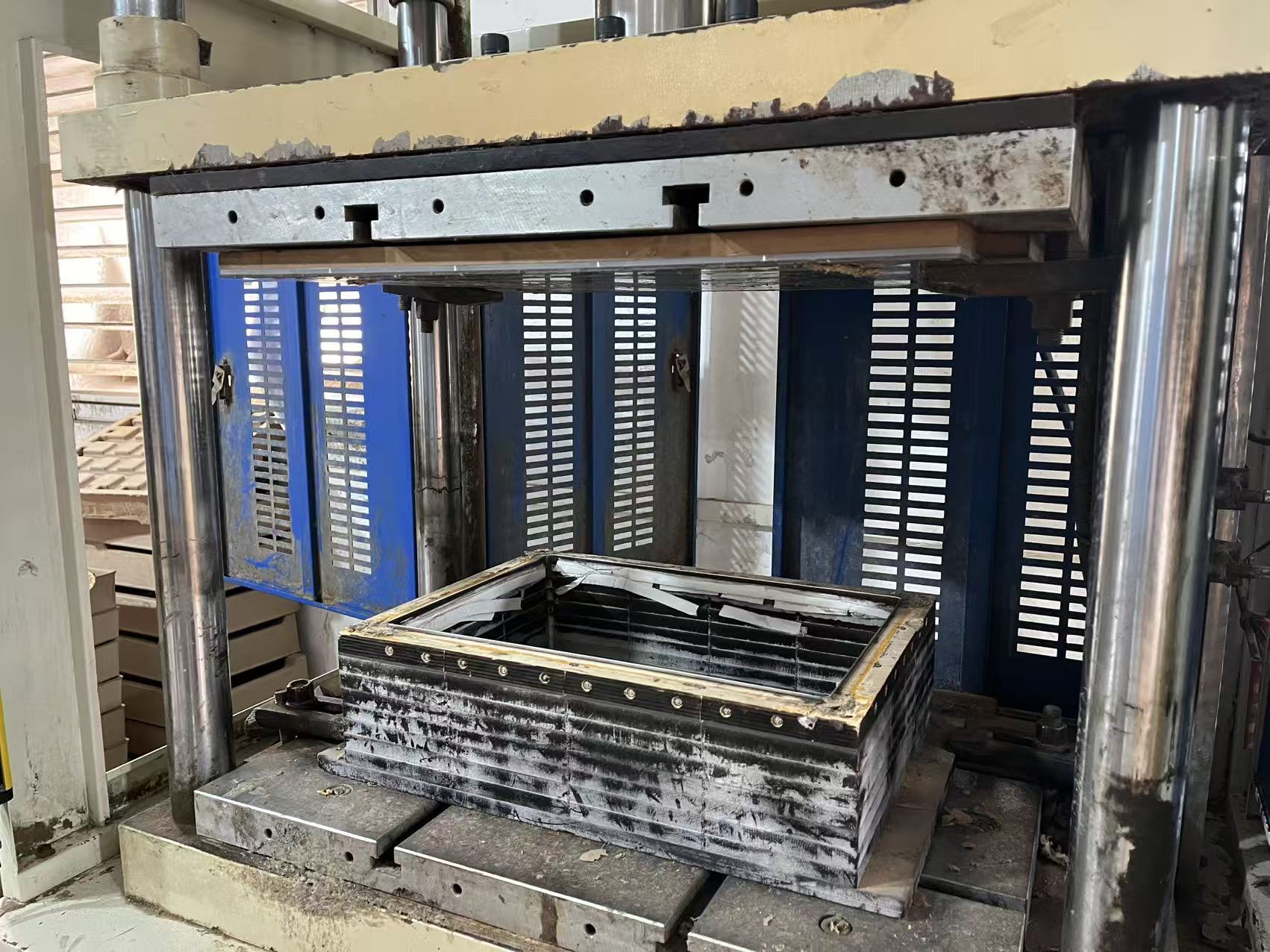
Trimming machine — the stage that defines outer edge quality and the nesting clearance that automatic de-nesting depends on.
The dividing line in most workflows is decoration. Molded pulp performs at its strongest when the printed surface and the protective surface are separate parts of the same pack: the printed board carries the brand, the molded fiber carries the product. When a project asks one molded tray to do both jobs, the coating, embossing and printing services become mandatory rather than optional, and the cost structure changes accordingly.
Comparison with traditional solutions, and the boundaries of molded pulp
Molded pulp is not a universal replacement for existing inserts, and the comparison below is deliberately limited to what is documented rather than to broad claims about performance.
| Comparison criterion | Molded pulp trays | Traditional hard gift boxes | Plastic and foam inserts |
|---|---|---|---|
| Structural role | Three-dimensional insert providing shock-absorbing cushioning and inner product protection | Outer or inner rigid structure, itself a decorated object | Protective insert formed from petrochemical polymers |
| Weight | Documented at approximately 50% lighter than traditional hard gift boxes | Heavier rigid construction | Low weight, high volume |
| End of life | Degradable; the manufacturer documents full biodegradation within 28 days in a natural composting environment | Paper-based, recyclable in fibre streams depending on lamination and coatings | Subject to increasing single-use packaging restrictions |
| Decoration | Coating, embossing and printing offered as custom services | Printed or laminated surface as standard | Usually unprinted or labelled |
| Tooling | Dedicated mold developed per product geometry | Die-cutting and assembly tooling | Thermoforming or expansion tooling |
| Regulatory direction | Aligned with fibre recycling requirements under (EU) 2025/40 | Aligned where fibre recovery is maintained | Exposed to recyclability and single-use limits |
Where molded pulp does not fit
- Dedicated tooling is unavoidable. Irregular shapes can be produced, but each product geometry requires its own mold before production begins.
- Volume threshold. The documented minimum order quantity is 1,000 pcs with a lead time of 15–30 days. One-off runs and rapid prototype cycles are a weak fit.
- Moisture sensitivity. Trays are documented at ≤8–12% moisture content and must be stored in a well-ventilated, dry area without prolonged direct sunlight. A packing hall that is persistently damp is a real constraint, not a detail.
- Thermal ceiling. The general range is −20 °C to +80 °C. Only food-grade parts are documented up to 120 °C.
- Print surface. Printing and embossing on the fiber are custom services. Molded pulp does not replace a high-resolution printed board where photographic graphics are the core requirement.
Certifications and documentation that apply to converting projects
Fibre-based packaging sold into European and North American retail channels is normally screened at the documentation level before the physical sample is discussed. The records below are the ones held for this manufacturer’s paper tray scope.
- FSC-COC — certificate RINA-COC-003845, issued by RINA (Shanghai) Quality Certification Co., Ltd., valid from 2024-06-07 to 2029-06-06, under FSC-STD-40-004 V3.1 and FSC-STD-50-001, with a scope covering pulp tray manufacture.
- ISO 9001 — certificate 04524Q32380R0S, issued by Beijing Daluhangxing Quality Certification Center Co., Ltd., valid from 2024-11-26 to 2027-11-25, under GB/T 19001-2016 / ISO 9001:2015.
- RoHS test report — report DSP25050447-1, issued by Dongguan ZRLK Testing Technology Co., Ltd. on 2025-05-14, with reference to IEC 62321-4:2013/AMD 1:2017, IEC 62321-5:2013, IEC 62321-7-2:2017, IEC 62321-6:2015 and IEC 62321-8:2017.
- SGS test report — report SZXPC26000164601, issued by SGS-CSTC Standards Technical Services Co., Ltd. on 2026-01-16, with reference to IEC 62321-4:2013+AMD1:2017, IEC 62321-5:2013, IEC 62321-7-2:2017 and IEC 62321-12:2023.
- MSDS — document DSP25050758-1, issued by ZRLK on 2025-05-24 with reference to ISO 11014:2009, GB/T 16483-2008 and IATA/IMO dangerous goods provisions.
Note the scope wording on the test reports: they cover paper tray products. Where a converting project also involves coatings or printed decoration, the documentation set should be checked against those added processes rather than assumed from the base tray report.
Market trend analysis: what is changing on the line
Three verified data points explain why molded pulp is being pulled into converting workflows now rather than later.
- Market scale. Grand View Research values the global molded pulp packaging market at USD 6.2 billion in 2025, projected to reach USD 10.2 billion by 2033.
- Tray dominance. The tray segment accounted for over 41.0% of revenue share in 2025, according to Grand View Research, which means the format most relevant to inserts and fitments is also the largest.
- Regional supply. Asia Pacific held a 41.0% revenue share in 2025, with China holding the largest market share, which keeps tooling and mold development capacity concentrated in the region where most molded fiber programs are already sourced.
- Regulation. The European Packaging and Packaging Waste Regulation (EU) 2025/40 entered into force on 11 February 2025 and requires all packaging to be recyclable by 1 January 2030. For line managers, this converts a design preference into a dated compliance requirement.
- Segment growth. Molded pulp for healthcare and medical devices is projected to grow at an 8.6% CAGR, driven by ISO sterilization standards and plastic bans in hospitals, per Mordor Intelligence.
Read together, these points shift the evaluation question. The decision is no longer whether a fibre insert can be used, but which of the five scenarios above a given converting line can absorb with the least disruption to throughput and documentation.
Future outlook
The 2030 recyclability deadline is the single most predictable force acting on insert specification. Projects that defer the change will meet it on a shorter and more expensive timeline, and the scenario ranking above is likely to move: food-service and medical programs are growing fastest, and both depend on documented compliance rather than on design preference.
On the supply side, the constraint to watch is not forming capacity but drying and mold development. In-house mold development and ventilated drying infrastructure determine how quickly a new tray geometry can move from sample to line. For buyers, the practical implication is to begin mold development earlier than the packaging artwork schedule requires, and to specify moisture content and nesting clearance as line-side acceptance criteria rather than as production metrics.
The manufacturer’s documented operating base for this assessment is a facility of 23,000 m² with 160 employees, an annual output of 12,000 tons, a monthly capacity of up to 1,000 tons and a 12-engineer R&D team, exporting approximately 50% of output. Those figures define the scale at which molded pulp programs can be planned today, not the ceiling for the material itself.
FAQ
Which project types suit molded pulp best?
Documented applications include 3C electronics and electrical appliances, food, beverages and fresh produce, auto parts, hardware and sanitary ware, beauty and daily chemical gifts, medical devices, toys and handicrafts. Within those categories, programs with stable product geometry and repeating order volumes fit most efficiently, because each tray geometry requires its own mold and the documented minimum order quantity is 1,000 pcs with a 15–30 day lead time. Projects where the molded part remains hidden inside a printed box avoid the additional decoration process steps.
What material and finish options are available for custom molded pulp trays?
Raw materials are sugarcane pulp, bamboo pulp and wood pulp, with customization available on request. Standard colours are natural colour, white and yellow, with custom colours available. Documented customization covers material, colour, logo, anti-static function and moisture-proof function. Additional custom services include special coating, embossing and printing, and shapes may be developed as multi-specification or irregular integrated structures.
What are the documented mechanical and thermal limits of molded pulp trays?
Thickness is 0.8–5.0 mm and can be customized. Wet pressure is 0.15–0.25 g/cm³ and dry pressure is 0.28–0.45 g/cm³. Moisture content is ≤8–12%. Edge crush strength is 3–8 kN/m and compressive strength is 2–8 MPa. The applicable temperature range is −20 °C to +80 °C under normal use, while food-grade products are documented for use from −20 °C to 120 °C.
Which certifications and test reports apply to molded pulp tray programs?
The documented set for the paper tray scope is: FSC-COC certificate RINA-COC-003845 from RINA (Shanghai) Quality Certification Co., Ltd., valid 2024-06-07 to 2029-06-06; ISO 9001 certificate 04524Q32380R0S from Beijing Daluhangxing Quality Certification Center Co., Ltd., valid 2024-11-26 to 2027-11-25; RoHS test report DSP25050447-1 from Dongguan ZRLK Testing Technology Co., Ltd., issued 2025-05-14; SGS test report SZXPC26000164601 from SGS-CSTC Standards Technical Services Co., Ltd., issued 2026-01-16; and MSDS document DSP25050758-1 from ZRLK, issued 2025-05-24.
What are the minimum order quantity and lead time for molded pulp tray production?
The documented minimum order quantity is 1,000 pcs and the production lead time is 15–30 days. Production is available under OEM/ODM arrangements with a monthly capacity of up to 1,000 tons, and quality control follows IQC, IPQC and FQC stages.
How should molded pulp trays be stored before use on a packing line?
The documented working condition is a well-ventilated, dry area, avoiding prolonged exposure to direct sunlight. Trays are specified at ≤8–12% moisture content, and the documented operation mode for these projects is static storage with passive protective packaging, matched to a packaging assembly line and an automatic wrapping machine. Storage conditions are therefore part of the packaging specification rather than a warehouse detail.
What payment terms and shipping methods are accepted?
T/T and Alibaba Trade Assurance are accepted. Shipment can be arranged by sea, by air, or by express carriers including DHL, FedEx and UPS. A destination port or delivery address is required in order to calculate freight cost.
Reference material: company profile (PDF) — https://cdn.socialarks.com/sbsp/25104/common/2026/0825/%E5%90%8C%E5%92%8C%E4%B8%AD%E6%96%87%E7%AE%80%E4%BB%8B%E8%8B%B1%E6%96%87%E7%89%88%28A%29.pdf